Paper II — Q5
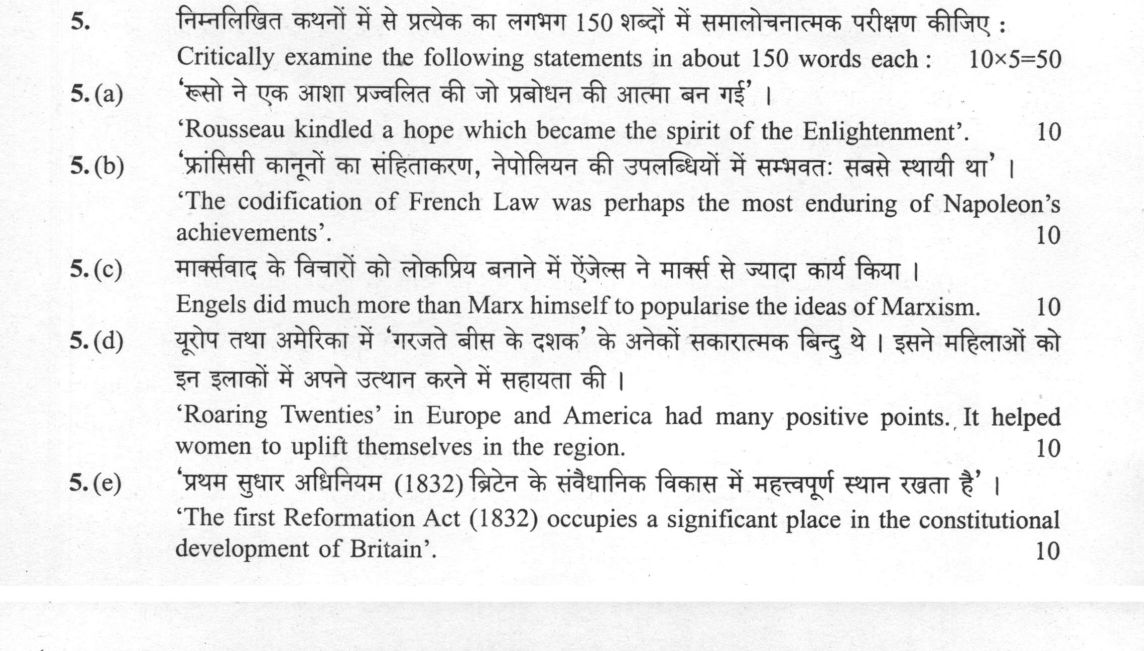
Critically examine the following statements in about 150 words each: (a) 'Rousseau kindled a hope which became the spirit of the…
Critically examine the following statements in about 150 words each: 'Rousseau kindled a hope which became the spirit of the Enlightenment'. 10 marks
'The codification of French Law was perhaps the most enduring of Napoleon's achievements'. 10 marks
Engels did much more than Marx himself to popularise the ideas of Marxism. 10 marks
'Roaring Twenties' in Europe and America had many positive points. It helped women to uplift themselves in the region. 10 marks
'The first Reformation Act (1832) occupies a significant place in the constitutional development of Britain'. 10 marks
हिंदी में प्रश्न पढ़ें
निम्नलिखित कथनों में से प्रत्येक का लगभग 150 शब्दों में समालोचनात्मक परीक्षण कीजिए : 'रूसो ने एक आशा प्रज्वलित की जो प्रबोधन की आत्मा बन गई' । (10 अंक)
'फ्रांसीसी कानूनों का संहिताकरण, नेपोलियन की उपलब्धियों में सम्भवतः सबसे स्थायी था' । (10 अंक)
मार्क्सवाद के विचारों को लोकप्रिय बनाने में एंगेल्स ने मार्क्स से ज्यादा कार्य किया । (10 अंक)
यूरोप तथा अमेरिका में 'गरजते बीस के दशक' के अनेकों सकारात्मक बिंदु थे । इसने महिलाओं को इन इलाकों में अपने उत्थान करने में सहायता की । (10 अंक)
'प्रथम सुधार अधिनियम (1832) ब्रिटेन के संवैधानिक विकास में महत्वपूर्ण स्थान रखता है' । (10 अंक)
Model answer
Written by UPSC Answer Check against this question's marking rubric, to the 150-word length. UPSC does not publish answers for Mains — this is one way to score well, not an official key.
(a) Rousseau and the Enlightenment Rousseau’s claim to have kindled the Enlightenment’s hope is defensible but overstated. His general will and popular sovereignty transformed political thought by locating sovereignty in the citizen body rather than a monarch or propertied elite. This was more radical than Locke’s constitutionalism, which protected rights, property and representative limits, and more democratic than Voltaire’s philosophic elitism, which trusted enlightened rulers. Rousseau’s Social Contract inspired the French Revolution, civic nationalism and later democratic movements, giving the Enlightenment a participatory, egalitarian hope. Yet his thought contained an authoritarian paradox: the general will could override individual dissent, and the virtuous legislator or ‘forced to be free’ language opened space for despotism in the people’s name. Thus Rousseau did not create the Enlightenment, but he radicalised it, making popular sovereignty its most powerful and dangerous hope.
(b) Napoleon’s Civil Code Napoleon’s codification of French law was indeed one of his most enduring achievements, but its significance must be qualified. The Civil Code of 1804 established legal equality before the law, rational procedure, and strong protection of private property; associated Napoleonic state reforms promoted meritocracy in administration, though the Code itself did not create career rules. Its endurance is evident in adoption across much of Europe and Latin America, shaping civil-law systems. However, it was not universally liberal. It reinforced patriarchal family law, limiting women’s legal capacity; it contained employer-favouring provisions such as Article 1781, making wage claims hard for workers to prove, although the ban on trade unions came from the Le Chapelier Law of 1791 and later penal legislation, not the Code. In many colonies it often reinforced racial and social hierarchies. Hence its durability is real, but it preserved inequality for women, workers and colonial subjects.
(c) Engels and Marx Engels did much to popularise Marxism, but the statement overstates his role relative to Marx. Marx’s original theoretical contribution in *Capital*—especially commodity value, surplus value and capitalist accumulation—remained the intellectual core of Marxism. Engels made those ideas more accessible and durable; his financial support also sustained Marx’s research. His Condition of the Working Class in England (1845) gave a vivid empirical account of industrial misery; Anti-Dühring (1878) defended and systematised dialectical materialism; and Socialism: Utopian and Scientific explained socialism in popular terms. After Marx’s death in 1883, Engels edited and published Capital volumes II and III, wrote prefaces, and helped shape the international movement. Marxism was therefore collaborative: Marx supplied the foundational critique, while Engels popularised, preserved and extended it. Engels was indispensable, but not ‘much more’ than Marx in creating the theory.
(d) The Roaring Twenties The Roaring Twenties in Europe and America had many positive points, especially for women, but the claim needs qualification. Economic prosperity, mass production, electricity, automobiles, radio and cinema created new consumer culture and confidence. Women’s legal and social position improved: the US 19th Amendment (1920) gave women the vote, and the UK Representation of the People Act 1928 established equal franchise at 21. Flapper culture, jazz and greater public visibility symbolised liberation, while employment expanded in clerical, sales, teaching and professional work. Yet the decade was uneven. Agricultural depression, falling farm prices and rural hardship contrasted with urban boom; stock-market speculation and rising inequality left many vulnerable. In Weimar Germany, women gained civic rights but faced economic instability. For working-class women, women of colour and much of Europe, gains were partial, constrained by war debt, inflation or conservative politics. Thus the Twenties uplifted some women, particularly urban middle-class ones, but did not deliver broad, equal transformation.
(e) The 1832 Reform Act The 1832 Reform Act occupies a significant place in Britain’s constitutional development, but its significance is partly symbolic and limited. It corrected glaring rotten-borough anomalies by disfranchising 56 small boroughs, reducing many others and redistributing seats to industrial towns such as Manchester and Birmingham. It extended the franchise to middle-class industrialists through a borough £10 householder or occupier qualification, while county franchises remained different and more property-based. This produced a symbolic shift toward parliamentary sovereignty, strengthening the Commons and parliamentary government, but it did not establish ultimate supremacy of the Commons over the Lords; the Lords retained power to reject bills until the Parliament Act 1911. The Act left most workers excluded, though some better-off artisans and working-class voters could qualify in boroughs, and it excluded women. Aristocratic and landed interests still dominated the Cabinet and peerage. Hence 1832 was a major step toward representative government, not a democratic settlement.
What "Critically examine" is asking you to do
Test the proposition the question puts to you and return a finding on how far it holds. Examine stems carry a claim, or ask whether something has happened, and expect evidence weighed both ways before the extent is stated — often with remedial measures attached. “Critically” is not a section added at the end: name the yardstick you are judging by — the evidence, the stated objective, a constitutional principle, a rival explanation — and let a verdict close each part of the body. Where the question quotes a claim, that verdict must land on the claim itself, accepted, qualified or rejected, and not on the theme in general.
Structure that answers it
Restate the claim as the question frames it → evidence that supports it → evidence that undercuts it → the conditions under which it holds → verdict on how far it stands
Where marks are lost
Merits in one paragraph, demerits in the next, and a conclusion calling for a balanced and holistic approach. That is a survey with the judgement left out and it holds the answer in the middle band. The opposite error is reading “critically” as permission to attack — and with the odd pairings, critically describe or critically explain, the exposition still carries most of the marks, the judgement being a layer on it rather than a substitute for it.
How this answer will be evaluated
Approach
Framework: Context > Thesis > Evidence > Historiography. (a) critique: the claim > its strengths > its weaknesses > your judgment | (b) critique: the claim > its strengths > its weaknesses > your judgment | (c) critique: the claim > its strengths > its weaknesses > your judgment | (d) critique: the claim > its strengths > its weaknesses > your judgment | (e) critique: the claim > its strengths > its weaknesses > your judgment Full marks: Thesis-driven, cites specific sources/historians, nuanced judgment, precise terminology.
Key points expected
- Define Rousseau's specific contribution (e.g., Social Contract, General Will).
- Contrast Rousseau's romanticism with the rationalism of Voltaire/Diderot.
- Identify the 'hope' (e.g., popular sovereignty, individual liberty).
- Provide a judgment on whether he 'kindled' or merely reflected the movement.
- Identify the 'codification' as the Napoleonic Code (Code Civil).
- Explain why it is 'enduring' (survived the fall of the Empire).
- Compare its impact to his military conquests (which were lost).
- Mention its influence on other legal systems (e.g., Latin America, Europe).
Evaluation rubric
Each sub-part is marked on its own, against the marks and word limit printed on the paper.
- (a) Assess the validity of the claim that Rousseau's work was the primary spirit of the Enlightenment. 10 marks · 150 words
critique— the claim → its strengths → its weaknesses → your judgment
Must cover
- Define Rousseau's specific contribution (e.g., Social Contract, General Will).
- Contrast Rousseau's romanticism with the rationalism of Voltaire/Diderot.
- Identify the 'hope' (e.g., popular sovereignty, individual liberty).
- Provide a judgment on whether he 'kindled' or merely reflected the movement.
Loses marks
- Treating the Enlightenment as a single monolithic view.
- Confusing Rousseau with the French Revolutionaries (Robespierre).
Earns more
- Mention specific works like 'The Social Contract' or 'Emile'.
- Reference the 'Enlightenment' as a specific intellectual movement.
- Cite a historian's view on Rousseau's role.
Extra mark
- Quote a specific line from 'The Social Contract'.
- Name a specific Enlightenment rival (e.g., Hume, Kant).
- (b) Evaluate the claim that the Napoleonic Code was his most enduring achievement compared to military conquests. 10 marks · 150 words
critique— the claim → its strengths → its weaknesses → your judgment
Must cover
- Identify the 'codification' as the Napoleonic Code (Code Civil).
- Explain why it is 'enduring' (survived the fall of the Empire).
- Compare its impact to his military conquests (which were lost).
- Mention its influence on other legal systems (e.g., Latin America, Europe).
Loses marks
- Focusing only on military battles (Austerlitz, Waterloo).
- Ignoring the social impact of the Code on women/serfs.
Earns more
- Mention the unification of French law.
- Reference the abolition of feudal privileges in the Code.
- Cite a legal historian's perspective.
Extra mark
- Name a specific country that adopted the Code.
- Quote a specific article of the Code.
- (c) Critically examine the statement that Engels was more responsible than Marx for popularizing Marxism. 10 marks · 150 words
critique— the claim → its strengths → its weaknesses → your judgment
Must cover
- Acknowledge Marx's role as the primary theorist (Das Kapital).
- Detail Engels' role in funding, editing, and publishing Marx's work.
- Discuss Engels' own writings (e.g., 'Anti-Duhring', 'Origin of the Family').
- Assess the 'popularization' aspect (making it accessible to the working class).
Loses marks
- Dismissing Marx's own popular works (e.g., '18th Brumaire').
- Treating Engels as a mere secretary rather than a co-theorist.
Earns more
- Mention the 'Engels-Marx' partnership dynamic.
- Reference the 'Communist Manifesto' as a joint effort.
- Cite a biographer's view on their relationship.
Extra mark
- Quote a letter between Marx and Engels.
- Name a specific edition of Das Kapital edited by Engels.
- (d) Evaluate the positive aspects of the 'Roaring Twenties' with specific focus on women's upliftment. 10 marks · 150 words
critique— the claim → its strengths → its weaknesses → your judgment
Must cover
- Define the 'Roaring Twenties' (1920s economic boom).
- Identify specific positive points (e.g., jazz, cinema, consumerism).
- Detail women's upliftment (e.g., 'Flapper' culture, voting rights, workforce).
- Provide a balanced view (acknowledge the crash or social backlash).
Loses marks
- Ignoring the economic crash of 1929.
- Generalizing 'upliftment' without specific examples (e.g., just saying 'they were happy').
Earns more
- Mention the 19th Amendment (USA) or similar in Europe.
- Reference specific cultural icons (e.g., Gatsby, Charlie Chaplin).
- Cite a sociologist's view on the 'New Woman'.
Extra mark
- Quote a specific statistic on women's workforce participation.
- Name a specific feminist leader of the era.
- (e) Assess the significance of the 1832 Reform Act in Britain's constitutional development. 10 marks · 150 words
critique— the claim → its strengths → its weaknesses → your judgment
Must cover
- Identify the Act as the 'Great Reform Act' or 'Reform Act 1832'.
- Explain its constitutional significance (expansion of the franchise).
- Detail the changes (e.g., redistribution of seats, 'rotten boroughs').
- Assess its impact on the political landscape (rise of the middle class).
Loses marks
- Confusing it with the 1867 or 1884 Reform Acts.
- Ignoring the opposition (e.g., the Duke of Wellington).
Earns more
- Mention the 'Whig' government (Grey, Canning).
- Reference the 'Chartist' movement as a follow-up.
- Cite a historian's view on the Act's limitations.
Extra mark
- Quote a specific clause of the Act.
- Name a specific 'rotten borough' that was abolished.
Practice this exact question
Write your answer and it is marked point by point against the model answer above — what you covered, what you missed, what you got wrong.
Evaluate my answer →More from History 2022 Paper II
- Q2 (a) Explain how the Permanent Settlement initiated a rule of property in Bengal and what…
- Q3 (a) Do you think that the Indian National Movement was a 'multi class movement' which rep…
- Q4 (a) Discuss the policies and programmes of the early nationalists (moderates). To what ex…
- Q5 Critically examine the following statements in about 150 words each: (a) 'Rousseau kindle…
- Q6 (a) Do you agree that the economic effects of the Industrial Revolution were to add enorm…
- Q7 (a) Do you understand that the lack of statesmanship in London during the 1760's and the…
- Q8 (a) Describe the launching of Non-Alignment Movement. Why the small nations wanted to rem…