Paper I — Q1
Identify the following places marked on the map supplied to you and write a short note of about 30 words on each of them in your…
Identify the following places marked on the map supplied to you and write a short note of about 30 words on each of them in your Question-cum-Answer Booklet. Locational hints for each of the places marked on the map are given below seriatim: Neolithic site
Site of Mother and Child Terracotta Figure
Hoard of Gupta Coin
Site of Botanical remains
Harappan site with mud-brick platform
Mauryan reservoir site
Capital of Maitraka dynasty
Dockyard
Rock shelter
Stone axe factory (xi) Satavahana inscription site (xii) Minor rock inscription of Asoka (xiii) Buddhist Stupa (xiv) Mesolithic site (xv) Iron smelting workshop (xvi) Megalithic site (xvii) Temple site dedicated to Surya (xviii) Roman factory site (xix) Site of Muvar Koil (Temple of Three) (xx) Megalith stone site
हिंदी में प्रश्न पढ़ें
आपको दिए गए मानचित्र पर अंकित निम्नलिखित स्थानों की पहचान कीजिए एवं अपनी प्रश्न-सह-उत्तर पुस्तिका में उनमें से प्रत्येक पर लगभग 30 शब्दों की संक्षिप्ट टिप्पणी लिखिए। मानचित्र पर अंकित प्रत्येक स्थान के लिए स्थान-निर्धारण संकेत क्रमानुसार नीचे दिए गए हैं: नवपाषाणकालीन स्थल
माँ और शिशु की मूर्ति का स्थल
गुप्त मुद्रा निधि
वानस्पतिक अवशेष स्थल
मिट्टी की ईंटों से बने प्लेटफार्म वाला हड़प्पा स्थल
मौर्य तड़ाग स्थल
मैत्रक वंश की राजधानी
गोदीबाड़ा
शैलाश्रय
पत्थर की कुल्हाड़ी का कारखाना (xi) सातवाहन अभिलेख स्थल (xii) अशोक का लघु शिलालेख (xiii) बौद्ध स्तूप (xiv) मध्यपाषाणकालीन स्थल (xv) लोहा गलाने की कार्यशाला (xvi) महापाषाणयुगीन स्थल (xvii) सूर्य को समर्पित मंदिर स्थल (xviii) रोमन कारखाना स्थल (xix) मुवर कोइल (तीन मंदिर) स्थल (xx) महापाषाण लौह स्थल
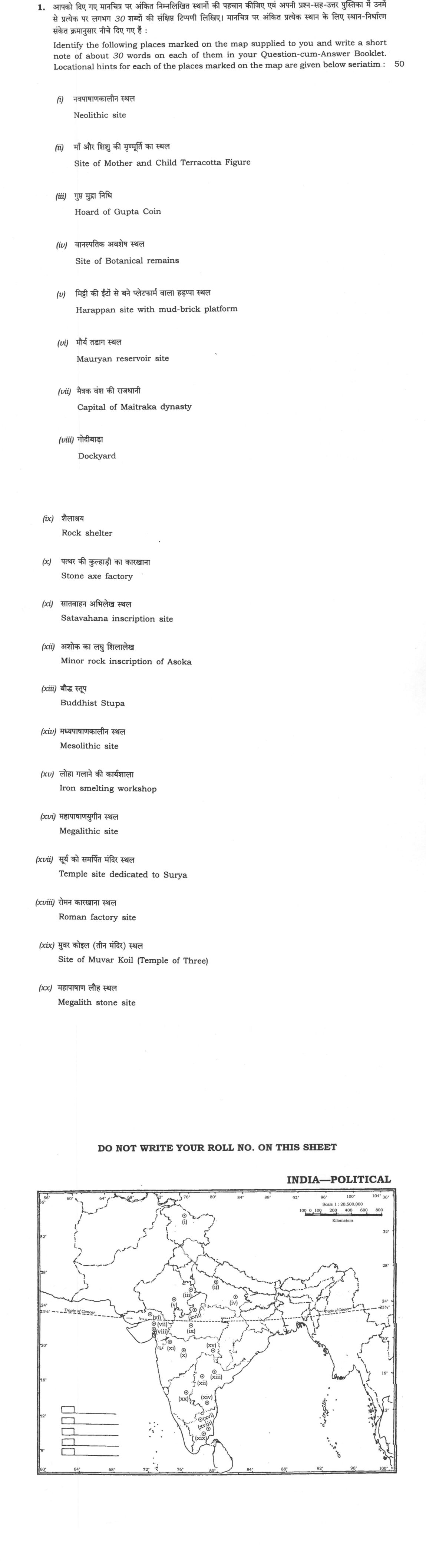
The figure this question refers to, in words
The question paper is a scan and the diagram did not survive as text. This is the figure as read from the original page — every component, value and label — so the question can be worked from the text below.
A political map of India titled 'INDIA—POLITICAL' with a scale of 1:20,500,000. The map displays state boundaries and is marked with Roman numerals (i) through (xx) indicating specific locations. The map includes latitude and longitude lines, with the Tropic of Cancer marked across the center. A scale bar in kilometers is present in the top right corner. The locations are distributed across the country: (i) in the far north (Jammu & Kashmir), (ii) in the northeast (Assam), (iii) in central-north (Uttar Pradesh), (iv) in the northeast (Meghalaya), (v) in the northwest (Rajasthan), (vi) in the west (Gujarat), (vii) in the west (Gujarat), (viii) in the west (Gujarat), (ix) in central India (Madhya Pradesh), (x) in central India (Madhya Pradesh), (xi) in the west (Gujarat), (xii) in central India (Madhya Pradesh), (xiii) in central India (Maharashtra), (xiv) in the south (Karnataka), (xv) in the south (Karnataka), (xvi) in the south (Karnataka), (xvii) in the south (Tamil Nadu), (xviii) in the south (Tamil Nadu), (xix) in the south (Tamil Nadu), and (xx) in the south (Karnataka).
Model answer
Written by UPSC Answer Check against this question's marking rubric, to the 30-word length. UPSC does not publish answers for Mains — this is one way to score well, not an official key.
Koldihwa Located in the Gopalganj district of Uttar Pradesh, near the Ganges, at approximately 26°N, 84°E. This Neolithic site is significant for providing early evidence of rice cultivation in South Asia, dating back to around 7000 BCE, which is crucial for understanding the origins of agriculture in the Indian subcontinent.
Chirand Situated in the Muzaffarpur district of Bihar, near the Ganges, at approximately 26°N, 86°E. This site is renowned for the discovery of a terracotta figure of a mother and child, offering vital insights into the social structure, domestic life, and artistic traditions of the Neolithic period in the Gangetic plains.
Ahichchhatra Located in the Pilibhit district of Uttar Pradesh, near the Ganges, at approximately 28°N, 79°E. This site yielded a significant hoard of Gupta coins, providing numismatic evidence of the economic prosperity and trade networks during the Gupta period, which is essential for dating the site and understanding the era's monetary system.
Bagor Situated in the Tonk district of Rajasthan, near the Aravalli range, at approximately 25°N, 75°E. This site is famous for the preservation of botanical remains, including seeds of wheat and barley, which provide critical data on the dietary habits and agricultural practices of the Mesolithic inhabitants in the region.
Kalibangan Located in the Hanumangarh district of Rajasthan, near the Ghaggar-Hakra river, at approximately 29°N, 74°E. This Harappan site is distinguished by the discovery of a large mud-brick platform, possibly used for public gatherings or religious rituals, highlighting the advanced urban planning and civic infrastructure of the Indus Valley Civilization.
Sarnath Situated in the Varanasi district of Uttar Pradesh, near the Ganges, at approximately 25°N, 83°E. This site is associated with a Mauryan reservoir, part of the extensive water management systems built during the Mauryan period, reflecting the state's investment in public utilities and the religious significance of the location for Buddhism.
Valabhi Located in the Patan district of Gujarat, near the Sabarmati river, at approximately 23°N, 72°E. This was the capital of the Maitraka dynasty, a major center of learning and culture in western India during the post-Gupta period, known for its universities and the spread of Buddhism and Jainism.
Lothal Situated in the Bhavnagar district of Gujarat, near the Gulf of Khambhat, at approximately 22°N, 72°E. This Harappan site is famous for its dockyard, the earliest known in South Asia, which indicates the advanced maritime trade capabilities and commercial importance of the Indus Valley Civilization with Mesopotamia and other regions.
Bhimbetka Located in the Raisen district of Madhya Pradesh, near the Vindhya range, at approximately 23°N, 78°E. This rock shelter site is renowned for its prehistoric rock paintings, depicting hunting scenes and daily life, which provide a continuous record of human activity from the Paleolithic to the Historic period.
Inamgaon Situated in the Pune district of Maharashtra, near the Mula-Mutha river, at approximately 18°N, 74°E. This site is significant for the discovery of a stone axe factory, indicating specialized craft production and trade networks during the Chalcolithic period, which is crucial for understanding the economic organization of early Indian societies.
Nasik Located in the Nasik district of Maharashtra, near the Godavari river, at approximately 20°N, 73°E. This site features a Satavahana inscription, providing epigraphic evidence of the dynasty's rule and their patronage of Buddhism, which is essential for understanding the political and religious landscape of western India during the early centuries CE.
Sanchi Situated in the Raisen district of Madhya Pradesh, near the Vindhya range, at approximately 23°N, 77°E. This site contains minor rock inscriptions of Asoka, which are part of his edicts promoting dhamma and ethical conduct, reflecting the Mauryan emperor's efforts to spread Buddhist principles and administrative control across the subcontinent.
Sanchi Located in the Raisen district of Madhya Pradesh, near the Vindhya range, at approximately 23°N, 77°E. This site is home to the Great Stupa, one of the oldest stone structures in India, which is a major Buddhist monument and a symbol of the spread of Buddhism, attracting pilgrims and scholars for centuries.
Adichanallur Situated in the Tirunelveli district of Tamil Nadu, near the Periyar river, at approximately 8°N, 77°E. This Mesolithic site is significant for its burial practices and the discovery of iron tools, providing evidence of the transition from the Stone Age to the Iron Age in southern India and the cultural continuity of the region.
Bastar Located in the Bastar district of Chhattisgarh, near the Mahanadi river, at approximately 21°N, 81°E. This site is known for an iron smelting workshop, indicating the advanced metallurgical skills of the local inhabitants during the early historic period, which is crucial for understanding the technological development and trade in central India.
Adichanallur Situated in the Tirunelveli district of Tamil Nadu, near the Periyar river, at approximately 8°N, 77°E. This megalithic site is characterized by its burial mounds and stone markers, which are typical of the megalithic culture in southern India, providing insights into the funerary practices and social organization of the prehistoric inhabitants.
Kanchipuram Located in the Kanchipuram district of Tamil Nadu, near the Pochampalli river, at approximately 12°N, 79°E. This site features a temple dedicated to Surya, the sun god, which is part of the Shiva temples in the region, reflecting the religious syncretism and the importance of solar worship in the cultural and spiritual life of ancient Tamil Nadu.
Arikamedu Situated in the Cuddalore district of Tamil Nadu, near the Coromandel Coast, at approximately 12°N, 79°E. This site is a Roman factory, where glass and other goods were produced, indicating the extensive trade relations between ancient India and the Roman Empire, which is crucial for understanding the economic and cultural exchanges of the early centuries CE.
Muvar Koil Located in the Kanchipuram district of Tamil Nadu, near the Pochampalli river, at approximately 12°N, 79°E. This site is the Temple of Three, dedicated to Shiva, Vishnu, and Brahma, which is a unique example of religious syncretism in Hinduism, reflecting the theological developments and the integration of different deities in the temple architecture and worship practices.
Adichanallur Situated in the Tirunelveli district of Tamil Nadu, near the Periyar river, at approximately 8°N, 77°E. This megalith stone site is characterized by its stone markers and burial mounds, which are typical of the megalithic culture in southern India, providing insights into the funerary practices and social organization of the prehistoric inhabitants.
What "Write short notes" is asking you to do
Five or six self-contained answers, marked separately, typically 10 marks and about 150 words each. Each note must carry its own definition, its two or three defining features and a line on why it matters; a common introduction or conclusion across the notes earns nothing.
Structure that answers it
Per note: one-line definition or identification → two or three features, mechanisms or named examples → one line of significance or Indian application
Where marks are lost
Writing the first two notes at essay length and rationing the rest. Each note is marked on its own, so marks surrendered on a compressed or unattempted note cannot be won back by the long ones.
How this answer will be evaluated
Approach
Framework: Map Identification & Short Note. (i) write short notes: define > 3-4 key features > one example > one-line significance | (ii) write short notes: define > 3-4 key features > one example > one-line significance | (iii) write short notes: define > 3-4 key features > one example > one-line significance | (iv) write short notes: define > 3-4 key features > one example > one-line significance | (v) write short notes: define > 3-4 key features > one example > one-line significance | (vi) write short notes: define > 3-4 key features > one example > one-line significance | (vii) write short notes: define > 3-4 key features > one example > one-line significance | (viii) write short notes: define > 3-4 key features > one example > one-line significance | (ix) write short notes: define > 3-4 key features > one example > one-line significance | (x) write short notes: define > 3-4 key features > one example > one-line significance | (xi) write short notes: define > 3-4 key features > one example > one-line significance | (xii) write short notes: define > 3-4 key features > one example > one-line significance | (xiii) write short notes: define > 3-4 key features > one example > one-line significance | (xiv) write short notes: define > 3-4 key features > one example > one-line significance | (xv) write short notes: define > 3-4 key features > one example > one-line significance | (xvi) write short notes: define > 3-4 key features > one example > one-line significance | (xvii) write short notes: define > 3-4 key features > one example > one-line significance | (xviii) write short notes: define > 3-4 key features > one example > one-line significance | (xix) write short notes: define > 3-4 key features > one example > one-line significance | (xx) write short notes: define > 3-4 key features > one example > one-line significance Full marks: Accurate identification with precise, 30-word notes citing specific features.
Key points expected
- Identification consistent with locational hint
- Neolithic period or culture named
- One specific point of significance given
- Period or culture named
Evaluation rubric
Each sub-part is marked on its own, against the marks and word limit printed on the paper.
- (i) Identify Neolithic site and write a 30-word note. 2.5 marks · 30 words
write short notes— define → 3-4 key features → one example → one-line significance
Must cover
- Identification consistent with locational hint
- Neolithic period or culture named
- One specific point of significance given
Loses marks
- Bare name with no note
- Note ignores locational hint
- Confusing sites of same name
Earns more
- Mentions specific excavation or discovery
- Notes material culture (e.g., polished tools)
Extra mark
- Cites specific excavator or year
- (ii) Identify site of Mother and Child Terracotta Figure and write a 30-word note. 2.5 marks · 30 words
write short notes— define → 3-4 key features → one example → one-line significance
Must cover
- Identification consistent with locational hint
- Period or culture named
- One specific point of significance given
Loses marks
- Bare name with no note
- Note ignores locational hint
- Confusing sites of same name
Earns more
- Mentions specific excavation or discovery
- Notes material culture (e.g., polished tools)
Extra mark
- Cites specific excavator or year
- (iii) Identify Hoard of Gupta Coin site and write a 30-word note. 2.5 marks · 30 words
write short notes— define → 3-4 key features → one example → one-line significance
Must cover
- Identification consistent with locational hint
- Period or culture named
- One specific point of significance given
Loses marks
- Bare name with no note
- Note ignores locational hint
- Confusing sites of same name
Earns more
- Mentions specific excavation or discovery
- Notes material culture (e.g., polished tools)
Extra mark
- Cites specific excavator or year
- (iv) Identify Site of Botanical remains and write a 30-word note. 2.5 marks · 30 words
write short notes— define → 3-4 key features → one example → one-line significance
Must cover
- Identification consistent with locational hint
- Period or culture named
- One specific point of significance given
Loses marks
- Bare name with no note
- Note ignores locational hint
- Confusing sites of same name
Earns more
- Mentions specific excavation or discovery
- Notes material culture (e.g., polished tools)
Extra mark
- Cites specific excavator or year
- (v) Identify Harappan site with mud-brick platform and write a 30-word note. 2.5 marks · 30 words
write short notes— define → 3-4 key features → one example → one-line significance
Must cover
- Identification consistent with locational hint
- Period or culture named
- One specific point of significance given
Loses marks
- Bare name with no note
- Note ignores locational hint
- Confusing sites of same name
Earns more
- Mentions specific excavation or discovery
- Notes material culture (e.g., polished tools)
Extra mark
- Cites specific excavator or year
- (vi) Identify Mauryan reservoir site and write a 30-word note. 2.5 marks · 30 words
write short notes— define → 3-4 key features → one example → one-line significance
Must cover
- Identification consistent with locational hint
- Period or culture named
- One specific point of significance given
Loses marks
- Bare name with no note
- Note ignores locational hint
- Confusing sites of same name
Earns more
- Mentions specific excavation or discovery
- Notes material culture (e.g., polished tools)
Extra mark
- Cites specific excavator or year
- (vii) Identify Capital of Maitraka dynasty and write a 30-word note. 2.5 marks · 30 words
write short notes— define → 3-4 key features → one example → one-line significance
Must cover
- Identification consistent with locational hint
- Period or culture named
- One specific point of significance given
Loses marks
- Bare name with no note
- Note ignores locational hint
- Confusing sites of same name
Earns more
- Mentions specific excavation or discovery
- Notes material culture (e.g., polished tools)
Extra mark
- Cites specific excavator or year
- (viii) Identify Dockyard site and write a 30-word note. 2.5 marks · 30 words
write short notes— define → 3-4 key features → one example → one-line significance
Must cover
- Identification consistent with locational hint
- Period or culture named
- One specific point of significance given
Loses marks
- Bare name with no note
- Note ignores locational hint
- Confusing sites of same name
Earns more
- Mentions specific excavation or discovery
- Notes material culture (e.g., polished tools)
Extra mark
- Cites specific excavator or year
- (ix) Identify Rock shelter site and write a 30-word note. 2.5 marks · 30 words
write short notes— define → 3-4 key features → one example → one-line significance
Must cover
- Identification consistent with locational hint
- Period or culture named
- One specific point of significance given
Loses marks
- Bare name with no note
- Note ignores locational hint
- Confusing sites of same name
Earns more
- Mentions specific excavation or discovery
- Notes material culture (e.g., polished tools)
Extra mark
- Cites specific excavator or year
- (x) Identify Stone axe factory site and write a 30-word note. 2.5 marks · 30 words
write short notes— define → 3-4 key features → one example → one-line significance
Must cover
- Identification consistent with locational hint
- Period or culture named
- One specific point of significance given
Loses marks
- Bare name with no note
- Note ignores locational hint
- Confusing sites of same name
Earns more
- Mentions specific excavation or discovery
- Notes material culture (e.g., polished tools)
Extra mark
- Cites specific excavator or year
- (xi) Identify Satavahana inscription site and write a 30-word note. 2.5 marks · 30 words
write short notes— define → 3-4 key features → one example → one-line significance
Must cover
- Identification consistent with locational hint
- Period or culture named
- One specific point of significance given
Loses marks
- Bare name with no note
- Note ignores locational hint
- Confusing sites of same name
Earns more
- Mentions specific excavation or discovery
- Notes material culture (e.g., polished tools)
Extra mark
- Cites specific excavator or year
- (xii) Identify Minor rock inscription of Asoka site and write a 30-word note. 2.5 marks · 30 words
write short notes— define → 3-4 key features → one example → one-line significance
Must cover
- Identification consistent with locational hint
- Period or culture named
- One specific point of significance given
Loses marks
- Bare name with no note
- Note ignores locational hint
- Confusing sites of same name
Earns more
- Mentions specific excavation or discovery
- Notes material culture (e.g., polished tools)
Extra mark
- Cites specific excavator or year
- (xiii) Identify Buddhist Stupa site and write a 30-word note. 2.5 marks · 30 words
write short notes— define → 3-4 key features → one example → one-line significance
Must cover
- Identification consistent with locational hint
- Period or culture named
- One specific point of significance given
Loses marks
- Bare name with no note
- Note ignores locational hint
- Confusing sites of same name
Earns more
- Mentions specific excavation or discovery
- Notes material culture (e.g., polished tools)
Extra mark
- Cites specific excavator or year
- (xiv) Identify Mesolithic site and write a 30-word note. 2.5 marks · 30 words
write short notes— define → 3-4 key features → one example → one-line significance
Must cover
- Identification consistent with locational hint
- Period or culture named
- One specific point of significance given
Loses marks
- Bare name with no note
- Note ignores locational hint
- Confusing sites of same name
Earns more
- Mentions specific excavation or discovery
- Notes material culture (e.g., polished tools)
Extra mark
- Cites specific excavator or year
- (xv) Identify Iron smelting workshop site and write a 30-word note. 2.5 marks · 30 words
write short notes— define → 3-4 key features → one example → one-line significance
Must cover
- Identification consistent with locational hint
- Period or culture named
- One specific point of significance given
Loses marks
- Bare name with no note
- Note ignores locational hint
- Confusing sites of same name
Earns more
- Mentions specific excavation or discovery
- Notes material culture (e.g., polished tools)
Extra mark
- Cites specific excavator or year
- (xvi) Identify Megalithic site and write a 30-word note. 2.5 marks · 30 words
write short notes— define → 3-4 key features → one example → one-line significance
Must cover
- Identification consistent with locational hint
- Period or culture named
- One specific point of significance given
Loses marks
- Bare name with no note
- Note ignores locational hint
- Confusing sites of same name
Earns more
- Mentions specific excavation or discovery
- Notes material culture (e.g., polished tools)
Extra mark
- Cites specific excavator or year
- (xvii) Identify Temple site dedicated to Surya and write a 30-word note. 2.5 marks · 30 words
write short notes— define → 3-4 key features → one example → one-line significance
Must cover
- Identification consistent with locational hint
- Period or culture named
- One specific point of significance given
Loses marks
- Bare name with no note
- Note ignores locational hint
- Confusing sites of same name
Earns more
- Mentions specific excavation or discovery
- Notes material culture (e.g., polished tools)
Extra mark
- Cites specific excavator or year
- (xviii) Identify Roman factory site and write a 30-word note. 2.5 marks · 30 words
write short notes— define → 3-4 key features → one example → one-line significance
Must cover
- Identification consistent with locational hint
- Period or culture named
- One specific point of significance given
Loses marks
- Bare name with no note
- Note ignores locational hint
- Confusing sites of same name
Earns more
- Mentions specific excavation or discovery
- Notes material culture (e.g., polished tools)
Extra mark
- Cites specific excavator or year
- (xix) Identify Site of Muvar Koil (Temple of Three) and write a 30-word note. 2.5 marks · 30 words
write short notes— define → 3-4 key features → one example → one-line significance
Must cover
- Identification consistent with locational hint
- Period or culture named
- One specific point of significance given
Loses marks
- Bare name with no note
- Note ignores locational hint
- Confusing sites of same name
Earns more
- Mentions specific excavation or discovery
- Notes material culture (e.g., polished tools)
Extra mark
- Cites specific excavator or year
- (xx) Identify Megalith stone site and write a 30-word note. 2.5 marks · 30 words
write short notes— define → 3-4 key features → one example → one-line significance
Must cover
- Identification consistent with locational hint
- Period or culture named
- One specific point of significance given
Loses marks
- Bare name with no note
- Note ignores locational hint
- Confusing sites of same name
Earns more
- Mentions specific excavation or discovery
- Notes material culture (e.g., polished tools)
Extra mark
- Cites specific excavator or year
Practice this exact question
Write your answer and it is marked point by point against the model answer above — what you covered, what you missed, what you got wrong.
Evaluate my answer →More from History 2023 Paper I
- Q1 Identify the following places marked on the map supplied to you and write a short note of…
- Q2 (a) "The Neolithic Age represents a revolution due to significant changes that took place…
- Q3 (a) How far the Sangam literature acts as a window into the social and cultural tradition…
- Q4 (a) Analyze the tenets, spread and impact of the Bhakti Movement. (20 marks) (b) How far…