Paper I — Q5
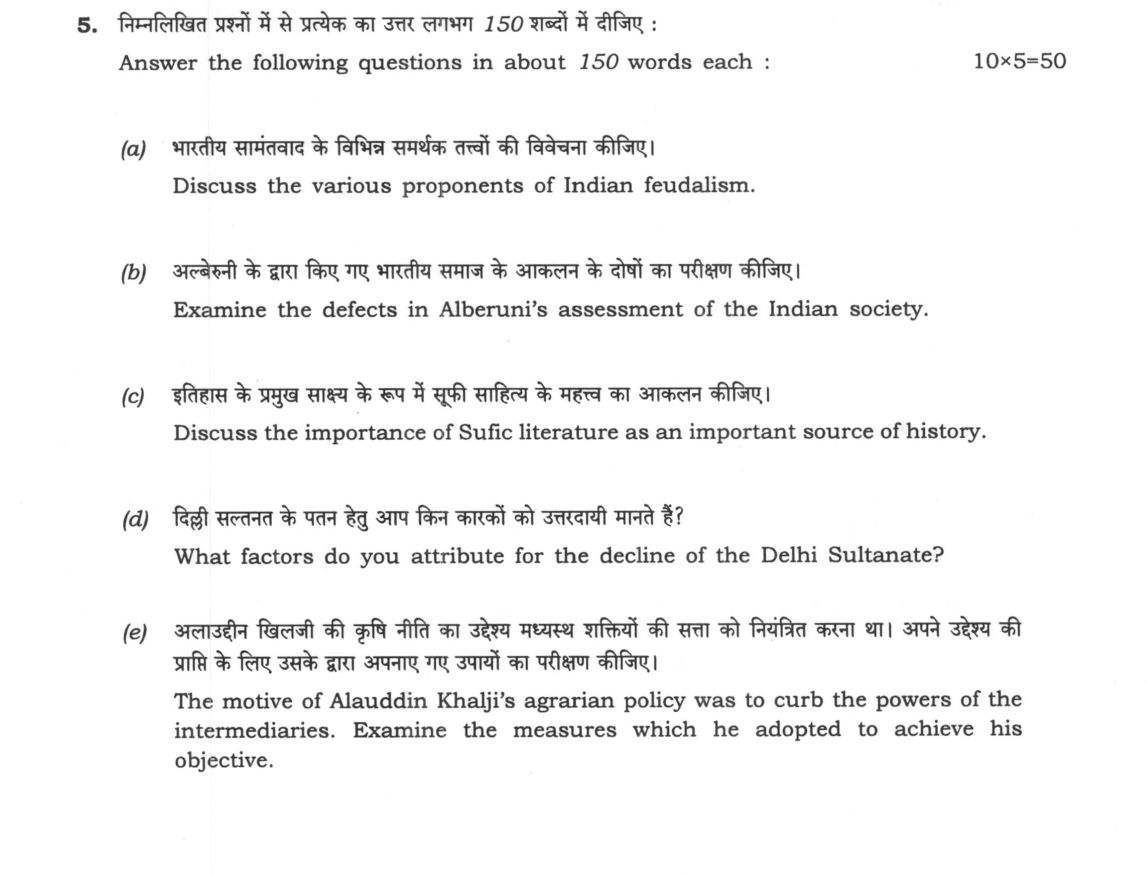
Answer the following questions in about 150 words each: (a) Discuss the various proponents of Indian feudalism. (10 marks) (b)…
Answer the following questions in about 150 words each: Discuss the various proponents of Indian feudalism. 10 marks
Examine the defects in Alberuni's assessment of the Indian society. 10 marks
Discuss the importance of Sufic literature as an important source of history. 10 marks
What factors do you attribute for the decline of the Delhi Sultanate? 10 marks
The motive of Alauddin Khalji's agrarian policy was to curb the powers of the intermediaries. Examine the measures which he adopted to achieve his objective. 10 marks
हिंदी में प्रश्न पढ़ें
निम्नलिखित प्रश्नों में से प्रत्येक का उत्तर लगभग 150 शब्दों में दीजिए: भारतीय सामंतवाद के विभिन्न समर्थक तत्त्वों की विवेचना कीजिए। (10 अंक)
अलबेरुनी के द्वारा किए गए भारतीय समाज के आकलन के दोषों का परीक्षण कीजिए। (10 अंक)
इतिहास के प्रमुख साक्ष्य के रूप में सूफी साहित्य के महत्त्व का आकलन कीजिए। (10 अंक)
दिल्ली सल्तनत के पतन हेतु आप किन कारकों को उत्तरदायी मानते हैं? (10 अंक)
अलाउद्दीन खिलजी की कृषि नीति का उद्देश्य मध्यस्थ शक्तियों की सत्ता को नियंत्रित करना था। अपने उद्देश्य की प्राप्ति के लिए उसके द्वारा अपनाए गए उपायों का परीक्षण कीजिए। (10 अंक)
Model answer
Written by UPSC Answer Check against this question's marking rubric, to the 150-word length. UPSC does not publish answers for Mains — this is one way to score well, not an official key.
(a) The debate on Indian feudalism is best understood through its proponents and their regional-chronological emphases. R.S. Sharma, in Indian Feudalism, argued that the early medieval period (c. 6th–12th centuries) was feudal, stressing land grants, caste hierarchy, village autonomy and the weakening of urban trade, with a pan-Indian but especially North Indian focus. D.D. Kosambi gave it a Marxist class-struggle framing, seeing early medieval agrarian expansion and slave/serf labour as producing feudal relations. B.N.S. Yadava extended the thesis to early medieval North Indian land-grant and caste structures, while R.N. Nandi applied it to early medieval Bengal’s agrarian and administrative change, and D.N. Jha examined early medieval Bihar’s grants and social hierarchy. Later critics—B.D. Chattopadhyaya’s processual Bengal focus and Harbans Mukhia’s anti-feudalism—tested the thesis but did not replace its core argument. Sharma’s model remains the baseline for examining early medieval land, caste, state and political economy.
(b) Alberuni’s assessment is valuable but defective. His Brahmanical bias is evident because he relied heavily on Sanskrit texts and Brahmanical informants, so his picture of “Hindu” society is often a textual, priestly ideal rather than lived practice. His social penetration was limited: he observed mainly elite, urban and courtly circles, and could not adequately represent peasants, artisans, women, lower castes or regional variations. His method was text-centric: he used Smriti, Puranas and Sanskrit learning to explain institutions, sometimes treating scriptural norms as actual customs. His religious prejudice led him to judge Indian practices by Islamic standards, producing ethnocentric condemnations of idolatry, caste, sati and social customs. These comparisons were not anachronistic, since he wrote about contemporary 11th-century India, but they were ethnocentric and normative. Thus his work is a source for elite knowledge and cross-cultural comparison, but not a neutral social survey.
(c) Sufic literature is important because it records religious, social and cultural processes that court chronicles often omit. Hagiographies such as Amir Khusrau’s Tazkirat al-Awliya preserve details of saintly networks, patronage, Sufi orders and the interaction of Sufis with rulers and local communities. Sufi poetry and letters reveal syncretic ideas, popular devotion, language change and the moral vocabulary of medieval Indian society. They also help trace the spread of Sufism from gharis to urban khanqahs, and the negotiation between Sufi authority and state power. These sources must be distinguished from courtly Persian works: Khusrau’s Khazain-ul-Futuh is court panegyric/historical poetry, Barani’s Fatawa-i-Jahandari is a political-theological treatise, and Sijzi’s Fawa’id-ul-Fu’ad is a historical/administrative chronicle. They are valuable for administrative practices and political thought, but they are not Sufic literature. Read critically, Sufic texts provide social history, syncretism and the inner life of medieval religion, while courtly texts supply the state framework in which Sufis operated.
(d) The decline of the Delhi Sultanate was both immediate and structural. The immediate shock was Timur’s invasion of 1398, which devastated Delhi, destroyed military prestige and encouraged provincial disintegration. But structural weaknesses had already weakened the state. The iqta system made the army dependent on fiefs; iqtadars often withheld revenue, resisted transfer and turned military land grants into quasi-hereditary power, reducing central control. Factionalism among nobles, especially after weak successors in the Tughlaq and Sayyid periods, produced palace intrigues, rebellions and loss of provincial loyalty. Zamindar resurgence, as local landholders and tribal chiefs asserted autonomy, further eroded the sultanate’s fiscal and administrative base. Economic crisis—over-taxation, disrupted trade, famine and monetary instability—reduced revenue and popular support. The emergence of regional sultanates in Gujarat, Bengal and Jaunpur completed the fragmentation. Thus Timur’s raid was the final blow to a state already undermined by fiscal, military and political decay.
(e) Alauddin Khalji’s agrarian policy aimed to reduce the fiscal and political power of intermediaries between the state and the peasant. His central measure was direct assessment of kharaj: officials measured land, fixed revenue and reduced the discretion of local amils, muqaddams and other revenue intermediaries who could manipulate accounts. He also reformed iqta: by revoking, consolidating and reassigning iqtas, he prevented iqtadars from building hereditary, autonomous power bases and made military land grants more dependent on the sultan. These measures brought revenue and military resources closer to the centre. Market control through the shahna-i-mandi, price fixation and espionage were broader administrative tools; they helped the state monitor prices and bypass intermediaries, but they were not strictly agrarian measures. Their relevance to curbing intermediaries was indirect, by limiting local elites’ profits from grain and revenue flows. On balance, Alauddin’s agrarian reforms centralised revenue, though their long-term success was limited by resistance and continuing local power.
What "Examine" is asking you to do
Test the proposition the question puts to you and return a finding on how far it holds. Examine stems carry a claim, or ask whether something has happened, and expect evidence weighed both ways before the extent is stated — often with remedial measures attached.
Structure that answers it
Restate the claim as the question frames it → evidence that supports it → evidence that undercuts it → the conditions under which it holds → verdict on how far it stands
Where marks are lost
Stopping at description. An examination has to reach a finding, and “examine with justification” means the extent must be stated, not implied.
How this answer will be evaluated
Approach
Framework: Context > Thesis > Evidence > Historiography. (a) discuss: intro > 3-4 dimensions > example > balanced close | (b) examine: intro > how/why with reasoning > evidence > conclusion | (c) discuss: intro > 3-4 dimensions > example > balanced close | (d) account for: state the phenomenon > the causes in order of weight > conclusion | (e) examine: intro > how/why with reasoning > evidence > conclusion Full marks: Thesis-driven, cites specific historians/sources, balanced analysis, precise terminology.
Key points expected
- Identify the 'Feudal' school (e.g., R.S. Sharma, D.D. Kosambi)
- Identify the 'Non-Feudal' or 'Anti-Feudal' school (e.g., Irfan Habib, Romila Thapar)
- Contrast the core arguments of both schools
- Provide a balanced conclusion on the debate
- Identify specific defects (e.g., bias, lack of local knowledge)
- Explain the context of his stay (short duration, court access)
- Provide specific examples of his errors or omissions
- Conclude on the utility of his work despite defects
Evaluation rubric
Each sub-part is marked on its own, against the marks and word limit printed on the paper.
- (a) Analytical overview of the historiographical debate on Indian feudalism. · 150 words
discuss— intro → 3-4 dimensions → example → balanced close
Must cover
- Identify the 'Feudal' school (e.g., R.S. Sharma, D.D. Kosambi)
- Identify the 'Non-Feudal' or 'Anti-Feudal' school (e.g., Irfan Habib, Romila Thapar)
- Contrast the core arguments of both schools
- Provide a balanced conclusion on the debate
Loses marks
- Narrating history without historiographical context
- Failing to name specific schools or historians
- Presenting one view as absolute fact
Earns more
- Mention specific arguments regarding land grants (Brahmadeya)
- Reference the 'Slave Mode of Production' debate
- Cite specific historians' works or dates
Extra mark
- Reference to specific inscriptions (e.g., Talagunda)
- Mention of the 'Brahmanical' vs 'Feudal' distinction
- (b) Critical analysis of the limitations and biases in Alberuni's account. · 150 words
examine— intro → how/why with reasoning → evidence → conclusion
Must cover
- Identify specific defects (e.g., bias, lack of local knowledge)
- Explain the context of his stay (short duration, court access)
- Provide specific examples of his errors or omissions
- Conclude on the utility of his work despite defects
Loses marks
- Generalizing without specific examples
- Ignoring the value of his work entirely
- Confusing his work with other chronicles
Earns more
- Mention his reliance on Persian sources
- Note his focus on the elite/court over commoners
- Reference specific errors (e.g., on caste or religion)
Extra mark
- Comparison with other contemporary sources
- Specific quote from Alberuni's work
- (c) Evaluation of Sufi literature as a primary source for history. · 150 words
discuss— intro → 3-4 dimensions → example → balanced close
Must cover
- Define the scope of Sufi literature (hagiographies, poetry)
- Explain its value for social/cultural history
- Mention specific works or authors (e.g., Masnavi, Tazkirat al-Awliya)
- Note the limitations (myth vs fact, religious bias)
Loses marks
- Treating all Sufi literature as purely religious
- Ignoring the historical context of the texts
- Failing to distinguish between different types of Sufi literature
Earns more
- Reference to specific Sufi orders (Qadiri, Chishti)
- Mention the role in documenting syncretism
- Cite specific historical events recorded in Sufi texts
Extra mark
- Reference to specific manuscripts or archives
- Mention of specific Sufi poets (e.g., Amir Khusrau)
- (d) Causal analysis of the factors leading to the decline of the Delhi Sultanate. · 150 words
account for— state the phenomenon → the causes in order of weight → conclusion
Must cover
- Identify internal factors (e.g., weak successors, civil wars)
- Identify external factors (e.g., Mongol invasions, regional powers)
- Explain the economic/administrative failures
- Conclude with the final collapse (1526)
Loses marks
- Listing factors without explaining their impact
- Ignoring the role of regional powers
- Failing to provide a chronological sequence
Earns more
- Mention specific weak sultans (e.g., Muhammad bin Tughlaq)
- Reference the rise of regional kingdoms (e.g., Vijayanagara)
- Note the impact of the Mongol threat
Extra mark
- Reference to specific battles or dates
- Mention of specific administrative reforms that failed
- (e) Analysis of Alauddin Khalji's specific measures to control intermediaries. · 150 words
examine— intro → how/why with reasoning → evidence → conclusion
Must cover
- Identify the 'intermediaries' (e.g., muqaddams, muqtas)
- Explain the 'Iqta' system reforms
- Detail the 'market control' measures (e.g., Daulat Khan)
- Explain the 'land survey' (Mansab system precursors)
Loses marks
- Confusing Alauddin's policies with other sultans
- Failing to link measures to the 'curbing intermediaries' goal
- Generalizing without specific administrative details
Earns more
- Mention the 'Dagh' and 'Chehra' systems
- Reference the 'Diwan-i-Riyasat' or specific officials
- Note the impact on the nobility
Extra mark
- Reference to specific inscriptions or chronicles
- Mention of the 'Sijil' (register) system
Practice this exact question
Write your answer and it is marked point by point against the model answer above — what you covered, what you missed, what you got wrong.
Evaluate my answer →More from History 2023 Paper I
- Q2 (a) "The Neolithic Age represents a revolution due to significant changes that took place…
- Q3 (a) How far the Sangam literature acts as a window into the social and cultural tradition…
- Q4 (a) Analyze the tenets, spread and impact of the Bhakti Movement. (20 marks) (b) How far…
- Q5 Answer the following questions in about 150 words each: (a) Discuss the various proponent…
- Q6 (a) Discuss the role of Nur Jahan in the Mughal court politics during the reign of Jahang…
- Q7 (a) The Marathas posed a significant threat to the integrity of the Mughal Empire. Discus…
- Q8 (a) Mughal architecture was syncretic in character. Comment. (20 marks) (b) The economy o…