Paper I — Q6
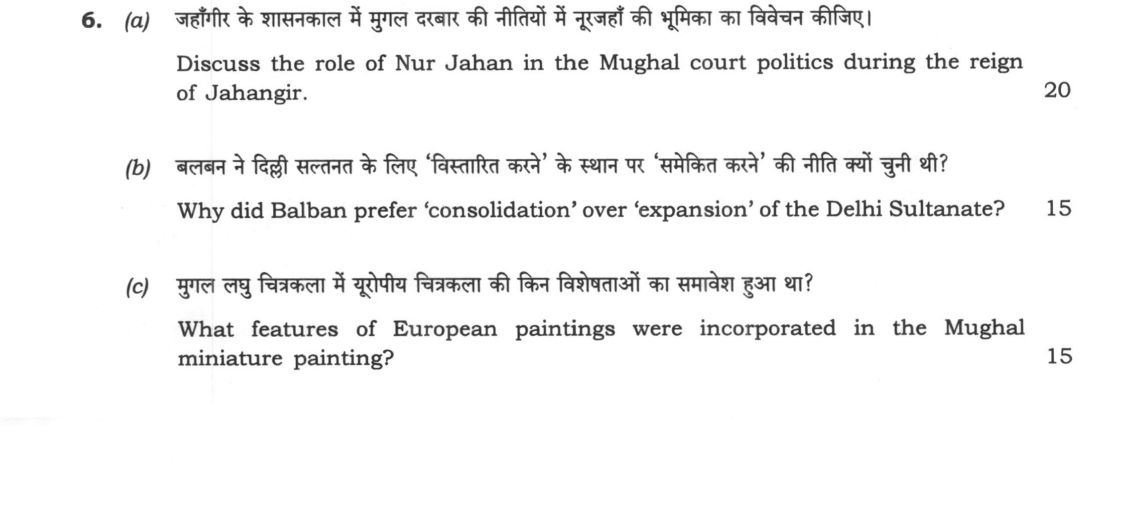
(a) Discuss the role of Nur Jahan in the Mughal court politics during the reign of Jahangir. (20 marks) (b) Why did Balban prefer…
Discuss the role of Nur Jahan in the Mughal court politics during the reign of Jahangir. 20 marks
Why did Balban prefer 'consolidation' over 'expansion' of the Delhi Sultanate? 15 marks
What features of European paintings were incorporated in the Mughal miniature painting? 15 marks
हिंदी में प्रश्न पढ़ें
जहाँगीर के शासनकाल में मुगल दरबार की नीतियों में नूरजहाँ की भूमिका का विवेचन कीजिए। (20 अंक)
बलबन ने दिल्ली सल्तनत के लिए 'विस्तारित करने' के स्थान पर 'संमेकित करने' की नीति क्यों चुनी थी? (15 अंक)
मुगल लघु चित्रकला में यूरोपीय चित्रकला की किन विशेषताओं का समावेश हुआ था? (15 अंक)
Model answer
Written by UPSC Answer Check against this question's marking rubric, to the expected length. UPSC does not publish answers for Mains — this is one way to score well, not an official key.
The Mughal and Delhi Sultanate episodes show that court politics and statecraft were shaped less by formal titles than by control of access, patronage, and legitimacy. In Jahangir’s reign, Nur Jahan became the central node of that control; under Balban, the Sultanate’s survival depended on consolidating a fragile state; and in Mughal painting, European visual devices were absorbed into a Persianate idiom.
Nur Jahan and Jahangir’s court Nur Jahan’s political ascendancy became visible from 1611 onwards, after her marriage to Jahangir and her entry into the imperial household. She exercised influence through control of access to the emperor, management of petitions, grants, and patronage, and by shaping court factions. Her most striking symbol was coinage: silver rupees were struck in her name by Jahangir’s order, an exceptional honour that signalled her unique status, though it was not ordinary joint imperial coinage. She also intervened in succession politics, initially supporting her son Shahryar against Khurram, the future Shah Jahan, before later accommodation with the latter. The “Nur Jahan Junta” theory presents her as head of a family clique, with her father Mirza Ghiyas Beg elevated to Itimad-ud-Daulah and her brother Asaf Khan as a key minister, together directing policy. Modern revisionist views, however, stress that her power was derivative and relational: she acted as an intermediary, patron, and negotiator within a shared authority structure, rather than as a de facto sovereign. Her role was therefore best understood as the exercise of extraordinary influence within Mughal imperial politics, not independent rule.
Balban’s consolidation Balban preferred consolidation over expansion because the Delhi Sultanate in the mid-thirteenth century was still fragile. The Chalisa, or forty powerful nobles, had weakened royal authority by controlling iqtas and acting as a counterweight to the sultan. Balban destroyed this group, reconstructed the iqta system to make assignments revocable and dependent on royal service, and created an espionage network, the barid, to monitor nobles and frontier officials. He also advanced the doctrine of Niyabat-i-Khudai, the vicegerency of God, to sacralise kingship and justify absolute obedience. The external context reinforced this caution: the Mongol threat, or Sit-i-Mughuli, made reckless frontier expansion dangerous, while internal rebellions, such as Tughril Khan of Bengal, showed that the provinces were not securely integrated. Unlike Iltutmish, whose aggressive campaigns helped build the Sultanate’s foundations, Balban faced a state that needed internal discipline. His policy was therefore defensive and centralising: secure the core, subordinate the nobility, and prevent fragmentation before further expansion.
European features in Mughal painting European painting influenced Mughal miniature painting mainly through Jesuit missionaries at Akbar’s court, especially Rodolfo Acquaviva, and through artists such as Manohar and Abu’l Hasan. Mughal painters selectively incorporated European devices: linear perspective to create depth, chiaroscuro and shading to model forms, naturalistic portraiture with individualised physiognomy, and motifs such as angels, putti, and halos. These features are visible in works like the portrait of Jahangir holding a picture of the Madonna and in illustrations of the Dastan-i-Amir Hamza. Yet the synthesis was not a wholesale adoption of European structure. Mughal artists retained Persian planar composition, decorative patterning, and narrative conventions, using European illusionism as an added layer. The result was not imitation but cultural synthesis: decorative borrowing and selective structural integration enriched the Mughal idiom without replacing it. Thus, European elements were absorbed as techniques and motifs, not as a new pictorial system.
Taken together, these cases show that Mughal and Sultanate statecraft depended on managing legitimacy, access, and institutional control, while Mughal culture demonstrated the capacity to absorb external influences into indigenous forms.
What "Discuss" is asking you to do
Lay the issue out from more than one side — how it arose, what is claimed for it, what is held against it, and where it now stands. UPSC attaches discuss to broad topics with several live dimensions, so coverage of the dimensions earns more than the strength of your opinion.
Structure that answers it
Set the issue up → the case as it is made → the case against → the dimension both sides leave out → where the balance now lies
Where marks are lost
Listing facts with no thread between them, or arguing one side throughout and calling it a discussion.
How this answer will be evaluated
Approach
Framework: Context > Thesis > Evidence > Historiography. (a) discuss: intro > 3-4 dimensions > example > balanced close | (b) explain: definition/context > points in order > small example > short close | (c) highlight: name the salient points > one line of substance each > close Full marks: Thesis-driven, cites specific sources, names historiographical debates, and provides balanced analysis.
Key points expected
- Thesis on her role as co-ruler or power broker
- Evidence of administrative control (e.g., Diwani, coinage)
- Analysis of court factions (e.g., Prince Salim, Prince Khurram)
- Balanced conclusion on the limits of her power
- Context of the 'Age of Slave Kings' instability
- Threat of internal rebellions (e.g., Chalsuti, Iltutmish's family)
- Need to secure the 'Iqta' system and revenue
- Strategic focus on the 'Sipahsalar' and military control
Evaluation rubric
Each sub-part is marked on its own, against the marks and word limit printed on the paper.
- (a) Analytical assessment of Nur Jahan's political agency and influence on Mughal statecraft. 20 marks
discuss— intro → 3-4 dimensions → example → balanced close
Must cover
- Thesis on her role as co-ruler or power broker
- Evidence of administrative control (e.g., Diwani, coinage)
- Analysis of court factions (e.g., Prince Salim, Prince Khurram)
- Balanced conclusion on the limits of her power
Loses marks
- Narrative retelling of her biography without analysis
- Ignoring the political context of Jahangir's reign
- Overstating her power without evidence of limits
Earns more
- Citation of Jahangirnama or Itimad-ud-Daula's letters
- Reference to the 'Nur Jahan' coinage controversy
- Mention of her role in the 'Mansabdari' system
- Comparison with other influential Mughal queens
Extra mark
- Specific quote from a contemporary chronicle
- Reference to a specific historiographical debate
- (b) Reasons for Balban's strategic shift from territorial expansion to internal consolidation. 15 marks
explain— definition/context → points in order → small example → short close
Must cover
- Context of the 'Age of Slave Kings' instability
- Threat of internal rebellions (e.g., Chalsuti, Iltutmish's family)
- Need to secure the 'Iqta' system and revenue
- Strategic focus on the 'Sipahsalar' and military control
Loses marks
- Focusing only on external threats (e.g., Mongols)
- Ignoring the internal political dynamics
- Vague generalizations about 'consolidation'
Earns more
- Reference to the 'Sijilnama' or 'Tarikh-i-Firishta'
- Mention of the 'Sijilnama' of Balban
- Analysis of the 'Iqta' system's role in consolidation
- Comparison with earlier Sultans' expansionist policies
Extra mark
- Specific example of a rebellion suppressed
- Reference to a specific administrative reform
- (c) Identification of specific European artistic techniques adopted in Mughal miniature painting. 15 marks
highlight— name the salient points → one line of substance each → close
Must cover
- Use of perspective (linear and atmospheric)
- Application of chiaroscuro (light and shadow)
- Realistic portraiture and individualized features
- Integration of European motifs into Mughal style
Loses marks
- Listing features without explaining their impact
- Ignoring the Mughal context of adoption
- Overstating the European influence
Earns more
- Reference to the 'Padshahnama' or 'Akbarnama'
- Mention of specific European artists (e.g., Giuseppe Castiglione)
- Analysis of the 'Mughal-Rajput' synthesis
- Comparison with pre-European Mughal styles
Extra mark
- Specific example of a painting showing these features
- Reference to a specific European influence (e.g., Flemish)
Practice this exact question
Write your answer and it is marked point by point against the model answer above — what you covered, what you missed, what you got wrong.
Evaluate my answer →More from History 2023 Paper I
- Q3 (a) How far the Sangam literature acts as a window into the social and cultural tradition…
- Q4 (a) Analyze the tenets, spread and impact of the Bhakti Movement. (20 marks) (b) How far…
- Q5 Answer the following questions in about 150 words each: (a) Discuss the various proponent…
- Q6 (a) Discuss the role of Nur Jahan in the Mughal court politics during the reign of Jahang…
- Q7 (a) The Marathas posed a significant threat to the integrity of the Mughal Empire. Discus…
- Q8 (a) Mughal architecture was syncretic in character. Comment. (20 marks) (b) The economy o…