Paper I — Q7
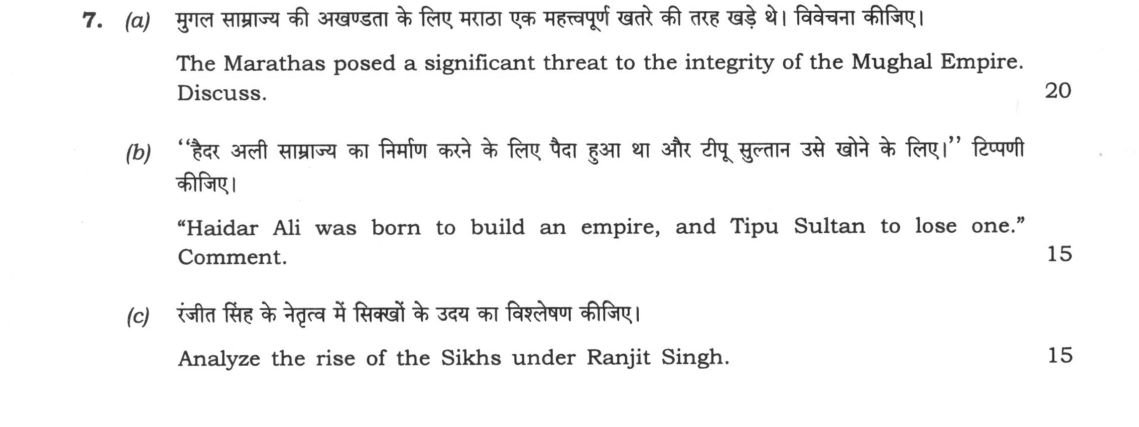
(a) The Marathas posed a significant threat to the integrity of the Mughal Empire. Discuss. (20 marks) (b) "Haidar Ali was born…
The Marathas posed a significant threat to the integrity of the Mughal Empire. Discuss. 20 marks
"Haidar Ali was born to build an empire, and Tipu Sultan to lose one." Comment. 15 marks
Analyze the rise of the Sikhs under Ranjit Singh. 15 marks
हिंदी में प्रश्न पढ़ें
मुगल साम्राज्य की अखंडता के लिए मराठा एक महत्त्वपूर्ण खतरे की तरह खड़े थे। विवेचना कीजिए। (20 अंक)
"हैदर अली साम्राज्य का निर्माण करने के लिए पैदा हुआ था और टीपू सुल्तान उसे खोने के लिए।" टिप्पणी कीजिए। (15 अंक)
रंजीत सिंह के नेतृत्व में सिक्खों के उदय का विश्लेषण कीजिए। (15 अंक)
Model answer
Written by UPSC Answer Check against this question's marking rubric, to the expected length. UPSC does not publish answers for Mains — this is one way to score well, not an official key.
Marathas and Mughal integrity The Marathas challenged Mughal sovereignty from the seventeenth century. Their raids, independent administration and claim to swarajya made the Mughal claim to universal sovereignty untenable in the Deccan. Shivaji’s execution of Afzal Khan in 1659, the plunder of Surat in 1664 and 1670, and the establishment of swarajya in 1674 demonstrated a rival political order. The Treaty of Purandar in 1665 temporarily subdued him, but his escape and subsequent conflicts showed a persistent challenge to Mughal sovereignty. Under the Peshwas, the threat became structural. The emperor’s authority became nominal in the Deccan and contested in the north. Baji Rao I’s raid on Delhi in 1737 and the defeat of Mughal forces at Bhopal in the same year exposed the emperor’s impotence. The Battle of Panipat in 1761, though a Maratha defeat, proved that their reach extended into the Gangetic Doab and north India. The Marathas also weakened the Mughal state by extracting chauth across the Deccan and beyond, while sardeshmukhi remained mainly a Deccan levy; their penetration into Malwa, Gujarat, Bundelkhand and the Doab turned Mughal provinces into tributary zones. This fiscal and military pressure coincided with Mughal nobiliary fragmentation and financial crisis after Aurangzeb, making the empire unable to defend its territorial integrity. Thus the Marathas did not merely raid Mughal territory; they reorganized its political space.
Haidar Ali and Tipu Sultan Haidar Ali, as de facto ruler of the Wodeyar kingdom of Mysore, transformed it from a subordinate Deccan kingdom into an independent and centralized state. His centralization strengthened the state and created a more disciplined command. He modernized the army with French-trained infantry and rocket artillery, strengthened administration, and expanded against the Marathas, the Nizam and the British, as in the First Anglo-Mysore War of 1767-69. Tipu Sultan continued these reforms and pursued diplomacy with Ottoman Turkey and France, initially under Louis XVI and later with Revolutionary France. His embassies sought external support against British expansion. The quotation that Haidar was born to build an empire and Tipu to lose one captures the military vulnerability of Mysore after the Fourth Anglo-Mysore War of 1799. The defeat was therefore a colonial victory, not simply personal failure. Yet it is too narrow. Tipu’s Treaty of Mangalore in 1784, his economic development and his resistance to colonial expansion show that he was not merely a loser; he defended Mysore’s independence and projected its power in the Deccan.
Rise of Ranjit Singh Ranjit Singh’s rise was based on the unification of the Sikh misls from 1799 and the capture of Lahore in the same year. Lahore became the capital, and his court combined Sikh, Hindu and Muslim officials. He established Khalsa rule while giving non-Sikhs a place in administration and the army. The Fauj-i-Khas and Fauj-i-Ain were modernized, and his secular government incorporated Hindu and Muslim nobles. The Fauj-i-Khas served as the standing core, while the Fauj-i-Ain provided regional levies. The treaty with the British in 1809 secured a stable boundary, while expansion to Peshawar in 1834 extended Sikh power into the northwest. His success lay in combining military organization, administrative pragmatism and a multi-ethnic elite. This made the state durable beyond Ranjit Singh’s personal leadership.
Conclusion All three powers exploited the decline of Mughal authority. The Marathas challenged it from within the Deccan and north India, Mysore built a modernized state on the margins, and the Sikhs created a consolidated Punjab. Their rise shows that the Mughal Empire’s disintegration was not only internal decay but also the emergence of strong regional states that redefined Indian political order. Together they show the Mughal decline as a process of regional reconstitution.
What "Discuss" is asking you to do
Lay the issue out from more than one side — how it arose, what is claimed for it, what is held against it, and where it now stands. UPSC attaches discuss to broad topics with several live dimensions, so coverage of the dimensions earns more than the strength of your opinion.
Structure that answers it
Set the issue up → the case as it is made → the case against → the dimension both sides leave out → where the balance now lies
Where marks are lost
Listing facts with no thread between them, or arguing one side throughout and calling it a discussion.
How this answer will be evaluated
Approach
Framework: Context > Thesis > Evidence > Historiography. (a) discuss: intro > 3-4 dimensions > example > balanced close | (b) comment: context > arguments both sides > judgment > close | (c) analyse: intro > causes > effects > stakeholders/linkages > way forward Full marks: Strong thesis, specific evidence, historiographical awareness, and clear analysis.
Key points expected
- Thesis on Mughal decline vs Maratha rise
- Political fragmentation of Mughal authority
- Military tactics (guerrilla) and key battles
- Economic impact (Chauth/Sardeshmukhi)
- Context of Mysore's rise under Haidar
- Haidar's diplomatic and military consolidation
- Tipu's expansionist policies and conflicts
- Judgment on the 'loss' (Third Anglo-Mysore War)
Evaluation rubric
Each sub-part is marked on its own, against the marks and word limit printed on the paper.
- (a) Argue the structural and military threat Marathas posed to Mughal integrity. 20 marks
discuss— intro → 3-4 dimensions → example → balanced close
Must cover
- Thesis on Mughal decline vs Maratha rise
- Political fragmentation of Mughal authority
- Military tactics (guerrilla) and key battles
- Economic impact (Chauth/Sardeshmukhi)
Loses marks
- Chronological narrative without analysis
- Ignoring the 'integrity' aspect of the empire
Earns more
- Reference to specific battles (Panipat, Bhopal)
- Mention of Maratha Confederacy structure
- Comparison of Mughal vs Maratha military tech
Extra mark
- Citation of specific chronicle or historian
- Map showing Maratha expansion vs Mughal core
- (b) Evaluate the contrast between Haidar's state-building and Tipu's loss. 15 marks
comment— context → arguments both sides → judgment → close
Must cover
- Context of Mysore's rise under Haidar
- Haidar's diplomatic and military consolidation
- Tipu's expansionist policies and conflicts
- Judgment on the 'loss' (Third Anglo-Mysore War)
Loses marks
- Biographical sketch without evaluating the quote
- Failing to address the 'loss' aspect
Earns more
- Analysis of Tipu's administrative reforms
- Role of the British East India Company
- Comparison of Haidar vs Tipu leadership styles
Extra mark
- Reference to specific treaty (Srirangapatna)
- Mention of Tipu's technological innovations
- (c) Examine the causes and effects of Sikh consolidation under Ranjit Singh. 15 marks
analyse— intro → causes → effects → stakeholders/linkages → way forward
Must cover
- Causes: Unification of Misl system
- Effects: Creation of Sikh Empire
- Stakeholders: Role of Dal Khalsa and nobles
- Linkages: Impact on regional power dynamics
Loses marks
- General description of Sikh history
- Ignoring the specific role of Ranjit Singh
Earns more
- Mention of key battles (Sialkot, Peshawar)
- Analysis of administrative reforms
- Comparison with Mughal or Maratha states
Extra mark
- Reference to specific administrative structure
- Mention of Ranjit Singh's diplomatic relations
Practice this exact question
Write your answer and it is marked point by point against the model answer above — what you covered, what you missed, what you got wrong.
Evaluate my answer →More from History 2023 Paper I
- Q4 (a) Analyze the tenets, spread and impact of the Bhakti Movement. (20 marks) (b) How far…
- Q5 Answer the following questions in about 150 words each: (a) Discuss the various proponent…
- Q6 (a) Discuss the role of Nur Jahan in the Mughal court politics during the reign of Jahang…
- Q7 (a) The Marathas posed a significant threat to the integrity of the Mughal Empire. Discus…
- Q8 (a) Mughal architecture was syncretic in character. Comment. (20 marks) (b) The economy o…