Paper I — Q3
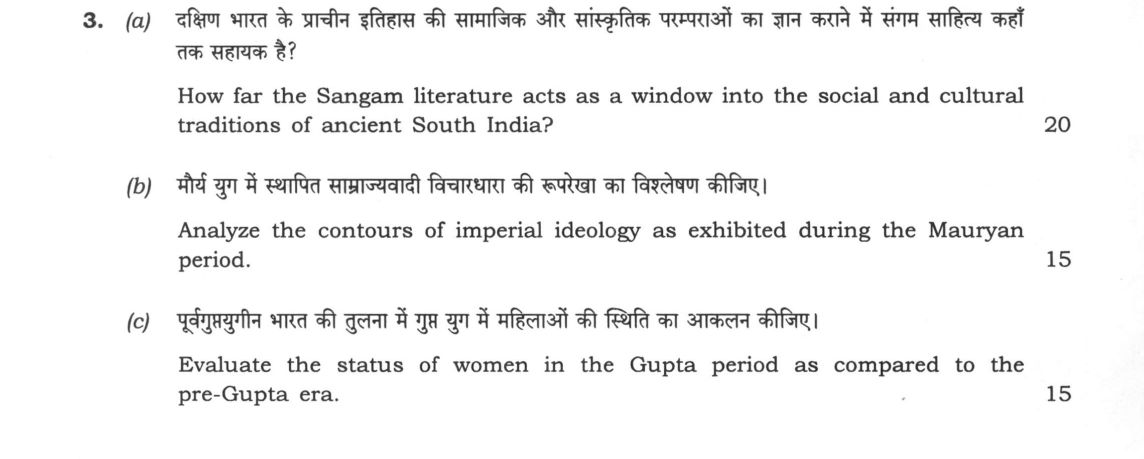
(a) How far the Sangam literature acts as a window into the social and cultural traditions of ancient South India? (20 marks) (b)…
How far the Sangam literature acts as a window into the social and cultural traditions of ancient South India? 20 marks
Analyze the contours of imperial ideology as exhibited during the Mauryan period. 15 marks
Evaluate the status of women in the Gupta period as compared to the pre-Gupta era. 15 marks
हिंदी में प्रश्न पढ़ें
दक्षिण भारत के प्राचीन इतिहास की सामाजिक और सांस्कृतिक परम्पराओं का ज्ञान करने में संगम साहित्य कहाँ तक सहायक है? (20 अंक)
मौर्य युग में स्थापित साम्राज्यवादी विचारधारा की रूपरेखा का विश्लेषण कीजिए। (15 अंक)
पूर्वगुप्तयुगीन भारत की तुलना में गुप्त युग में महिलाओं की स्थिति का आकलन कीजिए। (15 अंक)
Model answer
Written by UPSC Answer Check against this question's marking rubric, to the expected length. UPSC does not publish answers for Mains — this is one way to score well, not an official key.
Sangam literature opens a partial but valuable window onto ancient South India because it preserves social memory, not merely poetry. Its chronological layers, often associated with Puhar, Madurai and Kapatapuram, and its academies at Tinkasi, Kapatapuram and Madurai—the third at Madurai, not Puhar—correlate with megalithic burials, Arikamedu’s Roman glass and beads, and Kaveripattanam’s port remains. This links the corpus to agro-pastoral Tamilakam, maritime trade with Yavanas, and urban Chera/Pandya contexts. Yet the window is framed by bardic, priestly and elite interests. As Champakalakshmi argues, Sangam poems are a bardic tradition shaped by patronage, so the absence of subaltern voices, labouring communities, and many women is a real limitation.
Within that limitation, the social institutions are striking. Virakal or hero stones record a warrior ethos and local honour, while the poems’ five-fold terrain—mullai, kurinji, marutham, neithal and paalai—encode ecological and social roles. Tamilakam’s stratification is often described as varna-less, tied to land, cattle, trade and patronage, with merchants, fishermen and pastoralists visible. Women’s position is complex: about 30 women poets, including Avvaiyar, appear in the corpus, and women are shown as patrons, mourners and moral critics, though male bardic framing remains. The literature thus reveals a society in which ritual, trade, heroism and domesticity coexisted, but it must be read with archaeological and epigraphic caution.
Mauryan imperial ideology was not a single text but a projected order. Aśoka’s dhamma, in Major Rock Edicts and Pillar Edicts, shifted the state’s claim from digvijaya to dharma-vijaya: non-violence, respect for elders, tolerance, and welfare measures for animals and officials. This was imperial propaganda, but it also created a moral vocabulary for a multi-regional state. Visual propaganda through chakravartin symbolism reinforced universal kingship, while Kautilya’s Arthashastra supplied the counterpoint of statecraft, revenue, espionage and control. Romila Thapar’s reading of a “syndicated” Mauryan state helps explain how ideology combined coercion with consent: provincial governance through princes (kumāras) and mahāmātras, spy networks, and welfare rhetoric coexisted with coercive extraction. The Mauryan state thus projected a welfare state, but its ideological contour was ultimately the legitimation of centralized power.
Gupta women’s status requires comparison, not romantic periodisation. Pre-Gupta evidence from Satavahana and Kushan contexts shows women in inscriptions as donors, landholders and patrons, with some access to learning and public ritual. In the Gupta period, strīdhana continued as a recognized property right, and queens such as Prabhāvatīguptā and Dhruvadevī exercised political influence. Marriage practices also shifted: earlier bride-price or kanyadana norms became entangled with dowry and strīdhana, while educational access narrowed in Smṛti texts and literary representation moved from active women to regulated ideals. Yet Smṛti literature increasingly prescribed seclusion, remarriage restrictions, and moral regulation, while Devīpurāṇa injunctions and the uneven evidence for sati—some regional decline or absence, but also new ideological pressure—suggest a contested status. Kumkum Roy’s gendered critique reminds us that the “Gupta golden age” can mask a Brahmanical consolidation that redefined femininity. The verdict is therefore not simple decline: Gupta women retained elite agency and property rights, but the ideological frame became more restrictive, with regional variation and continuity from pre-Gupta practice.
Together, these cases show that ancient Indian “imperial” or “classical” periods are not uniform. They connect South Indian regionalism, Mauryan universalism, and Gupta Brahmanical consolidation: Sangam literature reveals regional, bardic and ecological particularity; Mauryan ideology universalizes dhamma through edicts and administration; Gupta texts consolidate Brahmanical norms while elite women still negotiate power. The verdict is that each period’s ‘progress’ must be judged against its own social frame. The historian’s task is to weigh the window against its frame: literature, edicts and texts are powerful, but they are also instruments of memory, rule and gendered order.
What "Evaluate" is asking you to do
Judge how well something has performed against the standard it set for itself — its stated aim, mandate or promise — and commit to a verdict. Name the yardstick before you judge; an unanchored judgement reads as opinion.
Structure that answers it
Name the yardstick — stated aim, mandate or benchmark → performance against it → shortfall against it → why the gap exists → verdict
Where marks are lost
Presenting both sides and then declining to decide, or delivering a verdict against a standard you never stated, which makes it look arbitrary.
How this answer will be evaluated
Approach
Framework: Context > Thesis > Evidence > Historiography. (a) discuss: intro > 3-4 dimensions > example > balanced close | (b) analyse: intro > causes > effects > stakeholders/linkages > way forward | (c) evaluate: criteria > evidence > balanced judgment Full marks: Argues a clear thesis, cites specific primary sources (inscriptions/texts), and engages with historiographical debates.
Key points expected
- Identify key Sangam texts (e.g., Tolkappiyam, Silappadikaram)
- Analyze social stratification and caste dynamics
- Examine cultural traditions (marriage, trade, religion)
- Critique the literature's limitations as a historical source
- Analyze the role of Arthashastra in statecraft
- Discuss the transition from conquest to Dhamma (Ashoka)
- Examine the administrative machinery (provincial governors, spies)
- Evaluate the concept of 'Chakravartin' or universal sovereignty
Evaluation rubric
Each sub-part is marked on its own, against the marks and word limit printed on the paper.
- (a) Assess Sangam literature as a source for social and cultural history of ancient South India. 20 marks
discuss— intro → 3-4 dimensions → example → balanced close
Must cover
- Identify key Sangam texts (e.g., Tolkappiyam, Silappadikaram)
- Analyze social stratification and caste dynamics
- Examine cultural traditions (marriage, trade, religion)
- Critique the literature's limitations as a historical source
Loses marks
- Treating literature as purely fictional
- Ignoring the political context of the Sangam age
- Generalizing without specific textual evidence
Earns more
- Reference to specific poems or verses
- Mention of specific social institutions (e.g., Pattini cult)
- Discussion of the three kings (Chera, Chola, Pandya)
Extra mark
- Citation of a specific modern historian (e.g., K.A. Nilakanta Sastri)
- Comparison with archaeological evidence (e.g., Arikamedu)
- (b) Examine the ideological foundations and mechanisms of Mauryan imperial power. 15 marks
analyse— intro → causes → effects → stakeholders/linkages → way forward
Must cover
- Analyze the role of Arthashastra in statecraft
- Discuss the transition from conquest to Dhamma (Ashoka)
- Examine the administrative machinery (provincial governors, spies)
- Evaluate the concept of 'Chakravartin' or universal sovereignty
Loses marks
- Focusing only on military conquest
- Ignoring the economic basis of the empire
- Confusing Mauryan ideology with later Gupta concepts
Earns more
- Reference to specific edicts (e.g., Rock Edict XIII)
- Mention of the 'Dhamma Mahamatta' role
- Discussion of the 'Mitra' (friend) vs 'Shatru' (enemy) policy
Extra mark
- Citation of a specific historian (e.g., Romila Thapar)
- Reference to the Lion Capital as a symbol of ideology
- (c) Compare the status of women in the Gupta period against the pre-Gupta era. 15 marks
evaluate— criteria → evidence → balanced judgment
Must cover
- Establish the 'pre-Gupta' baseline (e.g., Buddhist/Jain sources)
- Analyze the 'Gupta' status (e.g., Manusmriti, inscriptions)
- Evaluate the shift in legal and social rights
- Provide a balanced judgment on the 'Golden Age' narrative
Loses marks
- Presenting a purely linear decline without nuance
- Ignoring the regional variations in women's status
- Relying solely on Sanskrit literature without epigraphic evidence
Earns more
- Reference to the 'Saptapadi' marriage rite
- Mention of the 'Dattaka' (adoption) practice
- Discussion of the 'Purdah' system
Extra mark
- Citation of a specific historian (e.g., R.C. Majumdar)
- Reference to a specific inscription (e.g., Allahabad Pillar)
Practice this exact question
Write your answer and it is marked point by point against the model answer above — what you covered, what you missed, what you got wrong.
Evaluate my answer →More from History 2023 Paper I
- Q1 Identify the following places marked on the map supplied to you and write a short note of…
- Q2 (a) "The Neolithic Age represents a revolution due to significant changes that took place…
- Q3 (a) How far the Sangam literature acts as a window into the social and cultural tradition…
- Q4 (a) Analyze the tenets, spread and impact of the Bhakti Movement. (20 marks) (b) How far…
- Q5 Answer the following questions in about 150 words each: (a) Discuss the various proponent…
- Q6 (a) Discuss the role of Nur Jahan in the Mughal court politics during the reign of Jahang…