Paper I — Q4
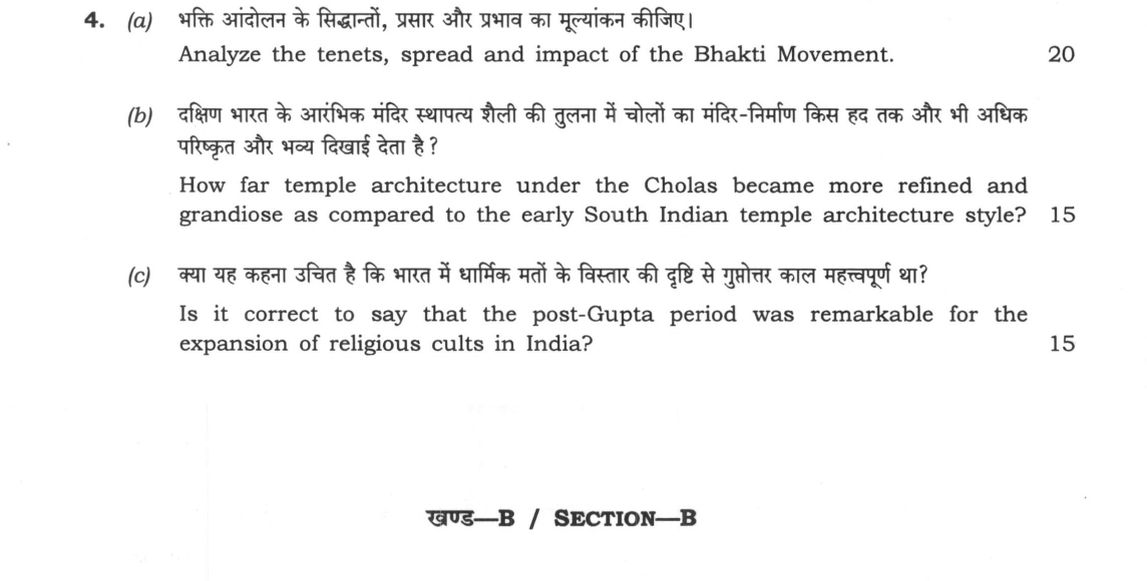
(a) Analyze the tenets, spread and impact of the Bhakti Movement. (20 marks) (b) How far temple architecture under the Cholas…
Analyze the tenets, spread and impact of the Bhakti Movement. 20 marks
How far temple architecture under the Cholas became more refined and grandiose as compared to the early South Indian temple architecture style? 15 marks
Is it correct to say that the post-Gupta period was remarkable for the expansion of religious cults in India? 15 marks
हिंदी में प्रश्न पढ़ें
भक्ति आंदोलन के सिद्धांतों, प्रसार और प्रभाव का मूल्यांकन कीजिए। (20 अंक)
दक्षिण भारत के आरंभिक मंदिर स्थापत्य शैली की तुलना में चोलों का मंदिर-निर्माण किस हद तक और भी अधिक परिष्कृत और भव्य दिखाई देता है? (15 अंक)
क्या यह कहना उचित है कि भारत में धार्मिक मतों के विस्तार की दृष्टि से गुप्तोत्तर काल महत्त्वपूर्ण था? (15 अंक)
Model answer
Written by UPSC Answer Check against this question's marking rubric, to the expected length. UPSC does not publish answers for Mains — this is one way to score well, not an official key.
The post-Gupta and early medieval eras reshaped India’s socio-religious and cultural landscape through the proliferation of regional cults, monumental temple building under dynasties like the Cholas, and the popular devotional currents of the Bhakti movement.
Tenets, Spread, and Impact of the Bhakti Movement
The Bhakti movement redefined Indian religious life by emphasizing intense, emotional, and direct personal devotion to God without priestly intermediation. Its core tenets included the rejection of rigid ritualism, caste hierarchies, and orthodox Brahmanical scriptural authority. The movement diverged into two theological strands: Nirguna (devotion to a formless absolute, articulated by Kabir and Guru Nanak) and Saguna (worship of personal, anthropomorphic deities, represented by Mirabai, Surdas, and Chaitanya). Devotional expression shifted decisively from Sanskrit to local vernacular idioms.
The spread of Bhakti followed a distinct regional trajectory. Originating in the Tamil country (6th–9th centuries CE) through the Vaishnava Alvars and Shaiva Nayanars, wandering saints popularized devotion across sacred pilgrimage networks. It expanded into Karnataka during the 12th century through Basavanna’s Virashaivism (Lingayats), entered Maharashtra via the 13th–17th-century Varkari tradition of Jnaneshwar, Namdev, and Tukaram, and culminated in the northern Indian Sant tradition. This expansion was structurally sustained by monastic centers (mathas), community gatherings (satsangs), and selective royal patronage.
Its impact was profound: it fostered social egalitarianism by incorporating outcastes and women (such as Andal and Akka Mahadevi), democratized religious discourse, and spurred the development of regional literatures (Tamil, Marathi, Bengali, and Brajbhasha). Nonetheless, the movement faced limitations: radical anti-caste stances were often co-opted into mainstream orthodox frameworks, and domestic gender hierarchies frequently persisted alongside devotional liberation.
Evolution and Grandeur of Chola Temple Architecture
Early South Indian temple traditions under the Pallavas (rock-cut rathas and structural shrines like the Shore Temple) and the Muttaraiyars laid the baseline for Dravida architecture. Under the imperial Cholas (9th–13th centuries CE), this style underwent monumental scale expansion and decorative refinement.
Chola architecture transformed the Dravida vimana into a soaring, multi-tiered pyramidal tower crowned by a heavy monolithic dome (sikhara). Rajaraja I’s Brihadeeswarar Temple at Thanjavur and Rajendra I’s temple at Gangaikondacholapuram exemplified this unprecedented monumental scale, where the vimana dominated the surrounding landscape. The Cholas introduced elaborate architectural innovations, including large pillared mandapas (ardhamandapa, mahamandapa), intricately carved dvarapalas, dedicated subsidiary shrines (parivara devatas), and increasingly prominent entrance gateways (gopurams).
Later Chola structures, notably the Airavatesvara Temple at Darasuram, transitioned from massive scale to intricate sculptural ornamentation, featuring stone chariot motifs and dynamic friezes. Imperial iconography closely linked the divinized king with the supreme deity, further mirrored in the zenith of Chola bronze casting, most famously the dynamic balance of the lost-wax Nataraja icons.
Expansion of Religious Cults in the Post-Gupta Period
It is historically accurate to view the post-Gupta period (c. 6th–12th centuries CE) as an era of marked religious proliferation and assimilation. Tantricism emerged as a pan-Indian phenomenon, deeply penetrating Saiva Siddhanta, Shakta cults (exemplified by the 64 Yogini temples), and heterodox traditions like Vajrayana Buddhism at Nalanda and Vikramashila. Jainism consolidated strongholds across Gujarat, Rajasthan, and Karnataka. Concurrently, regional folk and tribal deities were assimilated into Puranic Hinduism, creating syncretic pan-Indian cults such as Lord Jagannath at Puri and Vithoba at Pandharpur.
This expansion was driven by socio-economic transformations: extensive royal land grants (brahmadeyas and devadanas) to Brahmanas and temples integrated peripheral agrarian and tribal groups into the caste hierarchy (jati). However, this expansion was not an absolute historical rupture, but rather a qualitative evolution and institutional consolidation of the foundational Puranic synthesis established during the Gupta era.
Together, the institutionalized temple economy, royal patronage, and popular vernacular Bhakti movements reflected a dynamic medieval synthesis that balanced centralized Brahmanical authority with local, devotional expressions.
What "Analyse" is asking you to do
Break the subject into its working parts and show how they act on each other. The marks are in the interconnections — which factor drives which, and what the resulting structure explains — not in the inventory of factors.
Structure that answers it
Define the whole → separate it into its parts → show which part drives which → what that interaction produces → what the structure implies
Where marks are lost
A flat list of causes with no account of which drives which. An answer of neatly separated headings, each self-contained, scores as description.
How this answer will be evaluated
Approach
Framework: Context > Thesis > Evidence > Historiography. (a) analyse: intro > causes > effects > stakeholders/linkages > way forward | (b) compare: paired headings or table > key differences > significance > conclusion | (c) comment: context > arguments both sides > judgment > close Full marks: Thesis-driven, cites specific sources/historians, balanced analysis
Key points expected
- Define core tenets (monotheism, vernacular, anti-caste)
- Trace geographical spread (South to North India)
- Analyze social impact (caste mobility, vernacular literature)
- Cite specific saints (e.g., Kabir, Ramanuja, Basavanna)
- Identify early styles (e.g., Pallava, rock-cut)
- Detail Chola innovations (e.g., gopurams, vimana height)
- Cite specific examples (e.g., Brihadeeswara, Gangaikonda Cholapuram)
- Explain the shift to structural stone architecture
Evaluation rubric
Each sub-part is marked on its own, against the marks and word limit printed on the paper.
- (a) Analyze the tenets, spread, and impact of the Bhakti Movement. 20 marks
analyse— intro → causes → effects → stakeholders/linkages → way forward
Must cover
- Define core tenets (monotheism, vernacular, anti-caste)
- Trace geographical spread (South to North India)
- Analyze social impact (caste mobility, vernacular literature)
- Cite specific saints (e.g., Kabir, Ramanuja, Basavanna)
Loses marks
- Chronological listing of saints without analysis
- Ignoring the 'spread' or 'impact' dimensions
Earns more
- Mention specific texts (e.g., Gita Govinda, Vachanas)
- Reference regional variations (Veerashaiva vs. Vaishnava)
- Link to political patronage (e.g., Vijayanagara)
Extra mark
- Quote a specific verse from a Bhakti saint
- Name a specific historian (e.g., R.S. Sharma)
- (b) Compare Chola temple architecture with early South Indian styles. 15 marks
compare— paired headings or table → key differences → significance → conclusion
Must cover
- Identify early styles (e.g., Pallava, rock-cut)
- Detail Chola innovations (e.g., gopurams, vimana height)
- Cite specific examples (e.g., Brihadeeswara, Gangaikonda Cholapuram)
- Explain the shift to structural stone architecture
Loses marks
- Describing Chola temples without comparison to early styles
- Vague generalizations without specific temple names
Earns more
- Mention specific sculptural details (e.g., Nataraja)
- Reference specific inscriptions (e.g., Leela Perumal)
Extra mark
- Name a specific architectural historian (e.g., K.V. Ramesh)
- Include a comparative diagram of temple structures
- (c) Comment on the expansion of religious cults in the post-Gupta period. 15 marks
comment— context → arguments both sides → judgment → close
Must cover
- Define the post-Gupta period (6th-12th century)
- Identify expanding cults (e.g., Shaivism, Vaishnavism, Buddhism)
- Provide evidence of expansion (e.g., temple building, texts)
- Offer a balanced judgment on the 'remarkable' claim
Loses marks
- Narrating history without evaluating the 'remarkable' claim
- Ignoring the 'expansion' aspect (geographical or social)
Earns more
- Mention specific regional developments (e.g., Kashmir Shaivism)
- Reference specific texts (e.g., Puranas, Tantras)
Extra mark
- Name a specific historian (e.g., Romila Thapar)
- Cite a specific inscription or archaeological find
Practice this exact question
Write your answer and it is marked point by point against the model answer above — what you covered, what you missed, what you got wrong.
Evaluate my answer →More from History 2023 Paper I
- Q1 Identify the following places marked on the map supplied to you and write a short note of…
- Q2 (a) "The Neolithic Age represents a revolution due to significant changes that took place…
- Q3 (a) How far the Sangam literature acts as a window into the social and cultural tradition…
- Q4 (a) Analyze the tenets, spread and impact of the Bhakti Movement. (20 marks) (b) How far…
- Q5 Answer the following questions in about 150 words each: (a) Discuss the various proponent…
- Q6 (a) Discuss the role of Nur Jahan in the Mughal court politics during the reign of Jahang…
- Q7 (a) The Marathas posed a significant threat to the integrity of the Mughal Empire. Discus…