Paper I — Q2
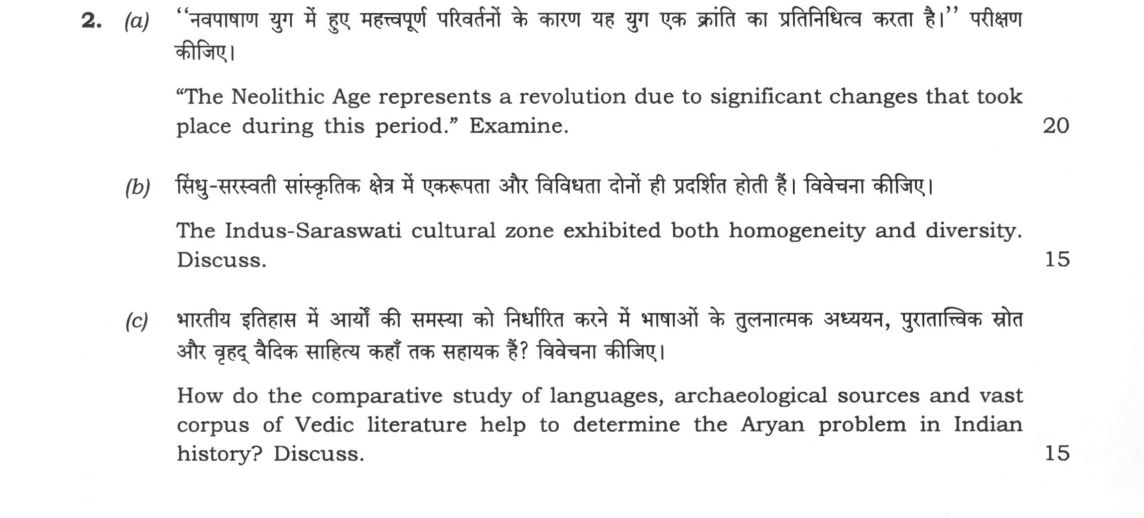
(a) "The Neolithic Age represents a revolution due to significant changes that took place during this period." Examine. (20…
"The Neolithic Age represents a revolution due to significant changes that took place during this period." Examine. 20 marks
The Indus-Saraswati cultural zone exhibited both homogeneity and diversity. Discuss. 15 marks
How do the comparative study of languages, archaeological sources and vast corpus of Vedic literature help to determine the Aryan problem in Indian history? Discuss. 15 marks
हिंदी में प्रश्न पढ़ें
"नवपाषाण युग में हुए महत्त्वपूर्ण परिवर्तनों के कारण यह युग एक क्रांति का प्रतिनिधित्व करता है।" परीक्षण कीजिए। (20 अंक)
सिंधु-सरस्वती सांस्कृतिक क्षेत्र में एकरूपता और विविधता दोनों ही प्रदर्शित होती हैं। विवेचना कीजिए। (15 अंक)
भारतीय इतिहास में आर्यों की समस्या को निर्धारित करने में भाषाओं के तुलनात्मक अध्ययन, पुरातात्विक स्रोत और बृहद् वैदिक साहित्य कहाँ तक सहायक हैं? विवेचना कीजिए। (15 अंक)
Model answer
Written by UPSC Answer Check against this question's marking rubric, to the expected length. UPSC does not publish answers for Mains — this is one way to score well, not an official key.
Early Indian history is best examined as a tripartite sequence: Neolithic, Indus-Saraswati and Vedic.
Neolithic Revolution The claim that the Neolithic Age was a revolution is valid when examined through Gordon Childe’s concept of a package of interlocking changes. In South Asia, radiocarbon dates from Mehrgarh, c. 7000 BCE, mark the transition from foraging to food production. This was not merely the use of polished stone tools; it included cultivation, domestication of sheep, goats and cattle, grinding technology, pottery and sedentary village communities. Sites in Kashmir, Bengal and South India show that this transformation was not confined to one ecological zone but produced new settlement patterns, surplus, population growth and social differentiation. By changing subsistence, settlement and social organisation, the Neolithic made repeated occupation, storage and craft specialisation possible, thereby increasing social complexity. It was therefore evolutionary in its local origins yet revolutionary in its consequences, because it created the material and demographic basis for later urban civilisation.
Indus-Saraswati Zone The Indus-Saraswati cultural zone exhibited homogeneity because it shared a recognisable urban and material culture across about 1.5 million sq km: planned grid streets, drainage systems, standardized weights, seals and a common script. These features suggest long-distance exchange, administrative coordination and a shared symbolic system. At the same time, diversity is evident in regional pottery traditions such as Sothi and Sorath, different burial practices, and ecological adaptations to riverine, arid and coastal environments. The historiographical debate between Shereen Ratnagar and Jonathan Mark Kenoyer on Harappan uniformity shows that the issue is not whether shared traits existed, but how far they extended and whether they masked local identities. Harappan stratigraphy confirms that this was a long-lived, regionally varied civilisation rather than a single rigid state.
Aryan Problem The Aryan problem is best approached by integrating languages, archaeology and Vedic texts. Comparative linguistics shows that Sanskrit has PIE roots and close Indo-Iranian connections, indicating a common ancestral language and cultural horizon. Archaeological sources provide material correlates: the OCP and Copper Hoards, generally dated to the second millennium BCE (c. 2000–1500 BCE), and the later Painted Grey Ware of the early first millennium BCE, are associated with pastoral-agricultural settlements and material culture that some scholars link to early Vedic society. The transition from OCP and Copper Hoards to PGW suggests a material and cultural shift, not a sudden replacement. The Vedic corpus, especially the Rigveda, helps by its geography of the Sapta Sindhu, references to rivers, tribes, chariots, sacrifice and polity. Philological methods, stratigraphy and radiocarbon dating together narrow the chronological range. The debate between B.B. Lal and Witzel reflects the central tension: Lal has stressed an internal, indigenous resolution, while Witzel has emphasised an external, Indo-Aryan linguistic origin. A balanced determination is that the Aryan problem is not a single invasion story but a complex process of linguistic, cultural and material change.
Conclusion Taken together, these phases show that early Indian history was evolutionary in its mechanisms but revolutionary in its outcomes. The Neolithic created food production and settled life; the Indus-Saraswati zone produced a homogeneous yet diverse urban civilisation; and the Aryan problem, when examined through language, archaeology and Vedic literature, reveals a layered transition rather than a single break. The verdict is that Indian civilisation emerged through cumulative transformations, each phase preserving continuity while generating new social and cultural forms. Thus, the three sub-questions trace a sequence: food production, urbanisation, and the linguistic-cultural formation of early Vedic India. This sequence shows that revolution in Indian history was not a single event but a long process of adaptation, integration and transformation. It also shows that sources must be read together to avoid overstatement.
What "Examine" is asking you to do
Test the proposition the question puts to you and return a finding on how far it holds. Examine stems carry a claim, or ask whether something has happened, and expect evidence weighed both ways before the extent is stated — often with remedial measures attached.
Structure that answers it
Restate the claim as the question frames it → evidence that supports it → evidence that undercuts it → the conditions under which it holds → verdict on how far it stands
Where marks are lost
Stopping at description. An examination has to reach a finding, and “examine with justification” means the extent must be stated, not implied.
How this answer will be evaluated
Approach
Framework: Context > Thesis > Evidence > Historiography. (a) examine: intro > how/why with reasoning > evidence > conclusion | (b) discuss: intro > 3-4 dimensions > example > balanced close | (c) discuss: intro > 3-4 dimensions > example > balanced close Full marks: Argues a clear thesis, integrates multiple source types, and engages with historiographical debates.
Key points expected
- Define the Neolithic Revolution (Childe's term)
- Detail the shift to sedentary agriculture and animal domestication
- Analyze the emergence of surplus and social stratification
- Explain the transition from egalitarian to hierarchical societies
- Define the Indus-Saraswati cultural zone
- Identify markers of homogeneity (standardized bricks, weights, script)
- Identify markers of diversity (regional seals, local pottery, food habits)
- Discuss the implications for the nature of the Harappan state
Evaluation rubric
Each sub-part is marked on its own, against the marks and word limit printed on the paper.
- (a) Justify the 'revolution' label by analyzing the shift from foraging to farming. 20 marks
examine— intro → how/why with reasoning → evidence → conclusion
Must cover
- Define the Neolithic Revolution (Childe's term)
- Detail the shift to sedentary agriculture and animal domestication
- Analyze the emergence of surplus and social stratification
- Explain the transition from egalitarian to hierarchical societies
Loses marks
- Narrating a timeline without causal analysis
- Ignoring the social consequences of the shift
Earns more
- Cite specific sites (Mehrgarh, Burzahom, Hallur)
- Mention the development of pottery and polished tools
- Reference the 'Neolithic package' of changes
Extra mark
- Name V. Gordon Childe
- Cite specific radiocarbon dates for Indian sites
- (b) Analyze the paradox of uniformity in planning versus diversity in material culture. 15 marks
discuss— intro → 3-4 dimensions → example → balanced close
Must cover
- Define the Indus-Saraswati cultural zone
- Identify markers of homogeneity (standardized bricks, weights, script)
- Identify markers of diversity (regional seals, local pottery, food habits)
- Discuss the implications for the nature of the Harappan state
Loses marks
- Treating homogeneity and diversity as separate topics
- Failing to link material culture to social organization
Earns more
- Mention the 'Indus script' as a unifying factor
- Reference the 'standardized' urban planning (grid systems)
- Cite specific sites (Lothal, Kalibangan, Dholavira)
Extra mark
- Name a specific seal motif (unicorn, bull)
- Reference the 'Indus civilization' vs 'Harappan' debate
- (c) Evaluate how linguistic, archaeological, and literary sources resolve the Aryan migration debate. 15 marks
discuss— intro → 3-4 dimensions → example → balanced close
Must cover
- Explain the 'Aryan problem' (migration vs. indigenous origin)
- Analyze linguistic evidence (Indo-Aryan vs. Dravidian)
- Analyze archaeological evidence (cultural continuity vs. break)
- Analyze Vedic literature (geography, genealogy, technology)
Loses marks
- Presenting one theory as absolute fact
- Ignoring the limitations of any single source type
Earns more
- Mention the 'Out of India' vs 'Out of Steppe' theories
- Reference the 'Aryan invasion' vs 'Aryan migration' debate
- Cite specific Vedic texts (Rigveda, Atharvaveda)
Extra mark
- Name a specific scholar (e.g., S.R. Rao, B.B. Lal)
- Reference specific archaeological sites (Rakhigarhi, Lothal)
Practice this exact question
Write your answer and it is marked point by point against the model answer above — what you covered, what you missed, what you got wrong.
Evaluate my answer →More from History 2023 Paper I
- Q1 Identify the following places marked on the map supplied to you and write a short note of…
- Q2 (a) "The Neolithic Age represents a revolution due to significant changes that took place…
- Q3 (a) How far the Sangam literature acts as a window into the social and cultural tradition…
- Q4 (a) Analyze the tenets, spread and impact of the Bhakti Movement. (20 marks) (b) How far…
- Q5 Answer the following questions in about 150 words each: (a) Discuss the various proponent…