Paper I — Q8
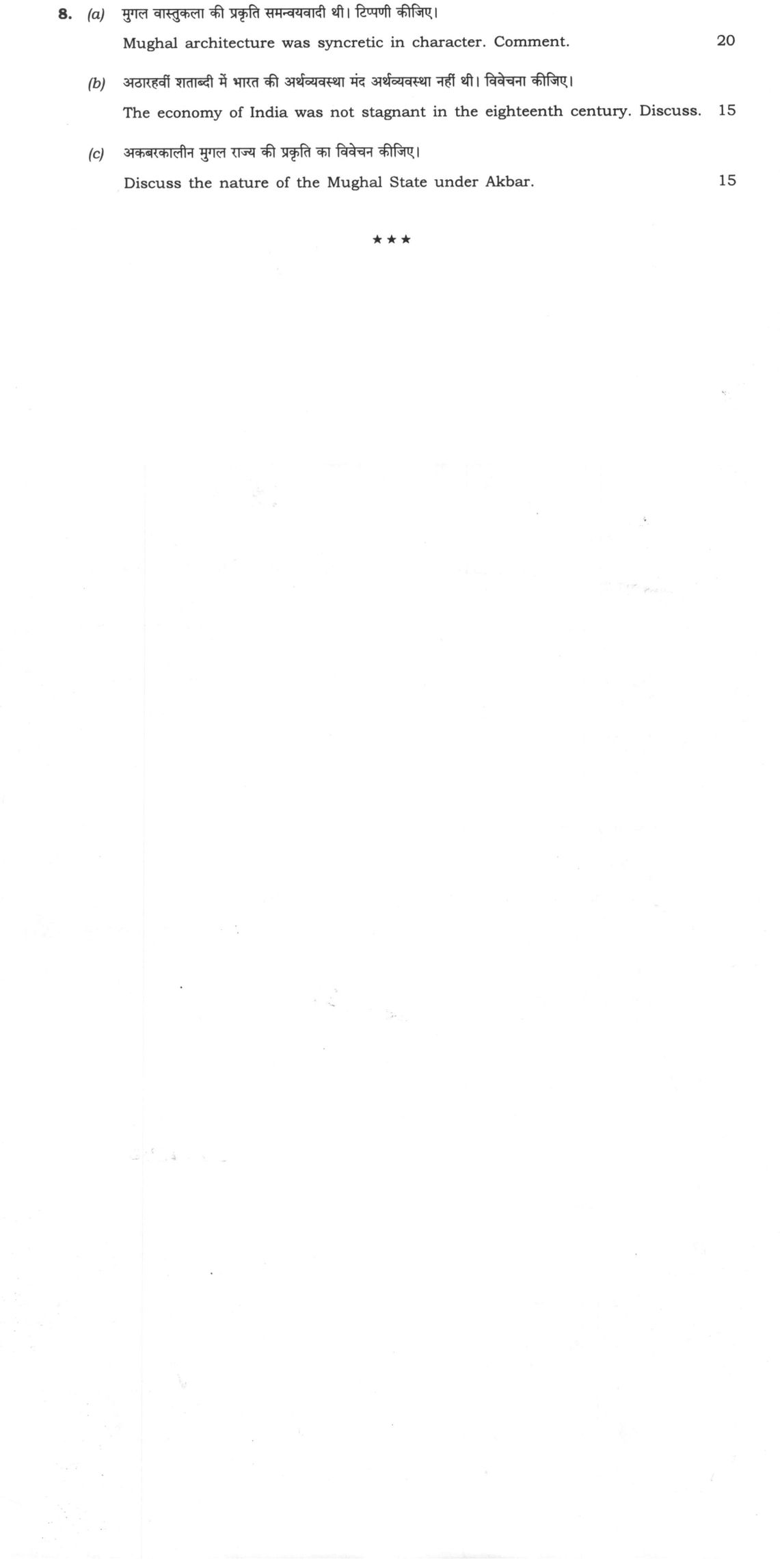
(a) Mughal architecture was syncretic in character. Comment. (20 marks) (b) The economy of India was not stagnant in the…
Mughal architecture was syncretic in character. Comment. 20 marks
The economy of India was not stagnant in the eighteenth century. Discuss. 15 marks
Discuss the nature of the Mughal State under Akbar. 15 marks
हिंदी में प्रश्न पढ़ें
मुगल वास्तुकला की प्रकृति समन्वयवादी थी। टिप्पणी कीजिए। (20 अंक)
अठारहवीं शताब्दी में भारत की अर्थव्यवस्था मंद अर्थव्यवस्था नहीं थी। विवेचना कीजिए। (15 अंक)
अकबरकालीन मुगल राज्य की प्रकृति का विवेचन कीजिए। (15 अंक)
Model answer
Written by UPSC Answer Check against this question's marking rubric, to the expected length. UPSC does not publish answers for Mains — this is one way to score well, not an official key.
Syncretic Character of Mughal Architecture
Mughal architecture was essentially an eclecticism of Persian, Timurid, Central Asian, and indigenous Indian traditions, creating an integrated imperial idiom. This syncretism began with Humayun’s Tomb, designed by the Persian architect Mirak Mirza Ghiyas, which blended Persian double domes and Charbagh layouts with traditional Indian chhatris (kiosks) and red sandstone masonry.
Under Akbar’s patronage, cross-cultural fusion matured rapidly. The buildings at Fatehpur Sikri explicitly married Islamic arcuated geometry with Hindu and Jain trabeate construction. The central carved pillar of the Diwan-i-Khas drew directly upon Gujarati and Rajasthani wooden architectural motifs, while the Buland Darwaza adapted indigenous bracket-and-lintel systems within a towering Persian pishtaq. Jahangir and Shah Jahan further institutionalized this syncretism. Shah Jahan substituted red sandstone with Makrana white marble, integrating Italianate pietra dura inlay work with bulbous Timurid domes and Hindu lotus finials (kalasa), culminating in the Taj Mahal designed by Ustad Ahmad Lahori.
Regional adaptations also shaped imperial forms. The bent-bamboo eaves of Bengal inspired the imperial 'Bangla' curved roofs at Agra and Lahore; Jahangir developed terraced water-gardens in Kashmir; and Deccan sultanate motifs were assimilated into later Mughal ornamentation. Mughal architecture thus became a visual manifesto of cultural synthesis.
Economic Vitality in the Eighteenth Century
Challenging the colonial and early nationalist characterization of the eighteenth century as an economic "Dark Age" caused by imperial fragmentation, revisionist historiography emphasizes continuity, commercialization, and regional dynamism. As argued by C.A. Bayly in Rulers, Townsmen and Bazaars and Muzaffar Alam in The Crisis of Empire in Mughal North India, the decline of the Delhi center resulted in the relocation of economic vitality to regional successor states such as Awadh, Bengal, and Hyderabad.
Agriculture expanded through intensified cash cropping, including cotton, indigo, sugarcane, and opium, supported by local well and tank irrigation. Internal and external trade flourished, backed by sophisticated mercantile credit systems centered on the hundi (bill of exchange) and managed by prominent financial houses like the Jagat Seths of Bengal. Urbanization diversified into prosperous regional qasbahs and capitals like Murshidabad, Faizabad, and Pune. Indian manufacturing, particularly artisanal textile production (calicoes, muslins, and silks), maintained a commanding trade surplus in Asian and European markets, proving that the eighteenth-century economy was structurally resilient rather than stagnant.
Nature of the Mughal State under Akbar
The Mughal polity under Akbar transitioned from an unstable conquest state into an institutionalized, composite empire. Structurally, Akbar built a centralized bureaucratic apparatus driven by the mansabdari system, checked by military regulations like dagh (horse branding) and chehra (descriptive rolls). The fiscal machinery was systematized through Raja Todar Mal’s zabt and ain-i-dahsala revenue systems, which measured land and monetized tax collection.
Ideologically, Akbar broadened the state's legitimacy beyond Islamic orthodoxy through the policy of sulh-i-kul (universal peace), the abolition of jizya and pilgrimage taxes, the incorporation of Rajput chieftains into the highest echelons of the nobility, and the promulgation of the eclectic Tauhid-i-Ilahi (Din-i-Ilahi).
Historians debate the fundamental character of this polity. Aligarh historians like Irfan Habib conceptualize the state as a highly centralized, extractive "despotism" that exercised rigorous bureaucratic control over agrarian surplus. Conversely, revisionist scholars like Muzaffar Alam and Sanjay Subrahmanyam characterize it as a system of "negotiated sovereignty," where imperial authority was continuously mediated, contested, and balanced through pragmatic compromises with local intermediaries, zamindars, and regional elites.
In sum, the Mughal experience demonstrates how administrative consolidation, architectural syncretism, and regional economic resilience intersected to build an enduring early modern imperial order.
What "Discuss" is asking you to do
Lay the issue out from more than one side — how it arose, what is claimed for it, what is held against it, and where it now stands. UPSC attaches discuss to broad topics with several live dimensions, so coverage of the dimensions earns more than the strength of your opinion.
Structure that answers it
Set the issue up → the case as it is made → the case against → the dimension both sides leave out → where the balance now lies
Where marks are lost
Listing facts with no thread between them, or arguing one side throughout and calling it a discussion.
How this answer will be evaluated
Approach
Framework: Context > Thesis > Evidence > Historiography. (a) comment: context > arguments both sides > judgment > close | (b) discuss: intro > 3-4 dimensions > example > balanced close | (c) discuss: intro > 3-4 dimensions > example > balanced close Full marks: Comprehensive analysis with specific examples, sources, and historiographical context.
Key points expected
- Define syncretism in architectural context
- Identify Persian, Central Asian, and Indian elements
- Analyze specific monuments (e.g., Taj Mahal, Humayun's Tomb)
- Provide a final judgment on the extent of syncretism
- Define the scope of 'stagnation' in economic terms
- Present evidence of economic growth or change
- Discuss specific sectors (e.g., agriculture, trade, industry)
- Provide a balanced conclusion on the economic state
Evaluation rubric
Each sub-part is marked on its own, against the marks and word limit printed on the paper.
- (a) Contextualize Mughal architecture and provide a judgment on its syncretic nature. 20 marks
comment— context → arguments both sides → judgment → close
Must cover
- Define syncretism in architectural context
- Identify Persian, Central Asian, and Indian elements
- Analyze specific monuments (e.g., Taj Mahal, Humayun's Tomb)
- Provide a final judgment on the extent of syncretism
Loses marks
- Listing monuments without analyzing their features
- Ignoring the 'syncretic' aspect of the question
- Generalizing without specific examples
Earns more
- Mention specific architectural features (e.g., chhatris, arches)
- Reference specific Mughal emperors and their styles
- Discuss the role of artisans and craftsmen
- Compare early vs. late Mughal architectural styles
Extra mark
- Cite a specific architectural treatise or source
- Name a specific historian of Mughal architecture
- (b) Examine the economic conditions of 18th-century India to refute the claim of stagnation. 15 marks
discuss— intro → 3-4 dimensions → example → balanced close
Must cover
- Define the scope of 'stagnation' in economic terms
- Present evidence of economic growth or change
- Discuss specific sectors (e.g., agriculture, trade, industry)
- Provide a balanced conclusion on the economic state
Loses marks
- Narrating political history without economic analysis
- Ignoring the 'not stagnant' aspect of the question
- Using vague terms without specific evidence
Earns more
- Mention specific economic indicators (e.g., trade volume, tax revenue)
- Reference specific regions or states (e.g., Bengal, Marathas)
- Discuss the impact of political fragmentation on the economy
- Compare with earlier or later periods
Extra mark
- Cite a specific economic historian (e.g., R.I. Templer)
- Reference a specific economic policy or event
- (c) Analyze the political, administrative, and social characteristics of the Mughal state under Akbar. 15 marks
discuss— intro → 3-4 dimensions → example → balanced close
Must cover
- Define the nature of the Mughal state under Akbar
- Discuss administrative reforms (e.g., Mansabdari, Iqta)
- Analyze religious policies (e.g., Din-i-Ilahi, Sulh-i-kul)
- Provide a conclusion on the state's overall character
Loses marks
- Focusing only on military conquests
- Ignoring the 'nature' of the state
- Generalizing without specific examples
Earns more
- Mention specific administrative divisions (e.g., Subahs, Sarkars)
- Reference specific policies or decrees
- Discuss the role of the nobility and bureaucracy
- Compare with earlier Mughal rulers
Extra mark
- Cite a specific source (e.g., Ain-i-Akbari)
- Name a specific historian of the Mughal period
Practice this exact question
Write your answer and it is marked point by point against the model answer above — what you covered, what you missed, what you got wrong.
Evaluate my answer →More from History 2023 Paper I
- Q5 Answer the following questions in about 150 words each: (a) Discuss the various proponent…
- Q6 (a) Discuss the role of Nur Jahan in the Mughal court politics during the reign of Jahang…
- Q7 (a) The Marathas posed a significant threat to the integrity of the Mughal Empire. Discus…
- Q8 (a) Mughal architecture was syncretic in character. Comment. (20 marks) (b) The economy o…