Paper II — Q1
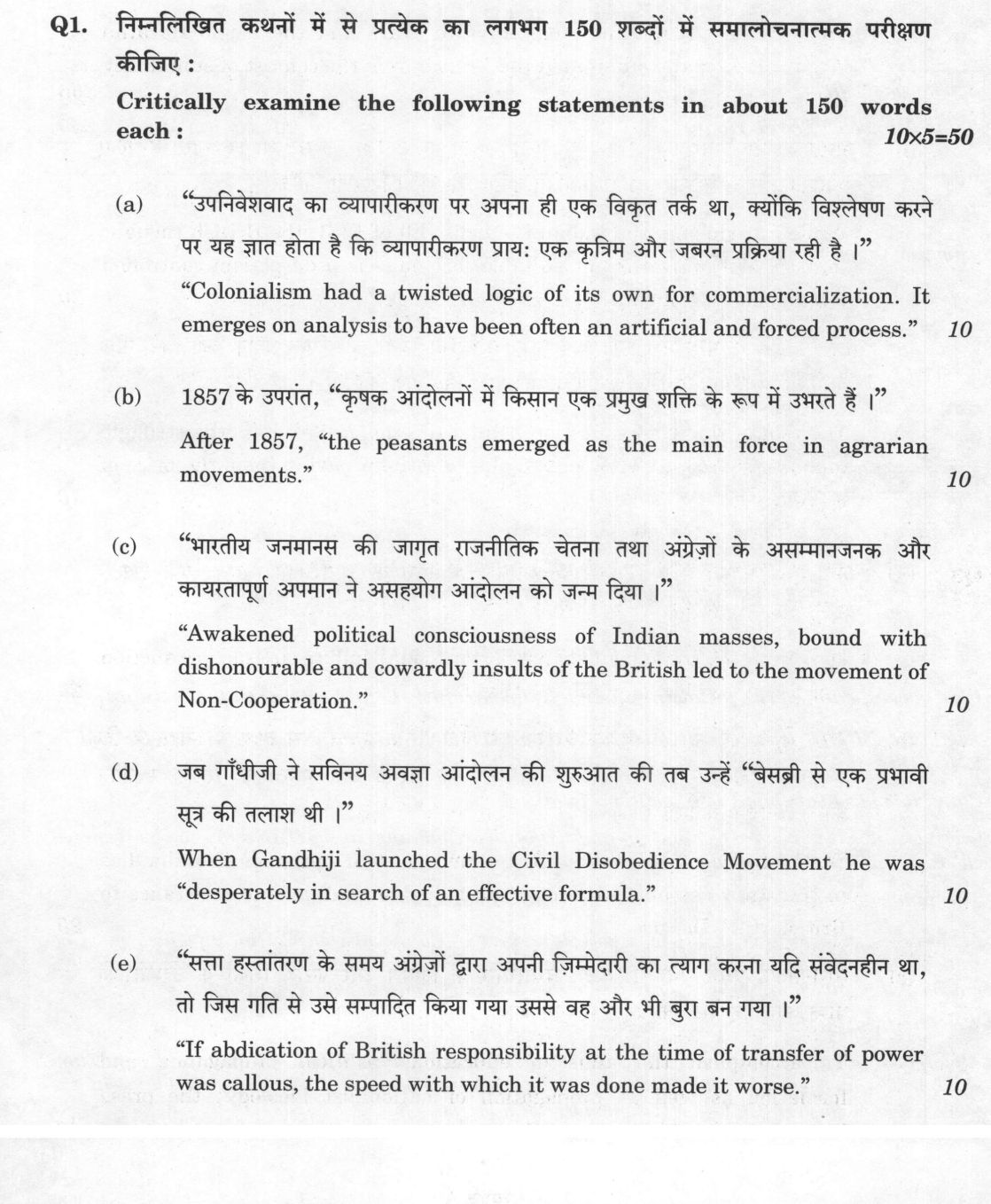
Critically examine the following statements in about 150 words each: (a) "Colonialism had a twisted logic of its own for…
Critically examine the following statements in about 150 words each:
"Colonialism had a twisted logic of its own for commercialization. It emerges on analysis to have been often an artificial and forced process." 10 marks
After 1857, "the peasants emerged as the main force in agrarian movements." 10 marks
"Awakened political consciousness of Indian masses, bound with dishonourable and cowardly insults of the British led to the movement of Non-Cooperation." 10 marks
When Gandhiji launched the Civil Disobedience Movement he was "desperately in search of an effective formula." 10 marks
"If abdication of British responsibility at the time of transfer of power was callous, the speed with which it was done made it worse." 10 marks
हिंदी में प्रश्न पढ़ें
निम्नलिखित कथनों में से प्रत्येक का लगभग 150 शब्दों में समालोचनात्मक परीक्षण कीजिए :
"उपनिवेशवाद का व्यापारीकरण पर अपना ही एक विकृत तर्क था, क्योंकि विश्लेषण करने पर यह ज्ञात होता है कि व्यापारीकरण प्रायः एक कृत्रिम और जबरन प्रक्रिया रही है।" (10 अंक)
1857 के उपरांत, "कृषक आंदोलनों में किसान एक प्रमुख शक्ति के रूप में उभरते हैं।" (10 अंक)
"भारतीय जनमानस की जागृत राजनीतिक चेतना तथा अंग्रेजों के असम्मानजनक और कायरतापूर्ण अपमान ने असहयोग आंदोलन को जन्म दिया।" (10 अंक)
जब गांधीजी ने सविनय अवज्ञा आंदोलन की शुरुआत की तब उन्हें "बेसब्री से एक प्रभावी सूत्र की तलाश थी।" (10 अंक)
"सत्ता हस्तांतरण के समय अंग्रेजों द्वारा अपनी जिम्मेदारी का त्याग करना यदि संवेदनहीन था, तो जिस गति से उसे संपादित किया गया उससे वह और भी बुरा बन गया।" (10 अंक)
Model answer
Written by UPSC Answer Check against this question's marking rubric, to the 150-word length. UPSC does not publish answers for Mains — this is one way to score well, not an official key.
(a) Colonial Commercialization of Agriculture
Colonial commercialization of Indian agriculture was fundamentally driven by the industrial needs of Britain rather than internal market dynamics. Following the deindustrialization of India and the destruction of the traditional artisanal economy, the colonial state restructured agriculture to supply raw materials—such as cotton, jute, indigo, and opium—to British industries and international markets. This process was largely artificial and coercive: high land revenue assessments demanded strictly in cash compelled peasants to cultivate market-oriented crops rather than food grains. Systems like the Tinkathia in Champaran and advances through the Dadni system bound cultivators in debt-traps to European planters. Although colonial apologists pointed to the development of railways, canal networks, and integration into global commodity markets as modernization, these infrastructural investments primarily facilitated colonial extraction. The artificiality is evident in how it precipitated widespread rural indebtedness, peasant pauperization, and recurrent famines. Thus, commercialization remained a distorted, extractive process serving metropolitan capital rather than fostering genuine agrarian capitalism.
(b) Post-1857 Agrarian Movements
The post-1857 phase marked a structural shift in agrarian resistance. Unlike the pre-1857 rebellions, which were frequently led by dispossessed rajas, taluqdars, and traditional feudal elites seeking restoration of the old order, post-1857 movements witnessed peasants emerging as the direct agents of their own struggles. The Pabna agrarian leagues in East Bengal (1873) utilized legal machinery and collective rent withholding against oppressive zamindars. Similarly, the Deccan Riots (1875) saw peasants systematically target the debt bonds of Marwari and Gujarati moneylenders. In the twentieth century, this autonomous consciousness matured through the Champaran Satyagraha (1917), Kheda (1918), and the formation of the UP Kisan Sabha (1918), Eka movement (1921), and the All India Kisan Sabha (1936). While middle-class intelligentsia and Gandhian nationalists later provided organizational mediation and linked local demands to the national freedom struggle, the agency, mobilization, and immediate leadership remained firmly rooted in the peasantry itself.
(c) Origins of the Non-Cooperation Movement
The launch of the Non-Cooperation Movement in 1920 was the culmination of wartime mass politicization colliding with British imperial intransigence. The First World War had heightened political consciousness across classes due to inflation, war taxation, and exposure to global events. However, Britain met Indian aspirations not with meaningful self-governance—the Montagu-Chelmsford Reforms proving inadequate—but with repression through the Rowlatt Act. The subsequent Jallianwala Bagh massacre (1919), accompanied by the martial law humiliations in Punjab and the Hunter Committee's whitewash, inflicted deep moral wounds. Concurrently, the British reneging on promises regarding the Ottoman Caliphate created profound alienation among Indian Muslims over the Khilafat wrongs. Mahatma Gandhi strategically fused these disparate grievances—Punjab wrongs, Khilafat, and Swaraj—into a single national programme. Thus, while imperial insults provided the emotional trigger, it was the structural readiness of an awakened mass consciousness that transformed moral outrage into India's first nationwide mass movement.
(d) Gandhi’s Search for a Formula in Civil Disobedience
Following the declaration of Purna Swaraj at the Lahore Congress (1929) and the boycott of the Simon Commission, Mahatma Gandhi faced the strategic challenge of launching a mass struggle without degenerating into premature violence, as had occurred at Chauri Chaura. The failure of the Nehru Report and Lord Irwin's evasive response left the Congress committed to direct action, yet without a clear operational modality. Gandhi's initial 11-point administrative ultimatum to Irwin represented an effort to unite disparate class interests—from industrialists to peasants. The breakthrough came with the selection of the Salt Tax as the central issue. Often perceived initially by contemporaries as an eccentric choice, the Dandi March (1930) proved to be an act of political genius. It universalized the struggle, linked elite politics to the basic survival of the poorest Indian, and provided a visible, non-violent form of civil disobedience. Rather than frantic desperation, his search reflected a deliberate, sophisticated tactical evolution.
(e) The Speed and Execution of the Transfer of Power
The British exit from India in August 1947 was characterized by an abrupt abdication of imperial responsibility, aggravated critically by its reckless speed. Under the Mountbatten Plan, the transfer of power was advanced by ten months from June 1948 to August 1947, leaving merely 72 days to partition an empire of 400 million people. This compressed timeline led to the hasty demarcation of borders by the Radcliffe Boundary Commission, whose award was withheld until after Independence Day, plunging borderlands into administrative vacuum and communal frenzy. As historians Penderel Moon in Divide and Quit and Yasmin Khan in The Great Partition demonstrate, the rapid withdrawal stripped the state of its apparatus to maintain law and order, directly causing over a million deaths, displacing fifteen million refugees, and leaving the integration of princely states volatile. The British priority was an expedient, casualty-free exit for imperial troops, reducing decolonization to a catastrophic abandonment of governance.
What "Critically examine" is asking you to do
Test the proposition the question puts to you and return a finding on how far it holds. Examine stems carry a claim, or ask whether something has happened, and expect evidence weighed both ways before the extent is stated — often with remedial measures attached. “Critically” is not a section added at the end: name the yardstick you are judging by — the evidence, the stated objective, a constitutional principle, a rival explanation — and let a verdict close each part of the body. Where the question quotes a claim, that verdict must land on the claim itself, accepted, qualified or rejected, and not on the theme in general.
Structure that answers it
Restate the claim as the question frames it → evidence that supports it → evidence that undercuts it → the conditions under which it holds → verdict on how far it stands
Where marks are lost
Merits in one paragraph, demerits in the next, and a conclusion calling for a balanced and holistic approach. That is a survey with the judgement left out and it holds the answer in the middle band. The opposite error is reading “critically” as permission to attack — and with the odd pairings, critically describe or critically explain, the exposition still carries most of the marks, the judgement being a layer on it rather than a substitute for it.
How this answer will be evaluated
Approach
Framework: Context > Thesis > Evidence > Historiography. (a) critique: the claim > its strengths > its weaknesses > your judgment | (b) critique: the claim > its strengths > its weaknesses > your judgment | (c) critique: the claim > its strengths > its weaknesses > your judgment | (d) critique: the claim > its strengths > its weaknesses > your judgment | (e) critique: the claim > its strengths > its weaknesses > your judgment Full marks: Thesis-driven, cites specific sources/historians, clear judgment on the claim.
Key points expected
- Define 'twisted logic' of colonial commercialization
- Evidence of forced monoculture (e.g., indigo, opium)
- Contrast with pre-colonial subsistence economy
- Judgment on 'artificial' nature of the process
- Context of post-1857 agrarian distress
- Examples of peasant-led movements (e.g., Moplah, Chuar)
- Role of landlords vs. peasants in these movements
- Assessment of 'main force' claim
Evaluation rubric
Each sub-part is marked on its own, against the marks and word limit printed on the paper.
- (a) Assess the validity of the claim that colonial commercialization was artificial and forced. 10 marks · 150 words
critique— the claim → its strengths → its weaknesses → your judgment
Must cover
- Define 'twisted logic' of colonial commercialization
- Evidence of forced monoculture (e.g., indigo, opium)
- Contrast with pre-colonial subsistence economy
- Judgment on 'artificial' nature of the process
Loses marks
- Generalizing without specific crop examples
- Ignoring the role of Indian merchants
Earns more
- Reference to 'drain of wealth' theory
- Mention of specific colonial acts (e.g., Permanent Settlement)
- Comparison with free market logic
Extra mark
- Citation of R.C. Dutt or Dadabhai Naoroji
- Specific statistic on trade deficit
- (b) Evaluate the assertion that peasants were the main force in agrarian movements post-1857. 10 marks · 150 words
critique— the claim → its strengths → its weaknesses → your judgment
Must cover
- Context of post-1857 agrarian distress
- Examples of peasant-led movements (e.g., Moplah, Chuar)
- Role of landlords vs. peasants in these movements
- Assessment of 'main force' claim
Loses marks
- Confusing agrarian with general nationalist movements
- Ignoring the role of the state in these movements
Earns more
- Mention of specific regions (e.g., Bengal, Kerala)
- Reference to land revenue systems
- Distinction between 'peasant' and 'landlord' interests
Extra mark
- Citation of specific movement dates
- Reference to a specific historian (e.g., Bipan Chandra)
- (c) Analyze the link between political consciousness, British insults, and the Non-Cooperation Movement. 10 marks · 150 words
critique— the claim → its strengths → its weaknesses → your judgment
Must cover
- Identify specific 'insults' (e.g., Rowlatt Act, Jallianwala)
- Explain the 'awakened political consciousness' mechanism
- Link these factors to the launch of Non-Cooperation
- Assess the causal relationship
Loses marks
- Focusing only on Gandhi without the 'masses'
- Ignoring the role of the Khilafat movement
Earns more
- Mention of Khilafat issue as a catalyst
- Reference to Gandhi's role in mobilization
- Distinction between 'insults' and structural oppression
Extra mark
- Citation of a specific British statement or act
- Reference to a specific historian's interpretation
- (d) Evaluate the claim that Gandhi was searching for an effective formula during the Civil Disobedience Movement. 10 marks · 150 words
critique— the claim → its strengths → its weaknesses → your judgment
Must cover
- Context of the failure of Non-Cooperation
- Explain the 'formula' (Salt March, Satyagraha)
- Assess the 'desperate' nature of the search
- Judgment on the effectiveness of the formula
Loses marks
- Describing the CDM without analyzing the 'search'
- Ignoring the political context of the 1930s
Earns more
- Mention of the Dandi March as the 'formula'
- Reference to the failure of the 1922 movement
- Analysis of the 'effective' aspect of the strategy
Extra mark
- Citation of Gandhi's writings on the strategy
- Reference to a specific historian's view on CDM
- (e) Assess the claim that the speed of the transfer of power made the abdication of British responsibility worse. 10 marks · 150 words
critique— the claim → its strengths → its weaknesses → your judgment
Must cover
- Define 'abdication of British responsibility'
- Explain the 'speed' of the transfer (Mountbatten Plan)
- Analyze the consequences of this speed (e.g., Partition)
- Judgment on whether speed made it 'worse'
Loses marks
- Focusing only on the violence without the 'speed' aspect
- Ignoring the role of the Indian leaders in the process
Earns more
- Mention of the Radcliffe Line
- Reference to the violence of Partition
- Comparison with the original 1947 plan
Extra mark
- Citation of a specific British official's statement
- Reference to a specific historian's view on the transfer
Practice this exact question
Write your answer and it is marked point by point against the model answer above — what you covered, what you missed, what you got wrong.
Evaluate my answer →More from History 2023 Paper II
- Q1 Critically examine the following statements in about 150 words each: (a) "Colonialism had…
- Q2 (a) The Carnatic Wars, the Anglo-Mysore Wars and the Anglo-Maratha Wars had virtually eli…
- Q3 (a) Do you agree that 'the decline of traditional Indian artisan production was a fact, s…
- Q4 (a) The universalist perspective of socio-religious reform movements was not a 'purely ph…