Paper II — Q6
(a) The philosophers and thinkers may have laid the foundation of the French Revolution, but it was precipitated by social and…
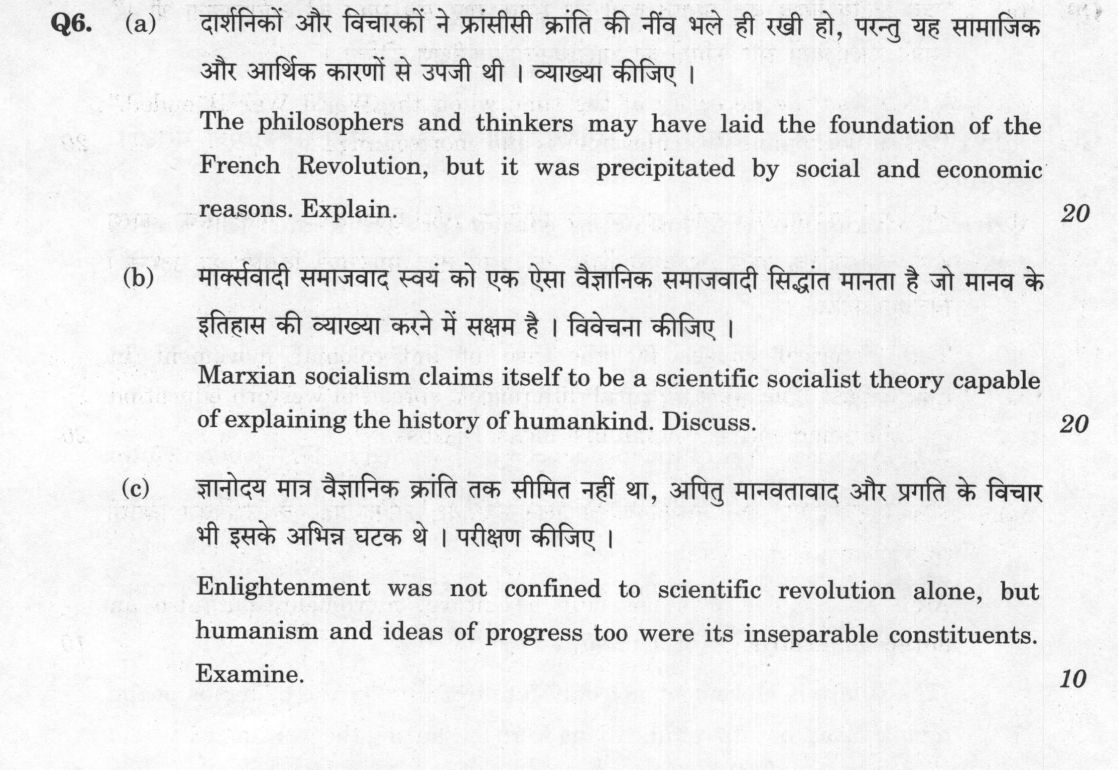
The philosophers and thinkers may have laid the foundation of the French Revolution, but it was precipitated by social and economic reasons. Explain. 20 marks
Marxian socialism claims itself to be a scientific socialist theory capable of explaining the history of humankind. Discuss. 20 marks
Enlightenment was not confined to scientific revolution alone, but humanism and ideas of progress too were its inseparable constituents. Examine. 10 marks
हिंदी में प्रश्न पढ़ें
दार्शनिकों और विचारकों ने फ्रांसीसी क्रांति की नींव भले ही रखी हो, परन्तु यह सामाजिक और आर्थिक कारणों से उपजी थी । व्याख्या कीजिए । (20 अंक)
मार्क्सवादी समाजवाद स्वयं को एक ऐसा वैज्ञानिक समाजवादी सिद्धांत मानता है जो मानव के इतिहास की व्याख्या करने में सक्षम है । विवेचना कीजिए । (20 अंक)
ज्ञानोदय मात्र वैज्ञानिक क्रांति तक सीमित नहीं था, अपितु मानवतावाद और प्रगति के विचार भी इसके अभिन्न घटक थे । परीक्षण कीजिए । (10 अंक)
Model answer
Written by UPSC Answer Check against this question's marking rubric, to the expected length. UPSC does not publish answers for Mains — this is one way to score well, not an official key.
Philosophical Foundations versus Socio-Economic Precipitants of 1789
The French Revolution was the product of Enlightenment thought converging with acute structural crises. Philosophers like Voltaire, Montesquieu, and Jean-Jacques Rousseau dismantled the ideological pillars of the Ancien Régime. Montesquieu’s separation of powers challenged absolutism, Voltaire attacked clerical privilege and intolerance, and Rousseau’s conception of popular sovereignty and the "general will" redefined political legitimacy.
However, these philosophical ideas remained theoretical until social and economic realities precipitated revolution. Eighteenth-century France was stratified into a rigid estate hierarchy where the First and Second Estates enjoyed tax exemptions, leaving the fiscal burden to the Third Estate. This structural inequity was brought to a crisis point by the severe agrarian failure of 1788–1789, which caused soaring bread prices, widespread subsistence crises, and urban bread riots. Compounding this, state bankruptcy resulting from expensive foreign entanglements, such as the American War of Independence, paralyzed the crown. When Louis XVI convened the Estates-General in 1789, the educated bourgeoisie mobilized popular distress, translating Enlightenment principles into political action through influential pamphlets such as Abbé Sieyès’ What is the Third Estate?. Philosophical ideas supplied the vocabulary of revolt, but material deprivation triggered the collapse of the monarchy.
Marxian Socialism as a Scientific Explanation of History
Karl Marx and Friedrich Engels distinguished their doctrine from the "utopian socialism" of Claude Henri de Saint-Simon, Charles Fourier, and Robert Owen, which they viewed as ungrounded moral idealism. Marxian socialism asserted a scientific status by anchoring historical development in empirical economic laws through historical materialism and dialectical materialism. Marx posited that the economic base (the mode, forces, and relations of production) conditions the political, legal, and ideological superstructure.
According to Marx, history progresses through class struggles generated by internal contradictions within successive modes of production. Under capitalism, the bourgeoisie extracts surplus value from the proletariat, leading to structural crises of overproduction, the falling rate of profit, and the progressive immiseration of labor. Marx maintained that these dynamic laws made the overthrow of capitalism and the subsequent transition to a classless communist society scientifically inevitable.
However, Marxism’s claim to scientific precision has met substantial critique. Karl Popper argued that historical materialism failed the criterion of falsifiability, as its adherents adjusted hypotheses ad hoc when predictions failed. Moreover, the theory exhibited a Eurocentric teleology that poorly explained non-Western historical trajectories. Furthermore, contrary to Marx’s predictions, proletarian revolutions did not occur in advanced industrial economies; instead, rising living standards and legal trade unions led thinkers like Eduard Bernstein to advance revisionism, favoring democratic reform over deterministic collapse.
Humanism, Progress, and the Scientific Roots of Enlightenment
The Enlightenment extended beyond the scientific revolution of Francis Bacon, Isaac Newton, and René Descartes; it was equally defined by humanism and a belief in historical progress. The scientific method provided the epistemological model, demonstrating that natural laws could be discovered through empirical reason. Enlightenment thinkers applied this rationalist methodology to society, arguing that human institutions could be systematically reformed.
Humanism anchored this project by asserting the primacy of human reason, individual autonomy, and secular well-being. Immanuel Kant captured this in his motto Sapere Aude ("Dare to know"), urging humanity to emerge from self-incurred tutelage, while Gotthold Ephraim Lessing championed religious tolerance and moral dignity. Simultaneously, Anne-Robert-Jacques Turgot and the Marquis de Condorcet, in his Sketch for a Historical Picture of the Progress of the Human Mind, conceptualized history as a linear march toward human perfectibility.
The Enlightenment functioned as an integrated paradigm where scientific empiricism supplied the analytical method, humanist ethics defined the moral ends, and the doctrine of progress provided the ultimate historical justification for social transformation.
What "Explain" is asking you to do
Make the working of something clear — what sets it off, what follows from what, and what it produces. Explain is the Commission's mechanism word: it dominates the technical papers and the “explain why” stems, where the marks sit in the causal chain and not in the label.
Structure that answers it
State what it is → the initiating condition → the chain of cause, step by step → an instance where it plays out → what the chain produces
Where marks are lost
Describing what something looks like instead of why it works that way. Naming the stages without linking them reads as description too.
How this answer will be evaluated
Approach
Framework: UPSC History Paper 2 (Modern World History). (a) explain: definition/context > points in order > small example > short close | (b) discuss: intro > 3-4 dimensions > example > balanced close | (c) examine: intro > how/why with reasoning > evidence > conclusion Full marks: Analytical, cites specific sources/historians, clear structure, addresses all parts of the prompt.
Key points expected
- Define the social structure of the Ancien Regime (Estates)
- Explain the fiscal crisis and regressive tax system
- Analyze the economic impact of the Agricultural Revolution
- Link social grievances to the political collapse of 1789
- Define 'Historical Materialism' as the core methodology
- Explain the 'Base and Superstructure' model
- Describe the 'Stages of History' (Asiatic to Communist)
- Analyze the 'Class Struggle' as the engine of change
Evaluation rubric
Each sub-part is marked on its own, against the marks and word limit printed on the paper.
- (a) Explain the social and economic causes that precipitated the French Revolution. 20 marks
explain— definition/context → points in order → small example → short close
Must cover
- Define the social structure of the Ancien Regime (Estates)
- Explain the fiscal crisis and regressive tax system
- Analyze the economic impact of the Agricultural Revolution
- Link social grievances to the political collapse of 1789
Loses marks
- Focusing primarily on the role of philosophers
- Treating the Revolution as a single event rather than a process
- Ignoring the economic context of the 1780s
Earns more
- Reference to the 'Third Estate' as the revolutionary agent
- Mention of the 'Great Fear' or specific economic shocks
- Contrast between Enlightenment ideals and material reality
- Reference to the 'Cahiers de Doléances'
Extra mark
- Citation of specific tax data (e.g., taille, gabelle)
- Reference to a specific historian (e.g., Soboul, Hobsbawm)
- (b) Discuss the claim that Marxian socialism is a scientific theory of history. 20 marks
discuss— intro → 3-4 dimensions → example → balanced close
Must cover
- Define 'Historical Materialism' as the core methodology
- Explain the 'Base and Superstructure' model
- Describe the 'Stages of History' (Asiatic to Communist)
- Analyze the 'Class Struggle' as the engine of change
Loses marks
- Confusing 'Scientific Socialism' with 'Utopian Socialism'
- Failing to explain the 'scientific' claim (laws of history)
- Treating the answer as a biography of Marx
Earns more
- Reference to 'Das Kapital' or 'Communist Manifesto'
- Mention of 'Surplus Value' or 'Alienation'
- Comparison with 'Utopian Socialism' (e.g., Owen, Saint-Simon)
- Discussion of the 'Dialectical' method
Extra mark
- Reference to a specific critique (e.g., Weber, Popper)
- Citation of a specific Marxist concept (e.g., 'Praxis')
- (c) Examine the role of humanism and progress in the Enlightenment. 10 marks
examine— intro → how/why with reasoning → evidence → conclusion
Must cover
- Define the Enlightenment beyond just 'science'
- Explain the concept of 'Humanism' (reason, individualism)
- Analyze the 'Idea of Progress' (perfectibility of man)
- Link these ideas to the rejection of traditional authority
Loses marks
- Focusing only on scientific discoveries (Newton, etc.)
- Ignoring the social/political implications of humanism
- Failing to define 'Progress' in the 18th-century context
Earns more
- Reference to 'Encyclopedists' (Diderot, d'Alembert)
- Mention of 'Salons' as centers of humanist thought
- Reference to 'Natural Rights' (Locke, Rousseau)
- Discussion of the 'Age of Reason'
Extra mark
- Reference to a specific Enlightenment text (e.g., 'Encyclopedie')
- Mention of a specific philosopher (e.g., Voltaire, Kant)
Practice this exact question
Write your answer and it is marked point by point against the model answer above — what you covered, what you missed, what you got wrong.
Evaluate my answer →More from History 2023 Paper II
- Q3 (a) Do you agree that 'the decline of traditional Indian artisan production was a fact, s…
- Q4 (a) The universalist perspective of socio-religious reform movements was not a 'purely ph…
- Q5 Critically examine the following statements in about 150 words each: (a) "The American Wa…
- Q6 (a) The philosophers and thinkers may have laid the foundation of the French Revolution,…
- Q7 (a) The impact of industrial revolution on the middle class world view is reflected in th…
- Q8 (a) "UNO was the necessity of the time when the World War II ended." Critically examine i…