Paper II — Q7
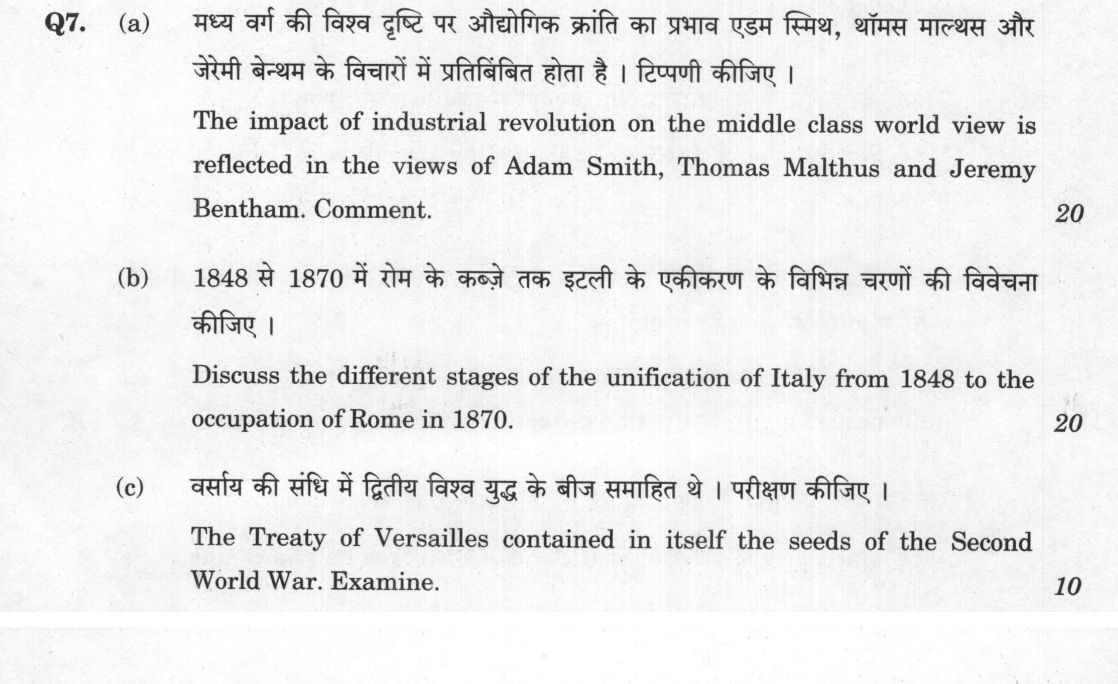
(a) The impact of industrial revolution on the middle class world view is reflected in the views of Adam Smith, Thomas Malthus…
The impact of industrial revolution on the middle class world view is reflected in the views of Adam Smith, Thomas Malthus and Jeremy Bentham. Comment. 20 marks
Discuss the different stages of the unification of Italy from 1848 to the occupation of Rome in 1870. 20 marks
The Treaty of Versailles contained in itself the seeds of the Second World War. Examine. 10 marks
हिंदी में प्रश्न पढ़ें
मध्य वर्ग की विश्व दृष्टि पर औद्योगिक क्रांति का प्रभाव एडम स्मिथ, थॉमस माल्थस और जेरेमी बेंथम के विचारों में प्रतिबिंबित होता है । टिप्पणी कीजिए । (20 अंक)
1848 से 1870 में रोम के कब्जे तक इटली के एकीकरण के विभिन्न चरणों की विवेचना कीजिए । (20 अंक)
वर्साय की संधि में द्वितीय विश्व युद्ध के बीज समाहित थे । परीक्षण कीजिए । (10 अंक)
Model answer
Written by UPSC Answer Check against this question's marking rubric, to the expected length. UPSC does not publish answers for Mains — this is one way to score well, not an official key.
The nineteenth century witnessed a dual transformation of the European order, driven economically by industrial capitalism and politically by the forces of nationalism and imperial diplomacy.
The Industrial Revolution and Bourgeois Worldview
The Industrial Revolution dismantled feudal-mercantilist structures and elevated the industrial bourgeoisie, whose socioeconomic aspirations were articulated through classical political economy and utilitarian philosophy.
Adam Smith’s The Wealth of Nations (1776) mirrored the rising middle class’s hostility toward aristocratic privileges, monopolies, and mercantilist restrictions. By conceptualizing the "invisible hand" and laissez-faire, Smith provided an optimistic justification for free-market capitalism, positing that the unfettered individual pursuit of self-interest generated universal national wealth.
Conversely, Thomas Malthus’s Essay on the Principle of Population (1798) embodied bourgeois anxieties regarding rapid urbanization and working-class reproduction outstripping the food supply. Malthus’s pessimistic scarcity thesis justified wage suppression and the reform of the Poor Laws, transforming poverty into an individual moral failing rather than a systemic flaw of industrial capitalism.
Jeremy Bentham provided the philosophical legitimation for this emerging order through Utilitarianism. His principle of "the greatest happiness of the greatest number" offered a metric of calculative rationality, championing legal and institutional reforms to protect private property, dismantle traditional encumbrances, and foster market efficiency.
While Smith was an optimist of productive expansion, Malthus a prophet of demographic limits, and Bentham an architect of institutional rationality, all three converged to articulate the class standpoint of the emerging industrial bourgeoisie, establishing market-driven individualism as the normative world order.
Stages of Italian Unification (1848–1870)
Italian unification (Risorgimento) progressed from romantic insurrection to pragmatic statecraft across five distinct stages:
The first stage arose from the 1848 revolutions. The defeat of King Charles Albert of Piedmont-Sardinia against Austria in the First Italian War of Independence exposed the inadequacy of republican insurrections and Italia farà da sé (Italy will act alone). Leadership consequently shifted to Piedmont under King Victor Emmanuel II and Count Cavour, who modernized the state and deployed realpolitik to internationalize the Italian question.
The second stage unfolded in 1859. Securing a secret military alliance with Napoleon III at Plombières, Cavour provoked Austria into war. Franco-Piedmontese victories at Magenta and Solferino liberated Lombardy, while nationalist uprisings in Tuscany, Parma, and Modena culminated in plebiscites for annexation to Piedmont.
The third stage was Garibaldi’s southern campaign in 1860. Leading the "Expedition of the Thousand," Giuseppe Garibaldi overthrew the Bourbon monarchy in the Kingdom of the Two Sicilies. Subordinating republican ideals to national unity, Garibaldi handed his conquests to Victor Emmanuel II at Teano. Following popular plebiscites, the unified Kingdom of Italy was proclaimed in March 1861.
The fourth stage occurred in 1866. Italy allied with Bismarck in the Austro-Prussian War (Third Italian War of Independence). Despite Italian defeats at Custoza and Lissa, Prussia’s decisive victory forced Austria to cede Venetia.
The final stage culminated in 1870. The outbreak of the Franco-Prussian War forced Napoleon III to withdraw the French garrison guarding the Papacy. Italian royal troops breached the Porta Pia in September 1870, annexing Rome and establishing it as the national capital.
The Treaty of Versailles and the Second World War
The Treaty of Versailles (1919) undeniably sowed structural grievances in interwar Europe. The "War Guilt" clause (Article 231), crippling reparations, territorial dismemberment (loss of Alsace-Lorraine and the Polish Corridor), and severe demilitarization engendered pervasive revanchism across Germany. The institutional weakness of the League of Nations further undermined collective security.
However, viewing Versailles as the sole determinant of the Second World War is historically reductive. The treaty was considerably more moderate than the terms Germany imposed on Russia at Brest-Litovsk (1918). While A.J.P. Taylor underscored the structural flaws of Versailles in creating an unstable balance of power, revisionist historiography demonstrates that war was not an inevitable outcome of 1919.
The catastrophic impact of the 1929 Great Depression, aggressive fascist and Nazi racial-imperialist ideologies, Japanese expansionism in Asia, and the strategic miscalculations of Anglo-French appeasement acted as the primary operational catalysts. Versailles created the psychological grievances and institutional vulnerabilities, but deliberate policy choices in the 1930s ultimately ignited the global conflagration.
The economic, nationalist, and diplomatic currents of the long nineteenth century reshaped Europe by establishing bourgeois-dominated nation-states, yet left a precarious balance of power that fractured under twentieth-century ideological and economic crises.
What "Comment" is asking you to do
Take a position on the statement and support it. Comment usually attaches to a quoted line in the short slots, so the reasoning must be compressed — an opening view, a few load-bearing reasons, and the limit of the claim.
Structure that answers it
Unpack what the statement asserts → your stance → two or three supporting reasons → the qualification that limits it
Where marks are lost
Neutral summary; a comment without a stance has not answered. Equally costly is accepting the quoted line wholesale and never testing where it fails.
How this answer will be evaluated
Approach
Framework: UPSC History Paper 2 (Modern World History). (a) comment: context > arguments both sides > judgment > close | (b) discuss: intro > 3-4 dimensions > example > balanced close | (c) examine: intro > how/why with reasoning > evidence > conclusion Full marks: Analytical, cites specific works/clauses, synthesizes thinkers/events, clear thesis.
Key points expected
- Adam Smith: Wealth of Nations, free market, division of labor
- Thomas Malthus: Population Principle, resource limits, subsistence
- Jeremy Bentham: Utilitarianism, 'greatest happiness', legal reform
- Synthesis: How these views reflect the new middle-class worldview
- 1848-1849: First phase, Cavour, Piedmont, failed revolutions
- 1859: Second phase, Franco-Sardinian War, Treaty of Zurich
- 1860-61: Third phase, Garibaldi's Expedition, plebiscites
- 1870: Final phase, Fall of Rome, unification complete
Evaluation rubric
Each sub-part is marked on its own, against the marks and word limit printed on the paper.
- (a) Contextualize Industrial Revolution's shift to middle-class worldview via Smith, Malthus, and Bentham. 20 marks
comment— context → arguments both sides → judgment → close
Must cover
- Adam Smith: Wealth of Nations, free market, division of labor
- Thomas Malthus: Population Principle, resource limits, subsistence
- Jeremy Bentham: Utilitarianism, 'greatest happiness', legal reform
- Synthesis: How these views reflect the new middle-class worldview
Loses marks
- Biographical details of the thinkers without analysis
- Treating the three thinkers as isolated rather than a worldview
- Ignoring the 'middle class' aspect of the question
Earns more
- Contrast with pre-industrial/feudal worldview
- Mention specific works (e.g., An Essay on the Principle of Population)
- Link to political economy or social contract theory
- Reference to the 'invisible hand' or 'utility' principle
Extra mark
- Cite specific quote from Wealth of Nations or Malthus
- Mention a specific historian's interpretation (e.g., Hobsbawm)
- (b) Analyze the stages of Italian unification from 1848 to the capture of Rome in 1870. 20 marks
discuss— intro → 3-4 dimensions → example → balanced close
Must cover
- 1848-1849: First phase, Cavour, Piedmont, failed revolutions
- 1859: Second phase, Franco-Sardinian War, Treaty of Zurich
- 1860-61: Third phase, Garibaldi's Expedition, plebiscites
- 1870: Final phase, Fall of Rome, unification complete
Loses marks
- Chronological list without analysis of causes/effects
- Ignoring the role of the Papal States or external powers
- Confusing the phases or dates of the wars
Earns more
- Role of Cavour (diplomacy) vs. Garibaldi (militia)
- Role of external powers (France, Austria, Prussia)
- Mention of the 'Red Shirts' or specific battles (e.g., Aspromonte)
- Reference to the 'Question of Rome' and Papal States
Extra mark
- Mention of specific dates (e.g., 20 Sept 1870 for Rome)
- Reference to a specific treaty (e.g., Plombières Treaty)
- (c) Examine how the Treaty of Versailles contained the seeds of WWII. 10 marks
examine— intro → how/why with reasoning → evidence → conclusion
Must cover
- War Guilt Clause (Article 231) and reparations
- Territorial losses and loss of colonies for Germany
- Military restrictions (Treaty of Versailles military clauses)
- Economic impact and the 'Diktat' narrative
Loses marks
- General statement about 'unfairness' without specific clauses
- Ignoring the economic or military dimensions
- Focusing on other treaties (e.g., Saint-Germain) instead of Versailles
Earns more
- Mention of the 'Stab-in-the-back' myth
- Reference to the Weimar Republic's instability
- Link to the rise of Nazism and Hitler's propaganda
- Mention of the 'Versailles System' and its failure
Extra mark
- Cite a specific article (e.g., Article 231)
- Mention a specific historian (e.g., Fischer or Keynes)
Practice this exact question
Write your answer and it is marked point by point against the model answer above — what you covered, what you missed, what you got wrong.
Evaluate my answer →More from History 2023 Paper II
- Q4 (a) The universalist perspective of socio-religious reform movements was not a 'purely ph…
- Q5 Critically examine the following statements in about 150 words each: (a) "The American Wa…
- Q6 (a) The philosophers and thinkers may have laid the foundation of the French Revolution,…
- Q7 (a) The impact of industrial revolution on the middle class world view is reflected in th…
- Q8 (a) "UNO was the necessity of the time when the World War II ended." Critically examine i…