Paper II — Q2
(a) The Carnatic Wars, the Anglo-Mysore Wars and the Anglo-Maratha Wars had virtually eliminated the French from the contest of…
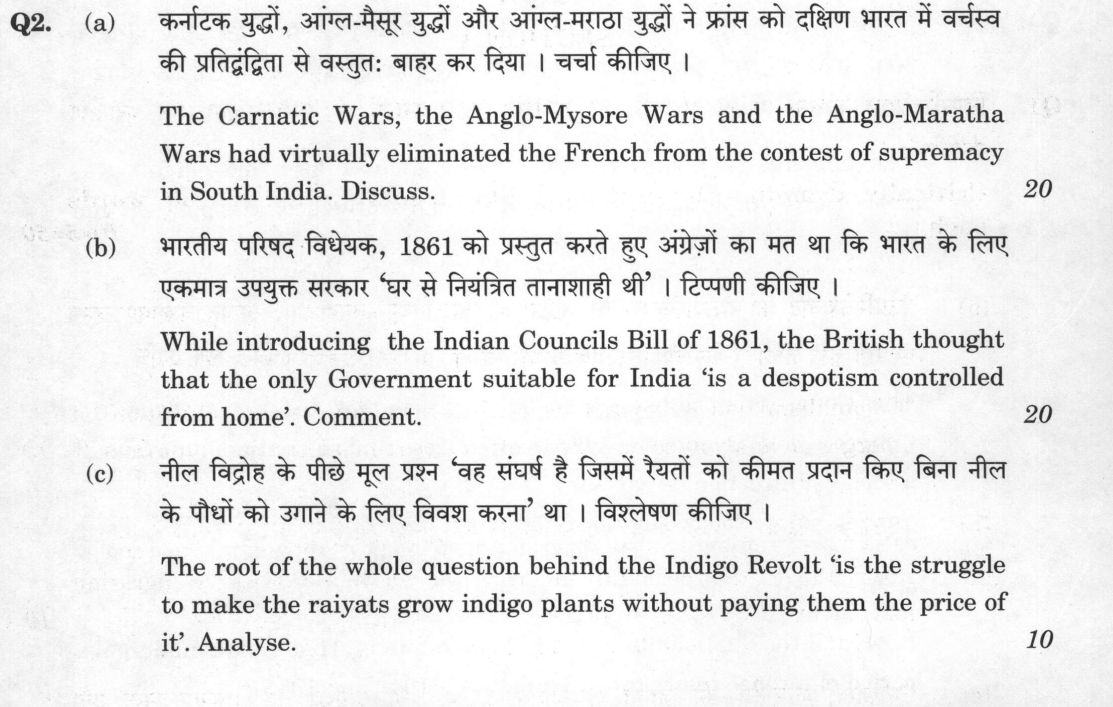
The Carnatic Wars, the Anglo-Mysore Wars and the Anglo-Maratha Wars had virtually eliminated the French from the contest of supremacy in South India. Discuss. 20 marks
While introducing the Indian Councils Bill of 1861, the British thought that the only Government suitable for India 'is a despotism controlled from home'. Comment. 20 marks
The root of the whole question behind the Indigo Revolt 'is the struggle to make the raiyats grow indigo plants without paying them the price of it'. Analyse. 10 marks
हिंदी में प्रश्न पढ़ें
कर्नाटक युद्धों, आंग्ल-मैसूर युद्धों और आंग्ल-मराठा युद्धों ने फ्रांस को दक्षिण भारत में वर्चस्व की प्रतिद्वंद्विता से वस्तुतः बाहर कर दिया । चर्चा कीजिए । (20 अंक)
भारतीय परिषद विधेयक, 1861 को प्रस्तुत करते हुए अंग्रेजों का मत था कि भारत के लिए एकमात्र उपयुक्त सरकार 'घर से नियंत्रित तानाशाही थी' । टिप्पणी कीजिए । (20 अंक)
नील विद्रोह के पीछे मूल प्रश्न 'वह संघर्ष है जिसमें रैयतों को कीमत प्रदान किए बिना नील के पौधों को उगाने के लिए विवश करना' था । विश्लेषण कीजिए । (10 अंक)
Model answer
Written by UPSC Answer Check against this question's marking rubric, to the expected length. UPSC does not publish answers for Mains — this is one way to score well, not an official key.
Carnatic, Mysore and Maratha wars. The elimination of France from the contest for supremacy in South India was not a single event but the cumulative result of three conflicts that successively removed French, Mysorean and Maratha rivals. In the Carnatic Wars (1746–63), French ambitions under Dupleix turned the Carnatic into a theatre of European rivalry. The first and second wars ended without decisive settlement, but the third war, fought against the Nawab of Carnatic and his French-backed forces, ended in French defeat. Pondicherry was surrendered as a base of independent French power; after the Treaty of Paris (1763), France was reduced to commercial enclaves and could no longer project military power in the Carnatic. The British later used subsidiary alliances with the Nizam, the Nawab of Carnatic and other rulers to keep French influence out of their courts and armies.
The Anglo-Mysore Wars (1767–99) completed the process in the south. Tipu Sultan’s alliance with France made Mysore a French client, and the British treated each war as a struggle against that combination. The first three wars, though costly, failed to destroy Mysore; the fourth war ended with the storming of Seringapatam and Tipu’s death in 1799. Mysore was divided and its independent power destroyed, removing the last organized French-backed rival in South India. The Anglo-Maratha Wars (1775–1818) then turned the same logic against the Marathas. The first two wars checked Maratha expansion, but the third war of 1817–18 ended with the defeat of the Peshwa, Baji Rao II, who was pensioned off and deposed. British paramountcy was thereby established over the Deccan and beyond, leaving no major indigenous power capable of challenging British control or sheltering French influence.
Despotism controlled from home. The phrase “a despotism controlled from home,” used while introducing the Indian Councils Bill of 1861, reflected the British parliamentary and Secretary of State view after 1857 rather than a single minister’s formula. It meant that India should be governed by a strong, centralized authority under the Crown, answerable to London, with only limited Indian participation. The Government of India Act 1858 had transferred power from the Company to the Crown, and the Indian Councils Act 1861 expanded the Governor-General’s legislative council, permitted nominated Indians, and separated legislative from executive functions. These changes were a safety valve, not genuine devolution: Indians were consulted, not responsible; the council advised, but real power remained with the Governor-General and the Secretary of State. Later reforms, such as the Morley-Minto Reforms of 1909 and the Montagu-Chelmsford Reforms of 1919, increased representation and provincial institutions, yet retained the same imperial principle of control from home.
Indigo Revolt. The root of the Indigo Revolt of 1859–60 was economic coercion. European planters compelled raiyats to grow indigo on a fixed proportion of their land—often three-twentieths, a proportion later associated with Champaran as tinkathia—while paying them far less than the market price. The system was enforced through contracts, Indian mahajans, police and courts, making cultivation a debt-bound obligation rather than a free choice. Peasant resistance was led by figures such as the Biswas brothers, and it was given literary force by Dinabandhu Mitra’s Neel Darpan. The revolt forced the government to appoint the Indigo Commission in 1860, whose recommendations brought partial regulation of indigo cultivation and a check on the worst abuses, though the planter economy survived in modified form.
Together, the wars created the military base of British supremacy, the 1861 council expressed its political logic, and the indigo revolt revealed its agrarian exploitation. The British consolidation of South India was thus a sequence of conquest, constitutional control and economic extraction, each stage making the next possible.
What "Discuss" is asking you to do
Lay the issue out from more than one side — how it arose, what is claimed for it, what is held against it, and where it now stands. UPSC attaches discuss to broad topics with several live dimensions, so coverage of the dimensions earns more than the strength of your opinion.
Structure that answers it
Set the issue up → the case as it is made → the case against → the dimension both sides leave out → where the balance now lies
Where marks are lost
Listing facts with no thread between them, or arguing one side throughout and calling it a discussion.
How this answer will be evaluated
Approach
Framework: UPSC History Paper 2. (a) discuss: intro > 3-4 dimensions > example > balanced close | (b) comment: context > arguments both sides > judgment > close | (c) analyse: intro > causes > effects > stakeholders/linkages > way forward Full marks: Thesis-driven, cites specific treaties/acts, names historians, and directly addresses the command word.
Key points expected
- Carnatic Wars: Battle of Plassey/Buxar and Treaty of Aix-la-Chapelle
- Anglo-Mysore Wars: Tipu Sultan's alliance with France
- Anglo-Maratha Wars: Maratha-French relations and British consolidation
- Conclusion: French withdrawal from the contest for supremacy
- Context: Failure of the 1853 Act and the 1857 Revolt
- Analysis of 'despotism': Centralization of power in the Governor-General
- Analysis of 'controlled from home': Role of the Viceroy and London
- Judgment: The Bill as a reaction to the 1857 uprising
Evaluation rubric
Each sub-part is marked on its own, against the marks and word limit printed on the paper.
- (a) Analyze the military and political impact of the three wars on French power in South India. 20 marks
discuss— intro → 3-4 dimensions → example → balanced close
Must cover
- Carnatic Wars: Battle of Plassey/Buxar and Treaty of Aix-la-Chapelle
- Anglo-Mysore Wars: Tipu Sultan's alliance with France
- Anglo-Maratha Wars: Maratha-French relations and British consolidation
- Conclusion: French withdrawal from the contest for supremacy
Loses marks
- Narrative retelling of battles without political analysis
- Ignoring the specific role of the Marathas in the third war
Earns more
- Mention of specific French commanders (e.g., Lally, Bussy)
- Reference to the Treaty of Paris (1763) or Treaty of Amiens
- Analysis of the shift from indirect to direct British control
Extra mark
- Citation of a specific primary source or historian (e.g., Dalrymple)
- Map showing the extent of French influence pre- and post-wars
- (b) Critique the British rationale for the 1861 Bill as a 'despotism controlled from home'. 20 marks
comment— context → arguments both sides → judgment → close
Must cover
- Context: Failure of the 1853 Act and the 1857 Revolt
- Analysis of 'despotism': Centralization of power in the Governor-General
- Analysis of 'controlled from home': Role of the Viceroy and London
- Judgment: The Bill as a reaction to the 1857 uprising
Loses marks
- Treating the Bill as a step towards democracy rather than control
- Ignoring the 'controlled from home' aspect of the quote
Earns more
- Mention of the 'Doctrine of Lapse' or specific administrative changes
- Reference to the 'Indian Councils Act' provisions on membership
- Comparison with the 1858 Government of India Act
Extra mark
- Quotation from the Bill's preamble or a contemporary British source
- Mention of specific members of the first Council (e.g., Ranade)
- (c) Explain the economic exploitation of raiyats as the root cause of the Indigo Revolt. 10 marks
analyse— intro → causes → effects → stakeholders/linkages → way forward
Must cover
- The 'Nij' and 'Raj' systems of indigo cultivation
- The 'blue bond' and forced cultivation without fair price
- The role of the indigo planters (e.g., Mahisadal)
Loses marks
- Focusing only on the violence of the revolt, not the economic cause
- Ignoring the 'without paying them the price' aspect of the quote
Earns more
- Mention of the 'Indigo Commission' or specific planters (e.g., Holman)
- Reference to the 'blue bond' as a legal instrument of coercion
Extra mark
- Mention of the 'Indigo Act' or specific court cases
- Reference to the 'Indigo Commission' report findings
Practice this exact question
Write your answer and it is marked point by point against the model answer above — what you covered, what you missed, what you got wrong.
Evaluate my answer →More from History 2023 Paper II
- Q1 Critically examine the following statements in about 150 words each: (a) "Colonialism had…
- Q2 (a) The Carnatic Wars, the Anglo-Mysore Wars and the Anglo-Maratha Wars had virtually eli…
- Q3 (a) Do you agree that 'the decline of traditional Indian artisan production was a fact, s…
- Q4 (a) The universalist perspective of socio-religious reform movements was not a 'purely ph…
- Q5 Critically examine the following statements in about 150 words each: (a) "The American Wa…