Paper II — Q5
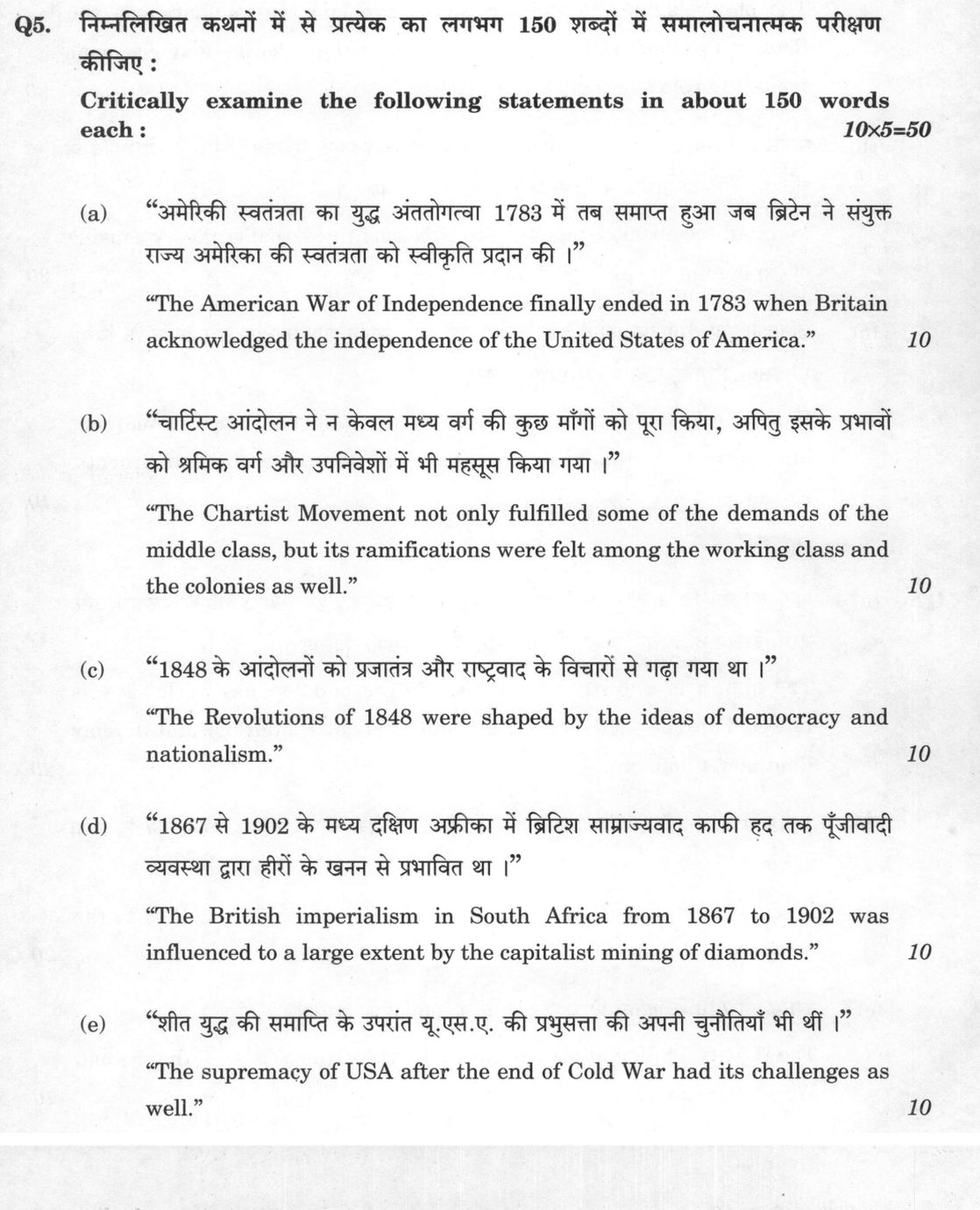
Critically examine the following statements in about 150 words each: (a) "The American War of Independence finally ended in 1783…
Critically examine the following statements in about 150 words each:
"The American War of Independence finally ended in 1783 when Britain acknowledged the independence of the United States of America." 10 marks
"The Chartist Movement not only fulfilled some of the demands of the middle class, but its ramifications were felt among the working class and the colonies as well." 10 marks
"The Revolutions of 1848 were shaped by the ideas of democracy and nationalism." 10 marks
"The British imperialism in South Africa from 1867 to 1902 was influenced to a large extent by the capitalist mining of diamonds." 10 marks
"The supremacy of USA after the end of Cold War had its challenges as well." 10 marks
हिंदी में प्रश्न पढ़ें
निम्नलिखित कथनों में से प्रत्येक का लगभग 150 शब्दों में समालोचनात्मक परीक्षण कीजिए :
"अमेरिकी स्वतंत्रता का युद्ध अंततोगत्वा 1783 में तब समाप्त हुआ जब ब्रिटेन ने संयुक्त राज्य अमेरिका की स्वतंत्रता को स्वीकृति प्रदान की।" (10 अंक)
"चार्टिस्ट आंदोलन ने न केवल मध्य वर्ग की कुछ मांगों को पूरा किया, अपितु इसके प्रभावों को श्रमिक वर्ग और उपनिवेशों में भी महसूस किया गया।" (10 अंक)
"1848 के आंदोलनों को प्रजातंत्र और राष्ट्रवाद के विचारों से गढ़ा गया था।" (10 अंक)
"1867 से 1902 के मध्य दक्षिण अफ्रीका में ब्रिटिश साम्राज्यवाद काफी हद तक पूंजीवादी व्यवस्था द्वारा हीरों के खनन से प्रभावित था।" (10 अंक)
"शीत युद्ध की समाप्ति के उपरांत यू.एस.ए. की प्रभुसत्ता की अपनी चुनौतियाँ भी थीं।" (10 अंक)
Model answer
Written by UPSC Answer Check against this question's marking rubric, to the 150-word length. UPSC does not publish answers for Mains — this is one way to score well, not an official key.
(a) American independence The statement is broadly correct but incomplete. The American War of Independence ended formally with the Treaty of Paris in 1783, when Britain recognised the United States as a sovereign republic and ended belligerency. This was a decisive legal and diplomatic conclusion. Yet the war’s ideological and cultural dimensions did not end with the treaty. The new republic remained entangled with Britain through trade, imperial rivalry and unresolved frontier issues. The Jay Treaty of 1794, which settled commercial disputes and British evacuations from the Northwest, and the War of 1812, fought over impressment, trade restrictions and western frontier conflicts, show that Anglo-American tensions persisted. Thus, 1783 closed the formal war and secured recognition, but it did not immediately produce a settled, conflict-free relationship. The statement is valid as a legal conclusion, but it understates the continuing contestation that shaped early American statehood.
(b) Chartism Chartism was fundamentally a working-class movement, so the statement’s middle-class clause needs qualification. The six points, namely universal male suffrage, secret ballot, payment of MPs, annual parliaments, equal districts and no property qualification for MPs, mixed working-class demands with reforms that also appealed to middle-class liberals, especially the secret ballot and equal districts. Yet the middle class had secured its franchise in the Reform Act of 1832, so Chartism did not chiefly fulfil middle-class demands. Later adoptions, such as the secret ballot in 1872 and payment of MPs in 1911, show partial fulfilment, not the core programme. The movement’s ramifications were working-class: the 1838 and 1842 petitions and political education strengthened class consciousness, while disappointment pushed many towards trade unionism. Its colonial reach is evident in Chartist emigration to Australia and the influence of its constitutional ideas on settler demands. The statement is partly valid: it overstates middle-class benefit but correctly identifies working-class and colonial consequences.
(c) Revolutions of 1848 The statement is valid but incomplete. The Revolutions of 1848 were shaped by liberal democracy and nationalism. In France, the February Revolution restored the Second Republic and expanded suffrage; in Germany, the Frankfurt Parliament sought a unified constitutional state; in Italy, Mazzini’s republican nationalism inspired uprisings against Austrian rule. These ideas gave them a common language of rights, popular sovereignty and self-determination. Yet ideology alone cannot explain them. Economic distress, industrial unemployment and the failure of old regimes to adapt were equally important. Marx’s critique showed that the revolutions were class struggles, in which bourgeois liberalism compromised with conservative power. The outcomes confirm this tension: France’s social republic was soon overthrown, while nationalist hopes in Germany and Italy were suppressed or postponed by the Austrian Empire and other conservative forces. Thus, democracy and nationalism were mobilising ideas, but the revolutions were also shaped by socio-economic pressures and the limits of bourgeois leadership.
(d) South African imperialism The statement is substantially correct but too narrow. Diamonds were first discovered in South Africa in 1867 near Hopetown on the Orange River, and the Kimberley diamond fields were developed later, around 1871. This mineral wealth transformed the region: capital-intensive mining, corporate consolidation and figures such as Cecil Rhodes and De Beers created powerful economic interests that pushed for British control, security and investment protection. The discovery helped justify British annexation and administrative expansion in the 1870s and 1880s. Yet diamonds alone do not explain British imperialism in South Africa. The Cape route to India, strategic competition with the Boer republics, racial ideology and imperial rivalry were also decisive. The Boer Wars of 1899–1902 show that imperialism became a contest over territory, sovereignty and empire, not merely mining profit. Thus, capitalist diamond mining was a major driver, but it operated within wider strategic and imperial motives.
(e) US supremacy The statement is valid. After the Cold War, the United States enjoyed unipolar supremacy, visible in the expansion of NATO, the ability to lead humanitarian interventions in the Balkans, and its dominance in global finance, technology and military power. This unipolar moment allowed Washington to set much of the international agenda. Yet the supremacy was challenged. The 9/11 attacks exposed vulnerabilities and triggered a prolonged war on terrorism. The Iraq War became a costly quagmire that damaged American credibility and overstretched its military. The 2008 financial crisis weakened the global economic order that the United States had led. At the same time, China’s rise and Russia’s resurgence, along with regional powers and non-state actors, eroded the assumption of permanent American dominance. Thus, post-1991 US supremacy was real but not absolute; it was constrained by terrorism, overreach, economic crisis and a shifting multipolar world.
What "Critically examine" is asking you to do
Test the proposition the question puts to you and return a finding on how far it holds. Examine stems carry a claim, or ask whether something has happened, and expect evidence weighed both ways before the extent is stated — often with remedial measures attached. “Critically” is not a section added at the end: name the yardstick you are judging by — the evidence, the stated objective, a constitutional principle, a rival explanation — and let a verdict close each part of the body. Where the question quotes a claim, that verdict must land on the claim itself, accepted, qualified or rejected, and not on the theme in general.
Structure that answers it
Restate the claim as the question frames it → evidence that supports it → evidence that undercuts it → the conditions under which it holds → verdict on how far it stands
Where marks are lost
Merits in one paragraph, demerits in the next, and a conclusion calling for a balanced and holistic approach. That is a survey with the judgement left out and it holds the answer in the middle band. The opposite error is reading “critically” as permission to attack — and with the odd pairings, critically describe or critically explain, the exposition still carries most of the marks, the judgement being a layer on it rather than a substitute for it.
How this answer will be evaluated
Approach
Framework: Context > Thesis > Evidence > Historiography. (a) critique: the claim > its strengths > its weaknesses > your judgment | (b) critique: the claim > its strengths > its weaknesses > your judgment | (c) critique: the claim > its strengths > its weaknesses > your judgment | (d) critique: the claim > its strengths > its weaknesses > your judgment | (e) critique: the claim > its strengths > its weaknesses > your judgment Full marks: Thesis-driven, cites specific sources/historians, nuanced critique of the statement.
Key points expected
- Mention the Treaty of Paris (1783)
- Identify the key signatories (Britain, US, France, Spain)
- Note the exclusion of Native American interests
- Critique the 'finality' of the 1783 date
- List the 'People's Charter' demands
- Analyze the 'Six Points' of the Charter
- Assess the impact on the working class
- Discuss the influence on colonial movements
Evaluation rubric
Each sub-part is marked on its own, against the marks and word limit printed on the paper.
- (a) Assess the validity of the 1783 Treaty of Paris as the definitive end of the war. 10 marks · 150 words
critique— the claim → its strengths → its weaknesses → your judgment
Must cover
- Mention the Treaty of Paris (1783)
- Identify the key signatories (Britain, US, France, Spain)
- Note the exclusion of Native American interests
- Critique the 'finality' of the 1783 date
Loses marks
- Narrative retelling of the war without analysis
- Ignoring the role of France or Spain
Earns more
- Reference to the Battle of Yorktown (1781)
- Mention of the Jay Treaty (1794)
- Discussion of the Northwest Indian War
Extra mark
- Citation of a specific primary source document
- Reference to a specific historian's interpretation
- (b) Evaluate the Chartist Movement's impact on the middle class, working class, and colonies. 10 marks · 150 words
critique— the claim → its strengths → its weaknesses → your judgment
Must cover
- List the 'People's Charter' demands
- Analyze the 'Six Points' of the Charter
- Assess the impact on the working class
- Discuss the influence on colonial movements
Loses marks
- Treating the movement as a single, monolithic entity
- Ignoring the role of the middle class
Earns more
- Mention of the 1832 Reform Act
- Reference to the 1867 Reform Act
- Discussion of the 'New Model Unionism'
Extra mark
- Citation of a specific Chartist pamphlet
- Reference to a specific historian's interpretation
- (c) Examine the role of democracy and nationalism in the 1848 Revolutions. 10 marks · 150 words
critique— the claim → its strengths → its weaknesses → your judgment
Must cover
- Identify the key ideas of democracy
- Identify the key ideas of nationalism
- Analyze the impact of these ideas on the revolutions
- Assess the success or failure of the revolutions
Loses marks
- Ignoring the role of the working class
- Treating the revolutions as a single, monolithic event
Earns more
- Mention of the 'Springtime of Nations'
- Reference to the 'Young Italy' movement
- Discussion of the 'June Days' uprising
Extra mark
- Citation of a specific primary source document
- Reference to a specific historian's interpretation
- (d) Assess the influence of diamond mining on British imperialism in South Africa (1867-1902). 10 marks · 150 words
critique— the claim → its strengths → its weaknesses → your judgment
Must cover
- Mention the discovery of diamonds in 1867
- Analyze the impact of diamond mining on the economy
- Assess the role of the British government
- Discuss the impact on the local population
Loses marks
- Ignoring the role of the Boers
- Treating the mining industry as a single, monolithic entity
Earns more
- Mention of the 'Diamond Rush'
- Reference to the 'Boer War'
- Discussion of the 'Miners' Charter'
Extra mark
- Citation of a specific primary source document
- Reference to a specific historian's interpretation
- (e) Evaluate the challenges to US supremacy after the Cold War. 10 marks · 150 words
critique— the claim → its strengths → its weaknesses → your judgment
Must cover
- Identify the key challenges to US supremacy
- Analyze the impact of these challenges
- Assess the US response to these challenges
- Discuss the long-term implications
Loses marks
- Ignoring the role of other major powers
- Treating the challenges as a single, monolithic entity
Earns more
- Mention of the 'War on Terror'
- Reference to the 'Global Financial Crisis'
- Discussion of the 'Rise of China'
Extra mark
- Citation of a specific primary source document
- Reference to a specific historian's interpretation
Practice this exact question
Write your answer and it is marked point by point against the model answer above — what you covered, what you missed, what you got wrong.
Evaluate my answer →More from History 2023 Paper II
- Q2 (a) The Carnatic Wars, the Anglo-Mysore Wars and the Anglo-Maratha Wars had virtually eli…
- Q3 (a) Do you agree that 'the decline of traditional Indian artisan production was a fact, s…
- Q4 (a) The universalist perspective of socio-religious reform movements was not a 'purely ph…
- Q5 Critically examine the following statements in about 150 words each: (a) "The American Wa…
- Q6 (a) The philosophers and thinkers may have laid the foundation of the French Revolution,…
- Q7 (a) The impact of industrial revolution on the middle class world view is reflected in th…
- Q8 (a) "UNO was the necessity of the time when the World War II ended." Critically examine i…