Paper II — Q3
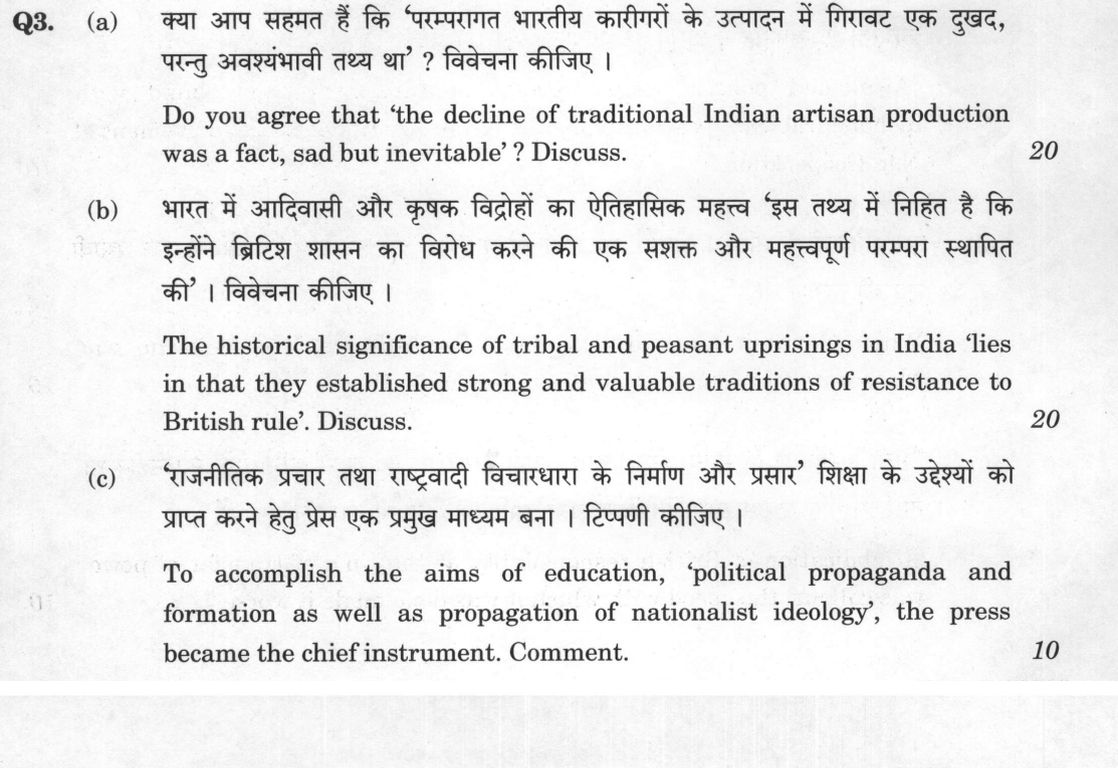
(a) Do you agree that 'the decline of traditional Indian artisan production was a fact, sad but inevitable'? Discuss. (20…
Do you agree that 'the decline of traditional Indian artisan production was a fact, sad but inevitable'? Discuss. 20 marks
The historical significance of tribal and peasant uprisings in India 'lies in that they established strong and valuable traditions of resistance to British rule'. Discuss. 20 marks
To accomplish the aims of education, 'political propaganda and formation as well as propagation of nationalist ideology', the press became the chief instrument. Comment. 10 marks
हिंदी में प्रश्न पढ़ें
क्या आप सहमत हैं कि 'परंपरागत भारतीय कारीगरों के उत्पादन में गिरावट एक दुःखद, परंतु अवश्यंभावी तथ्य था' ? विवेचना कीजिए । (20 अंक)
भारत में आदिवासी और कृषक विद्रोहों का ऐतिहासिक महत्व 'इस तथ्य में निहित है कि इन्होंने ब्रिटिश शासन का विरोध करने की एक सशक्त और महत्त्वपूर्ण परंपरा स्थापित की' । विवेचना कीजिए । (20 अंक)
'राजनीतिक प्रचार तथा राष्ट्रवादी विचारधारा के निर्माण और प्रसार' शिक्षा के उद्देश्यों को प्राप्त करने हेतु प्रेस एक प्रमुख माध्यम बना । टिप्पणी कीजिए । (10 अंक)
Model answer
Written by UPSC Answer Check against this question's marking rubric, to the expected length. UPSC does not publish answers for Mains — this is one way to score well, not an official key.
Colonial rule simultaneously restructured India’s economy through deindustrialization and generated multi-layered resistance, moving from localized subaltern rebellions to an institutionalized national public sphere.
Decline of Artisan Production: Inevitability vs. Colonial Policy
Nationalist historians like R.C. Dutt and D.R. Gadgil established the deindustrialization thesis, arguing that the collapse of artisanal manufacturing—evident in the ruin of urban textile hubs like Dacca, Surat, and Murshidabad, and metal crafts like Bidri and Tanjore bronze—was engineered by deliberate colonial interventions. These included one-way free trade, discriminatory tariff policies, preferential railway freight structures that favored raw material exports and imported British goods, and the abrupt loss of courtly patronage.
Conversely, revisionist scholars such as Morris D. Morris and Clingingsmith argue that this decline was an inevitable structural consequence of global technological transformation and market integration, where cheaper, machine-made Lancashire textiles naturally outcompeted manual production.
However, presenting this decline as merely "sad but inevitable" masks colonial distortion. Unlike Western Europe, where artisanal displaced labor was absorbed by domestic modern industries, India witnessed forced peasantization and de-urbanization. While artisans displayed resilience through subcontracting, utilizing cheap mill yarn in niche handloom varieties, and spatial migration, their systemic ruin was not an inevitable economic law, but the direct outcome of an asymmetric colonial political economy.
Tribal and Peasant Uprisings: Traditions of Resistance
Subaltern resistance systematically challenged the colonial-feudal nexus across the nineteenth century. Pre-1857 uprisings—such as the Kol insurrection (1831–32) and the Santhal Hool (1855–56) led by Sidhu and Kanhu—and post-1857 movements like Birsa Munda’s Ulgulan (1899–1900), alongside Bhil and Gond disturbances, contested the alien legal-administrative order (dikus), forest enclosures, and rack-renting.
Historiographically, these movements combined restorative, millenarian consciousness with embryonic anti-imperialism. Ranajit Guha’s Elementary Aspects of Peasant Insurgency demonstrates that subaltern defiance was not spontaneous or irrational; rather, it relied on autonomous codes of inversion, solidarity, and targeted violence. Shahid Amin’s analysis of peasant consciousness further highlights how subaltern classes selectively adapted ideological symbols to mount structural opposition.
These rebellions established durable operational repertoires—including social banditry, selective attacks on usurers' records, and forest satyagrahas. While early revolts remained geographically fragmented, their militant traditions created experiential templates and mobilization channels that later seamlessly converged with the broader Gandhian mass movements.
The Press as Chief Nationalist Instrument
The nationalist press functioned as an educational institution and the foremost medium of anti-colonial political socialization. Operating within what Benedict Anderson conceptualized as "print capitalism," vernacular and English newspapers—such as Tilak’s Kesari and Mahratta, Surendranath Banerjea’s The Bengalee, Kasturi Ranga Iyengar’s The Hindu, Dayal Singh Majithia’s The Tribune, G.K. Gokhale’s The Hitavada, and Annie Besant’s *New India*—unified disparate regional concerns into a coherent national public sphere.
Despite draconian legislative fetters, notably Lytton’s Vernacular Press Act (1878) and the Indian Press Act (1910), the press carried out ideological education by popularizing the drain of wealth theory, critiquing famine relief policies, and reporting agrarian grievances. By aligning print media with public mobilizations—such as Tilak's popularization of the Ganapati and Shivaji festivals—the press transcended formal literacy barriers, emerging as the decisive ideological vanguard of the Indian national movement.
Together, the economic dispossession of artisans and agrarian communities created the material basis of discontent, subaltern uprisings provided the legacy of militant struggle, and the nationalist press supplied the ideological coherence necessary to challenge colonial hegemony.
What "Discuss" is asking you to do
Lay the issue out from more than one side — how it arose, what is claimed for it, what is held against it, and where it now stands. UPSC attaches discuss to broad topics with several live dimensions, so coverage of the dimensions earns more than the strength of your opinion.
Structure that answers it
Set the issue up → the case as it is made → the case against → the dimension both sides leave out → where the balance now lies
Where marks are lost
Listing facts with no thread between them, or arguing one side throughout and calling it a discussion.
How this answer will be evaluated
Approach
Framework: Context > Thesis > Evidence > Historiography. (a) discuss: intro > 3-4 dimensions > example > balanced close | (b) discuss: intro > 3-4 dimensions > example > balanced close | (c) comment: context > arguments both sides > judgment > close Full marks: Argues a clear thesis, cites specific sources/historians, and provides a balanced, analytical conclusion.
Key points expected
- Identify specific industries (e.g., textiles, iron) affected
- Explain the mechanism of deindustrialization (tariffs, machine-made imports)
- Address the 'inevitable' aspect (technological gap vs. colonial policy)
- Provide a balanced conclusion on the 'sad but inevitable' claim
- Define the scope of 'tribal and peasant uprisings' (e.g., Santhal, Moplah)
- Explain the 'tradition of resistance' (inspiration for later movements)
- Provide specific examples of uprisings and their outcomes
- Link these uprisings to the broader nationalist movement
Evaluation rubric
Each sub-part is marked on its own, against the marks and word limit printed on the paper.
- (a) Evaluate the inevitability of the decline of traditional artisan production under colonialism. 20 marks
discuss— intro → 3-4 dimensions → example → balanced close
Must cover
- Identify specific industries (e.g., textiles, iron) affected
- Explain the mechanism of deindustrialization (tariffs, machine-made imports)
- Address the 'inevitable' aspect (technological gap vs. colonial policy)
- Provide a balanced conclusion on the 'sad but inevitable' claim
Loses marks
- Generalizing without naming specific industries
- Ignoring the 'inevitable' aspect of the prompt
- Narrating history without analytical argument
Earns more
- Reference to specific trade data or import statistics
- Mention of specific artisan groups (e.g., weavers, potters)
- Discussion of the 'drain of wealth' concept
- Comparison with pre-colonial artisan status
Extra mark
- Citation of a specific historian (e.g., R.I. Moore, Tirthankar Roy)
- Reference to a specific primary source or report
- (b) Analyze how tribal and peasant uprisings created a tradition of resistance to British rule. 20 marks
discuss— intro → 3-4 dimensions → example → balanced close
Must cover
- Define the scope of 'tribal and peasant uprisings' (e.g., Santhal, Moplah)
- Explain the 'tradition of resistance' (inspiration for later movements)
- Provide specific examples of uprisings and their outcomes
- Link these uprisings to the broader nationalist movement
Loses marks
- Listing uprisings without analyzing their significance
- Ignoring the 'tradition of resistance' aspect
- Failing to link to the broader nationalist movement
Earns more
- Mention of specific leaders (e.g., Sidhu Kanhu, Mangal Pandey)
- Discussion of the 'rebel' image in colonial historiography
- Reference to the impact on British administrative policies
- Comparison with the 1857 revolt
Extra mark
- Citation of a specific historian (e.g., Sumit Sarkar, Bipan Chandra)
- Reference to a specific primary source or document
- (c) Comment on the role of the press in political propaganda and nationalist ideology. 10 marks
comment— context → arguments both sides → judgment → close
Must cover
- Explain the press as a tool for political propaganda
- Discuss the formation of nationalist ideology through the press
- Provide examples of specific newspapers or publications
- Assess the impact of the press on public opinion
Loses marks
- Generalizing without naming specific newspapers
- Ignoring the 'nationalist ideology' aspect
- Failing to assess the impact on public opinion
Earns more
- Mention of specific newspapers (e.g., The Hindu, Kesari)
- Discussion of the Vernacular Press Act
- Reference to specific journalists (e.g., Bal Gangadhar Tilak)
- Comparison with other mediums of propaganda
Extra mark
- Citation of a specific historian (e.g., Ranajit Guha)
- Reference to a specific primary source or article
Practice this exact question
Write your answer and it is marked point by point against the model answer above — what you covered, what you missed, what you got wrong.
Evaluate my answer →More from History 2023 Paper II
- Q1 Critically examine the following statements in about 150 words each: (a) "Colonialism had…
- Q2 (a) The Carnatic Wars, the Anglo-Mysore Wars and the Anglo-Maratha Wars had virtually eli…
- Q3 (a) Do you agree that 'the decline of traditional Indian artisan production was a fact, s…
- Q4 (a) The universalist perspective of socio-religious reform movements was not a 'purely ph…
- Q5 Critically examine the following statements in about 150 words each: (a) "The American Wa…
- Q6 (a) The philosophers and thinkers may have laid the foundation of the French Revolution,…