Paper II — Q8
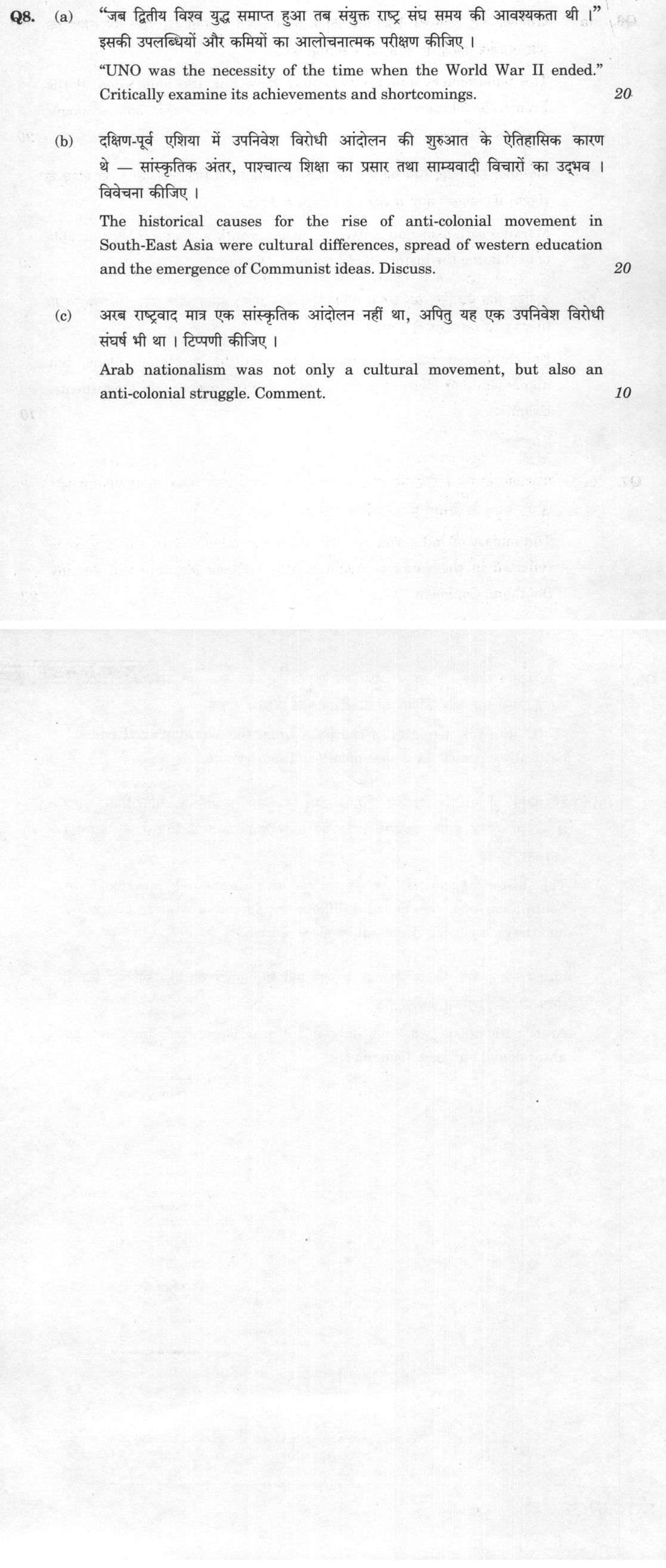
(a) "UNO was the necessity of the time when the World War II ended." Critically examine its achievements and shortcomings. (20…
"UNO was the necessity of the time when the World War II ended." Critically examine its achievements and shortcomings. 20 marks
The historical causes for the rise of anti-colonial movement in South-East Asia were cultural differences, spread of western education and the emergence of Communist ideas. Discuss. 20 marks
Arab nationalism was not only a cultural movement, but also an anti-colonial struggle. Comment. 10 marks
हिंदी में प्रश्न पढ़ें
"जब द्वितीय विश्व युद्ध समाप्त हुआ तब संयुक्त राष्ट्र संघ समय की आवश्यकता थी ।" इसकी उपलब्धियों और कमियों का आलोचनात्मक परीक्षण कीजिए । (20 अंक)
दक्षिण-पूर्व एशिया में उपनिवेश विरोधी आंदोलन की शुरुआत के ऐतिहासिक कारण थे — सांस्कृतिक अंतर, पाश्चात्य शिक्षा का प्रसार तथा साम्यवादी विचारों का उद्भव । विवेचना कीजिए । (20 अंक)
अरब राष्ट्रवाद मात्र एक सांस्कृतिक आंदोलन नहीं था, अपितु यह एक उपनिवेश विरोधी संघर्ष भी था । टिप्पणी कीजिए । (10 अंक)
Model answer
Written by UPSC Answer Check against this question's marking rubric, to the expected length. UPSC does not publish answers for Mains — this is one way to score well, not an official key.
When World War II ended, the UNO appeared necessary because the League had failed to prevent aggression, and the Atlantic Charter’s promise of self-determination and collective security demanded an institutional successor. San Francisco 1945 created a stronger body with a Security Council, General Assembly and a system of specialized agencies, but its design froze Cold War power relations.
UNO: achievements and shortcomings Its achievements were real. It provided a forum for decolonization, legitimizing self-determination and admitting new states, while WHO and UNESCO built global health, education and cultural cooperation. Peacekeeping, though not in the Charter, and collective action in the Korean War and Congo operations showed that the UN could manage crises where great-power war was dangerous. India’s perspective matters: it contributed troops to peacekeeping, raised Kashmir before the Security Council, and has made recent UNSC reform demands, arguing that veto power and membership do not reflect post-colonial realities. Yet the UNO was a transformation constrained by continuity. It learned from the League by giving the Security Council enforcement powers and a permanent structure, but the veto allowed the US and USSR to paralyse it on issues touching their interests. Cold War instrumentalization turned the UN into a stage for superpower rivalry, and selective intervention exposed its limits: failure to prevent the 1994 Rwanda genocide and inability to stop ethnic violence in Bosnia showed that collective security remained dependent on great-power consent. The verdict is that the UNO was necessary and useful, but not adequate; it institutionalized cooperation while preserving a power structure that repeatedly blocked decisive action.
Anti-colonialism in South-East Asia The rise of anti-colonial movements in South-East Asia cannot be reduced to one cause. Cultural differences and indigenous revival provided identity: Buddhism in Burma and Islam in Indonesia and Malaya supplied moral and communal frameworks for resistance, while reaction against Christian missionary education and rediscovery of pre-colonial heritage helped articulate a distinct Asian identity. Western education had a dual role: it created an educated elite who could organize modern parties and press demands, as in Vietnam and the Philippines, and transmitted French revolutionary ideas of liberty and equality as well as American democratic models. Communist ideas added a radical grammar of class struggle and anti-imperialism. Ho Chi Minh’s Viet Minh combined national liberation with communist organization; the Malayan Communist Party mobilized rural resistance against British rule; Indonesia’s PKI linked anti-colonial struggle with socialist ideas, with Comintern support reinforcing these networks. These factors were interconnected: Western education produced cadres who could use communist ideas, while cultural revival gave those ideas local legitimacy. Thus anti-colonialism emerged from the collision of colonial modernity, indigenous identity and revolutionary ideology.
Arab nationalism Arab nationalism was indeed both cultural and anti-colonial. Its cultural core rested on fus-ha, shared Islamic heritage and Pan-Arab ideas, later expressed in Nasserism and Ba'athism. Yet it was forged against external domination: first against Ottoman/Turkish rule, then against British and French mandates after the First World War. The Sykes-Picot legacy, which carved the region into colonial spheres, made it inseparable from the struggle for territorial integrity and self-rule. The Palestinian cause further integrated cultural identity with anti-colonial resistance, as the creation of Israel and the displacement of Palestinians became a central grievance of the Arab world. Thus, to treat Arab nationalism merely as a cultural movement would miss its political force as a challenge to colonial partition and imperial control.
In synthesis, the post-war period produced institutions and ideologies that both managed and challenged decolonization. The way forward is to read decolonization as a negotiation between local cultures, Western education and revolutionary ideas, while reforming institutions such as the UN to reflect post-colonial realities.
What "Critically examine" is asking you to do
Test the proposition the question puts to you and return a finding on how far it holds. Examine stems carry a claim, or ask whether something has happened, and expect evidence weighed both ways before the extent is stated — often with remedial measures attached. “Critically” is not a section added at the end: name the yardstick you are judging by — the evidence, the stated objective, a constitutional principle, a rival explanation — and let a verdict close each part of the body. Where the question quotes a claim, that verdict must land on the claim itself, accepted, qualified or rejected, and not on the theme in general.
Structure that answers it
Restate the claim as the question frames it → evidence that supports it → evidence that undercuts it → the conditions under which it holds → verdict on how far it stands
Where marks are lost
Merits in one paragraph, demerits in the next, and a conclusion calling for a balanced and holistic approach. That is a survey with the judgement left out and it holds the answer in the middle band. The opposite error is reading “critically” as permission to attack — and with the odd pairings, critically describe or critically explain, the exposition still carries most of the marks, the judgement being a layer on it rather than a substitute for it.
How this answer will be evaluated
Approach
Framework: UPSC History Paper 2 (Modern World History). (a) critique: the claim > its strengths > its weaknesses > your judgment | (b) discuss: intro > 3-4 dimensions > example > balanced close | (c) comment: context > arguments both sides > judgment > close Full marks: Nuanced, evidence-based, critical analysis with specific examples and historiographical awareness.
Key points expected
- Context of post-WWII necessity (failure of League of Nations)
- Key achievements (peacekeeping, decolonization, human rights)
- Structural shortcomings (Security Council veto, Cold War paralysis)
- Critical judgment on its effectiveness as a global body
- Impact of Western education on creating a nationalist intelligentsia
- Role of cultural differences in resisting colonial homogenization
- Influence of Communist ideas (Marxism/Leninism) on anti-colonial movements
- Specific examples from SE Asia (e.g., Vietnam, Indonesia, Philippines)
Evaluation rubric
Each sub-part is marked on its own, against the marks and word limit printed on the paper.
- (a) Critical assessment of the UN's utility, achievements, and structural failures post-WWII. 20 marks
critique— the claim → its strengths → its weaknesses → your judgment
Must cover
- Context of post-WWII necessity (failure of League of Nations)
- Key achievements (peacekeeping, decolonization, human rights)
- Structural shortcomings (Security Council veto, Cold War paralysis)
- Critical judgment on its effectiveness as a global body
Loses marks
- Listing achievements without critical analysis of their limits
- Ignoring the Security Council veto as a primary shortcoming
- Treating the UN as a monolithic entity without internal dynamics
Earns more
- Reference to specific UN Charter articles or resolutions
- Mention of specific peacekeeping missions (e.g., UNFICYP, UNMOGIP)
- Comparison with the League of Nations' structural flaws
Extra mark
- Citation of a specific UN Secretary-General's report
- Reference to a specific UN General Assembly resolution
- (b) Analysis of how cultural, educational, and ideological factors fueled anti-colonialism in SE Asia. 20 marks
discuss— intro → 3-4 dimensions → example → balanced close
Must cover
- Impact of Western education on creating a nationalist intelligentsia
- Role of cultural differences in resisting colonial homogenization
- Influence of Communist ideas (Marxism/Leninism) on anti-colonial movements
- Specific examples from SE Asia (e.g., Vietnam, Indonesia, Philippines)
Loses marks
- Treating the three causes as isolated rather than interconnected
- Failing to link Western education to the rise of specific political parties
- Generalizing 'SE Asia' without specific country examples
Earns more
- Mention of specific leaders (e.g., Ho Chi Minh, Sukarno, Jose Rizal)
- Reference to specific movements (e.g., Viet Minh, PNI, Katipunan)
- Discussion of the 'cultural' dimension beyond just language (e.g., religion, tradition)
Extra mark
- Citation of a specific primary source or manifesto
- Reference to a specific historiographical debate on SE Asian nationalism
- (c) Commentary on the dual nature of Arab nationalism as cultural and anti-colonial. 10 marks
comment— context → arguments both sides → judgment → close
Must cover
- Definition of Arab nationalism (cultural/linguistic unity)
- Link between cultural identity and resistance to colonialism
- Examples of anti-colonial struggle (e.g., Syria, Iraq, Palestine)
- Judgment on the interplay between culture and politics
Loses marks
- Focusing only on the cultural aspect and ignoring the political struggle
- Failing to distinguish Arab nationalism from Pan-Islamism
- Lack of specific historical examples of anti-colonial action
Earns more
- Mention of the Arab Revolt (1916) or specific nationalist leaders
- Reference to the role of the Arabic language as a unifying factor
- Discussion of the tension between pan-Arabism and local identities
Extra mark
- Citation of a specific nationalist text or speech
- Reference to a specific colonial power's reaction to Arab nationalism
Practice this exact question
Write your answer and it is marked point by point against the model answer above — what you covered, what you missed, what you got wrong.
Evaluate my answer →More from History 2023 Paper II
- Q5 Critically examine the following statements in about 150 words each: (a) "The American Wa…
- Q6 (a) The philosophers and thinkers may have laid the foundation of the French Revolution,…
- Q7 (a) The impact of industrial revolution on the middle class world view is reflected in th…
- Q8 (a) "UNO was the necessity of the time when the World War II ended." Critically examine i…