Paper II — Q4
(a) The universalist perspective of socio-religious reform movements was not a 'purely philosophic concern; it strongly…
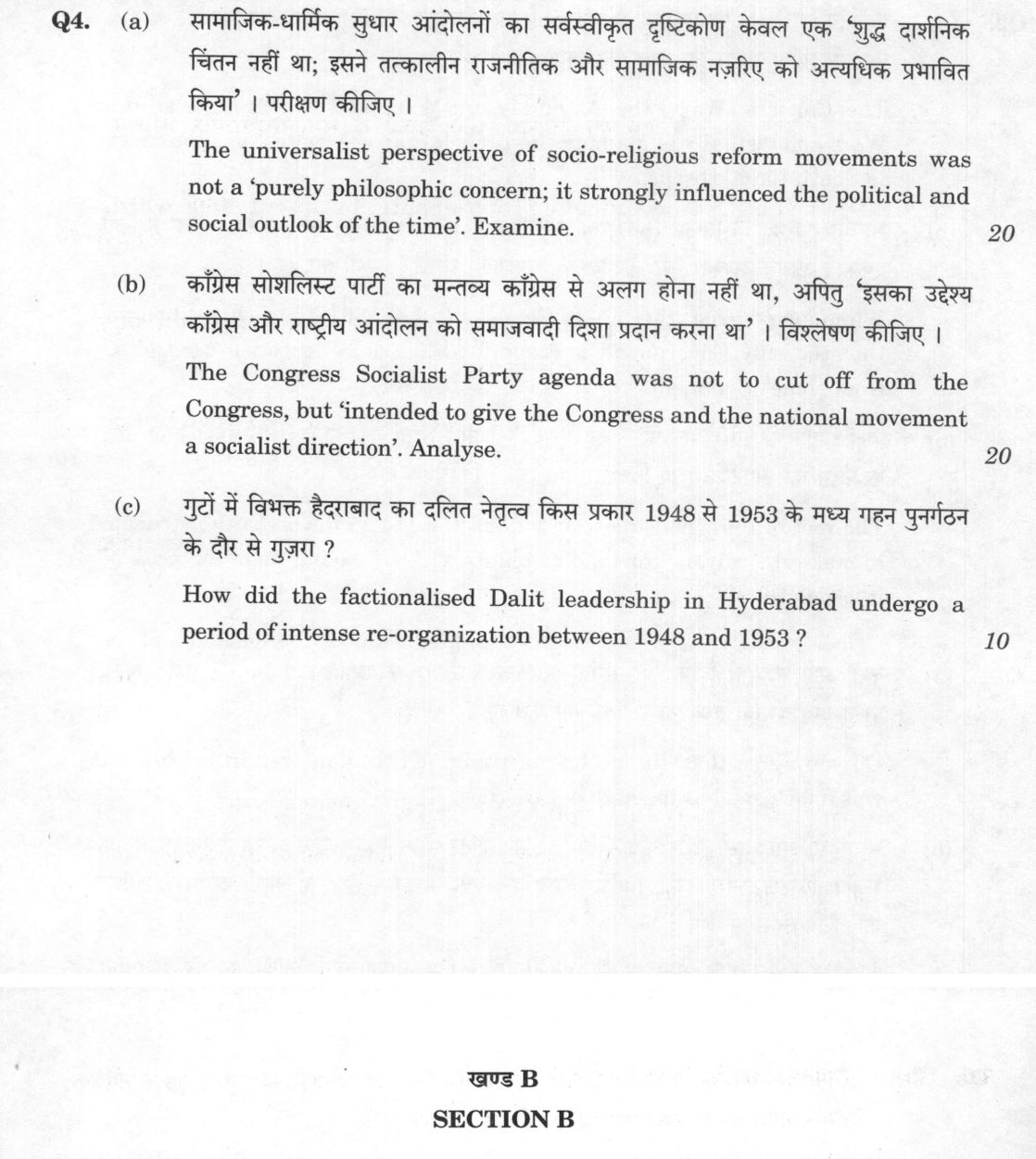
The universalist perspective of socio-religious reform movements was not a 'purely philosophic concern; it strongly influenced the political and social outlook of the time'. Examine. 20 marks
The Congress Socialist Party agenda was not to cut off from the Congress, but 'intended to give the Congress and the national movement a socialist direction'. Analyse. 20 marks
How did the factionalised Dalit leadership in Hyderabad undergo a period of intense re-organization between 1948 and 1953? 10 marks
हिंदी में प्रश्न पढ़ें
सामाजिक-धार्मिक सुधार आंदोलनों का सर्वव्यापी दृष्टिकोण केवल एक 'शुद्ध दार्शनिक चिंतन नहीं था; इसने तत्कालीन राजनीतिक और सामाजिक नजरिए को अत्यधिक प्रभावित किया'। परीक्षण कीजिए। (20 अंक)
कांग्रेस सोशलिस्ट पार्टी का मंतव्य कांग्रेस से अलग होना नहीं था, अपितु 'इसका उद्देश्य कांग्रेस और राष्ट्रीय आंदोलन को समाजवादी दिशा प्रदान करना था'। विश्लेषण कीजिए। (20 अंक)
गुटों में विभक्त हैदराबाद का दलित नेतृत्व किस प्रकार 1948 से 1953 के मध्य गहन पुनर्गठन के दौर से गुजरा ? (10 अंक)
Model answer
Written by UPSC Answer Check against this question's marking rubric, to the expected length. UPSC does not publish answers for Mains — this is one way to score well, not an official key.
(a) Universalism and political outlook The claim is broadly valid, but the universalism of reform movements was uneven in its political consequences. The Brahmo Samaj’s monotheism and rationalism attacked idolatry, caste privilege, child marriage and orthodoxy, producing a public language of equality, citizenship and modern education. Its reformist universalism helped shape an anti-colonial outlook linking social degradation to colonial rule, though it did not automatically create cross-communal politics. The Arya Samaj’s “back to the Vedas” claimed a universal Vedic knowledge and generated reformist citizenship within the Hindu fold; however, its shuddhi and sangathan campaigns reinforced Hindu identity and often sharpened communal boundaries rather than building anti-colonial solidarity beyond Hindu-Muslim divides. The Ramakrishna Mission’s practical Vedanta and the Theosophical Society’s comparative, occult universalism were more directly bridging: they connected spiritual reform with early nationalist mobilization between the 1880s and 1905, giving nationalism a moral and cultural vocabulary while encouraging service, education and self-respect. Thus universalism was not merely philosophic; it made equality, rights and national dignity central, but its reach depended on whether it was ecumenical or Vedic-Hindu.
(b) CSP’s socialist direction The Congress Socialist Party’s agenda was strategic rather than separatist. Founded through the 1934 Bombay resolution, the CSP sought to use Congress as the mass national platform while pushing it toward socialism. Its 1936 Faizpur session demands—zamindari abolition, workers’ rights, peasant relief and an anti-imperialist economic policy—were pressed inside Congress, not as a break from it. The Congress absorbed some leftward vocabulary, but did not adopt the full CSP programme; it stopped short of uncompensated abolition of zamindari and socialization of core industries. This explains the tension between JP Narayan’s “socialism from within” and the CPI’s critique that Congress was bourgeois and that reform from inside was insufficient. JP Narayan’s 1939 presidential address to the CSP emphasized Congress as the only possible national platform, because only Congress could carry the national movement. The CSP worked through sessions, resolutions, local committees and electoral alliances to make socialism legitimate within nationalist politics. Its success was real but limited: it radicalized the Congress left and kept socialist demands alive, yet Congress remained a broad nationalist coalition rather than a socialist party.
(c) Hyderabad Dalit reorganization Between 1948 and 1953, Hyderabad’s factionalised Dalit leadership was reorganized around the new constitutional and party context created by the state’s integration. The Hyderabad State Congress merged with the Indian National Congress in 1948, reducing space for separate state-level depressed-class politics and forcing local Dalit leaders to choose between accommodation within Congress and assertive caste organization. This period saw consolidation of Scheduled Castes Federation units and, by 1953, a shift toward the Republican Party of India under Ambedkar’s national influence. The reorganization was not driven by a single dominant local figure; it was a contest between accommodationist leaders seeking representation inside Congress and militant SCF/RPI activists demanding separate political assertion. National accommodationist currents associated with M. C. Rajah influenced some leaders, but Hyderabad’s realignment was shaped more by local factional struggles and Ambedkar’s party politics. Forums such as the Hyderabad People’s Convention helped articulate Dalit grievances, while linguistic-state agitation created pressure on Hyderabad’s composite identity; however, the actual reorganization of states came only in 1956, after this period. Thus the 1948-53 phase was a transition from fragmented local factions to a more disciplined caste-political structure linked to national Dalit organizations.
Taken together, these processes show that reformist universalism, socialist nationalism and Dalit regional politics were linked transitions: universalism supplied the moral language of rights, the CSP made socialism a legitimate nationalist direction, and Hyderabad’s Dalit reorganization translated caste assertion into party politics. The verdict is that their influence was real but conditional, shaped by communal limits, Congress moderation and state integration.
What "Examine" is asking you to do
Test the proposition the question puts to you and return a finding on how far it holds. Examine stems carry a claim, or ask whether something has happened, and expect evidence weighed both ways before the extent is stated — often with remedial measures attached.
Structure that answers it
Restate the claim as the question frames it → evidence that supports it → evidence that undercuts it → the conditions under which it holds → verdict on how far it stands
Where marks are lost
Stopping at description. An examination has to reach a finding, and “examine with justification” means the extent must be stated, not implied.
How this answer will be evaluated
Approach
Framework: UPSC History Paper 2 (Modern India). (a) examine: intro > how/why with reasoning > evidence > conclusion | (b) analyse: intro > causes > effects > stakeholders/linkages > way forward | (c) trace: start point > the stages in sequence > end point > what changed Full marks: Demonstrates deep analytical understanding, cites specific evidence, and addresses all parts of the question with historical precision.
Key points expected
- Identify specific reform movements (e.g., Arya Samaj, Brahmo Samaj)
- Explain the 'universalist' philosophical basis of the movements
- Link religious reform to political nationalism or social change
- Provide evidence of influence on contemporary political outlook
- Define the CSP's relationship with the Indian National Congress
- Explain the 'socialist direction' agenda of the CSP
- Analyze the internal dynamics between CSP and Congress leadership
- Assess the impact of CSP on the national movement's direction
Evaluation rubric
Each sub-part is marked on its own, against the marks and word limit printed on the paper.
- (a) Demonstrate the causal link between reformist ideology and political/social outlooks. 20 marks
examine— intro → how/why with reasoning → evidence → conclusion
Must cover
- Identify specific reform movements (e.g., Arya Samaj, Brahmo Samaj)
- Explain the 'universalist' philosophical basis of the movements
- Link religious reform to political nationalism or social change
- Provide evidence of influence on contemporary political outlook
Loses marks
- Treating reform as purely religious/philosophical
- Listing movements without analyzing their impact
- Ignoring the 'political and social outlook' aspect
Earns more
- Mention specific leaders (e.g., Dayanand, Vidyasagar)
- Reference specific texts or publications
- Discuss the role of vernacular press
- Compare different regional reform movements
Extra mark
- Cite a specific primary source or quote
- Name a specific historiographical debate on this topic
- (b) Analyze the strategic intent of the CSP to steer Congress rather than split it. 20 marks
analyse— intro → causes → effects → stakeholders/linkages → way forward
Must cover
- Define the CSP's relationship with the Indian National Congress
- Explain the 'socialist direction' agenda of the CSP
- Analyze the internal dynamics between CSP and Congress leadership
- Assess the impact of CSP on the national movement's direction
Loses marks
- Treating CSP as a separate, independent party
- Focusing only on the split without the 'direction' aspect
- Ignoring the 'national movement' context
Earns more
- Mention key CSP leaders (e.g., Jayaprakash Narayan, Acharya Narendra Deva)
- Reference specific Congress sessions or resolutions
- Discuss the tension between socialist and Gandhian approaches
- Mention the role of CSP in the Quit India Movement
Extra mark
- Cite a specific CSP manifesto or speech
- Name a specific historian's interpretation of CSP's role
- (c) Trace the re-organization of Dalit leadership in Hyderabad from 1948 to 1953. 10 marks
trace— start point → the stages in sequence → end point → what changed
Must cover
- Identify the initial factional state of Dalit leadership in 1948
- Describe the process of re-organization between 1948 and 1953
- Explain the outcome or new structure by 1953
- Contextualize within the Hyderabad state's political situation
Loses marks
- Generalizing about Dalit movements without Hyderabad specifics
- Ignoring the 1948-1953 timeframe
- Focusing on other regions or time periods
Earns more
- Name specific Dalit leaders involved in the re-organization
- Mention specific organizations or groups formed
- Discuss the role of the Nizam's government or Congress
- Reference specific events or conferences during this period
Extra mark
- Cite a specific primary source from Hyderabad
- Name a specific historian who has studied this period
Practice this exact question
Write your answer and it is marked point by point against the model answer above — what you covered, what you missed, what you got wrong.
Evaluate my answer →More from History 2023 Paper II
- Q1 Critically examine the following statements in about 150 words each: (a) "Colonialism had…
- Q2 (a) The Carnatic Wars, the Anglo-Mysore Wars and the Anglo-Maratha Wars had virtually eli…
- Q3 (a) Do you agree that 'the decline of traditional Indian artisan production was a fact, s…
- Q4 (a) The universalist perspective of socio-religious reform movements was not a 'purely ph…
- Q5 Critically examine the following statements in about 150 words each: (a) "The American Wa…
- Q6 (a) The philosophers and thinkers may have laid the foundation of the French Revolution,…
- Q7 (a) The impact of industrial revolution on the middle class world view is reflected in th…