Paper I — Q1
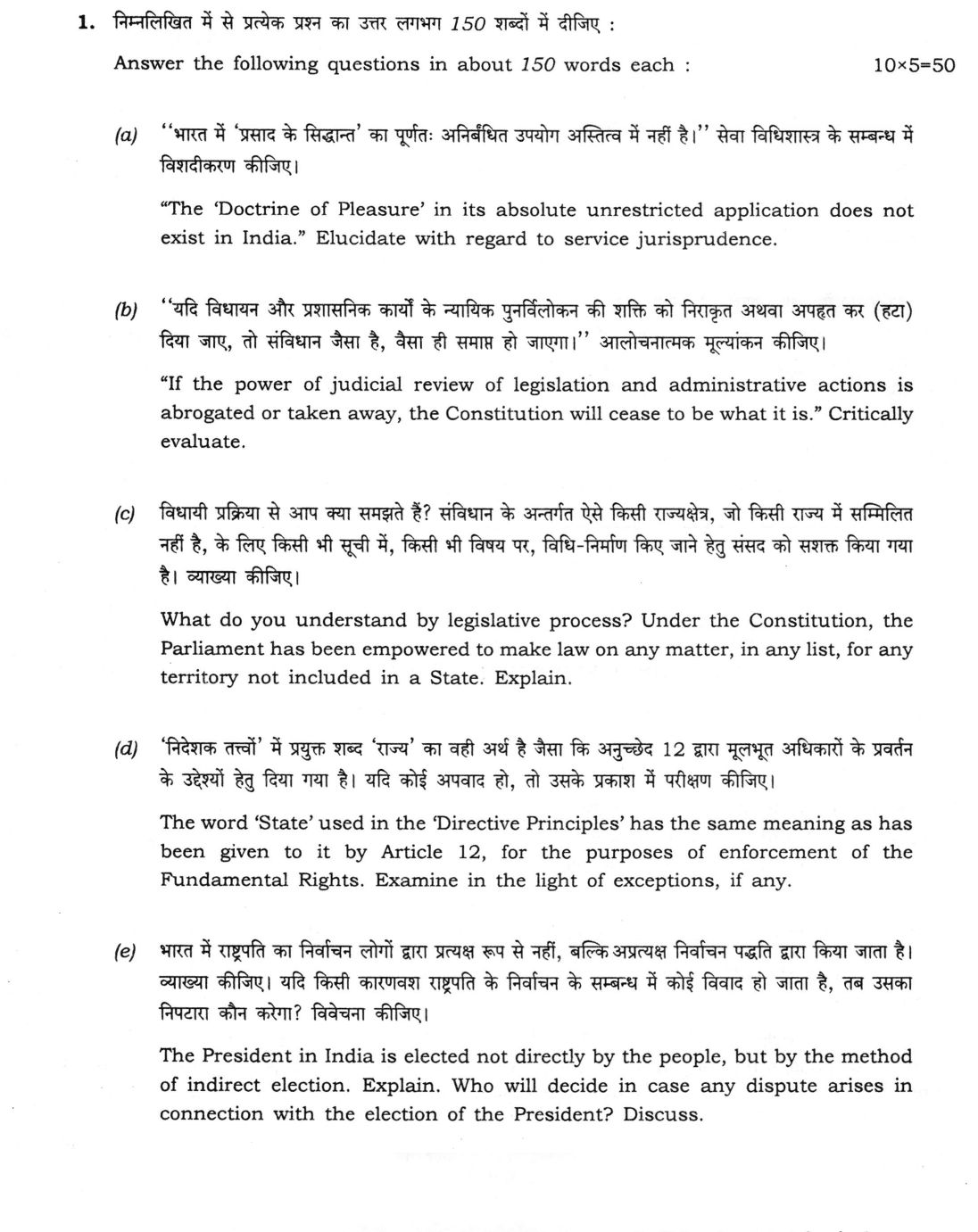
(a) “The ‘Doctrine of Pleasure’ in its absolute unrestricted application does not exist in India.” Elucidate with regard to…
Answer the following questions in about 150 words each :
“The ‘Doctrine of Pleasure’ in its absolute unrestricted application does not exist in India.” Elucidate with regard to service jurisprudence. 10 marks
“If the power of judicial review of legislation and administrative actions is abrogated or taken away, the Constitution will cease to be what it is.” Critically evaluate. 10 marks
What do you understand by legislative process? Under the Constitution, the Parliament has been empowered to make law on any matter, in any list, for any territory not included in a State. Explain. 10 marks
The word ‘State’ used in the ‘Directive Principles’ has the same meaning as has been given to it by Article 12, for the purposes of enforcement of the Fundamental Rights. Examine in the light of exceptions, if any. 10 marks
The President in India is elected not directly by the people, but by the method of indirect election. Explain. Who will decide in case any dispute arises in connection with the election of the President? Discuss. 10 marks
हिंदी में प्रश्न पढ़ें
निम्नलिखित में से प्रत्येक प्रश्न का उत्तर लगभग 150 शब्दों में दीजिए :
“भारत में ‘प्रसाद के सिद्धान्त’ का पूर्णत: अनिर्बन्धित उपयोग अस्तित्व में नहीं है।” सेवा विधिशास्त्र के सम्बन्ध में विशदीकरण कीजिए। (10 अंक)
“यदि विधायन और प्रशासनिक कार्यों के न्यायिक पुनर्विलोकन की शक्ति को निराकृत अथवा अपहृत कर (हटा) दिया जाए, तो संविधान जैसा है, वैसा ही समाप्त हो जाएगा।” आलोचनात्मक मूल्यांकन कीजिए। (10 अंक)
विधायी प्रक्रिया से आप क्या समझते हैं? संविधान के अन्तर्गत ऐसे किसी राज्यक्षेत्र, जो किसी राज्य में सम्मिलित नहीं है, के लिए किसी भी सूची में, किसी भी विषय पर, विधि-निर्माण किए जाने हेतु संसद को सशक्त किया गया है। व्याख्या कीजिए। (10 अंक)
‘निदेशक तत्त्वों’ में प्रयुक्त शब्द ‘राज्य’ का वही अर्थ है जैसा कि अनुच्छेद 12 द्वारा मूलभूत अधिकारों के प्रवर्तन के उद्देश्यों हेतु दिया गया है। यदि कोई अपवाद हो, तो उसके प्रकाश में परीक्षण कीजिए। (10 अंक)
भारत में राष्ट्रपति का निर्वाचन लोगों द्वारा प्रत्यक्ष रूप से नहीं, बल्कि अप्रत्यक्ष निर्वाचन पद्धति द्वारा किया जाता है। व्याख्या कीजिए। यदि किसी कारणवश राष्ट्रपति के निर्वाचन के सम्बन्ध में कोई विवाद हो जाता है, तब उसका निपटारा कौन करेगा? विवेचना कीजिए। (10 अंक)
Model answer
Drafted with AI by UPSC Answer Check against this question's marking rubric, to the 150-word length. UPSC does not publish answers for Mains — this is one way to score well, not an official key. How we build rubrics and answers.
(a) Doctrine of Pleasure in Service Jurisprudence
Article 310(1) embodies the doctrine of pleasure, but it opens with the words "Except as expressly provided by this Constitution", so the absolute English form does not apply in India. Article 311(1) bars dismissal or removal by an authority subordinate to the appointing authority, and Article 311(2) requires an inquiry with a reasonable opportunity of being heard; the 42nd Amendment (1976) only removed the second show-cause notice on penalty. The inquiry may be dispensed with only under the three provisos: conviction on a criminal charge; the authority recording in writing that an inquiry is not reasonably practicable; or the President/Governor being satisfied that it is not expedient in the interest of the security of the State. Article 311(3) makes the "not reasonably practicable" decision final, but Union of India v. Tulsiram Patel (1985) held that the recorded reasons remain open to judicial review for mala fides or irrelevance. Babu Ram Upadhya (1961) held Article 310 subject to Article 311, and Article 309 rules are likewise subject to it. Judges, the CAG and the CEC are outside the pleasure doctrine altogether (Articles 124(4), 218, 148(1), 324(5)), and B.P. Singhal (2010) held even the pleasure under Article 156 not unfettered.
(b) Judicial Review and the Identity of the Constitution
Judicial review is the enforcement mechanism of the Constitution; Dr. Ambedkar called Article 32 its "very soul". Review of legislation rests on Article 13, legislative competence under Articles 245-246 and Part III, enforced through Articles 32, 136 and 226/227; administrative action is reviewed through the writs of habeas corpus, mandamus, prohibition, certiorari and quo warranto.
The courts have treated it as unamendable. Kesavananda Bharati (1973) held that Parliament cannot alter the basic structure; Indira Nehru Gandhi v. Raj Narain (1975) struck down Article 329A(4), which excluded review of an election; Minerva Mills (1980) invalidated Article 368(4) and (5), holding limited amending power and judicial review basic features; and L. Chandra Kumar (1997) held review under Articles 32 and 226/227 part of the basic structure. The ADM Jabalpur (1976) episode, overruled in Puttaswamy (2017), shows what happens when review is suspended.
Critics raise the counter-majoritarian difficulty and judicial overreach, and the answer lies in restraint, not abolition. Without review, Part III would become an unenforceable declaration and constitutional supremacy would collapse, so the statement is correct.
(c) Legislative Process and Article 246(4)
The legislative process is the procedure by which a Bill becomes an Act. An ordinary Bill passes through introduction and three readings in each House (Article 107); a deadlock is resolved at a joint sitting (Article 108); and it becomes law on the President's assent (Article 111). Money Bills originate only in the Lok Sabha and the Rajya Sabha can only recommend (Articles 109-110); Financial Bills need the President's recommendation (Article 117); Constitution Amendment Bills follow Article 368.
Parliament's competence flows from Article 245 and is distributed by Article 246 across the Union, State and Concurrent Lists of the Seventh Schedule. Article 246(4), however, empowers Parliament to make laws for any part of the territory of India not included in a State on any matter, even one in the State List. This is the source of Parliament's plenary power over Union Territories, which are administered by the President under Article 239. It survives even where a UT has a legislature: Puducherry (Article 239A) and Delhi (Article 239AA(3)(b)). For certain UTs the President may also make regulations under Article 240. The power is distinct from the residuary power in Article 248.
(d) Meaning of 'State' in Part IV
Article 36 provides that in Part IV, "unless the context otherwise requires", "the State" has the same meaning as in Article 12, which inclusively covers the Government and Parliament of India, the Governments and Legislatures of the States, and all local or other authorities. The duty to apply the Directive Principles therefore binds every organ and every instrumentality that the courts have brought within "other authorities" (Rajasthan SEB v. Mohan Lal, 1967; Ajay Hasia, 1981; Pradeep Kumar Biswas, 2002).
The exceptions lie in context. For Part III, the judiciary acting judicially is not "State": judicial orders cannot be challenged under Article 32 (Naresh Shridhar Mirajkar, 1966; Rupa Ashok Hurra, 2002). In Part IV the context points the other way: Article 50 (separation of the judiciary) and Article 39A (equal justice and free legal aid) address the judiciary, and courts consider themselves guided by the Directive Principles in interpretation.
The legal consequence also differs. Article 37 makes Part IV unenforceable in any court though fundamental in governance, whereas Part III is enforceable under Article 32. The definition is shared; the remedy is not.
(e) Indirect Election of the President and Election Disputes
The President is elected indirectly by an electoral college of the elected members of both Houses of Parliament and of the Legislative Assemblies of the States (Article 54), including Delhi and Puducherry under the Explanation added by the 70th Amendment, 1992; nominated members and Legislative Councils are excluded. Article 55 secures uniformity among States and parity between the States and the Union in the value of votes, population being taken as per the 1971 census (84th Amendment, 2001). The election is by proportional representation by means of the single transferable vote, and the voting is by secret ballot (Article 55(3)).
Disputes are decided by the Supreme Court, whose decision is final (Article 71(1)). If the election is declared void, acts done by the President earlier are not invalidated (Article 71(2)). Under Article 71(3), the Presidential and Vice-Presidential Elections Act, 1952 allows a petition by a candidate or twenty electors jointly within thirty days of the result. Under Article 71(4), a rule first introduced by the 11th Amendment, 1961, a vacancy in the electoral college is no ground to challenge the election. A petition by persons without such standing was dismissed in Charan Lal Sahu v. Giani Zail Singh (1984).
How this answer will be evaluated
Evaluation rubric
Each sub-part is marked on its own, against the marks and word limit printed on the paper.
- (a) 'Elucidate' requires the candidate to explain and illustrate, not merely define: state the doctrine of pleasure as embodied in Article 310(1) and then demonstrate, through Article 311 and case law, that its operation in India is hedged in by constitutional restrictions, so that the absolute English form does not survive here. 10 marks · 150 words
Must cover
- Article 310(1) and the opening words 'Except as expressly provided by this Constitution'
- Article 311(1), 311(2) and 311(3)
- The three provisos to Article 311(2)
- Deletion of the second show-cause notice by the 42nd Amendment, 1976
- Union of India v. Tulsiram Patel, (1985) 3 SCC 398
- Articles 124(4), 148(1), 218 and 324(5) as exclusions
Loses marks
- Reproducing the English doctrine at length and never reaching Article 311, so the 'not absolute in India' proposition is asserted but not proved.
- Confusing Article 310 with Article 309 or treating Article 311 as applicable to all public employment — it protects only members of a civil service of the Union/State or persons holding a civil post, so defence personnel are outside it (its terms cover only civil services and civil posts).
- Stating that the second show-cause notice on penalty still survives — it was removed in 1976.
- Claiming that the three provisos make the action wholly non-justiciable; the recorded reasons and the existence of the satisfying material remain reviewable.
- Writing an essay on natural justice generally instead of service jurisprudence, or omitting case names entirely.
Earns more
- Lists the three provisos to Article 311(2) under which the inquiry is dispensed with: (a) conviction on a criminal charge; (b) the disciplinary authority records in writing its reasons for holding that it is not reasonably practicable to hold an inquiry; (c) the President or Governor is satisfied that in the interest of the security of the State it is not expedient to hold an inquiry — together with Article 311(3), which makes the authority's decision on whether an inquiry is reasonably practicable (proviso (b)) final, subject to limited judicial review as explained in Tulsiram Patel.
- Notes the constitutional functionaries deliberately placed outside the pleasure doctrine — Judges of the Supreme Court and High Courts (Articles 124(4) and 218), the Comptroller and Auditor-General (Article 148(1)) and the Chief Election Commissioner (Article 324(5)) — and Article 310(2), which permits compensation for premature termination of a contract with a person of special qualifications.
Extra mark
- State of U.P. v. Babu Ram Upadhya, AIR 1961 SC 751 (Article 310 is subject to Article 311)
- Moti Ram Deka v. General Manager, N.E.F. Railways, AIR 1964 SC 600 (rules permitting termination of permanent servants by notice struck down)
- B.P. Singhal v. Union of India, (2010) 6 SCC 331 (pleasure under Article 156 is not unfettered)
- Article 309 service rules are subject to Article 311
- (b) 'Critically evaluate' demands both support and challenge: establish that judicial review of legislation and of administrative action is a basic feature without which the Constitution loses its identity, and then weigh the counter-arguments (counter-majoritarian objection, judicial overreach) before taking a reasoned position. 10 marks · 150 words
Must cover
- Textual bases: Articles 13, 32, 136 and 226/227; legislative competence (Articles 245-246) and Part III as grounds for review of legislation
- Kesavananda Bharati v. State of Kerala, (1973) 4 SCC 225 — basic structure
- Indira Nehru Gandhi v. Raj Narain, 1975 Supp SCC 1
- Minerva Mills v. Union of India, (1980) 3 SCC 625
- L. Chandra Kumar v. Union of India, (1997) 3 SCC 261
- Review of administrative action through the writs under Articles 32 and 226
- Counter-majoritarian difficulty / judicial overreach as the critical side
Loses marks
- Writing a one-sided panegyric to the judiciary; the directive is 'critically evaluate', so an answer with no counter-argument cannot get more than about half the key-point marks.
- Confining the answer to review of legislation and ignoring administrative action, although the question expressly names both.
- Citing Kesavananda without saying what it decided, or attributing the basic-structure-includes-judicial-review proposition to the wrong case (L. Chandra Kumar is the clearest authority on Articles 226/227 and 32).
- Saying judicial review is 'expressly provided by Article 13 alone' and missing Articles 32/226 and the basic structure doctrine.
- Confusing judicial review with judicial activism or with appellate jurisdiction.
Earns more
- Covers judicial review of administrative and executive action distinctly: the writs under Articles 32 and 226 (habeas corpus, mandamus, prohibition, certiorari, quo warranto); grounds of review — illegality, irrationality and procedural impropriety (Council of Civil Service Unions v. Minister for the Civil Service, [1985] AC 374); A.K. Kraipak v. Union of India, (1969) 2 SCC 262 (natural justice applies to administrative action); S.R. Bommai v. Union of India, (1994) 3 SCC 1 (a Proclamation under Article 356 is justiciable and the material on which the satisfaction rests can be examined, Article 74(2) notwithstanding); Kihoto Hollohan v. Zachillhu, 1992 Supp (2) SCC 651 (Paragraph 7 of the Tenth Schedule, which ousted judicial review, invalid for want of ratification under the proviso to Article 368(2)).
- Draws the evaluative conclusion with a concrete illustration of what abrogation looks like: the 38th and 42nd Amendments and the ADM Jabalpur v. Shivkant Shukla, (1976) 2 SCC 521 experience, since overruled in Justice K.S. Puttaswamy v. Union of India, (2017) 10 SCC 1, showing that a constitution without review becomes what Loewenstein called a nominal or semantic constitution, and that Part III would be reduced to an unenforceable declaration.
Extra mark
- Marbury v. Madison (1803) as the origin of judicial review of legislation
- S.R. Bommai v. Union of India, (1994) 3 SCC 1 (Article 356 Proclamation justiciable)
- I.R. Coelho v. State of Tamil Nadu, (2007) 2 SCC 1 (Ninth Schedule laws after 24.4.1973 open to basic-structure review)
- ADM Jabalpur (1976), overruled in Puttaswamy (2017)
- (c) Two distinct limbs must both be answered: (i) explain what the legislative process is — the stages by which a Bill becomes an Act under Articles 107 to 111; and (ii) explain the specific power in Article 246(4) by which Parliament may legislate on any matter in any List for any part of the territory of India not included in a State, i.e. for Union Territories. 10 marks · 150 words
Must cover
- Article 107 (ordinary Bills) and Article 108 (joint sitting)
- Articles 109 and 110 (Money Bills), Article 117 (Financial Bills)
- Article 111 (assent of the President)
- Article 245 and Article 246, with Article 246(4) stated correctly
- Seventh Schedule — Union, State and Concurrent Lists
- Articles 239, 239A, 239AA and 240 on Union Territories
Loses marks
- Answering only one limb — usually describing the three readings at length and never reaching Article 246(4), which is the sharper half of the question.
- Misquoting Article 246(4) as a residuary power; the residuary power is in Article 248 read with Entry 97 of List I and is a different provision.
- Saying the Rajya Sabha can reject a Money Bill, or that a joint sitting can be called for a Money Bill or a Constitution Amendment Bill — neither is correct.
- Asserting that the President may veto a Bill absolutely; under Article 111 a returned Bill passed again must receive assent.
- Ignoring Delhi and Puducherry, where a legislature exists, and therefore stating the Article 246(4) power in unqualified terms.
Earns more
- Distinguishes the special legislative procedures: Money Bills under Article 110 (defined exhaustively; Speaker's certificate final under Article 110(3)) and Article 109 (originate only in the Lok Sabha, Rajya Sabha may only recommend within 14 days); Financial Bills under Article 117 (recommendation of the President for introduction); Constitution Amendment Bills under Article 368 (special majority, plus ratification by not less than one-half of the State Legislatures for the entrenched matters in the proviso to Article 368(2)); Ordinances under Articles 123 and 213 as a temporary substitute.
Extra mark
- Article 368 (Constitution Amendment Bills) as a distinct legislative procedure
- Government of NCT of Delhi v. Union of India, (2018) 8 SCC 501
- Article 1(3) — territory of India includes Union Territories
- (d) 'Examine in the light of exceptions, if any' requires the candidate to verify the proposition against Article 36, agree that the definition is carried over from Article 12, and then identify the qualifications: the opening words 'unless the context otherwise requires', the inclusive and judicially expanded meaning of 'other authorities', the contested position of the judiciary, and the fact that Article 36 operates only within Part IV. 10 marks · 150 words
Must cover
- Article 36 and its opening words 'In this Part, unless the context otherwise requires'
- Article 12 and its inclusive definition, including 'other authorities'
- Article 37 (Part IV not enforceable but fundamental in governance)
- Judicial expansion of 'other authorities' (e.g. Rajasthan SEB v. Mohan Lal, AIR 1967 SC 1857; Ajay Hasia v. Khalid Mujib, (1981) 1 SCC 722; Pradeep Kumar Biswas v. IICB, (2002) 5 SCC 111)
- The judiciary question — Mirajkar and Rupa Ashok Hurra
Loses marks
- Answering only on Article 12 and never quoting Article 36, so the actual proposition in the question is never verified.
- Missing the words 'unless the context otherwise requires', which are the textual source of the 'exceptions' the question asks for.
- Saying flatly that the judiciary 'is' or 'is not' State without distinguishing the administrative from the judicial side — the correct answer is a distinction, and the judicial side remains debated.
- Treating Article 51A (Fundamental Duties) as part of Part IV; it is Part IVA and is addressed to citizens, not the State.
- Confusing non-enforceability under Article 37 with the definition question, or asserting that DPSPs are enforceable against private parties.
Earns more
- Deals with the contested position of the judiciary and with Article 37: the judiciary acting on its administrative or rule-making side is 'State' (Prem Chand Garg v. Excise Commissioner, AIR 1963 SC 996), but judicial orders of superior courts are not amenable to Article 32 (Naresh Shridhar Mirajkar v. State of Maharashtra, AIR 1967 SC 1; Rupa Ashok Hurra v. Ashok Hurra, (2002) 4 SCC 388); and Article 37 declares Part IV non-enforceable by any court while making the principles fundamental in governance and casting a duty on the State to apply them in making laws — so identity of definition does not mean identity of legal consequence.
Extra mark
- R.D. Shetty v. International Airport Authority, (1979) 3 SCC 489
- Zee Telefilms Ltd. v. Union of India, (2005) 4 SCC 649
- Article 51A (Part IVA) — duties on citizens, outside the definition
- (e) Two limbs: (i) explain the indirect mode of the President's election — the composition of the electoral college under Article 54, the uniformity and proportionality scheme under Article 55, and the method of a single transferable vote by secret ballot; and (ii) discuss who decides election disputes, which is the Supreme Court under Article 71(1), with the consequences in Article 71(2)-(4) and the statute made under Article 71(3). 10 marks · 150 words
Must cover
- Article 54 — electoral college of elected MPs and elected MLAs
- 70th Amendment, 1992 — Delhi and Puducherry Assemblies included
- Article 55 — uniformity and parity; value of vote formula; 1971 census (84th Amendment, 2001)
- Single transferable vote, proportional representation, secret ballot
- Article 71(1) — Supreme Court decides, decision final
- Article 71(2) — acts done before the declaration not invalidated
- Article 71(3) and the Presidential and Vice-Presidential Elections Act, 1952
- Article 71(4) (11th Amendment, 1961) — vacancy in the electoral college no ground
Loses marks
- Including nominated members of Parliament or members of the State Legislative Councils in the electoral college — both are excluded.
- Omitting Delhi and Puducherry, or attributing their inclusion to the wrong amendment (it is the 70th Amendment, 1992).
- Saying the population figure used is the latest census; it is the 1971 census by virtue of the 84th Amendment, 2001.
- Answering the dispute limb by naming the Election Commission or a High Court; Article 71(1) vests exclusive jurisdiction in the Supreme Court.
- Confusing Article 71 with Article 103 (disqualification of MPs, decided by the President on the ECI's opinion) or with Article 61 (impeachment for violation of the Constitution).
Earns more
- States the method: election in accordance with the system of proportional representation by means of the single transferable vote, the voting being by secret ballot (Article 55(3)) — a candidate must secure the prescribed quota of more than half the total value of valid votes, with second and subsequent preferences transferred until the quota is reached; the Election Commission conducts the election, the Returning Officer being the Secretary-General of either House by rotation.
- Completes the consequences: Article 71(2) — if the election is declared void, acts done by the President in the exercise of the powers of his office before the declaration are not invalidated; Article 71(3) — Parliament may by law regulate any matter relating to or connected with the election, under which the Presidential and Vice-Presidential Elections Act, 1952 and the Rules of 1974 were made (an election petition may be presented by any candidate or by twenty or more electors joined together, within thirty days of the declaration of the result); Article 71(4), as substituted by the Constitution (Eleventh Amendment) Act, 1961 — the election shall not be called in question on the ground of the existence of any vacancy for whatever reason in the electoral college; illustrated by In re Presidential Poll, (1974) 2 SCC 33 and Charan Lal Sahu v. Neelam Sanjiva Reddy, (1978) 2 SCC 500.
Extra mark
- Article 62 (election to fill a vacancy) and Article 58 (qualifications)
- 39th Amendment (1975) ousting courts and 44th Amendment (1978) restoring the Supreme Court's jurisdiction
What "Elucidate" is asking you to do
Make a stated proposition plain and then prove it with instances. Elucidate stems almost always carry a claim or a named concept, and very often the words “with examples” or “with suitable diagrams” — the illustration is part of the directive, not decoration.
Structure that answers it
Plain-language statement of what the proposition means → the part that is obscure, resolved → first illustration → second illustration → why the proposition holds
Where marks are lost
Adding terminology; elucidate rewards removing it. The commoner loss is a clean explanation with no example, when the stem asked for examples.
Practice this exact question
Write your answer and it is marked point by point against the model answer above — what you covered, what you missed, what you got wrong.
Evaluate my answer →More from Law 2026 Paper I
- Q1 Answer the following questions in about 150 words each : (a) “The ‘Doctrine of Pleasure’…
- Q2 (a) "While interpreting Article 21 of the Constitution, the Supreme Court introduced the…
- Q3 (a) Keshavananda illustrates judicial creativity and the policy-making role of the Suprem…
- Q4 (a) “The Supreme Court of India is a multi-jurisdictional Court and may be regarded as th…