Paper I — Q4
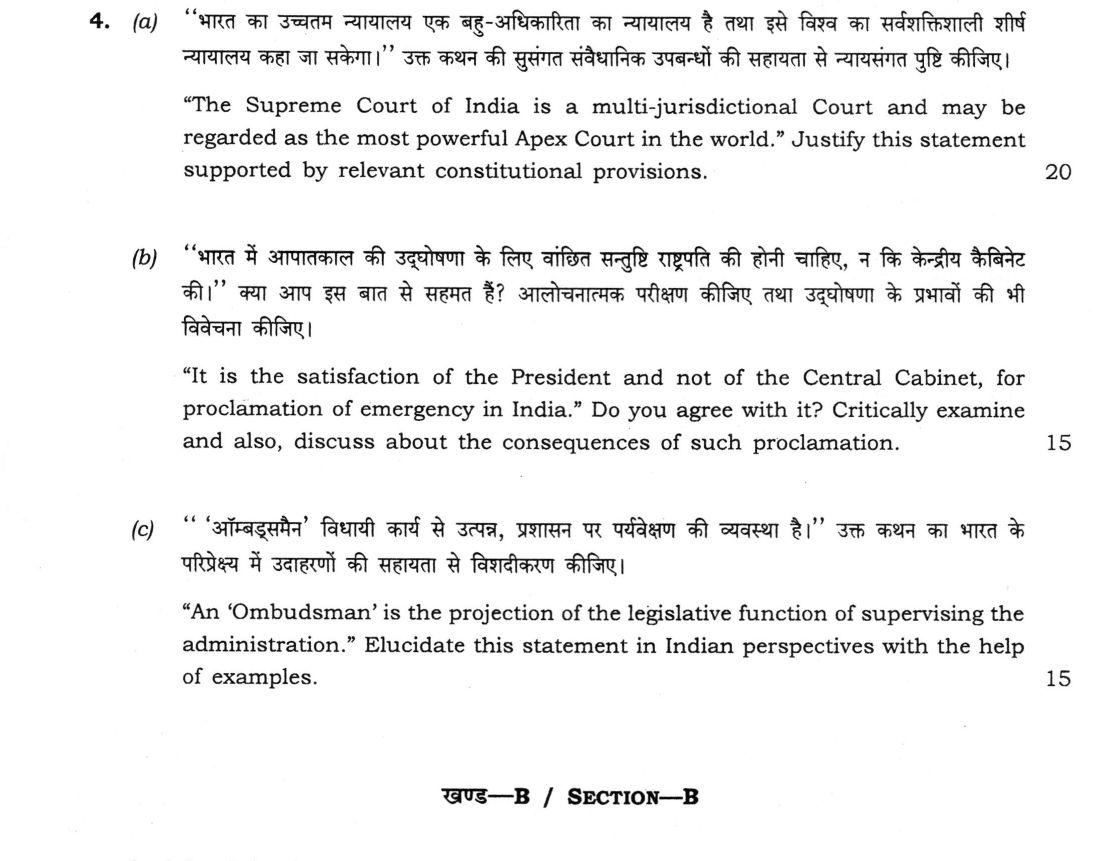
(a) “The Supreme Court of India is a multi-jurisdictional Court and may be regarded as the most powerful Apex Court in the…
“The Supreme Court of India is a multi-jurisdictional Court and may be regarded as the most powerful Apex Court in the world.” Justify this statement supported by relevant constitutional provisions. 20 marks
“It is the satisfaction of the President and not of the Central Cabinet, for proclamation of emergency in India.” Do you agree with it? Critically examine and also, discuss about the consequences of such proclamation. 15 marks
“An ‘Ombudsman’ is the projection of the legislative function of supervising the administration.” Elucidate this statement in Indian perspectives with the help of examples. 15 marks
हिंदी में प्रश्न पढ़ें
‘‘भारत का उच्चतम न्यायालय एक बहु-अधिकारिता का न्यायालय है तथा इसे विश्व का सर्वशक्तिशाली शीर्ष न्यायालय कहा जा सकेगा।’’ उक्त कथन की सुसंगत संवैधानिक उपबन्धों की सहायता से न्यायसंगत पुष्टि कीजिए। (20 अंक)
‘‘भारत में आपातकाल की उद्घोषणा के लिए वांछित सन्तुष्टि राष्ट्रपति की होनी चाहिए, न कि केन्द्रीय कैबिनेट की।’’ क्या आप इस बात से सहमत हैं? आलोचनात्मक परीक्षण कीजिए तथा उद्घोषणा के प्रभावों की भी विवेचना कीजिए। (15 अंक)
‘‘ ‘ऑम्बड्समैन’ विधायी कार्य से उत्पन्न, प्रशासन पर पर्यवेक्षण की व्यवस्था है।’’ उक्त कथन का भारत के परिप्रेक्ष्य में उदाहरणों की सहायता से विशदीकरण कीजिए। (15 अंक)
Model answer
Drafted with AI by UPSC Answer Check against this question's marking rubric, to the expected length. UPSC does not publish answers for Mains — this is one way to score well, not an official key. How we build rubrics and answers.
(a) The Supreme Court as a Multi-jurisdictional Apex Court
The assertion that the Supreme Court of India is the most powerful Apex Court in the world is justified by its unique aggregation of multiple jurisdictions and expansive powers. It is a multi-jurisdictional court exercising Original Jurisdiction under Article 131 for disputes between the Union and one or more States, or between States (excluding disputes under pre-Constitution treaties, and inter-State water disputes, which Article 262 and the Inter-State River Water Disputes Act, 1956 keep out); Writ Jurisdiction under Article 32, which is a fundamental right; and Appellate Jurisdiction under Articles 132–135. Crucially, Article 136 grants it plenary, discretionary power to grant Special Leave to Appeal from any court in India.
Its power is further amplified by Advisory Jurisdiction (Article 143), which has no parallel in the US, and the power to do "complete justice" under Article 142, as seen in Union Carbide v. Union of India (1991), though Supreme Court Bar Association v. Union of India (1998) held that Article 142 cannot be used to supplant substantive law. Advisory opinions under Article 143(1) are not binding and the Court may decline a reference (as it did in M. Ismail Faruqui, 1994), whereas a reference under Article 143(2) must be answered. Under Article 141, the law declared by the Court is binding on all courts. Additionally, it possesses a Review Jurisdiction (Article 137) supplemented by the curative petition evolved in Rupa Ashok Hurra (2002), and as a court of record it can punish for contempt of itself (Article 129). It also has exclusive jurisdiction over disputes about the election of the President and Vice-President (Article 71), inquires into the removal of members of Public Service Commissions on a presidential reference (Article 317), can transfer cases between High Courts (Article 139A), and all civil and judicial authorities must act in its aid (Article 144). Through public interest litigation, with relaxed standing and letters treated as petitions (S.P. Gupta, 1981; Hussainara Khatoon, 1980), it has widened access further. In comparison, the US Supreme Court has narrow original jurisdiction, operates mainly by discretionary certiorari and has refused advisory opinions since 1793, while the UK Supreme Court cannot invalidate primary legislation and can only issue a declaration of incompatibility under Section 4 of the Human Rights Act, 1998. The Indian Court’s ability to strike down even constitutional amendments via basic structure review makes it exceptionally powerful, though its efficacy is limited by the need for executive compliance, a heavy backlog of cases, and criticism that Article 142 is too open-ended. Its sanctioned strength is the Chief Justice and 37 other Judges (Supreme Court (Number of Judges) Amendment Act, 2026).
(b) Satisfaction for a Proclamation of Emergency and its Consequences
I do not agree with the statement in its literal form. Article 352(1) allows the President to proclaim an emergency if satisfied that the security of India or any part of it is threatened by war, external aggression or armed rebellion (the 44th Amendment, 1978 replaced 'internal disturbance' with 'armed rebellion'). The 42nd Amendment (1976) made ministerial advice binding under Article 74(1), and the 44th Amendment added a proviso letting the President return advice once for reconsideration. Crucially, the 44th Amendment also inserted Article 352(3): the President cannot issue the proclamation unless the decision of the Union Cabinet (the Prime Minister and Cabinet Ministers) has been communicated to him in writing. Therefore, the satisfaction is not personal to the President but a collective executive decision. The 38th Amendment's ouster clause, which made this satisfaction final and non-justiciable, was deleted, allowing judicial review; S.R. Bommai v. Union of India (1994) holds that the material behind the satisfaction can be examined and a mala fide or wholly irrelevant basis struck down. Parliamentary control is also built in: both Houses must approve the proclamation within one month by a special majority (a majority of total membership and two-thirds of those present and voting), approval lasts six months at a time, and the Lok Sabha can end it by a simple-majority resolution, for which a special sitting must be held within 14 days on a notice from one-tenth of its members.
The consequences of such a proclamation are far-reaching:
- Executive: The Union executive can issue directions to States (Article 353) and Parliament can legislate on the State List (Article 250).
- Financial: The President can modify the distribution of revenues between the Union and the States (Article 354).
- Legislative: The term of the Lok Sabha can be extended by law one year at a time (proviso to Article 83(2)), and State Assembly terms likewise (proviso to Article 172(1)), but not beyond six months after the proclamation ends.
- Fundamental Rights: Article 358 automatically suspends Article 19, but only when the emergency is declared on grounds of war or external aggression, and only for laws that recite that they relate to the emergency. Article 359 allows the President to suspend the right to move court for enforcement of Part III, except Articles 20 and 21, a vital safeguard added by the 44th Amendment after the ADM Jabalpur judgment (1976), which was overruled in Puttaswamy (2017). A national emergency has been proclaimed three times: 1962, 1971 and 1975.
(c) The Ombudsman in the Indian Perspective
An Ombudsman is an institution created by the legislature to supervise the administration on its behalf, ensuring it remains accountable to the people. The office began in Sweden (Justitieombudsman, 1809) as an officer of Parliament; the UK Parliamentary Commissioner for Administration (1967) takes complaints only through MPs, which shows the link to the legislature most clearly. In India, the First Administrative Reforms Commission (1966) recommended a Lokpal and Lokayuktas; the first Lokpal Bill came in 1968, and several later Bills lapsed. The function is now performed by the Lokpal and Lokayuktas. The Lokpal and Lokayuktas Act, 2013 (in force from 16 January 2014) set up a Lokpal with a Chairperson and up to eight Members, at least half of them judicial, chosen by a committee of the Prime Minister, the Speaker, the Leader of the Opposition in the Lok Sabha, the Chief Justice of India or a nominated judge, and an eminent jurist. It investigates corruption allegations against public functionaries, including the Prime Minister (with exclusions such as international relations and national security, and special procedural safeguards). The first Lokpal was appointed only in March 2019. At the state level, Section 63 required every State to set up a Lokayukta within a year. Odisha passed the first law (1970), Maharashtra first set up the office (1971), and Karnataka's Lokayukta became the best-known example when Justice N. Santosh Hegde's 2011 report on illegal mining led to the Chief Minister's resignation. Powers vary widely, and some Lokayuktas cannot examine the Chief Minister.
The Indian model also includes cognate bodies like the Central Vigilance Commission (CVC), set up in 1964 on the Santhanam Committee's recommendation and given statutory status in 2003 after the Vineet Narain judgment (1998), as well as the NHRC, the Information Commissions under the RTI Act, 2005, and sectoral ombudsmen such as the RBI Integrated Ombudsman Scheme (2021). However, a critical assessment reveals that the Indian model is primarily focused on anti-corruption (under the Prevention of Corruption Act, 1988) rather than the classical Ombudsman role of redressing general grievances or maladministration. While these bodies project the legislative function of supervision, they often face challenges: the selection committee is dominated by the executive, the Lokpal has no general jurisdiction over everyday administrative injustice, and its annual report, though laid before both Houses, does not create the continuous link with the legislature that the classical model assumes.
How this answer will be evaluated
Evaluation rubric
Each sub-part is marked on its own, against the marks and word limit printed on the paper.
- (a) 'Justify this statement supported by relevant constitutional provisions' requires the candidate to enumerate, Article by Article, the distinct jurisdictions the Supreme Court exercises — original, writ, appellate, advisory, review, and the special powers under Articles 141 and 142 — and then to argue, with comparison, why this aggregation makes it exceptionally powerful, while acknowledging the criticisms. 20 marks
Must cover
- Article 131 — original jurisdiction; Article 32 — writ jurisdiction as a fundamental right
- Articles 132, 133, 134, 134A, 135 — appellate jurisdiction
- Article 136 — special leave to appeal, plenary and discretionary
- Article 143 — advisory jurisdiction, and the 143(1)/143(2) distinction
- Article 141 — law declared binding on all courts
- Article 142 — complete justice; Union Carbide (1991); SCBA v. Union of India (1998)
- Article 129 — court of record; Article 137 and the curative petition (Rupa Ashok Hurra, 2002)
- Basic structure review of constitutional amendments
- Comparison with the US Supreme Court and the UK Supreme Court
Loses marks
- Listing Articles without stating what each jurisdiction actually covers — the question asks for justification supported by provisions, not a table of numbers.
- Omitting the advisory jurisdiction or Article 142, which are the two features that most distinguish the Indian Court from the American one.
- Saying the advisory opinion under Article 143 is binding under Article 141; it is an opinion, of high persuasive value, and the Court may decline a reference under Article 143(1).
- Confusing Article 131 with Article 262 — inter-State water disputes are excluded from the Court's jurisdiction by Section 11 of the Inter-State River Water Disputes Act, 1956 made under Article 262.
- Providing no comparison at all, so the superlative in the quotation is asserted rather than justified.
- Stating an outdated sanctioned strength of Judges.
Earns more
- Covers the extraordinary powers that have no close parallel elsewhere: Article 129 (a court of record with power to punish for contempt of itself); Article 141 (the law declared by the Supreme Court is binding on all courts within the territory of India); Article 142 (power to pass any decree or order necessary for doing complete justice in any cause or matter pending before it — Union Carbide Corporation v. Union of India, (1991) 4 SCC 584, and its limits in Supreme Court Bar Assn. v. Union of India, (1998) 4 SCC 409 and Prem Chand Garg v. Excise Commissioner, AIR 1963 SC 996); Article 137 read with Order XLVII of the Supreme Court Rules (review) and the curative petition evolved in Rupa Ashok Hurra v. Ashok Hurra, (2002) 4 SCC 388; Article 139A (transfer of cases); Article 144 (all civil and judicial authorities to act in aid of the Supreme Court); Article 145 (rule-making); and the constitutional guardianship represented by basic structure review after Kesavananda.
- Adds the specialised and electoral jurisdictions that complete the 'multi-jurisdictional' claim: Article 71(1) (exclusive and final jurisdiction over disputes relating to the election of the President and Vice-President); Article 317(1) (inquiry into the removal of a Chairman or member of a Public Service Commission, on a reference by the President, the Court's advice being binding); Article 139 (conferment by Parliament of power to issue writs for purposes other than Part III); the withdrawal jurisdiction; and public interest litigation with relaxed locus standi and epistolary jurisdiction developed in S.P. Gupta v. Union of India, 1981 Supp SCC 87 and Hussainara Khatoon.
- Supplies the comparative and evaluative element without which 'justify' is incomplete: the United States Supreme Court has a narrow original jurisdiction under Article III, operates mainly by discretionary certiorari, and has refused to give advisory opinions since 1793; the United Kingdom Supreme Court cannot invalidate primary legislation and may only make a declaration of incompatibility under Section 4 of the Human Rights Act, 1998; by contrast the Indian Court unites original, writ, appellate, advisory, review and complete-justice powers and can invalidate even a constitutional amendment. Acknowledges the counter-view: the Court's power depends on executive compliance, its docket is overwhelmed, Article 142 has itself been criticised as unbounded, and the composition question (currently a sanctioned strength of the Chief Justice and thirty-seven other Judges under the Supreme Court (Number of Judges) Amendment Act, 2026) affects institutional coherence.
Extra mark
- Article 71 — Presidential election disputes; Article 317 — PSC removals
- Articles 139A and 144
- PIL / epistolary jurisdiction (S.P. Gupta, 1981; Hussainara Khatoon)
- (b) Two limbs. First, 'do you agree' and 'critically examine' the claim that the satisfaction for proclaiming an emergency is the President's and not the Cabinet's — requiring the candidate to take a position using Articles 352(3) and 74(1). Second, discuss the consequences of such a proclamation under Articles 353, 354, 358 and 359 and the extension of legislative terms. 15 marks
Must cover
- Article 352(1) and the three grounds; 'armed rebellion' substituted by the 44th Amendment, 1978
- Article 352(3) — written communication of the Union Cabinet's decision
- Article 74(1) and its proviso (44th Amendment)
- Deletion of the 38th Amendment's ouster clause; S.R. Bommai (1994) on reviewability
- Article 352(4)-(8) — parliamentary approval, special majority, one month, six months, revocation
- Article 353 and Article 250 — Union directions and Parliament's power over the State List
- Article 354 — modification of revenue distribution
- Proviso to Article 83(2) and Article 172(1) — extension of legislative terms
- Article 358 (Article 19 suspended, war/external aggression only) and Article 359 (Articles 20 and 21 excepted)
Loses marks
- Agreeing with the statement without qualification and never citing Article 352(3), which is the provision that decides the first limb.
- Stating that 'internal disturbance' is still a ground; it was replaced by 'armed rebellion' in 1978.
- Saying Article 358 suspends Article 19 in every national emergency; after the 44th Amendment it operates only where the ground is war or external aggression.
- Saying Articles 20 and 21 can be suspended under Article 359; they cannot, since 1978.
- Stating the approval period as two months; the 44th Amendment reduced it to one month, and the special majority requirement was introduced at the same time.
- Confusing a national emergency under Article 352 with President's Rule under Article 356 or a financial emergency under Article 360.
Earns more
- Adds the justiciability dimension: the Constitution (Thirty-eighth Amendment) Act, 1975 had made the President's satisfaction final and conclusive and not questionable in any court, and that ouster was removed by the 44th Amendment; although Article 74(2) bars inquiry into the advice tendered, S.R. Bommai v. Union of India, (1994) 3 SCC 1 holds that the material on which the satisfaction is based may be examined and that a proclamation based on wholly irrelevant or mala fide grounds is open to challenge; Minerva Mills v. Union of India, (1980) 3 SCC 625 also proceeded on the footing that the proclamation is not immune. Notes the parliamentary safeguards in Article 352(4) to (8): approval by both Houses within one month by a majority of the total membership of each House and not less than two-thirds of the members present and voting; continuance limited to six months at a time; revocation by the President; and mandatory revocation if the House of the People passes a disapproving resolution by simple majority, with a special sitting to be held within fourteen days on a notice signed by not less than one-tenth of the total members of that House.
- Discusses the consequences for fundamental rights with the post-1978 corrections: Article 358 — the guarantees of Article 19 are automatically suspended, but only where the Proclamation is made on the ground of war or external aggression and not on the ground of armed rebellion, and only in respect of a law that contains a recital that it is in relation to the Proclamation (both limitations introduced by the 44th Amendment); Article 359 — the President may by order suspend the right to move any court for the enforcement of the rights conferred by Part III except Articles 20 and 21, that exception having been added by the 44th Amendment in direct response to ADM Jabalpur v. Shivkant Shukla, (1976) 2 SCC 521, which was overruled in Justice K.S. Puttaswamy v. Union of India, (2017) 10 SCC 1. May note Makhan Singh v. State of Punjab, AIR 1964 SC 381 on the scope of an Article 359 order and the three occasions on which a national emergency has been proclaimed — 1962, 1971 and 1975.
Extra mark
- ADM Jabalpur (1976), overruled in Puttaswamy (2017)
- Makhan Singh v. State of Punjab, AIR 1964 SC 381; proclamations of 1962, 1971 and 1975
- (c) 'Elucidate in Indian perspectives with the help of examples' requires the candidate to explain the Ombudsman as an institution created by and reporting to the legislature to supervise administration, trace the Indian attempt to create one, and give real Indian examples — the Lokpal, the State Lokayuktas and cognate grievance-redressal bodies — with a critical assessment of how far the Indian model matches the classical one. 15 marks
Must cover
- Sweden 1809 — Justitieombudsman; UK Parliamentary Commissioner for Administration, 1967
- First Administrative Reforms Commission (1966) — Lokpal and Lokayukta recommendation
- Lokpal and Lokayuktas Act, 2013 (in force 16 January 2014)
- Composition: Chairperson and up to 8 Members, at least half judicial
- Selection Committee: PM, Speaker, Leader of Opposition, CJI or his nominee, eminent jurist
- Prime Minister within jurisdiction with subject-matter exclusions and procedural safeguards
- Section 63 — State Lokayuktas; Maharashtra 1971; Karnataka Lokayukta as an example
- Critical point: the Indian model is anti-corruption rather than maladministration-focused
Loses marks
- Writing about the Swedish and British ombudsmen at length with only a passing mention of India, although the question asks for the Indian perspective with examples.
- Giving no concrete example — the question expressly requires examples, so an answer without the Lokpal, a named Lokayukta or a cognate body loses those marks.
- Stating that the Prime Minister is wholly outside the Lokpal's jurisdiction; he is within it, subject to defined subject-matter exclusions and procedural safeguards.
- Getting the year of the Act wrong or calling it the 'Jan Lokpal Act'; the Jan Lokpal Bill was the civil-society draft, not the enactment.
- Confusing the Lokpal with the CVC, the CBI or the NHRC, or treating the Lokayukta as a subordinate of the Lokpal — State Lokayuktas are separate statutory bodies under State law.
Earns more
- Gives State-level examples: Section 63 of the 2013 Act requires every State to establish a Lokayukta by law within one year; Odisha was the first State to enact a law, the Orissa Lokpal and Lokayuktas Act, 1970, while Maharashtra was the first State actually to establish the institution, in 1971; Karnataka's Lokayukta is the most cited example of effective supervision, Justice N. Santosh Hegde's report on illegal mining in 2011 leading to the resignation of the Chief Minister; and the powers, tenure and jurisdiction of Lokayuktas vary widely from State to State, several having no power over the Chief Minister. May cite Justice K.P. Mohapatra v. Ram Chandra Nayak, (2002) 8 SCC 1.
- Completes the picture with cognate Indian institutions and a critical assessment: the Central Vigilance Commission, set up in 1964 on the Santhanam Committee's recommendation and given statutory status by the Central Vigilance Commission Act, 2003 following Vineet Narain v. Union of India, (1998) 1 SCC 226; the National Human Rights Commission under the Protection of Human Rights Act, 1993; the Central and State Information Commissions under the Right to Information Act, 2005; and sectoral ombudsmen such as the Banking Ombudsman (now the Reserve Bank - Integrated Ombudsman Scheme, 2021) and the Insurance Ombudsman (1998). Critically: the Indian Lokpal is an anti-corruption investigating and prosecuting authority built around the Prevention of Corruption Act, 1988, not a maladministration-redressal officer of the legislature on the Scandinavian model; it is appointed by a committee dominated by the executive; it lacks suo motu grievance jurisdiction over routine administrative injustice; appointments were delayed for over five years after enactment; and the annual report under the Act, though laid before each House, does not create the continuous parliamentary relationship the classical model assumes.
Extra mark
- First Lokpal Bill 1968 and the lapse of successive Bills
- Central Vigilance Commission (1964; statutory 2003) and Vineet Narain (1998)
What "Justify" is asking you to do
Defend a position with reasons that carry evidence, and show why the contrary view does not hold. Where the stem runs as a question and asks you to justify your answer, the position is yours to choose and the marks lie wholly in the defence.
Structure that answers it
Position stated plainly → reason 1 with evidence → reason 2 with evidence → strongest objection, met → position restated as qualified
Where marks are lost
Reasons stated and none of them evidenced. The other standard loss is fence-sitting — an answer that finds merit on both sides and commits to neither has justified nothing.
Practice this exact question
Write your answer and it is marked point by point against the model answer above — what you covered, what you missed, what you got wrong.
Evaluate my answer →More from Law 2026 Paper I
- Q1 Answer the following questions in about 150 words each : (a) “The ‘Doctrine of Pleasure’…
- Q2 (a) "While interpreting Article 21 of the Constitution, the Supreme Court introduced the…
- Q3 (a) Keshavananda illustrates judicial creativity and the policy-making role of the Suprem…
- Q4 (a) “The Supreme Court of India is a multi-jurisdictional Court and may be regarded as th…
- Q5 Answer the following questions in about 150 words each : (a) Whether International Law is…
- Q6 (a) “The present world economic order is supposed to be guided by the operation of free m…
- Q7 (a) Discuss the facts and the Principles of the Law of the Sea, emerged in ‘Corfu Channel…