Paper I — Q5
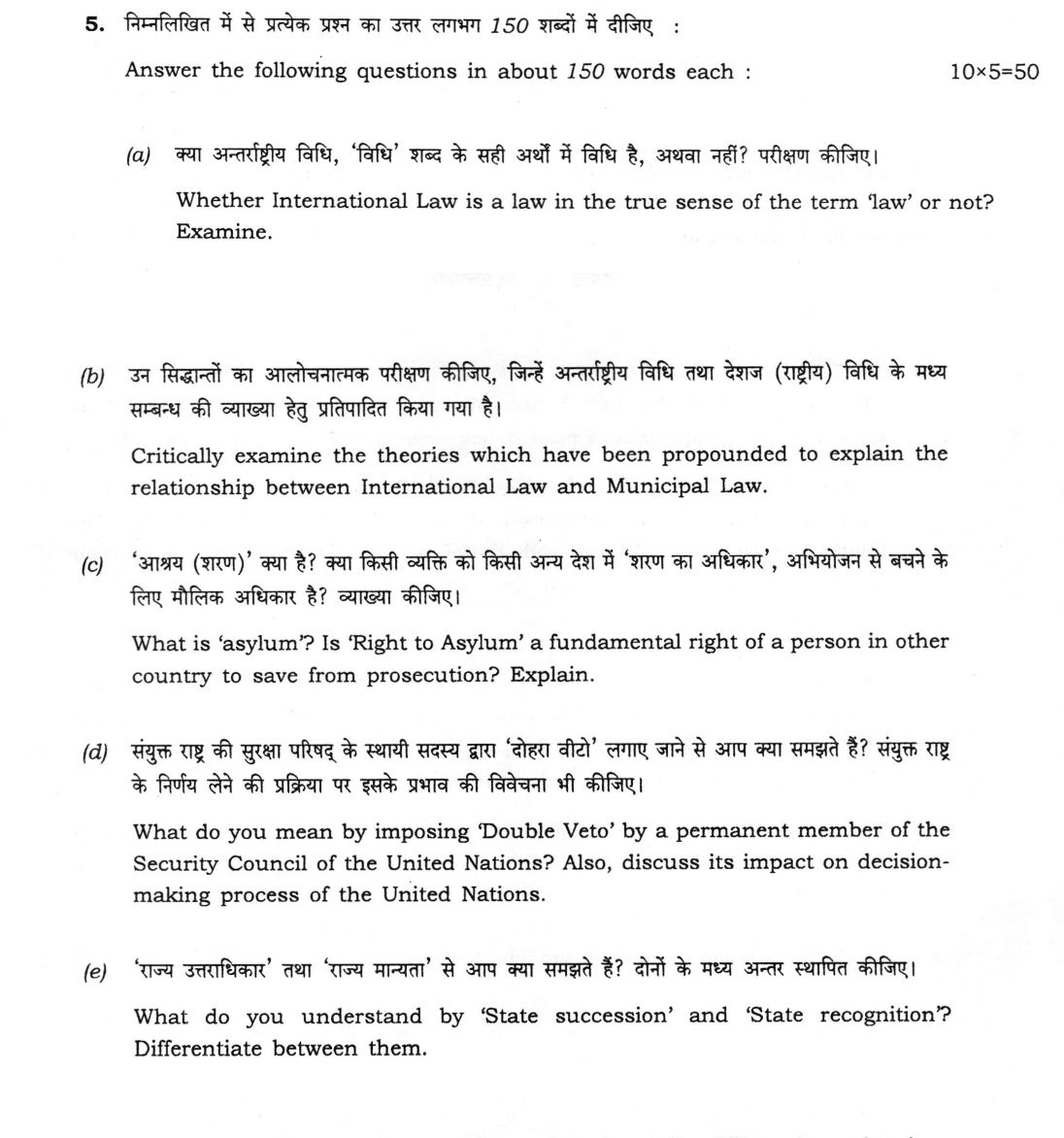
(a) Whether International Law is a law in the true sense of the term ‘law’ or not? Examine. (10 marks) (b) Critically examine…
Answer the following questions in about 150 words each :
Whether International Law is a law in the true sense of the term ‘law’ or not? Examine. 10 marks
Critically examine the theories which have been propounded to explain the relationship between International Law and Municipal Law. 10 marks
What is ‘asylum’? Is ‘Right to Asylum’ a fundamental right of a person in other country to save from prosecution? Explain. 10 marks
What do you mean by imposing ‘Double Veto’ by a permanent member of the Security Council of the United Nations? Also, discuss its impact on decision-making process of the United Nations. 10 marks
What do you understand by ‘State succession’ and ‘State recognition’? Differentiate between them. 10 marks
हिंदी में प्रश्न पढ़ें
निम्नलिखित में से प्रत्येक प्रश्न का उत्तर लगभग 150 शब्दों में दीजिए :
क्या अन्तर्राष्ट्रीय विधि, ‘विधि’ शब्द के सही अर्थों में विधि है, अथवा नहीं? परीक्षण कीजिए। (10 अंक)
उन सिद्धान्तों का आलोचनात्मक परीक्षण कीजिए, जिन्हें अन्तर्राष्ट्रीय विधि तथा देशज (राष्ट्रीय) विधि के मध्य सम्बन्ध की व्याख्या हेतु प्रतिपादित किया गया है। (10 अंक)
‘आश्रय (शरण)’ क्या है? क्या किसी व्यक्ति को किसी अन्य देश में ‘शरण का अधिकार’, अभियोजन से बचने के लिए मौलिक अधिकार है? व्याख्या कीजिए। (10 अंक)
संयुक्त राष्ट्र की सुरक्षा परिषद् के स्थायी सदस्य द्वारा ‘दोहरा वीटो’ लगाए जाने से आप क्या समझते हैं? संयुक्त राष्ट्र के निर्णय लेने की प्रक्रिया पर इसके प्रभाव की विवेचना भी कीजिए। (10 अंक)
‘राज्य उत्तराधिकार’ तथा ‘राज्य मान्यता’ से आप क्या समझते हैं? दोनों के मध्य अन्तर स्थापित कीजिए। (10 अंक)
Model answer
Drafted with AI by UPSC Answer Check against this question's marking rubric, to the 150-word length. UPSC does not publish answers for Mains — this is one way to score well, not an official key. How we build rubrics and answers.
(a) Whether International Law is a law in the true sense of the term ‘law’ or not? Examine.
John Austin, defining law as the command of a sovereign backed by sanction, denied that international law is law properly so called: with no world sovereign it was only "positive international morality"; Holland called it the "vanishing point of jurisprudence".
The affirmative view (Oppenheim, Starke) is stronger. Kelsen treats pacta sunt servanda as the basic norm of the international legal order, and Hart finds in it primary rules of obligation even though secondary rules of recognition, change and adjudication are undeveloped. It has recognised sources (Article 38(1) of the ICJ Statute: treaties, custom, general principles) and coercive enforcement under Chapter VII of the UN Charter, and Article 94 obliges compliance with ICJ judgments, with recourse to the Security Council. States treat it as law: Article 51(c) of the Indian Constitution directs respect for international law.
Its weaknesses are real: no legislature, no compulsory jurisdiction (the Article 36(2) optional clause) and enforcement blocked by the veto. The better conclusion is that international law is law, but a "weak", horizontal and decentralised legal order rather than a vertical one like municipal law.
(b) Critically examine the theories which have been propounded to explain the relationship between International Law and Municipal Law.
Monism (Kelsen, Lauterpacht, Scelle) treats international and municipal law as one legal order. Dualism (Triepel, Anzilotti) treats them as separate systems differing in sources, subjects and substance, so that international law operates internally only when adopted.
Subsidiary theories try to bridge the gap: transformation / specific adoption (a treaty operates internally only when transformed by legislation); delegation (international law leaves each constitution to decide how treaties take effect); and harmonisation (Fitzmaurice, Rousseau: the systems work in different spheres and conflict is exceptional).
India is dualist for treaties and follows incorporation for custom. Treaty-making is executive (Article 73), but a treaty affecting private rights needs legislation under Article 253 (Maganbhai Ishwarbhai Patel, 1970); custom is part of Indian law unless it conflicts with a statute (Gramophone Co. v. B.B. Pandey, 1984); a clear statute prevails over a treaty (Jolly George Varghese, 1980); and Vishaka (1997) used conventions to fill a legislative vacuum.
Neither theory fits practice fully: monism cannot explain why courts apply conflicting statutes, and dualism cannot explain the State's continuing international liability. Article 27 of the VCLT, 1969 bars a State from pleading its internal law to excuse non-performance of a treaty.
(c) What is ‘asylum’? Is ‘Right to Asylum’ a fundamental right of a person in other country to save from prosecution? Explain.
Asylum is protection granted by a State to a foreign national against the jurisdiction of another State. It is territorial (within the State's territory) or extra-territorial / diplomatic (in embassies, legations or warships), recognised mainly in Latin America (Havana Convention, 1928).
There is no fundamental right of an individual to be granted asylum. Article 14(1) UDHR gives only a right to "seek and enjoy" it, and Article 14(2) excludes prosecutions genuinely arising from non-political crimes; the 1967 Declaration on Territorial Asylum treats its grant as the State's sovereign right. In the Asylum Case (Colombia v. Peru), ICJ 1950, Colombia could not unilaterally and bindingly qualify Haya de la Torre's offence as political. The 1951 Refugee Convention protects refugees through non-refoulement (Article 33) but excludes serious non-political criminals (Article 1F).
Asylum protects against persecution, not ordinary prosecution; a fugitive from criminal justice is liable to extradition. India is not a party to the 1951 Convention, and foreigners are governed by the Immigration and Foreigners Act, 2025. Article 21 protects non-citizens (NHRC v. State of Arunachal Pradesh, 1996) but creates no right to asylum, and Mohammad Salimullah (2021) confirmed that Article 19(1)(e) is for citizens only.
(d) What do you mean by imposing ‘Double Veto’ by a permanent member of the Security Council of the United Nations? Also, discuss its impact on decision-making process of the United Nations.
Under Article 27 of the UN Charter, procedural decisions need nine affirmative votes (Article 27(2)); all other matters need nine votes including the concurring votes of the permanent members (Article 27(3)). The Charter does not define "procedural", and the San Francisco Four-Power Statement of 7 June 1945 made the preliminary question, whether a matter is procedural, itself non-procedural. A permanent member can therefore veto that preliminary question and then veto the substantive draft: this is the double veto.
Impact: it widened great-power control and, with the ordinary veto, paralysed the Council during the Cold War. Workarounds followed: the Uniting for Peace Resolution 377 (V), 1950 lets the General Assembly recommend collective measures when the Council is deadlocked, and Resolution 76/262 (2022) requires the Assembly to meet within ten working days of a veto, the vetoing member being given precedence to explain it. Abstention or absence is not a veto (Namibia advisory opinion, 1971), and the double veto is now rare. It still entrenches P5 privilege over collective security, which is why the G-4, Uniting for Consensus and Ezulwini reform proposals all target the veto.
(e) What do you understand by ‘State succession’ and ‘State recognition’? Differentiate between them.
State succession is the replacement of one State by another in the responsibility for the international relations of territory. It is governed by the Vienna Conventions of 1978 (treaties) and 1983 (property, archives and debts): newly independent States start with a "clean slate"; territory passing to an existing State follows the "moving treaty frontier" rule; boundary treaties survive (Gabcikovo-Nagymaros, ICJ 1997).
State recognition is the act by which existing States acknowledge a new State meeting the Montevideo Convention (1933) Article 1 criteria: permanent population, defined territory, government and capacity to enter into relations. Under the constitutive theory (Oppenheim, Lauterpacht) recognition creates statehood; under the declaratory theory (Brierly; Article 3, Montevideo) it acknowledges an existing fact. It may be de jure or de facto.
Differences:
- Nature: succession is a legal transfer of rights and obligations; recognition is a political-cum-legal act of acknowledgement.
- Occasion: succession follows a change of sovereignty over territory; recognition follows the emergence of a new State.
- Effect: succession decides who inherits treaties, property and debts; recognition decides the new State's standing with the recogniser.
- Discretion: succession follows legal rules; recognition is largely discretionary.
How this answer will be evaluated
Evaluation rubric
Each sub-part is marked on its own, against the marks and word limit printed on the paper.
- (a) 'Examine' the classic jurisprudential controversy: state the Austinian denial that international law is law properly so called, marshal the arguments on both sides with named jurists and concrete evidence of law-like features, and reach a reasoned conclusion. 10 marks · 150 words
Must cover
- Austin's command theory — international law as 'positive international morality'
- Affirmative view with named jurists — Oppenheim, Starke; Kelsen and pacta sunt servanda as the basic norm
- Law-like features: Article 38(1) ICJ Statute sources; Chapter VII and Article 94 of the UN Charter
- Weaknesses: no legislature, no compulsory jurisdiction (Article 36(2) optional clause), the veto
- Reasoned conclusion: law, though a 'weak' / horizontal, decentralised legal order
Loses marks
- Answering only one side of the debate; 'examine' requires both.
- Attributing the command theory to the wrong jurist, or confusing Austin with Bentham or Holland.
- Saying international law has 'no sanctions at all'; Chapter VII measures, countermeasures, reprisals and reputational costs are sanctions of a different kind.
- Omitting Article 38(1) of the ICJ Statute, which is the standard evidence of a recognised system of sources.
- Reaching no conclusion, or asserting a conclusion without argument.
Earns more
- States the residual weaknesses honestly and reaches the modern conclusion: there is no international legislature, the ICJ has no compulsory jurisdiction except by consent under the optional clause in Article 36(2) of its Statute, enforcement is hostage to the veto under Article 27(3) of the Charter, and breaches by powerful States often go unremedied; H.L.A. Hart's analysis in The Concept of Law that international law possesses primary rules of obligation but lacks a developed set of secondary rules — of recognition, change and adjudication — so that it resembles the law of a simple society; and J.G. Starke's characterisation of it as 'weak law'. May add municipal recognition of its legal quality — Article 51(c) of the Indian Constitution, Article 253, and The Paquete Habana, 175 US 677 (1900).
Extra mark
- Holland — 'the vanishing point of jurisprudence'
- H.L.A. Hart — primary rules without secondary rules
- Article 51(c) of the Indian Constitution; The Paquete Habana (1900)
- (b) 'Critically examine the theories' requires the candidate to set out monism, dualism and the subsidiary theories of transformation, specific adoption, delegation and harmonisation, name their principal proponents, and then criticise each against State practice — including the Indian position. 10 marks · 150 words
Must cover
- Monism and its proponents (Kelsen, Lauterpacht, Scelle)
- Dualism and its proponents (Triepel, Anzilotti); difference in sources, subjects and substance
- Subsidiary theories: transformation / specific adoption, delegation, harmonisation
- Indian position: dualist for treaties (Articles 73, 253), incorporation for custom; Article 51(c)
- Critical evaluation of the theories against State practice
- Article 27 of the VCLT, 1969 on the international plane
Loses marks
- Describing monism and dualism without naming a single proponent.
- Offering no criticism, although the directive is 'critically examine'.
- Describing India as purely monist or purely dualist; the correct answer is that India is dualist for treaties and follows incorporation for custom.
- Claiming Vishaka allowed a treaty to override an Indian statute; it filled a legislative vacuum and construed fundamental rights consistently with CEDAW.
- Omitting Article 27 VCLT, which is the decisive rule on the international plane.
Earns more
- Covers the subsidiary theories: specific adoption or transformation (a treaty rule becomes internally operative only when specifically adopted or transformed by legislation); delegation theory (international law itself delegates to each State's constitution the decision how treaties become internally effective, so no transformation is required); and the harmonisation or coordination theory, associated with Fitzmaurice and Rousseau, that the two systems operate in different spheres and the question of supremacy arises only in the event of conflict on the same plane.
Extra mark
- Maganbhai Ishwarbhai Patel v. Union of India (1970); Gramophone Co. v. B.B. Pandey (1984); Jolly George Varghese (1980)
- Vishaka v. State of Rajasthan (1997)
- UK practice (incorporation of custom, transformation of treaties); US Article VI and Medellin v. Texas (2008)
- (c) Two limbs: define asylum and distinguish its territorial and extra-territorial forms; then answer the specific question whether an individual has a fundamental or enforceable right to asylum in another country — which requires the answer 'no', supported by Article 14 UDHR, the 1967 Declaration on Territorial Asylum and the Asylum Case, with the further point that asylum protects against persecution, not against ordinary prosecution. 10 marks · 150 words
Must cover
- Definition; territorial versus extra-territorial / diplomatic asylum
- Article 14(1) and 14(2) UDHR — right to seek and enjoy, not to be granted
- Grant of asylum is the State's sovereign right — Declaration on Territorial Asylum, 1967
- Asylum Case (Colombia v. Peru), ICJ 1950
- 1951 Refugee Convention: non-refoulement (Article 33); Article 1F exclusions
- Asylum protects against persecution, not ordinary prosecution; fugitives are liable to extradition
- Conclusion: no fundamental right of an individual to be granted asylum
Loses marks
- Answering that there is a fundamental right to asylum; the settled position is that asylum is a right of the State, and the individual has only a right to seek and enjoy it.
- Treating the UDHR as a binding treaty.
- Omitting the Asylum Case, which is the standard authority on the question.
- Confusing asylum with refugee status or with extradition; they are related but distinct.
- Saying India is bound by the 1951 Refugee Convention — it is not a party.
Earns more
- Adds the Indian position and the persecution/prosecution distinction: India is not a party to the 1951 Refugee Convention or its 1967 Protocol and has no dedicated refugee statute, foreign nationals being governed by the Immigration and Foreigners Act, 2025 (in force from 1 September 2025), which repealed the Foreigners Act, 1946, the Registration of Foreigners Act, 1939, the Passport (Entry into India) Act, 1920 and the Immigration (Carriers' Liability) Act, 2000; Article 21 protects the life and personal liberty of non-citizens (National Human Rights Commission v. State of Arunachal Pradesh, (1996) 1 SCC 742, on the Chakmas), and some High Courts have read non-refoulement into Article 21, while the Supreme Court in Mohammad Salimullah v. Union of India (2021) declined interim relief against deportation, observing that the rights under Article 19(1)(e) are available only to citizens. Notes finally that the question's reference to escaping 'prosecution' is important: asylum protects against persecution on grounds such as race, religion, nationality, political opinion or membership of a particular social group, and is not available to a fugitive from ordinary criminal justice, who is liable to extradition under the Extradition Act, 1962 subject to the political offence exception.
Extra mark
- Haya de la Torre Case (1951); Havana Convention on Asylum, 1928
- India: not a party to the 1951 Convention; Immigration and Foreigners Act, 2025
- NHRC v. State of Arunachal Pradesh (1996); Mohammad Salimullah v. Union of India (2021)
- (d) Two limbs: explain precisely what the double veto is — the use of the veto first on the preliminary question whether a matter is procedural and then on the substance — grounding it in Article 27 of the UN Charter and the San Francisco Four-Power Statement; and then discuss its impact on United Nations decision-making, including the devices developed to work around it. 10 marks · 150 words
Must cover
- Article 27 of the UN Charter: procedural matters (27(2)) and all other matters (27(3)); nine affirmative votes; concurring votes of the permanent members
- Meaning: veto on the preliminary question whether a matter is procedural, then veto on the substance
- San Francisco Four-Power Statement on Voting Procedure, 7 June 1945
- Abstention or absence is not a veto
- Impact: paralysis of the Council; workarounds — Uniting for Peace Resolution 377 (V), GA Resolution 76/262 (2022)
- Evaluation: great-power privilege; the veto in reform proposals
Loses marks
- Defining the double veto as two permanent members exercising a veto, or as a veto exercised twice at different stages of a dispute; the essence is a veto on the preliminary characterisation question followed by a veto on the substance.
- Stating the affirmative vote requirement as seven; it has been nine since the 1965 enlargement.
- Saying an abstention amounts to a veto; consistent practice and the Namibia opinion hold otherwise.
- Ignoring the second limb on impact, or discussing UN reform generally without connecting it to the veto.
- Confusing the Security Council veto with the 'double majority' voting used in other international institutions.
Earns more
- States the settled practice that qualifies the veto: the abstention or absence of a permanent member is not treated as a veto, notwithstanding the literal requirement of 'concurring votes', a practice consistently followed since 1946 and endorsed by the International Court of Justice in the advisory opinion on Legal Consequences for States of the Continued Presence of South Africa in Namibia (South West Africa) notwithstanding Security Council Resolution 276 (1970), ICJ Reports 1971; and that the Soviet absence in 1950 allowed the Council to act on Korea.
Extra mark
- Namibia advisory opinion, ICJ 1971; Soviet absence and Korea, 1950
- Chapter VI abstention proviso in Article 27(3)
- Hidden or pocket veto; G-4, Uniting for Consensus, Ezulwini Consensus
- (e) Three tasks: define State succession, define State recognition, and then differentiate them on stated criteria. The marks turn on the quality of the differentiation, so the answer must not stop at two definitions. 10 marks · 150 words
Must cover
- Definition of State succession; Vienna Conventions of 1978 (treaties) and 1983 (property, archives and debts)
- Rules: clean slate, moving treaty frontier, survival of boundary / territorial treaties
- Definition of State recognition; Montevideo Convention, 1933, Article 1 criteria
- Constitutive versus declaratory theories; de jure and de facto recognition
- Express point-by-point differentiation
Loses marks
- Writing two separate notes and omitting the differentiation, which is the third and most heavily weighted task.
- Confusing recognition of a State with recognition of a government — the Estrada and Tobar doctrines concern governments.
- Stating that succession transfers all treaty obligations automatically; the clean slate rule for newly independent States is the general position, with boundary and territorial regimes as the main exception.
- Saying India and Pakistan were both new members of the UN in 1947; India retained the existing membership and Pakistan was admitted afresh.
- Misattributing the constitutive and declaratory theories to the wrong jurists.
Earns more
- States the operative rules of succession with illustrations: the clean slate or tabula rasa rule for newly independent States; the moving treaty frontier rule where territory passes to an existing State; the survival of localised, dispositive or 'real' treaties establishing boundary and territorial regimes, affirmed as customary in the Gabcikovo-Nagymaros Project (Hungary/Slovakia), ICJ Reports 1997; the non-transmission of personal or political treaties; devolution agreements and unilateral declarations; and membership of international organisations, illustrated by India retaining the original United Nations membership in 1947 while Pakistan was admitted as a new member, by the Russian Federation continuing the membership of the USSR in 1991, and by the separate admission of the successor States of Czechoslovakia in 1993.
Extra mark
- Gabcikovo-Nagymaros Project (Hungary/Slovakia), ICJ 1997
- India and Pakistan in 1947; Russian Federation 1991; Czechoslovakia 1993
- Stimson doctrine of non-recognition (1932)
What "Examine" is asking you to do
Test the proposition the question puts to you and return a finding on how far it holds. Examine stems carry a claim, or ask whether something has happened, and expect evidence weighed both ways before the extent is stated — often with remedial measures attached.
Structure that answers it
Restate the claim as the question frames it → evidence that supports it → evidence that undercuts it → the conditions under which it holds → verdict on how far it stands
Where marks are lost
Stopping at description. An examination has to reach a finding, and “examine with justification” means the extent must be stated, not implied.
Practice this exact question
Write your answer and it is marked point by point against the model answer above — what you covered, what you missed, what you got wrong.
Evaluate my answer →More from Law 2026 Paper I
- Q2 (a) "While interpreting Article 21 of the Constitution, the Supreme Court introduced the…
- Q3 (a) Keshavananda illustrates judicial creativity and the policy-making role of the Suprem…
- Q4 (a) “The Supreme Court of India is a multi-jurisdictional Court and may be regarded as th…
- Q5 Answer the following questions in about 150 words each : (a) Whether International Law is…
- Q6 (a) “The present world economic order is supposed to be guided by the operation of free m…
- Q7 (a) Discuss the facts and the Principles of the Law of the Sea, emerged in ‘Corfu Channel…
- Q8 (a) “The Bretton Woods Conference, 1944 adopted the statutes of two institutions to promo…