Paper I — Q6
(a) “The present world economic order is supposed to be guided by the operation of free market forces propelled by free…
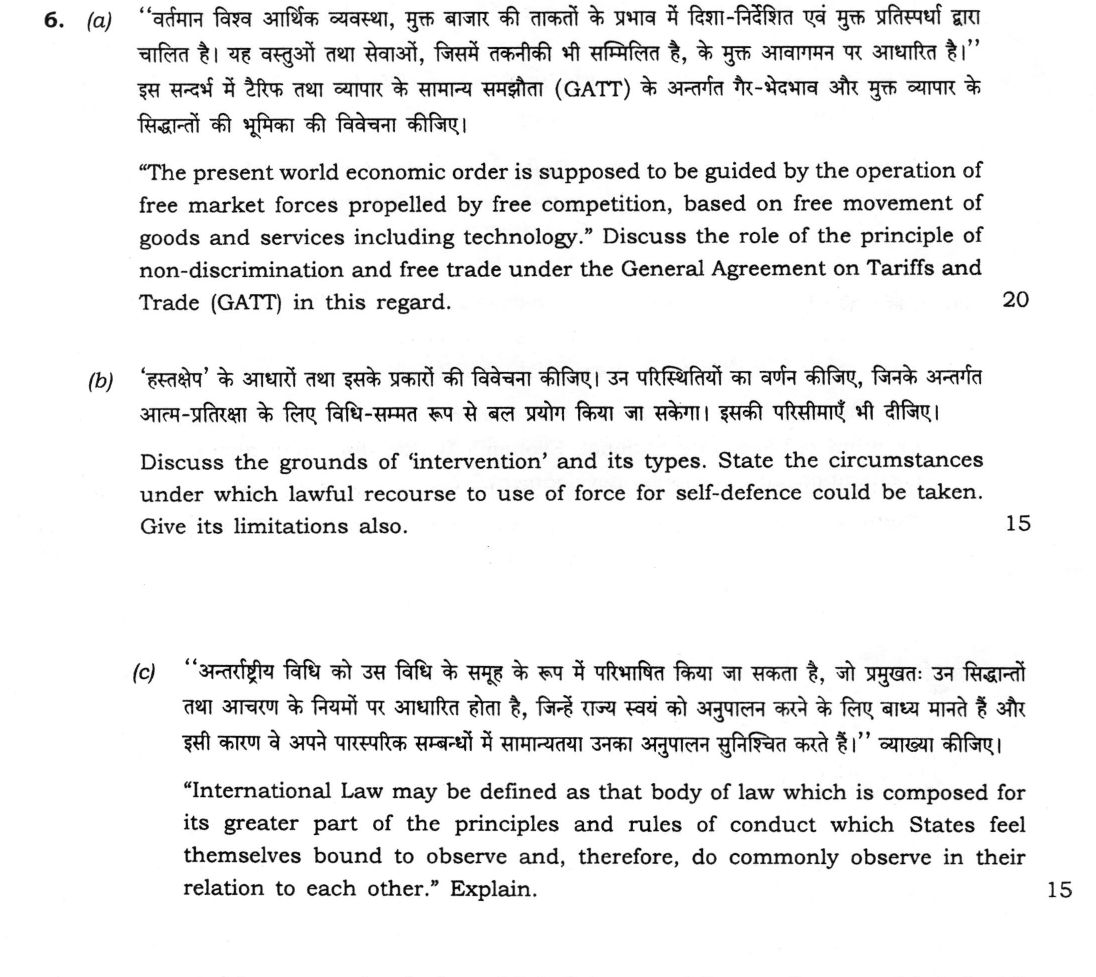
“The present world economic order is supposed to be guided by the operation of free market forces propelled by free competition, based on free movement of goods and services including technology.” Discuss the role of the principle of non-discrimination and free trade under the General Agreement on Tariffs and Trade (GATT) in this regard. 20 marks
Discuss the grounds of ‘intervention’ and its types. State the circumstances under which lawful recourse to use of force for self-defence could be taken. Give its limitations also. 15 marks
“International Law may be defined as that body of law which is composed for its greater part of the principles and rules of conduct which States feel themselves bound to observe and, therefore, do commonly observe in their relation to each other.” Explain. 15 marks
हिंदी में प्रश्न पढ़ें
‘वर्तमान विश्व आर्थिक व्यवस्था, मुक्त बाजार की ताकतों के प्रभाव में दिशा-निर्देशित एवं मुक्त प्रतिस्पर्धा द्वारा चालित है। यह वस्तुओं तथा सेवाओं, जिनमें तकनीकी भी सम्मिलित है, के मुक्त आवागमन पर आधारित है।’ इस सन्दर्भ में टैरिफ तथा व्यापार के सामान्य समझौता (GATT) के अन्तर्गत गैर-भेदभाव और मुक्त व्यापार के सिद्धान्तों की भूमिका की विवेचना कीजिए। (20 अंक)
‘हस्तक्षेप’ के आधारों तथा इसके प्रकारों की विवेचना कीजिए। उन परिस्थितियों का वर्णन कीजिए, जिनके अन्तर्गत आत्म-प्रतिरक्षा के लिए विधि-सम्मत रूप से बल प्रयोग किया जा सकेगा। इसकी परिसीमाएँ भी दीजिए। (15 अंक)
‘‘अन्तर्राष्ट्रीय विधि को उस विधि के समूह के रूप में परिभाषित किया जा सकता है, जो प्रमुखत: उन सिद्धान्तों तथा आचरण के नियमों पर आधारित होता है, जिन्हें राज्य स्वयं को अनुपालन करने के लिए बाध्य मानते हैं और इसी कारण वे अपने पारस्परिक सम्बन्धों में सामान्यतया उनका अनुपालन सुनिश्चित करते हैं।’’ व्याख्या कीजिए। (15 अंक)
Model answer
Drafted with AI by UPSC Answer Check against this question's marking rubric, to the expected length. UPSC does not publish answers for Mains — this is one way to score well, not an official key. How we build rubrics and answers.
(a) Non-discrimination and Free Trade under GATT
The General Agreement on Tariffs and Trade (GATT), concluded at Geneva on 30 October 1947 by twenty-three contracting parties, established the legal framework for a free-market world economic order. It was applied provisionally from 1 January 1948 under the Protocol of Provisional Application, following the failure of the Havana Charter for an International Trade Organization. After the Uruguay Round, the Marrakesh Agreement of 15 April 1994 established the World Trade Organization (WTO) on 1 January 1995, carrying forward the GATT as GATT 1994 alongside GATS, TRIPS and the Dispute Settlement Understanding. The system is anchored by the principle of non-discrimination, which consists of two distinct limbs: the Most-Favoured-Nation (MFN) principle under Article I, which requires equal treatment of foreign suppliers at the border, and National Treatment under Article III, which mandates equal treatment of imported and domestic goods within the internal market.
To facilitate free trade, GATT disciplines trade through Article II (tariff bindings) and Article XI (the elimination of quantitative restrictions). However, the system is "managed" rather than purely free, as it incorporates built-in exceptions. These include Article XX (general exceptions, notably XX(b) for measures necessary to protect human, animal or plant life or health and XX(g) for the conservation of exhaustible natural resources, subject to the chapeau against arbitrary or unjustifiable discrimination and disguised restrictions), Article XXI (security), Article XIX (safeguards), Article VI (anti-dumping and countervailing duties), Articles XII and XVIII:B (balance-of-payments restrictions), and Article XXIV (customs unions and free-trade areas). The Enabling Clause of 1979 further allows for the Generalized System of Preferences and special and differential treatment for developing countries.
Dispute settlement practice illustrates the system's application and limits. In US - Gasoline (1996), the first Appellate Body report, GATT was held not to be read in isolation from public international law. In US - Shrimp (1998), brought by India, Malaysia, Pakistan and Thailand, the Appellate Body held that environmental measures must satisfy the "chapeau" of Article XX to avoid arbitrary discrimination. Conversely, in India - Quantitative Restrictions (1999), India’s balance-of-payments justification was rejected, and in India - Solar Cells (2016) domestic-content requirements in India's solar mission were held to violate national treatment under Article III:4. Today, the system faces structural challenges, including the erosion of MFN by regional trade agreements; farm subsidies and the public stockholding issue for food security (the Bali 'peace clause', 2013); access to medicines, addressed by the Doha Declaration on TRIPS and Public Health (2001); and the paralysis of the Appellate Body since December 2019 for want of appointments, with the Multi-party Interim Appeal Arbitration Arrangement (MPIA) as a partial substitute. The free-market premise is therefore only partly realised: non-discrimination and tariff discipline have greatly opened trade, but within a managed and increasingly contested system.
(b) Intervention and Self-defence
Intervention is defined (following Oppenheim) as dictatorial or coercive interference by one state in the internal or external affairs of another. It is barred by Article 2(4) and, for the UN itself, Article 2(7) of the Charter, and by General Assembly Resolutions 2131 (XX) of 1965 and 2625 (XXV) of 1970 (Friendly Relations Declaration). In Nicaragua v. United States (1986), the ICJ established that coercion is the essence of intervention, while the Corfu Channel Case (1949) rejected any unilateral right of intervention. The primary types of intervention are internal, external, and punitive. It may also be individual or collective, and subversive. The grounds claimed differ in legal status: enforcement action authorised by the Security Council under Chapter VII and intervention at the invitation of the lawful government are lawful; self-defence is lawful within Article 51; protection of nationals abroad is disputed; humanitarian intervention (NATO in Kosovo, 1999, described by the Independent International Commission on Kosovo as "illegal but legitimate") is contested; and the Responsibility to Protect (paragraphs 138-139 of the 2005 World Summit Outcome, invoked in Security Council Resolution 1973 (2011) on Libya) operates through the Security Council for its coercive limb.
The use of force is generally prohibited by Article 2(4) of the UN Charter. Lawful recourse to force for self-defence, individual or collective, is permitted under Article 51 only if an "armed attack" occurs. In Nicaragua (1986) the ICJ held that only the gravest forms of force amount to an armed attack, and that collective self-defence requires the victim State to declare itself attacked and request help; Oil Platforms (2003) and DRC v. Uganda (2005) applied these limits strictly. General Assembly Resolution 3314 (XXIX) of 1974 (Definition of Aggression) helps identify an armed attack. The Caroline case (1837) and the Webster formula provide the foundational requirements for such action: a necessity that is "instant, overwhelming, leaving no choice of means, and no moment for deliberation", together with proportionality and immediacy.
The limitations on this right are strict. The state must report its actions to the Security Council, and the right is temporary, ceasing once the Security Council takes measures to maintain peace. Furthermore, the legal status of "anticipatory self-defence" and the use of force against non-state actors remains a subject of significant international legal dispute.
(c) Starke's Definition of International Law
The definition provided is that of J.G. Starke, which characterizes international law as a "body of law" composed of principles and rules of conduct, drawn from the sources listed in Article 38(1) of the ICJ Statute: treaties, custom, general principles, and judicial decisions and writings as subsidiary means. The phrase "for its greater part" signals that rules binding States inter se are only the major part: Starke's full definition expressly adds (a) rules relating to the functioning of international institutions or organisations and their relations with each other and with States (as recognised in the Reparation for Injuries advisory opinion, 1949), and (b) certain rules relating to individuals and non-State entities so far as their rights or duties concern the international community (as evidenced by the Nuremberg trials and the Rome Statute).
The phrase "feel themselves bound" refers to the psychological element of *opinio juris*—the belief that a practice is legally obligatory. This is paired with "do commonly observe," which refers to the objective element of state practice. Together, these form the basis of customary international law, as illustrated by the North Sea Continental Shelf cases (1969), the S.S. Lotus case (PCIJ, 1927) and the Asylum case (1950), where a claimed regional custom failed for want of constant and uniform practice.
While Starke’s definition is a classic formulation, it has limitations. It is somewhat circular in its reliance on states "feeling" bound, and it does not explicitly account for the hierarchy of norms, such as jus cogens or erga omnes obligations, which bind states regardless of their subjective consent (Article 53 of the VCLT, 1969; Barcelona Traction, ICJ 1970), nor for soft law. It is nevertheless an improvement on Oppenheim's older definition, which confined international law to rules binding between civilised States, because Starke expressly adds rules on the functioning of international organisations and on individuals and non-State entities so far as their rights and duties concern the international community.
How this answer will be evaluated
Evaluation rubric
Each sub-part is marked on its own, against the marks and word limit printed on the paper.
- (a) 'Discuss the role of the principle of non-discrimination and free trade under GATT' in the context of a free-market world economic order: the candidate must explain the two limbs of non-discrimination (MFN and national treatment) with their Article numbers, the free-trade disciplines on tariffs and quantitative restrictions, the built-in exceptions, and must evaluate how far the system delivers on the premise, using dispute settlement practice. 20 marks
Must cover
- GATT 1947 and its carry-forward as GATT 1994 under the WTO (1 January 1995)
- Article I — most-favoured-nation treatment
- Article III — national treatment
- Free-trade disciplines: Article II tariff bindings; Article XI quantitative restrictions
- Exceptions: Article XX (with the chapeau), XXI, XIX, VI, XXIV; Enabling Clause, 1979
- Evaluation through at least one dispute and the present challenges
Loses marks
- Treating MFN and national treatment as the same principle; they are distinct limbs, MFN operating between foreign suppliers at the border and national treatment operating between imported and domestic goods inside the market.
- Getting the Article numbers wrong — MFN is Article I and national treatment Article III; quantitative restrictions are Article XI and general exceptions Article XX.
- Confusing the GATT with the WTO, or saying the GATT was 'abolished' in 1995; GATT 1994 remains a covered agreement within the WTO.
- Presenting GATT as pure free trade and ignoring the exceptions, safeguards and special and differential treatment that make it a managed system.
- Writing an economics essay on globalisation with no legal content, or citing no dispute at all.
Earns more
- Sets the historical and institutional frame: the General Agreement on Tariffs and Trade was concluded at Geneva on 30 October 1947 by twenty-three contracting parties and applied provisionally from 1 January 1948 under the Protocol of Provisional Application, the Havana Charter for an International Trade Organization of 1948 having failed to come into force; after the Uruguay Round of 1986 to 1994 the Marrakesh Agreement Establishing the World Trade Organization was signed on 15 April 1994 and the WTO came into existence on 1 January 1995, GATT 1947 being carried forward as GATT 1994 alongside GATS, TRIPS and the Dispute Settlement Understanding.
- Sets out the exceptions that qualify the principles, showing that GATT is managed rather than pure free trade: Article XX general exceptions, including sub-paragraph (b) on measures necessary to protect human, animal or plant life or health and sub-paragraph (g) on measures relating to the conservation of exhaustible natural resources, all subject to the chapeau requiring that they not be applied so as to constitute arbitrary or unjustifiable discrimination or a disguised restriction on international trade; Article XXI security exceptions; Article XIX safeguards with the Agreement on Safeguards; Article VI with the Anti-Dumping and Subsidies and Countervailing Measures Agreements; Articles XII and XVIII:B on balance-of-payments restrictions; Article XXIV permitting customs unions and free-trade areas; and the Enabling Clause of 1979 authorising the Generalized System of Preferences and special and differential treatment for developing countries.
- Evaluates the system through dispute practice and the developing-country perspective: United States - Standards for Reformulated and Conventional Gasoline (1996), the first Appellate Body report, holding that GATT is not to be read in isolation from public international law; United States - Import Prohibition of Certain Shrimp and Shrimp Products (1998), brought by India, Malaysia, Pakistan and Thailand, where the measure fell within Article XX(g) but failed the chapeau; India - Quantitative Restrictions on Imports of Agricultural, Textile and Industrial Products (1999), where India's balance-of-payments justification was rejected; European Communities - Conditions for the Granting of Tariff Preferences to Developing Countries (2004), brought by India on the Drug Arrangements under the Enabling Clause. Adds the structural critique: agricultural subsidies under the Agreement on Agriculture, the public stockholding and food security issue and the Bali peace clause of 2013, TRIPS and access to medicines addressed by the Doha Declaration on the TRIPS Agreement and Public Health of 14 November 2001, the proliferation of regional trade agreements that erode MFN, and the paralysis of the Appellate Body since December 2019 for want of appointments, with the Multi-party Interim Appeal Arbitration Arrangement as a partial substitute.
Extra mark
- Protocol of Provisional Application; failed ITO / Havana Charter
- US - Gasoline (1996); US - Shrimp (1998); India - Quantitative Restrictions (1999); India - Solar Cells (2016)
- Appellate Body paralysis since 2019 and the MPIA; Doha Declaration on TRIPS and Public Health, 2001; Bali peace clause, 2013
- (b) Three limbs, all of which must be covered: (i) the grounds of intervention and its types; (ii) the circumstances in which force may lawfully be used in self-defence; and (iii) the limitations on that right. Precision about Article 2(4), Article 51 and the Caroline formula is what distinguishes a strong answer. 15 marks
Must cover
- Definition of intervention; prohibition in Article 2(4) and Article 2(7) of the UN Charter
- Types: internal, external, punitive; individual / collective; subversive
- Grounds claimed and their legal status: Chapter VII authorisation, invitation, self-defence, protection of nationals, humanitarian intervention, R2P
- Article 51 — armed attack; individual and collective self-defence
- Caroline formula: necessity and proportionality (and immediacy)
- Limitations: reporting to the Security Council; right lasts until the Council acts; anticipatory self-defence and non-State actors disputed
Loses marks
- Answering only on self-defence and ignoring intervention, or vice versa; there are three limbs and the marks are distributed across them.
- Stating Article 51 as permitting force against a 'threat'; the text requires that an armed attack occur, and anticipatory self-defence remains contested.
- Omitting the duty to report to the Security Council and the temporary nature of the right — these are precisely the 'limitations' the question asks for.
- Treating humanitarian intervention and the Responsibility to Protect as settled law; both are contested, and R2P's coercive limb operates through the Security Council.
- Citing Nicaragua without its holdings on coercion, the armed attack threshold or the requirements of collective self-defence.
Earns more
- Sets out the types and the grounds claimed: types — internal, external and punitive (Oppenheim's classification); individual and collective; subversive; and humanitarian. Grounds asserted in practice, with their legal status stated honestly: enforcement action authorised by the Security Council under Chapter VII, which is lawful; the consent or invitation of the lawful government; a treaty right of intervention; self-defence; protection of nationals abroad (disputed); humanitarian intervention (disputed, the Kosovo action of 1999 being the leading example and the Independent International Commission on Kosovo having described it as illegal but legitimate); the Responsibility to Protect, endorsed in paragraphs 138 and 139 of the 2005 World Summit Outcome and invoked in Security Council Resolution 1973 (2011) on Libya; counter-intervention to neutralise a prior unlawful intervention; and the balance of power, which has no legal foundation.
Extra mark
- GA Resolutions 2131 (XX) 1965, 2625 (XXV) 1970 and 3314 (XXIX) 1974
- Nicaragua v. United States (1986); Corfu Channel (1949)
- Oil Platforms (2003); DRC v. Uganda (2005)
- Kosovo 1999; 2005 World Summit Outcome paras 138-139; Resolution 1973 (2011)
- (c) 'Explain' the quoted definition: identify it as J.G. Starke's definition of international law, unpack its component expressions — 'body of law', 'for its greater part', 'feel themselves bound', 'do commonly observe', 'relations with each other' — supply the two extensions Starke himself adds on international organisations and individuals, and assess the definition's adequacy against other definitions. 15 marks
Must cover
- Identifies the definition as J.G. Starke's
- Explains key phrases: 'body of law', 'for its greater part', 'feel themselves bound', 'do commonly observe'
- Opinio juris and State practice as the two elements of custom; Article 38(1) ICJ Statute sources
- Starke's extension (a) — international organisations
- Starke's extension (b) — individuals and non-State entities
- Critical assessment: subjectivity / circularity; jus cogens and erga omnes; comparison with Oppenheim's definition
Loses marks
- Treating the quoted passage as the whole definition and never supplying the two extensions, which is what converts a traditional definition into a modern one.
- Misattributing the definition — it is Starke's, not Oppenheim's or Brierly's.
- Explaining the definition without ever mentioning the sources in Article 38(1) of the ICJ Statute.
- Confusing opinio juris with mere practice, or omitting one of the two elements of custom.
- Giving no criticism at all, so the phrase 'feel themselves bound' is left unexamined despite its obvious circularity.
Earns more
- Supplies the second extension: certain rules of law relating to individuals and non-State entities so far as their rights or duties are the concern of the international community — illustrated by the Jurisdiction of the Courts of Danzig advisory opinion, PCIJ, 1928 (a treaty may directly confer rights on individuals); the Nuremberg International Military Tribunal of 1946, which established individual criminal responsibility for crimes under international law; the Convention on the Prevention and Punishment of the Crime of Genocide, 1948; the Optional Protocol to the ICCPR, 1966 and the individual petition under the European Convention on Human Rights; and the Rome Statute of the International Criminal Court, 1998, in force 1 July 2002. May add insurgents and belligerents, the Holy See, the International Committee of the Red Cross, national liberation movements and multinational corporations as further non-State participants.
- Evaluates the definition critically and comparatively: it is superior to Oppenheim's older formulation, which confined international law to the customary and conventional rules considered legally binding by civilised States in their intercourse with each other, because Starke expressly accommodates organisations and individuals; but it is open to objection in that 'feel themselves bound' is subjective and circular, that it does not account for peremptory norms of general international law which bind irrespective of individual consent (Article 53 of the Vienna Convention on the Law of Treaties, 1969) or for obligations erga omnes recognised in Barcelona Traction, Light and Power Company, Limited (Belgium v. Spain), ICJ Reports 1970, and that it makes no provision for soft law. May contrast Brierly's definition in The Law of Nations and Philip Jessup's concept of transnational law (1956).
Extra mark
- North Sea Continental Shelf (1969); S.S. Lotus (1927); Asylum Case (1950)
- Reparation for Injuries advisory opinion (1949)
- Nuremberg IMT (1946); Rome Statute of the ICC (1998/2002); Danzig opinion (1928)
- Article 53 VCLT, 1969; Barcelona Traction (1970); Brierly's definition; Jessup's transnational law
What "Discuss" is asking you to do
Lay the issue out from more than one side — how it arose, what is claimed for it, what is held against it, and where it now stands. UPSC attaches discuss to broad topics with several live dimensions, so coverage of the dimensions earns more than the strength of your opinion.
Structure that answers it
Set the issue up → the case as it is made → the case against → the dimension both sides leave out → where the balance now lies
Where marks are lost
Listing facts with no thread between them, or arguing one side throughout and calling it a discussion.
Practice this exact question
Write your answer and it is marked point by point against the model answer above — what you covered, what you missed, what you got wrong.
Evaluate my answer →More from Law 2026 Paper I
- Q3 (a) Keshavananda illustrates judicial creativity and the policy-making role of the Suprem…
- Q4 (a) “The Supreme Court of India is a multi-jurisdictional Court and may be regarded as th…
- Q5 Answer the following questions in about 150 words each : (a) Whether International Law is…
- Q6 (a) “The present world economic order is supposed to be guided by the operation of free m…
- Q7 (a) Discuss the facts and the Principles of the Law of the Sea, emerged in ‘Corfu Channel…
- Q8 (a) “The Bretton Woods Conference, 1944 adopted the statutes of two institutions to promo…