Paper I — Q3
(a) Keshavananda illustrates judicial creativity and the policy-making role of the Supreme Court of a very high order and could…
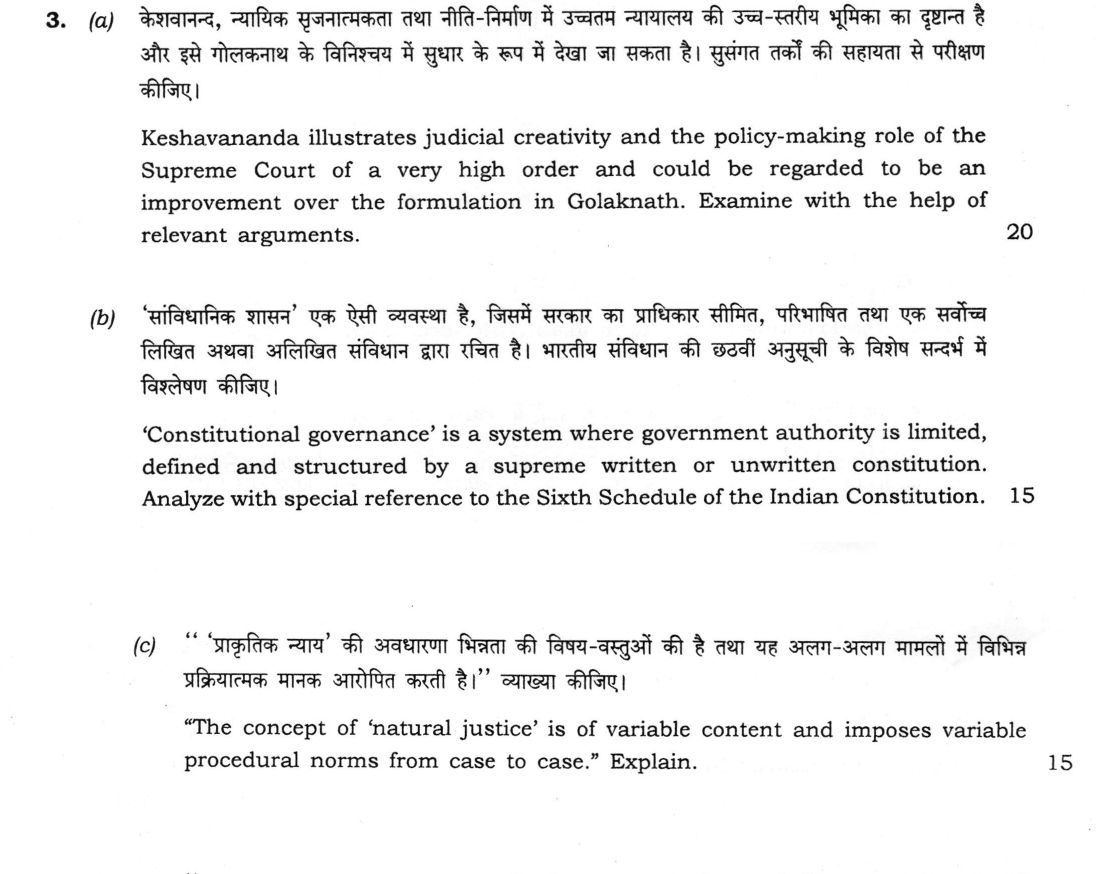
Keshavananda illustrates judicial creativity and the policy-making role of the Supreme Court of a very high order and could be regarded to be an improvement over the formulation in Golaknath. Examine with the help of relevant arguments. 20 marks
'Constitutional governance' is a system where government authority is limited, defined and structured by a supreme written or unwritten constitution. Analyze with special reference to the Sixth Schedule of the Indian Constitution. 15 marks
“The concept of ‘natural justice’ is of variable content and imposes variable procedural norms from case to case.” Explain. 15 marks
हिंदी में प्रश्न पढ़ें
केशवानन्द, न्यायिक सृजनात्मकता तथा नीति-निर्माण में उच्चतम न्यायालय की उच्च-स्तरीय भूमिका का दृष्टान्त है और इसे गोलकनाथ के विनिश्चय में सुधार के रूप में देखा जा सकता है। सुसंगत तर्कों की सहायता से परीक्षण कीजिए। (20 अंक)
'सांविधानिक शासन' एक ऐसी व्यवस्था है, जिसमें सरकार का प्राधिकार सीमित, परिभाषित तथा एक सर्वोच्च लिखित अथवा अलिखित संविधान द्वारा रचित है। भारतीय संविधान की छठवीं अनुसूची के विशेष सन्दर्भ में विश्लेषण कीजिए। (15 अंक)
‘‘ ‘प्राकृतिक न्याय’ की अवधारणा परिवर्तनशील विषय-वस्तु वाली है तथा यह अलग-अलग मामलों में विभिन्न प्रक्रियात्मक मानक आरोपित करती है।’’ व्याख्या कीजिए। (15 अंक)
Model answer
Drafted with AI by UPSC Answer Check against this question's marking rubric, to the expected length. UPSC does not publish answers for Mains — this is one way to score well, not an official key. How we build rubrics and answers.
(a) Kesavananda as an Improvement over Golaknath
Keshavananda Bharati v. State of Kerala (1973) represents a significant doctrinal and policy improvement over I.C. Golaknath v. State of Punjab (1967). Earlier, Shankari Prasad (1951) and Sajjan Singh (1965) had held that an amendment under Article 368 is not "law" under Article 13, though in Sajjan Singh Hidayatullah and Mudholkar JJ. doubted this, Mudholkar J. speaking of "basic features". In Golaknath, a Bench of 11 Judges (6:5) held that a constitutional amendment is a "law" under Article 13(2) and thus cannot abrogate Fundamental Rights; it located the amending power in the residuary power (Article 248 and Entry 97 of List I), treating Article 368 as merely procedural. However, it adopted the "prospective overruling" doctrine, leaving the validity of past amendments (like the 1st, 4th, and 17th) untouched. This created a constitutional anomaly where the validity of amendments depended on their date of enactment.
Parliament responded with the 24th, 25th and 29th Amendments. Kesavananda Bharati (13 Judges, 7:6, decided on 24 April 1973) corrected this by holding that Parliament possesses the power to amend any part of the Constitution, including Fundamental Rights, but this power is subject to the "Basic Structure" doctrine. It upheld the 24th Amendment (which had declared that the amending power is not a "law" under Article 13) but struck down the second limb of Article 31C (inserted by the 25th Amendment), which had purported to place all laws implementing Directive Principles beyond judicial review.
The "improvement" lies in the balance it struck: it preserved the supremacy of the Constitution by defining an unamendable core (Basic Structure) while allowing the legislature the flexibility to amend the rest. This "judicial creativity" was vindicated in Minerva Mills (1980), where the Court struck down clauses (4) and (5) of Article 368 (inserted by the 42nd Amendment) which had attempted to negate the Court's power to review amendments. The doctrine has since been applied in I.R. Coelho (2007) and the NJAC case (2015), establishing a robust check on constituent power; Waman Rao (1981) fixed 24 April 1973 as the cut-off date for its application to Ninth Schedule laws.
The creativity is also open to criticism. Drawing on Dietrich Conrad's argument about implied limits on the amending power and the example of Article 79(3) of the German Basic Law, the Court read in a limit that has no textual basis. Its content remains indeterminate and is decided case by case, and critics raise the counter-majoritarian objection that unelected judges fix the limits of constituent power. On balance, however, Kesavananda is an improvement: unlike Golaknath, it does not freeze Fundamental Rights and allows social-reform amendments, while protecting only the Constitution's core identity.
(b) Constitutional Governance and the Sixth Schedule
Constitutional governance is a system where government authority is limited, defined, and structured by a supreme constitution. The Sixth Schedule of the Indian Constitution is a prime example of this, providing for "Asymmetric Federalism" through Autonomous District Councils (ADCs) and Regional Councils in Assam, Meghalaya, Tripura, and Mizoram.
The authority of these Councils is "defined" and "limited" by the Schedule. Under Paragraph 3, their legislative competence is restricted to specific subjects such as land, forest (other than reserved forest), jhum cultivation, inheritance, and social customs. Crucially, any law passed by a Council requires the assent of the Governor (Paragraph 3(3)), which acts as a constitutional check on their autonomy.
The Schedule also structures their judicial and executive powers. Paragraphs 4 and 5 allow for the constitution of village courts and the conferment of civil/criminal powers, but with appeals lying to the District Council or High Court. Financially, their authority is structured through the District Fund (Paragraph 7) and the power to levy specific taxes and collect land revenue (Paragraph 8). Furthermore, Paragraph 16 provides for the dissolution of a Council by the Governor on the recommendation of a Commission appointed under Paragraph 14, or for the Governor to assume its functions where the administration of the district cannot be carried on in accordance with the Schedule. Paragraph 2 fixes the composition (normally not more than 30 members, of whom up to 4 are nominated by the Governor and the rest elected by adult suffrage), Paragraph 9 gives the Councils a share of mineral royalties, and Paragraphs 12A, 12AA and 12B make State law prevail over a repugnant Council law in Meghalaya, Tripura and Mizoram. The scheme flows from Article 244(2), with grants under Article 275(1), and differs from the Fifth Schedule (Article 244(1)), under which Tribes Advisory Councils only advise and the Governor directly adapts laws, and from the special provisions for Nagaland and Mizoram (Articles 371A and 371G). Thus, the Sixth Schedule creates a tier of governance that is autonomous yet strictly bounded by constitutional limits.
(c) Variable Content of Natural Justice
The concept of 'natural justice' is not a rigid code but a flexible principle of variable content. It is founded on two core rules: nemo judex in causa sua (no one should be a judge in their own cause) and audi alteram partem (hear the other side). As articulated by Tucker L.J. in Russell v. Duke of Norfolk [1949], the requirements of natural justice depend on the circumstances of the case, the nature of the inquiry and the rules under which the tribunal acts.
The "variable content" of these rules is demonstrated by how they adapt to the statutory framework and the nature of the inquiry. For instance, in A.K. Kraipak v. Union of India (1969), the Court held that the rules of natural justice apply to administrative inquiries as well, that the line between administrative and quasi-judicial power is thin, and that what the rules require depends on the facts and the statutory framework; a selection board member who was himself a candidate created a real likelihood of bias. Conversely, in Union of India v. Tulsiram Patel (1985), the Court held that the audi alteram partem rule can be excluded by an express constitutional or statutory provision or by necessary implication, as the second proviso to Article 311(2) does. In Bihar School Examination Board v. Subhas Chandra Sinha (1970), no individual hearing was needed before cancelling an examination marred by mass copying, and the doctrine of necessity allows even an interested adjudicator to act where no one else can.
Similarly, the audi alteram partem rule varies in its procedural requirements. In Swadeshi Cotton Mills v. Union of India (1981), the Court held that a pre-decisional hearing is the rule and a "post-decisional hearing" an exception permissible in urgent cases, as Maneka Gandhi (1978) had accepted for passport impounding. In ECIL v. B. Karunakar (1993), the inquiry report had to be supplied to the delinquent employee, but relief depended on showing prejudice. The requirement to give reasons also varies; while Siemens Engineering (1976) made it mandatory for quasi-judicial authorities, Kranti Associates (2010) extended it to administrative actions affecting rights. Thus, the "procedural norms" imposed by natural justice are not fixed but are determined by the context, the subject matter, and the consequences of the administrative action.
How this answer will be evaluated
Evaluation rubric
Each sub-part is marked on its own, against the marks and word limit printed on the paper.
- (a) 'Examine with the help of relevant arguments' requires a reasoned comparison, not narration: state what Golaknath held, what Kesavananda held, and then argue specifically why Kesavananda represents an improvement — both doctrinally and in its policy consequences — while acknowledging the criticisms of judicial creativity that the basic structure doctrine invites. 20 marks
Must cover
- Shankari Prasad (1951) and Sajjan Singh (1965)
- I.C. Golaknath v. State of Punjab, AIR 1967 SC 1643 — 11 Judges, 6:5, prospective overruling, Entry 97 List I
- 24th, 25th and 29th Constitutional Amendments
- Kesavananda Bharati v. State of Kerala, (1973) 4 SCC 225 — 13 Judges, 7:6, 24 April 1973
- Basic structure doctrine; 24th Amendment upheld; second limb of Article 31C struck down
- Minerva Mills (1980) — Article 368(4) and (5) struck down
- Why it is an improvement over Golaknath, and the criticisms of judicial creativity (no textual basis, indeterminacy, counter-majoritarian objection)
Loses marks
- Narrating the cases chronologically without ever advancing the comparative argument the question demands.
- Getting bench strengths or the split wrong: Golaknath was 11 Judges by 6:5, Kesavananda 13 Judges by 7:6 — these are checkable and frequently misstated.
- Saying Kesavananda struck down the 24th Amendment; it upheld the 24th Amendment and struck down only the second part of Article 31C inserted by the 25th.
- Attributing the striking down of Article 368(4) and (5) to Kesavananda; those clauses were inserted by the 42nd Amendment in 1976 and struck down in Minerva Mills (1980).
- Claiming that basic structure review applies to ordinary legislation; it applies to constitutional amendments, ordinary laws being tested against the provisions of the Constitution themselves (see Indira Gandhi and Kuldip Nayar v. Union of India, (2006) 7 SCC 1).
- Offering no criticism of the doctrine, although the question invites examination of judicial creativity and the policy-making role.
Earns more
- Sets the pre-Golaknath position: Shankari Prasad v. Union of India, AIR 1951 SC 458 (First Amendment upheld; 'law' in Article 13 does not include a constitutional amendment made under Article 368) and Sajjan Singh v. State of Rajasthan, AIR 1965 SC 845 (17th Amendment upheld by a 3-judge majority, with Hidayatullah and Mudholkar JJ. concurring in the result but doubting Shankari Prasad, and Mudholkar J. first using the language of 'basic features' of the Constitution).
- Presents the case for and against the judicial creativity involved, with the later history: in support, Dietrich Conrad's argument on implied limitations on the amending power (his 1965 Banaras Hindu University lecture) and the comparative example of Article 79(3) of the German Basic Law; against, the absence of any textual foundation, the indeterminacy of the content of 'basic structure' and the counter-majoritarian objection that an unelected court is setting the boundaries of constituent power. Notes the doctrine's later vindication: Indira Nehru Gandhi v. Raj Narain, 1975 Supp SCC 1; Minerva Mills v. Union of India, (1980) 3 SCC 625 (Article 368(4) and (5), inserted by the 42nd Amendment, struck down; limited amending power and the balance between Parts III and IV held to be basic features); Waman Rao v. Union of India, (1981) 2 SCC 362 (24 April 1973 as the cut-off date); I.R. Coelho v. State of Tamil Nadu, (2007) 2 SCC 1; and Supreme Court Advocates-on-Record Assn. v. Union of India, (2016) 5 SCC 1.
Extra mark
- Waman Rao (1981) — 24 April 1973 cut-off
- I.R. Coelho (2007); NJAC case (Supreme Court Advocates-on-Record Assn., (2016) 5 SCC 1)
- Dietrich Conrad's implied limitations argument; Article 79(3) German Basic Law
- Article 13(2) and Article 13(4); Article 368(3) inserted by the 24th Amendment
- (b) 'Analyse with special reference to the Sixth Schedule' requires the candidate to define constitutional governance as limited, defined and structured authority, and then to demonstrate it through the concrete example of the Sixth Schedule — the Autonomous District and Regional Councils, their constitutionally defined legislative, judicial, executive and financial powers, and the constitutionally fixed checks upon them. 15 marks
Must cover
- Article 244(2) and Article 275(1)
- Assam, Meghalaya, Tripura and Mizoram as the four States covered
- Autonomous District Councils and Regional Councils; Paragraph 2 composition (not more than 30 members, up to 4 nominated)
- Paragraph 3 legislative subjects — land, forest other than reserved forest, jhum cultivation, inheritance, marriage and divorce, social customs
- Paragraph 3(3) — Governor's assent
- Paragraphs 4 and 5 — village courts and conferment of civil/criminal court powers
- Paragraphs 7, 8 and 9 — District Fund, land revenue, taxes and mineral royalties
- Paragraph 14 Commission and Paragraph 16 dissolution/assumption by the Governor
Loses marks
- Writing only on constitutional governance in the abstract and disposing of the Sixth Schedule in one sentence; the question makes it the centre of the answer.
- Confusing the Fifth Schedule with the Sixth, or naming the wrong States — the Sixth Schedule covers Assam, Meghalaya, Tripura and Mizoram only.
- Stating that the Councils may legislate on reserved forests; Paragraph 3 covers forests other than reserved forests.
- Omitting the Governor's assent requirement, which is precisely the 'limited and structured' element the question is aimed at.
- Treating the Councils as sovereign or as a third tier of federalism on a par with States; they exercise delegated constitutional authority subject to defined checks.
Earns more
- Describes the composition and constitution of the Councils under Paragraph 2: a District Council of not more than thirty members, of whom not more than four are nominated by the Governor and the rest elected on the basis of adult suffrage, with a normal term of five years; Regional Councils for regions within an autonomous district; and the Governor's power under Paragraph 1 to constitute, divide, alter the boundaries of or rename autonomous districts and regions.
- Covers the judicial, executive and financial powers: Paragraph 4 (constitution of village councils and courts for the trial of suits and cases between parties all of whom belong to Scheduled Tribes, with appeals to the District Council, the High Court's jurisdiction being specified by the Governor); Paragraph 5 (conferment of the powers of a civil or criminal court on the Council); Paragraph 6 (establishment and management of primary schools, dispensaries, markets, cattle pounds, ferries, fisheries, roads and waterways); Paragraph 8 (assessment and collection of land revenue and levy of specified taxes); Paragraph 9 (share in royalties from licences or leases for the extraction of minerals); Paragraph 10 (regulation of money-lending and trading by non-tribals); and Paragraph 7 (District Fund and Regional Fund).
Extra mark
- Paragraphs 12A, 12AA and 12B — State law prevails over repugnant Council law
- Fifth Schedule under Article 244(1) contrasted; Articles 371A and 371G
- Asymmetric federalism / constitutionally structured autonomy
- (c) 'Explain' the proposition that natural justice has no fixed content: state the two core rules, then demonstrate with authority that what the rules require varies with the statutory framework, the nature of the inquiry, the subject matter and the consequences — including situations where the rules are curtailed or excluded altogether. 15 marks
Must cover
- Nemo judex in causa sua and audi alteram partem
- Russell v. Duke of Norfolk, [1949] 1 All ER 109 — Tucker L.J.'s formulation
- A.K. Kraipak v. Union of India, (1969) 2 SCC 262
- Maneka Gandhi v. Union of India, (1978) 1 SCC 248
- Swadeshi Cotton Mills v. Union of India, (1981) 1 SCC 664 — post-decisional hearing
- Union of India v. Tulsiram Patel, (1985) 3 SCC 398 — exclusion by express provision or necessary implication
Loses marks
- Merely defining the two rules and stopping, without demonstrating variability — which is the entire proposition in the quotation.
- Asserting that natural justice can never be excluded; statutory exclusion, impracticability, urgency and necessity are well-established exceptions.
- Confusing a post-decisional hearing (permitted exceptionally) with the normal rule of a pre-decisional hearing.
- Citing Kraipak without stating its ratio — that the rules extend to administrative action and that their content depends on the facts and the statutory framework.
- Ignoring the Indian statutory context entirely and writing only on English cases, or vice versa.
Earns more
- Illustrates the variable content with concrete Indian applications: Maneka Gandhi v. Union of India, (1978) 1 SCC 248 (audi alteram partem read into Section 10(3)(c) of the Passports Act, 1967, with a post-decisional hearing accepted); Swadeshi Cotton Mills v. Union of India, (1981) 1 SCC 664 (a pre-decisional hearing is the rule, a post-decisional hearing the exception, permissible where urgency demands); Managing Director, ECIL v. B. Karunakar, (1993) 4 SCC 727 (the inquiry officer's report must be furnished to the delinquent, but relief depends on proof of prejudice); Mohinder Singh Gill v. Chief Election Commissioner, (1978) 1 SCC 405 (an order must be judged by the reasons it records and cannot be supplemented later by affidavit); and the duty to give reasons — Siemens Engineering and Manufacturing Co. v. Union of India, (1976) 2 SCC 981 and Kranti Associates v. Masood Ahmed Khan, (2010) 9 SCC 496.
- Adds the debate on consequences, showing the remedy is also variable: S.L. Kapoor v. Jagmohan, (1980) 4 SCC 379 (non-observance of natural justice is itself prejudice, and the 'useless formality' argument was rejected), contrasted with Dharampal Satyapal Ltd. v. Deputy Commissioner of Central Excise, (2015) 8 SCC 519 and ECIL v. Karunakar, which apply a prejudice or useless-formality test; and the related doctrine of legitimate expectation (Food Corporation of India v. Kamdhenu Cattle Feed Industries, (1993) 1 SCC 71; Navjyoti Co-operative Group Housing Society v. Union of India, (1992) 4 SCC 477), which generates a duty of fairness of differing intensity depending on the expectation.
Extra mark
- Bihar School Examination Board v. Subhas Chandra Sinha, AIR 1970 SC 1269
- Doctrine of necessity; R. v. Sussex Justices, ex parte McCarthy, [1924] 1 KB 256
- ECIL v. B. Karunakar, (1993) 4 SCC 727 — prejudice test
- Duty to give reasons — Siemens Engineering (1976); Kranti Associates (2010)
What "Examine" is asking you to do
Test the proposition the question puts to you and return a finding on how far it holds. Examine stems carry a claim, or ask whether something has happened, and expect evidence weighed both ways before the extent is stated — often with remedial measures attached.
Structure that answers it
Restate the claim as the question frames it → evidence that supports it → evidence that undercuts it → the conditions under which it holds → verdict on how far it stands
Where marks are lost
Stopping at description. An examination has to reach a finding, and “examine with justification” means the extent must be stated, not implied.
Practice this exact question
Write your answer and it is marked point by point against the model answer above — what you covered, what you missed, what you got wrong.
Evaluate my answer →More from Law 2026 Paper I
- Q1 Answer the following questions in about 150 words each : (a) “The ‘Doctrine of Pleasure’…
- Q2 (a) "While interpreting Article 21 of the Constitution, the Supreme Court introduced the…
- Q3 (a) Keshavananda illustrates judicial creativity and the policy-making role of the Suprem…
- Q4 (a) “The Supreme Court of India is a multi-jurisdictional Court and may be regarded as th…
- Q5 Answer the following questions in about 150 words each : (a) Whether International Law is…
- Q6 (a) “The present world economic order is supposed to be guided by the operation of free m…