Paper I — Q2
(a) "While interpreting Article 21 of the Constitution, the Supreme Court introduced the concept of 'due process of law'…
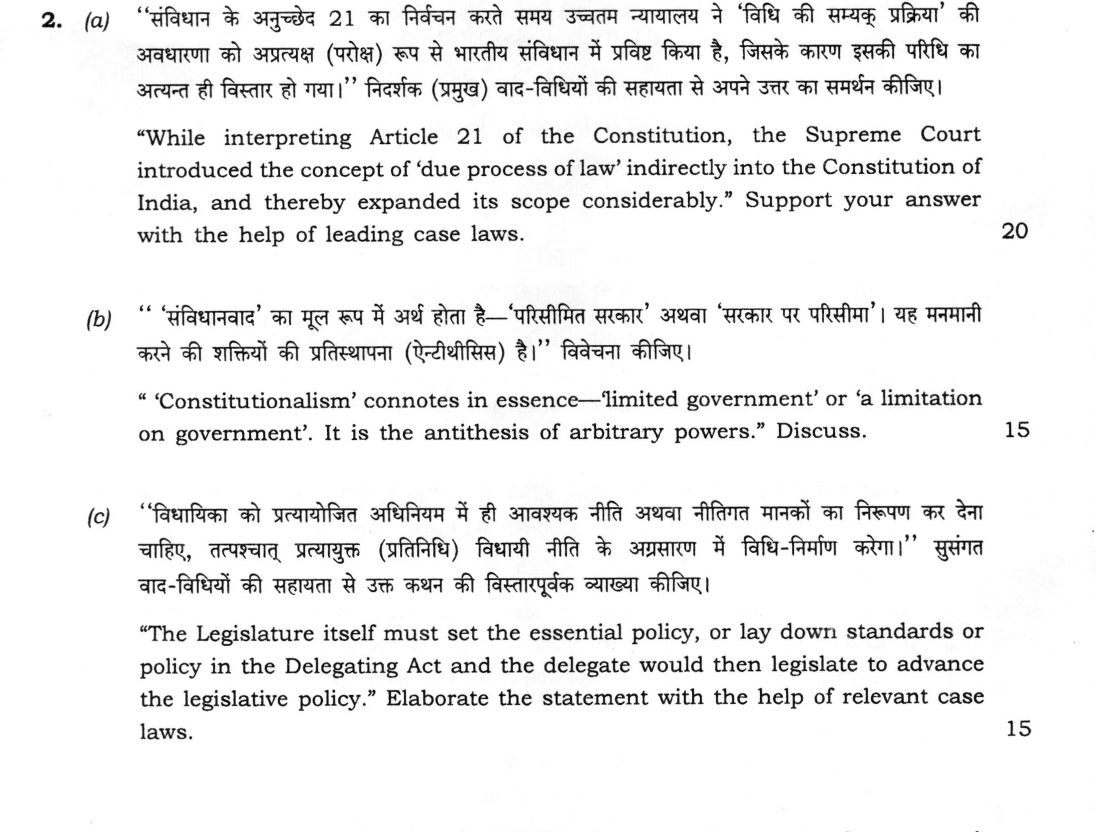
"While interpreting Article 21 of the Constitution, the Supreme Court introduced the concept of 'due process of law' indirectly into the Constitution of India, and thereby expanded its scope considerably." Support your answer with the help of leading case laws. 20 marks
" 'Constitutionalism' connotes in essence—'limited government' or 'a limitation on government'. It is the antithesis of arbitrary powers." Discuss. 15 marks
"The Legislature itself must set the essential policy, or lay down standards or policy in the Delegating Act and the delegate would then legislate to advance the legislative policy." Elaborate the statement with the help of relevant case laws. 15 marks
हिंदी में प्रश्न पढ़ें
"संविधान के अनुच्छेद 21 का निर्वचन करते समय उच्चतम न्यायालय ने 'विधि की सम्यक् प्रक्रिया' की अवधारणा को अप्रत्यक्ष (परोक्ष) रूप से भारतीय संविधान में प्रविष्ट किया है, जिसके कारण इसकी परिधि का अत्यन्त ही विस्तार हो गया।" निर्देशक (प्रमुख) वाद-विधियों की सहायता से अपने उत्तर का समर्थन कीजिए। (20 अंक)
" 'संविधानवाद' का मूल रूप में अर्थ होता है—'परिसीमित सरकार' अथवा 'सरकार पर परिसीमा'। यह मनमानी करने की शक्तियों की विपरीत अवधारणा (ऐन्टीथीसिस) है।" विवेचना कीजिए। (15 अंक)
"विधायिका को प्रत्यायोजक अधिनियम में ही आवश्यक नीति अथवा नीतिगत मानकों का निरूपण कर देना चाहिए, तत्पश्चात् प्रत्यायुक्त (प्रतिनिधि) विधायी नीति के अग्रसारण में विधि-निर्माण करेगा।" सुसंगत वाद-विधियों की सहायता से उक्त कथन की विस्तारपूर्वक व्याख्या कीजिए। (15 अंक)
Model answer
Drafted with AI by UPSC Answer Check against this question's marking rubric, to the expected length. UPSC does not publish answers for Mains — this is one way to score well, not an official key. How we build rubrics and answers.
(a) Article 21 and the Entry of 'Due Process'
The Supreme Court of India has transformed Article 21 from a mere procedural guarantee into a substantive reservoir of rights, effectively importing the concept of 'due process of law' while formally maintaining that the phrase was deliberately omitted from the Constitution.
Initially, in A.K. Gopalan v. State of Madras (AIR 1950 SC 27), the Court adopted the Japanese concept of 'procedure established by law,' holding that Article 21 was satisfied if a valid law existed, regardless of its fairness. This compartmentalised view was challenged in Kharak Singh v. State of U.P. (AIR 1963 SC 1295), where the majority struck down domiciliary visits but upheld other surveillance, though Justice Subba Rao’s dissent located a right to privacy within Article 21. The doctrinal shift began in R.C. Cooper v. Union of India (1970), which discarded *Gopalan*’s compartmentalisation in favor of a 'direct and inevitable effect' test.
The definitive move occurred in Maneka Gandhi v. Union of India (1978), where the Court held that the procedure must be "right, just and fair" and not "arbitrary, fanciful or oppressive"; a mere enacted law is not enough. This established the 'Golden Triangle' of Articles 14, 19, and 21, requiring that any law restricting liberty be reasonable and non-arbitrary. Consequently, the scope of Article 21 expanded to include the right to a speedy trial (Hussainara Khatoon, 1980), the right to live with human dignity (Francis Coralie Mullin, 1981), the right to livelihood (Olga Tellis, 1985), and the right to privacy (Justice K.S. Puttaswamy v. Union of India, (2017) 10 SCC 1). In Puttaswamy, the nine-judge Bench also applied the four-fold proportionality test (legality, legitimate aim, necessity, balancing) to limitations on privacy and expressly overruled ADM Jabalpur.
The Court has also exercised substantive review, striking down the mandatory death sentence under Section 303 IPC in Mithu v. State of Punjab (1983) as unjust and unfair (its successor, Section 104 of the Bharatiya Nyaya Sanhita, 2023, provides death or imprisonment for the remainder of natural life, not a mandatory death sentence) — review of the law itself, not merely its procedure. While the Court has not adopted American substantive due process wholesale—as noted in Rajbala v. State of Haryana (2016)—it has applied its substance. This expansion is structurally reinforced by the 44th Amendment (1978), which made Articles 20 and 21 non-suspendable even during an emergency.
(b) Constitutionalism as Limited Government
Constitutionalism, as defined by theorists like C.H. McIlwain and Carl J. Friedrich, is the normative idea of 'limited government' and serves as the antithesis of arbitrary power. It is distinct from a mere 'constitution'; a state may have a written constitution without possessing constitutionalism, a distinction highlighted by Loewenstein’s typology of semantic constitutions.
The essence of constitutionalism is the limitation of state power through the rule of law (A.V. Dicey) and the separation of powers (Montesquieu). In the Indian context, constitutionalism is institutionalised through several devices:
- Fundamental Rights (Part III): These act as direct limitations on the State.
- Judicial Review: Articles 32 and 226 empower the judiciary to strike down arbitrary state action.
- Basic Structure Doctrine: Established in Kesavananda Bharati (1973) and reaffirmed in Minerva Mills (1980), this doctrine limits the amending power of Parliament, ensuring that the 'limited government' itself is a basic feature that cannot be destroyed.
- Anti-Arbitrariness: In E.P. Royappa v. State of Tamil Nadu (1974), the Court held that arbitrariness is the enemy of equality, making Article 14 a tool against capricious state action.
- Federalism and independent institutions: The division of powers between the Union and States, an independent judiciary, the Election Commission (Art. 324), the CAG (Art. 148) and universal adult suffrage (Art. 326) keep power accountable.
However, the proposition is best tested against episodes where constitutionalism was strained. The 1975-77 Emergency and the ADM Jabalpur judgment (1976) represented a failure of constitutionalism, where the State claimed absolute power. This was corrected by the 44th Amendment and the subsequent overruling of ADM Jabalpur in Puttaswamy (2017). Similarly, the misuse of Article 356 was checked in S.R. Bommai (1994), and the abuse of ordinance-making power was addressed in D.C. Wadhwa (1987). These judicial interventions demonstrate that constitutionalism in India is a dynamic process of checking arbitrary power.
(c) Essential Legislative Function and Delegated Legislation
The doctrine of delegated legislation rests on the principle that while the Legislature can delegate the power to make rules, it cannot abdicate its essential legislative functions. As the statement suggests, the Legislature must set the essential policy and lay down standards in the Delegating Act, while the delegate (Executive) is limited to filling in the details to advance that policy.
The foundational authority is In re Delhi Laws Act (AIR 1951 SC 332), where the Supreme Court held that the essential legislative function is to determine the policy and lay down the standards. The delegate can only carry out the legislative policy in detail. If the Legislature delegates its essential function, the resulting law is void.
The Court has applied this 'policy and guideline' test in several cases:
- In Harishankar Bagla v. State of Madhya Pradesh (1954), the Court upheld the delegation of power to the Central Government under the Essential Supplies (Temporary Powers) Act, 1946, as the essential policy was already laid down by the Legislature.
- Conversely, in Hamdard Dawakhana v. Union of India (1960), the Court struck down Section 3(d) of the Drugs and Magic Remedies (Objectionable Advertisements) Act, 1954, which gave the Executive unguided discretion to specify diseases, holding that such a standard was too vague and amounted to an abdication of legislative power.
- In Devi Das Gopal Krishnan v. State of Punjab (1967), the Court struck down a provision letting the Government fix sales-tax rates without any guidance, and in Rajnarain Singh v. Patna Administration Committee (1954) it held that the power to extend laws with modifications cannot be used to change essential policy.
- In Jalan Trading Co. v. Mill Mazdoor Sabha (1967), the Court invalidated Section 37 of the Payment of Bonus Act, 1965 — a 'Henry VIII'-type removal-of-difficulties clause that let the Government resolve doubts under the Act by final orders — as an impermissible delegation, whereas in Gammon India v. Union of India (1974) a narrower removal-of-difficulties clause (Section 34, Contract Labour Act, 1970) was upheld.
- In Gwalior Rayon v. Assistant Commissioner (1974), Mathew J. proposed the alternative 'abdication' test (delegation is valid so long as the Legislature retains the power to repeal or control), but the majority kept the 'policy and guideline' test.
Delegated legislation must also be distinguished from conditional legislation, where the Legislature enacts the law fully and leaves only the time or place of its application to the Executive (Queen v. Burah, 1878).
To ensure the delegate does not exceed these limits, several controls exist:
- Parliamentary Control: The laying of rules before Parliament (simple laying, or laying subject to negative or affirmative resolution) and scrutiny by the Committees on Subordinate Legislation (Lok Sabha 1953, Rajya Sabha 1964).
- Judicial Control: The doctrine of ultra vires, where the Court strikes down rules that are arbitrary or beyond the scope of the parent Act.
- Publication: Rules must be published in the Official Gazette to be valid, as held in Harla v. State of Rajasthan (1951).
Thus, the delegate's power is strictly ancillary to the legislative policy set by the Legislature.
How this answer will be evaluated
Evaluation rubric
Each sub-part is marked on its own, against the marks and word limit printed on the paper.
- (a) The candidate must trace, through leading cases, how the Supreme Court moved from 'procedure established by law' to a requirement of fair, just and reasonable procedure — effectively importing due process — and must then show the resulting expansion of Article 21 into a reservoir of substantive rights. The instruction 'support your answer with the help of leading case laws' makes correct case names, years and holdings the core of the marking. 20 marks
Must cover
- A.K. Gopalan v. State of Madras, AIR 1950 SC 27
- R.C. Cooper v. Union of India, (1970) 1 SCC 248
- Maneka Gandhi v. Union of India, (1978) 1 SCC 248 — 'right, just and fair'
- Golden triangle of Articles 14, 19 and 21
- Francis Coralie Mullin (1981); Olga Tellis (1985); Hussainara Khatoon (1979-80)
- Mithu v. State of Punjab, (1983) 2 SCC 277
- Justice K.S. Puttaswamy v. Union of India, (2017) 10 SCC 1 and the proportionality test
- 44th Amendment, 1978 — Articles 20 and 21 non-suspendable under Article 359(1)
Loses marks
- Listing a dozen Article 21 rights without ever explaining the doctrinal move from Gopalan to Maneka, which is what the question actually asks.
- Attributing the overruling of Gopalan to Maneka Gandhi alone; the compartmentalisation was first broken in R.C. Cooper (1970), and Maneka built on it.
- Stating that Article 21 now contains 'due process' in terms; the Court has imported the substance while formally maintaining that the expression was deliberately omitted.
- Getting years or citations wrong — Maneka is 1978, Kesavananda 1973, Puttaswamy 2017, Olga Tellis 1985; a wrong year attached to a leading case is a visible error.
- Omitting Puttaswamy and the proportionality standard, which is the current operative test for a limitation on Article 21.
- Treating ADM Jabalpur as still good law; it was expressly overruled in Puttaswamy (2017).
Earns more
- Traces the intermediate steps: Kharak Singh v. State of U.P., AIR 1963 SC 1295 (domiciliary night visits under U.P. Police Regulation 236(b) struck down as violating personal liberty; Subba Rao J.'s dissent locating a right to privacy in Article 21); Satwant Singh Sawhney v. D. Ramarathnam, AIR 1967 SC 1836 (right to travel abroad is part of personal liberty); and Rustom Cavasjee Cooper v. Union of India, (1970) 1 SCC 248 (the Bank Nationalisation case) which discarded Gopalan's compartmentalisation and adopted the test of the direct and inevitable effect of State action on the right.
- Shows the substantive limb and the modern doctrinal frame: Mithu v. State of Punjab, (1983) 2 SCC 277 (Section 303 IPC, mandatory death sentence, struck down as unjust and unfair — substantive review of the law itself); Bachan Singh v. State of Punjab, (1980) 2 SCC 684 (rarest of rare); Selvi v. State of Karnataka, (2010) 7 SCC 263 (involuntary narco-analysis, polygraph and brain mapping violate Articles 20(3) and 21); Justice K.S. Puttaswamy v. Union of India, (2017) 10 SCC 1 (9 Judges; privacy is intrinsic to Articles 14, 19 and 21; the four-fold proportionality test of legality, legitimate aim, necessity and balancing; M.P. Sharma and the majority in Kharak Singh overruled to that extent; ADM Jabalpur v. Shivkant Shukla, (1976) 2 SCC 521 expressly overruled); Navtej Singh Johar v. Union of India, (2018) 10 SCC 1 and Joseph Shine v. Union of India, (2019) 3 SCC 39.
- Adds the critical or qualifying observation that the Court has not adopted American substantive due process wholesale — it has repeatedly said the expression is not part of the Indian Constitution while applying its substance, and in Rajbala v. State of Haryana, (2016) 2 SCC 445 it doubted the availability of substantive due process as a ground of invalidation; and notes the structural reinforcement in the Constitution (Forty-fourth Amendment) Act, 1978, which amended Article 359(1) so that the enforcement of Articles 20 and 21 cannot be suspended even during an emergency.
Extra mark
- Kharak Singh v. State of U.P., AIR 1963 SC 1295 and Subba Rao J.'s dissent
- Article 21A (86th Amendment, 2002)
- Drafting history: 'procedure established by law' from the Japanese Constitution; B.N. Rau and Justice Frankfurter
- (b) 'Discuss' the proposition that constitutionalism means limited government and is the antithesis of arbitrary power: define the concept and its theoretical sources, distinguish a constitution from constitutionalism, identify the devices through which the Indian Constitution institutionalises limitation, and test the claim against episodes where constitutionalism failed. 15 marks
Must cover
- C.H. McIlwain and Carl J. Friedrich on constitutionalism
- A.V. Dicey — rule of law; Montesquieu — separation of powers
- Constitution without constitutionalism; Loewenstein's normative/nominal/semantic typology
- Part III with Articles 32 and 226; judicial review; federalism; independent judiciary
- E.P. Royappa, (1974) 4 SCC 3 — arbitrariness is antithetic to equality
- Kesavananda Bharati (1973) and Minerva Mills (1980) — basic structure as limitation
- The 1975-77 Emergency and ADM Jabalpur as the counter-illustration
Loses marks
- Writing a general essay on the salient features of the Indian Constitution instead of engaging with constitutionalism as a normative idea.
- Treating 'constitution' and 'constitutionalism' as synonyms and thereby missing the pivot of the question.
- Naming no theorist — the examiner expects McIlwain, Friedrich, Dicey or Montesquieu at minimum.
- Asserting that India has an absolute separation of powers; the Indian scheme is functional separation with checks, not the American model.
- Offering no counter-illustration; an answer that never mentions a period or practice in which constitutionalism was strained reads as uncritical.
Earns more
- Locates the antithesis-of-arbitrariness claim in decided law: E.P. Royappa v. State of Tamil Nadu, (1974) 4 SCC 3 (equality is antithetic to arbitrariness; arbitrariness is the enemy of equality); Maneka Gandhi v. Union of India, (1978) 1 SCC 248; Kesavananda Bharati v. State of Kerala, (1973) 4 SCC 225 and the basic structure doctrine as the ultimate limitation, reaffirmed in Minerva Mills v. Union of India, (1980) 3 SCC 625 (limited government is itself a basic feature, and a limited amending power cannot be enlarged into an unlimited one); I.R. Coelho v. State of Tamil Nadu, (2007) 2 SCC 1 (constitutionalism discussed expressly); and Shayara Bano v. Union of India, (2017) 9 SCC 1 on manifest arbitrariness.
- Tests the proposition against Indian experience where constitutionalism was strained and the judicial correctives: the Emergency of 25 June 1975 to 21 March 1977 and ADM Jabalpur v. Shivkant Shukla, (1976) 2 SCC 521, corrected by the 44th Amendment, 1978 and overruled in Puttaswamy (2017); the misuse of Article 356 and S.R. Bommai v. Union of India, (1994) 3 SCC 1; Rameshwar Prasad v. Union of India, (2006) 2 SCC 1 (dissolution of the Bihar Assembly held mala fide); D.C. Wadhwa v. State of Bihar, (1987) 1 SCC 378 (re-promulgation of ordinances is a fraud on the Constitution), reaffirmed in Krishna Kumar Singh v. State of Bihar, (2017) 3 SCC 1; and the growth of unguided delegated legislation as a continuing threat.
Extra mark
- S.R. Bommai v. Union of India, (1994) 3 SCC 1
- D.C. Wadhwa v. State of Bihar, (1987) 1 SCC 378
- Article 324 (Election Commission), Article 148 (CAG), Article 326 (adult suffrage)
- (c) 'Elaborate with the help of relevant case laws' requires the candidate to explain the doctrine that essential legislative functions — laying down policy and standards — cannot be delegated, that the delegate may only fill in details to advance the declared policy, and to prove this through the Indian line of authority beginning with In re Delhi Laws Act. 15 marks
Must cover
- In re Delhi Laws Act, 1912, AIR 1951 SC 332 — essential legislative function
- Policy and guideline test; abdication test (Gwalior Rayon, (1974) 4 SCC 98)
- Hamdard Dawakhana v. Union of India, AIR 1960 SC 554
- Harishankar Bagla v. State of M.P., AIR 1954 SC 465
- Conditional legislation distinguished from delegated legislation
- Controls: laying procedures, Committee on Subordinate Legislation, substantive and procedural ultra vires
Loses marks
- Describing the advantages and disadvantages of delegated legislation generally instead of addressing the 'essential legislative function' limitation the quotation states.
- Citing In re Delhi Laws Act without stating what an essential legislative function is — the determination of policy and its conversion into a binding rule of conduct.
- Offering only cases that struck delegation down, giving the false impression that Indian courts are hostile to delegation; the practice is strongly permissive where policy is discoverable.
- Confusing conditional legislation (the legislature legislates fully and leaves only the fact of application to the executive) with delegated legislation.
- Ignoring case law entirely although the question expressly asks for it, or naming cases without holdings.
Earns more
- Gives at least two decisions upholding delegation because the policy was ascertainable, showing the doctrine is permissive in practice: Harishankar Bagla v. State of M.P., AIR 1954 SC 465 (Section 3 of the Essential Supplies (Temporary Powers) Act, 1946 upheld — policy of maintaining supplies and securing equitable distribution was laid down); Vasantlal Maganbhai Sanjanwala v. State of Bombay, AIR 1961 SC 4; Registrar of Co-operative Societies v. K. Kunjabmu, (1980) 1 SCC 340 (power of exemption upheld where the policy appeared from the Act); Avinder Singh v. State of Punjab, (1979) 1 SCC 137 (delegation of taxing power to a municipality upheld, subject to policy); Gammon India Ltd. v. Union of India, (1974) 1 SCC 596 (Section 34 of the Contract Labour (Regulation and Abolition) Act, 1970 upheld); St. John's Teachers Training Institute v. Regional Director, NCTE, (2003) 3 SCC 321.
- Completes the answer with the control mechanisms that make the doctrine workable: parliamentary control through laying procedures (simple laying, laying subject to negative resolution, and laying subject to affirmative resolution) and the Committee on Subordinate Legislation of the Lok Sabha, constituted in 1953, and of the Rajya Sabha in 1964; judicial control for substantive ultra vires (conflict with the parent Act or with the Constitution) and procedural ultra vires (non-compliance with mandatory conditions such as consultation or publication); and the requirement of publication — Harla v. State of Rajasthan, AIR 1951 SC 467 and State of Maharashtra v. M.H. George, AIR 1965 SC 722.
Extra mark
- Rajnarain Singh v. Chairman, Patna Administration Committee, AIR 1954 SC 569
- Devi Das Gopal Krishnan v. State of Punjab (1967)
- Henry VIII clause / removal of difficulties — Jalan Trading (1967) and Gammon India (1974)
- Harla v. State of Rajasthan, AIR 1951 SC 467 on publication
What "Discuss" is asking you to do
Lay the issue out from more than one side — how it arose, what is claimed for it, what is held against it, and where it now stands. UPSC attaches discuss to broad topics with several live dimensions, so coverage of the dimensions earns more than the strength of your opinion.
Structure that answers it
Set the issue up → the case as it is made → the case against → the dimension both sides leave out → where the balance now lies
Where marks are lost
Listing facts with no thread between them, or arguing one side throughout and calling it a discussion.
Practice this exact question
Write your answer and it is marked point by point against the model answer above — what you covered, what you missed, what you got wrong.
Evaluate my answer →More from Law 2026 Paper I
- Q1 Answer the following questions in about 150 words each : (a) “The ‘Doctrine of Pleasure’…
- Q2 (a) "While interpreting Article 21 of the Constitution, the Supreme Court introduced the…
- Q3 (a) Keshavananda illustrates judicial creativity and the policy-making role of the Suprem…
- Q4 (a) “The Supreme Court of India is a multi-jurisdictional Court and may be regarded as th…
- Q5 Answer the following questions in about 150 words each : (a) Whether International Law is…