Paper I — Q7
(a) Discuss the facts and the Principles of the Law of the Sea, emerged in ‘Corfu Channel Case’, with reference to the…
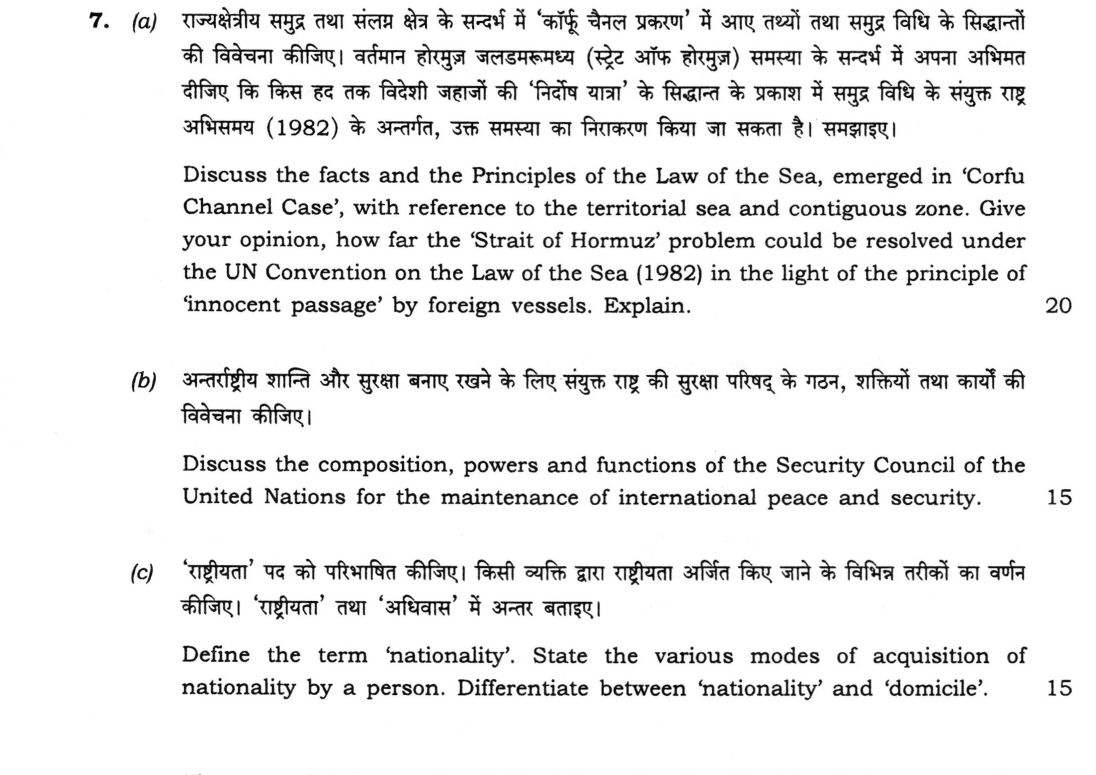
Discuss the facts and the Principles of the Law of the Sea, emerged in ‘Corfu Channel Case’, with reference to the territorial sea and contiguous zone. Give your opinion, how far the ‘Strait of Hormuz’ problem could be resolved under the UN Convention on the Law of the Sea (1982) in the light of the principle of ‘innocent passage’ by foreign vessels. Explain. 20 marks
Discuss the composition, powers and functions of the Security Council of the United Nations for the maintenance of international peace and security. 15 marks
Define the term ‘nationality’. State the various modes of acquisition of nationality by a person. Differentiate between ‘nationality’ and ‘domicile’. 15 marks
हिंदी में प्रश्न पढ़ें
राज्यक्षेत्रीय समुद्र तथा संलग्न क्षेत्र के सन्दर्भ में ‘कॉर्फू चैनल प्रकरण’ में आए तथ्यों तथा समुद्र विधि के सिद्धान्तों की विवेचना कीजिए। वर्तमान होरमुज़ जलडमरूमध्य (स्ट्रेट ऑफ होरमुज़) समस्या के सन्दर्भ में अपना अभिमत दीजिए कि किस हद तक विदेशी जहाजों की ‘निर्दोष यात्रा’ के सिद्धान्त के प्रकाश में समुद्र विधि के संयुक्त राष्ट्र अभिसमय (1982) के अन्तर्गत, उक्त समस्या का निराकरण किया जा सकता है। समझाइए। (20 अंक)
अन्तर्राष्ट्रीय शान्ति और सुरक्षा बनाए रखने के लिए संयुक्त राष्ट्र की सुरक्षा परिषद् के गठन, शक्तियों तथा कार्यों की विवेचना कीजिए। (15 अंक)
‘राष्ट्रीयता’ पद को परिभाषित कीजिए। किसी व्यक्ति द्वारा राष्ट्रीयता अर्जित किए जाने के विभिन्न तरीकों का वर्णन कीजिए। ‘राष्ट्रीयता’ तथा ‘अधिवास’ में अन्तर बताइए। (15 अंक)
Model answer
Drafted with AI by UPSC Answer Check against this question's marking rubric, to the expected length. UPSC does not publish answers for Mains — this is one way to score well, not an official key. How we build rubrics and answers.
(a) Corfu Channel Case and the Strait of Hormuz
The Corfu Channel Case (United Kingdom v. Albania, 1949) arose after Albanian shore batteries fired on British cruisers in the North Corfu Strait on 15 May 1946, and two British destroyers (HMS Saumarez and HMS Volage) struck mines there on 22 October 1946, killing 44 sailors. The strait lay within Albanian territorial waters. In its merits judgment of 9 April 1949, the International Court of Justice (ICJ) did not find that Albania had laid the mines itself, but held that it must have known of them and was responsible for failing to warn, on the basis of "elementary considerations of humanity" and every State's obligation not knowingly to allow its territory to be used for acts contrary to the rights of other States. It held the passage of 22 October lawful, and later awarded the UK £843,947 in compensation. The Court further held that the British "Operation Retail" (12–13 November 1946) was an unlawful intervention in Albania's sovereignty, rejecting the use of self-help; the Court's declaration of this violation was treated as appropriate satisfaction for Albania.
The case generated foundational principles of the Law of the Sea: warships possess a right of passage through straits used for international navigation without prior authorisation. This principle was codified in Article 16(4) of the Geneva Convention on the Territorial Sea and the Contiguous Zone (1958), which forbids the suspension of innocent passage. Under the UN Convention on the Law of the Sea (UNCLOS 1982, in force from 16 November 1994), the territorial sea may extend up to 12 nautical miles from the baselines (Article 3), and foreign ships enjoy innocent passage through it under Articles 17 to 32: passage is innocent so long as it is not prejudicial to the peace, good order or security of the coastal State (Article 19), submarines must navigate on the surface (Article 20), and the coastal State may temporarily suspend innocent passage in specified areas for security reasons (Article 25(3)). The contiguous zone may extend up to 24 nautical miles (Article 33; 12 miles under the 1958 Convention), where the coastal State may prevent and punish infringements of its customs, fiscal, immigration or sanitary laws; it gives no general security jurisdiction.
Regarding the Strait of Hormuz, which is roughly 21 nautical miles at its narrowest, the problem is governed by Part III of UNCLOS (Articles 37–44) concerning transit passage, not merely innocent passage. Transit passage, meaning continuous and expeditious passage by ships and aircraft (Article 38), cannot be suspended (Article 44), and States bordering the strait may not hamper it. The Strait lies between Iran on one side and Oman (the Musandam peninsula) on the other, with the UAE nearby. While Iran signed UNCLOS in 1982, it has not ratified it; on signing, it declared that transit passage is a treaty benefit only for States parties, and its domestic law requires prior authorisation for foreign warships. Oman is a party, while the United States is not a party but asserts transit passage as customary law and conducts freedom-of-navigation operations. However, the dominant view is that transit passage reflects customary international law. Consequently, any closure of the Strait would be an internationally wrongful act, violating Article 2(4) of the UN Charter and Article 301 of UNCLOS on peaceful uses of the seas, and it could not be justified as a countermeasure, because countermeasures may not involve the threat or use of force. Procedurally, Part XV of UNCLOS offers limited recourse due to the military activities exception in Article 298(1)(b). Iran, not being a party, is also not bound by Part XV. Therefore, as the Tanker War (1980-88) and Oil Platforms (ICJ, 2003) show, the realistic resolution of the Hormuz problem lies in diplomatic negotiation and Security Council intervention rather than adjudicative measures; UNCLOS clarifies the legal rights but cannot by itself enforce them.
(b) Security Council: Composition, Powers and Functions
The Security Council is the principal organ of the United Nations responsible for the maintenance of international peace and security. Its composition, powers, and functions are defined in the UN Charter.
Composition: Under Article 23, the Council consists of 15 members: five permanent members (China, France, Russia, the UK, and the USA) and ten non-permanent members elected by the General Assembly for two-year terms, five each year, without immediate re-election. The 1963 amendment, in force from 1965, raised the non-permanent seats from six to ten. Article 24 grants the Council primary responsibility for peace and security, while Article 25 makes its decisions binding on all UN members. Article 27 establishes the voting rule: nine affirmative votes for procedural matters, and nine affirmative votes including the concurring votes of the permanent members (the veto) for all other matters, with a party to a dispute required to abstain in decisions under Chapter VI. The Namibia advisory opinion (1971) clarified that voluntary abstention by a permanent member does not constitute a veto.
Powers and Functions: The Council’s powers are divided into two chapters. Chapter VI (Articles 33–38) provides for the peaceful settlement of disputes through recommendatory measures. Chapter VII empowers the Council to determine the existence of a threat to the peace, breach of the peace or act of aggression (Article 39), call for provisional measures (Article 40), and take enforcement action, ranging from non-military sanctions (Article 41) to the use of armed force (Article 42). Under Article 41 it created the ICTY (Resolution 827, 1993) and the ICTR (Resolution 955, 1994). Article 51 preserves the right of self-defence until the Council acts. Although Article 43 agreements for standing forces were never concluded, the Council has established peacekeeping operations, which the ICJ in Certain Expenses (1962) upheld as legitimate expenses of the Organization under Article 17(2). Peacekeeping has no express Charter basis and is often described as 'Chapter Six and a Half'.
Additionally, the Council performs other constitutional functions, such as recommending the admission of new members (Article 4(2)), electing ICJ judges together with the General Assembly (Articles 8 and 10, ICJ Statute), and referring situations to the International Criminal Court under Article 13(b) of the Rome Statute, as seen in the cases of Darfur (Resolution 1593, 2005) and Libya (Resolution 1970, 2011). It also recommends the appointment of the Secretary-General (Article 97), may take measures to enforce ICJ judgments (Article 94(2)) and may request advisory opinions (Article 96(1)).
Its limitations are equally important: the veto makes its responsibility dependent on great-power agreement, prompting the Uniting for Peace Resolution 377 (V) of 1950 and the veto initiative in General Assembly Resolution 76/262 (2022); the permanent membership is unrepresentative, which the G-4, Uniting for Consensus and the African Union's Ezulwini Consensus seek to address; and whether its decisions are subject to legal review was raised but left open in the Lockerbie orders (1992) and Prosecutor v. Tadic (1995).
(c) Nationality: Acquisition and Distinction from Domicile
Nationality is the legal bond of allegiance between an individual and a State, which determines the State's right to exercise diplomatic protection. Under Article 1 of the Hague Convention on Certain Questions relating to the Conflict of Nationality Laws (1930), each State determines under its own law who its nationals are, and other States must recognise that law so far as it is consistent with international law; Article 4 bars a State from protecting a dual national against the other State of nationality. In the Nottebohm case (1955), the ICJ held Liechtenstein's claim against Guatemala inadmissible because there was no "genuine link" between Nottebohm and Liechtenstein, without ruling his naturalisation invalid under Liechtenstein law. Diplomatic protection is the State's own right (Mavrommatis, PCIJ 1924). Article 15 of the UDHR (1948) declares the right to a nationality, and the 1954 and 1961 Conventions address statelessness.
Modes of Acquisition:
- Jus soli: Acquisition by birth within the territory of the State.
- Jus sanguinis: Acquisition by descent from a parent who is a national of the State.
- Naturalisation: Voluntary acquisition by an alien through a legal process.
- Registration: Acquisition by specified categories, such as persons of the State's origin or spouses of its nationals, by a simpler process than naturalisation, and resumption of a lost nationality.
- Cession of Territory: Change of nationality due to the transfer of territory between States.
- Subjugation: Acquisition following the conquest of a territory.
- Option: The right of a person to choose their nationality, often following a change in borders.
In India, the Citizenship Act, 1955 provides for citizenship by birth, descent, registration, naturalisation and incorporation of territory (Sections 3 to 7). Nationality may be lost by renunciation, deprivation, substitution on acquiring another nationality (Article 9 of the Constitution; Section 9 of the Act), expiration or release.
Differentiation between Nationality and Domicile:
- Nature: Nationality is a concept of public international law, while domicile is a connecting factor of private international law.
- Determination: Nationality is determined by the law of the State concerned, whereas domicile is determined by the law of the forum (lex fori).
- Multiplicity: A person may hold dual or multiple nationalities simultaneously, but a person can only have one domicile at a time; the domicile of origin revives when a domicile of choice is abandoned. In Dr. Pradeep Jain v. Union of India (1984), the Supreme Court held that there is only one domicile — of India — and not separate State domiciles.
- Animus: Domicile requires a physical presence and an intention to remain (animus manendi), whereas nationality may exist without any physical presence in the State's territory.
How this answer will be evaluated
Evaluation rubric
Each sub-part is marked on its own, against the marks and word limit printed on the paper.
- (a) Three tasks: state the facts and holdings of the Corfu Channel Case; extract the principles of the law of the sea it generated and relate them to the territorial sea and the contiguous zone; and give a reasoned opinion on how far the Strait of Hormuz problem can be resolved under UNCLOS 1982 in the light of passage rights by foreign vessels — which requires the candidate to notice that Hormuz is governed by transit passage under Part III, not merely innocent passage. 20 marks
Must cover
- Facts: mining of 22 October 1946 in Albanian waters; Operation Retail, 12-13 November 1946
- Holdings: Albania responsible for failing to warn; passage of 22 October lawful; Operation Retail an unlawful intervention, self-help rejected
- Principle: warships may pass through straits used for international navigation without prior authorisation; innocent passage there cannot be suspended
- UNCLOS 1982: 12 nm territorial sea (Article 3), innocent passage (Articles 17-32), 24 nm contiguous zone (Article 33)
- Hormuz is governed by transit passage under Part III (Articles 37-44), not merely innocent passage
- Iran signed but has not ratified UNCLOS; customary status of transit passage
- Reasoned opinion on how far UNCLOS can resolve the problem
Loses marks
- Answering the Hormuz limb purely in terms of innocent passage without recognising that Part III transit passage governs straits used for international navigation — this is the single most important analytical point in the question.
- Confusing the Corfu Channel holdings: the Court held the 22 October passage lawful and Operation Retail unlawful; candidates frequently reverse this.
- Stating that the Court found Albania had itself laid the mines; it found only that Albania must have known of the minelaying and failed to warn.
- Giving the contiguous zone as 12 nautical miles; under UNCLOS it extends up to 24 nautical miles from the baselines, and the four permitted heads of control are customs, fiscal, immigration and sanitary.
- Saying Iran is a party to UNCLOS; it signed in 1982 but has not ratified, which is central to the legal argument about Hormuz.
- Offering no opinion at all, although the question expressly asks for one.
Earns more
- Relates the principles to the law of the territorial sea and the contiguous zone: the Corfu Channel principle was codified in Article 16(4) of the Geneva Convention on the Territorial Sea and the Contiguous Zone, 1958, which forbade suspension of the innocent passage of foreign ships through straits used for international navigation; the 1982 United Nations Convention on the Law of the Sea, adopted at Montego Bay on 10 December 1982 and in force on 16 November 1994, fixes the territorial sea at a breadth not exceeding 12 nautical miles from the baselines (Article 3), regulates innocent passage in Articles 17 to 32 (Article 19 defining innocence and listing activities prejudicial to the peace, good order or security of the coastal State; Article 20 requiring submarines to navigate on the surface and show their flag; Article 25(3) permitting temporary, non-discriminatory and duly published suspension in specified areas where essential for security; Articles 29 to 32 on warships), and fixes the contiguous zone at not more than 24 nautical miles from the baselines, within which the coastal State may exercise control to prevent and punish infringement of its customs, fiscal, immigration or sanitary laws and regulations (Article 33), the corresponding 1958 limit having been 12 nautical miles.
- Gives a reasoned opinion on resolution, with the treaty-status complication and the procedural obstacles: Iran signed UNCLOS in 1982 but has not ratified it, and declared on signature that transit passage is a contractual benefit available only to States parties, non-parties being entitled at most to non-suspendable innocent passage; Iran's domestic legislation requires prior authorisation for the passage of warships through its territorial sea; Oman is a party, while the United States is not a party but asserts transit passage as customary international law and conducts freedom-of-navigation operations. The dominant view among publicists is that transit passage now reflects customary law, so that closure or obstruction of the Strait would be an internationally wrongful act, contrary also to Article 2(4) of the UN Charter and to Article 301 of UNCLOS on peaceful uses of the seas, and could not be justified as a countermeasure, since countermeasures may not involve the threat or use of force. Procedurally, however, Part XV of UNCLOS is of limited help: Iran is not bound by it, and Article 298(1)(b) permits a declaration excluding disputes concerning military activities from compulsory settlement. The realistic route is therefore diplomatic and through the Security Council rather than adjudicative, as the history of the Tanker War of 1980 to 1988 and of Oil Platforms (Islamic Republic of Iran v. United States of America), ICJ Reports 2003 suggests.
Extra mark
- Merits judgment of 9 April 1949; 'elementary considerations of humanity'; compensation of £843,947
- Geneva Convention on the Territorial Sea and the Contiguous Zone, 1958, Article 16(4)
- Article 298(1)(b) military activities exception; Article 301 UNCLOS; Article 2(4) of the Charter
- Tanker War (1980-88); Oil Platforms (ICJ, 2003)
- (b) Three named elements must be covered — composition, powers and functions of the Security Council — all directed to the maintenance of international peace and security, which means Chapter VI and Chapter VII must be explained with their Article numbers, not merely listed. 15 marks
Must cover
- Article 23: 15 members — 5 permanent, 10 non-permanent for two-year terms (since the 1963 amendment, in force 1965)
- Article 24 primary responsibility; Article 25 binding decisions
- Article 27 voting and the veto; abstention is not a veto
- Chapter VI (Articles 33-38) — recommendatory pacific settlement
- Chapter VII — Articles 39, 40, 41, 42; Article 43 agreements never concluded; Article 51
- Other functions: admission, Secretary-General, election of ICJ judges, enforcement of judgments, advisory opinions
- Peacekeeping, and the limits of the Council (veto, representativeness)
Loses marks
- Covering composition at length and treating powers and functions in one line; the question names all three.
- Failing to distinguish the recommendatory character of Chapter VI from the binding character of Chapter VII decisions under Article 25.
- Giving the number of affirmative votes as seven, or the non-permanent members as six — both are pre-1965 figures.
- Stating that the Council may deploy forces under Article 43 agreements; no such agreement has ever been concluded, and practice proceeds by authorisation.
- Confusing Article 39 (determination) with Article 41 (non-forcible measures) and Article 42 (forcible measures), or attributing peacekeeping to an express Charter provision.
Earns more
- States the voting rule under Article 27: one vote for each member; nine affirmative votes for procedural matters; nine affirmative votes including the concurring votes of the permanent members for all other matters, with the proviso that a party to a dispute shall abstain from voting in decisions under Chapter VI and under Article 52(3); and the established practice, endorsed in the Namibia advisory opinion, ICJ Reports 1971, that voluntary abstention or absence by a permanent member does not prevent adoption.
- Covers the Council's other constitutional functions and the peacekeeping practice: recommendation on the admission of new members (Article 4(2)), suspension of rights (Article 5) and expulsion (Article 6); recommendation of the Secretary-General to the General Assembly (Article 97); election of Judges of the International Court of Justice concurrently with but independently of the General Assembly; enforcement of ICJ judgments under Article 94(2); requesting advisory opinions under Article 96(1); participation in Charter amendment under Articles 108 and 109; functions in respect of strategic trust territories under Article 83; and Article 12 restricting the General Assembly while the Council is seised of a dispute. Adds peacekeeping, which has no express Charter basis and was famously described as belonging to 'Chapter Six and a Half', the financing of such operations having been upheld as expenses of the Organization under Article 17(2) in the Certain Expenses advisory opinion, ICJ Reports 1962; and the power to refer situations to the International Criminal Court under Article 13(b) of the Rome Statute, exercised in Resolution 1593 (2005) on Darfur and Resolution 1970 (2011) on Libya.
- Notes the limitations and reform debate: the veto renders the Council's primary responsibility conditional on great-power unanimity, prompting the Uniting for Peace Resolution 377 (V) of 1950 and, more recently, the standing veto-debate mandate created by General Assembly Resolution 76/262 of 2022; the non-conclusion of Article 43 agreements and the consequent reliance on authorised coalitions; the unrepresentative character of the permanent membership, addressed by the G-4, the Uniting for Consensus group and the African Union's Ezulwini Consensus; and the contested question whether Council decisions are subject to any legal review, raised in the Lockerbie provisional measures orders of 1992 and in Prosecutor v. Tadic.
Extra mark
- Namibia advisory opinion (ICJ, 1971)
- ICTY (Resolution 827, 1993) and ICTR (Resolution 955, 1994) under Article 41
- Certain Expenses (ICJ, 1962); Uniting for Peace Resolution 377 (V), 1950; GA Resolution 76/262 (2022)
- ICC referrals — Darfur (Resolution 1593, 2005), Libya (Resolution 1970, 2011); Lockerbie (1992); Tadic (1995)
- (c) Three tasks: define nationality in international law; state the various modes by which an individual acquires it; and differentiate nationality from domicile. Marks are distributed across all three, so none may be omitted. 15 marks
Must cover
- Definition: legal bond between individual and State; basis of diplomatic protection
- Each State determines its nationals under its own law (Hague Convention, 1930, Article 1), subject to international law
- Modes: jus soli, jus sanguinis, naturalisation, registration/resumption, cession, subjugation, option
- Indian law: Citizenship Act, 1955 and Article 9 of the Constitution
- Differentiation: public v. private international law; State's own law v. lex fori; multiple nationality v. one domicile at a time; animus manendi
Loses marks
- Treating nationality and citizenship as wholly interchangeable without qualification; in international law nationality denotes the international bond, while citizenship is the municipal-law status carrying political rights, and the two need not coincide.
- Listing fewer than four modes of acquisition, or omitting acquisition through cession, subjugation or option, which are the distinctively international modes.
- Getting Nottebohm backwards — the Court held Liechtenstein's claim inadmissible for want of a genuine link; it did not hold the naturalisation itself invalid under Liechtenstein law.
- Saying a person can have several domiciles simultaneously; only one domicile exists at a time, and the domicile of origin revives on abandonment of a domicile of choice.
- Omitting the differentiation altogether, or differentiating in one line — it carries a substantial share of the marks.
Earns more
- States the international framework governing the competence to confer nationality: Article 1 of the Hague Convention on Certain Questions relating to the Conflict of Nationality Laws, 1930 — it is for each State to determine under its own law who are its nationals, and that law shall be recognised by other States in so far as it is consistent with international conventions, international custom and the principles of law generally recognised with regard to nationality; Article 4 barring diplomatic protection by one State of nationality against another State whose nationality the person also possesses; Article 15 of the Universal Declaration of Human Rights, 1948 (everyone has the right to a nationality and no one shall be arbitrarily deprived of it nor denied the right to change it); and the Conventions relating to the Status of Stateless Persons, 1954 and on the Reduction of Statelessness, 1961.
Extra mark
- Nottebohm (ICJ, 1955) — genuine link
- Mavrommatis (PCIJ, 1924); Hague Convention, 1930, Article 4
- Article 15 UDHR; 1954 and 1961 statelessness Conventions
- Modes of loss: renunciation, deprivation, substitution, expiration, release
- Dr. Pradeep Jain v. Union of India (1984)
What "Discuss" is asking you to do
Lay the issue out from more than one side — how it arose, what is claimed for it, what is held against it, and where it now stands. UPSC attaches discuss to broad topics with several live dimensions, so coverage of the dimensions earns more than the strength of your opinion.
Structure that answers it
Set the issue up → the case as it is made → the case against → the dimension both sides leave out → where the balance now lies
Where marks are lost
Listing facts with no thread between them, or arguing one side throughout and calling it a discussion.
Practice this exact question
Write your answer and it is marked point by point against the model answer above — what you covered, what you missed, what you got wrong.
Evaluate my answer →More from Law 2026 Paper I
- Q4 (a) “The Supreme Court of India is a multi-jurisdictional Court and may be regarded as th…
- Q5 Answer the following questions in about 150 words each : (a) Whether International Law is…
- Q6 (a) “The present world economic order is supposed to be guided by the operation of free m…
- Q7 (a) Discuss the facts and the Principles of the Law of the Sea, emerged in ‘Corfu Channel…
- Q8 (a) “The Bretton Woods Conference, 1944 adopted the statutes of two institutions to promo…