Paper I — Q8
(a) “The Bretton Woods Conference, 1944 adopted the statutes of two institutions to promote New International Economic Order for…
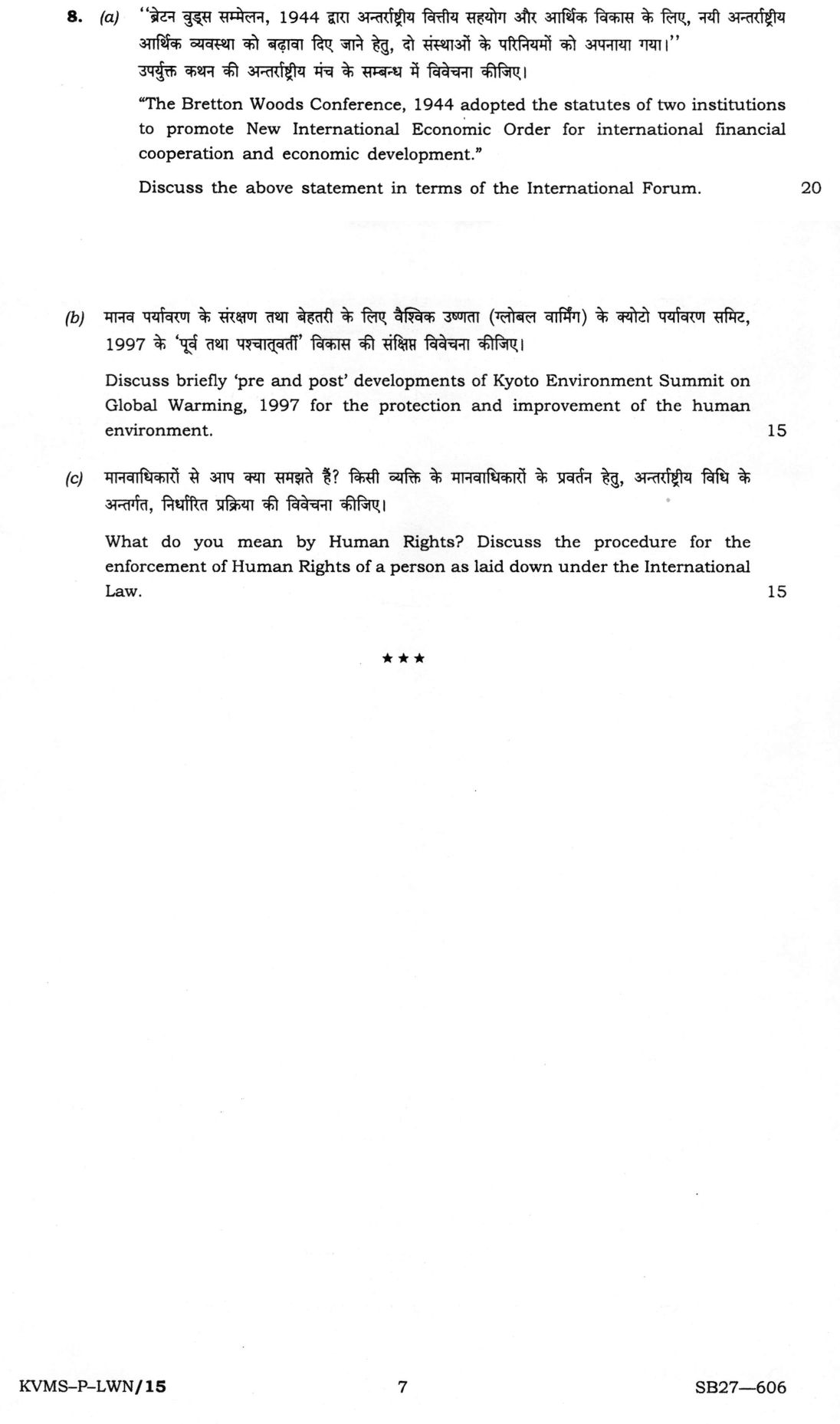
“The Bretton Woods Conference, 1944 adopted the statutes of two institutions to promote New International Economic Order for international financial cooperation and economic development.” Discuss the above statement in terms of the International Forum. 20 marks
Discuss briefly ‘pre and post’ developments of Kyoto Environment Summit on Global Warming, 1997 for the protection and improvement of the human environment. 15 marks
What do you mean by Human Rights? Discuss the procedure for the enforcement of Human Rights of a person as laid down under the International Law. 15 marks
हिंदी में प्रश्न पढ़ें
‘‘ब्रेटन वुड्स सम्मेलन, 1944 द्वारा अन्तर्राष्ट्रीय वित्तीय सहयोग और आर्थिक विकास के लिए, नयी अन्तर्राष्ट्रीय आर्थिक व्यवस्था को बढ़ावा दिए जाने हेतु, दो संस्थाओं के परिनियमों को अपनाया गया।’’ उपर्युक्त कथन की अन्तर्राष्ट्रीय मंच के सम्बन्ध में विवेचना कीजिए। (20 अंक)
मानव पर्यावरण के संरक्षण तथा बेहतरी के लिए वैश्विक उष्णता (ग्लोबल वार्मिंग) के क्योटो पर्यावरण समिट, 1997 के ‘पूर्व तथा पश्चात्वर्ती’ विकास की संक्षिप्त विवेचना कीजिए। (15 अंक)
मानवाधिकारों से आप क्या समझते हैं? किसी व्यक्ति के मानवाधिकारों के प्रवर्तन हेतु, अन्तर्राष्ट्रीय विधि के अन्तर्गत, निर्धारित प्रक्रिया की विवेचना कीजिए। (15 अंक)
Model answer
Drafted with AI by UPSC Answer Check against this question's marking rubric, to the expected length. UPSC does not publish answers for Mains — this is one way to score well, not an official key. How we build rubrics and answers.
(a) Bretton Woods Institutions and the NIEO
The United Nations Monetary and Financial Conference, held at Bretton Woods from 1 to 22 July 1944, was attended by delegates of forty-four nations, including India as a founding member. While John Maynard Keynes proposed an International Clearing Union, Harry Dexter White’s plan for the United States substantially prevailed, leading to the adoption of the Articles of Agreement for two institutions: the International Monetary Fund (IMF) and the International Bank for Reconstruction and Development (IBRD). These Articles entered into force on 27 December 1945. The IMF was established to ensure exchange-rate stability and provide balance-of-payments support through a system of quotas and weighted voting, later adding the Special Drawing Right (SDR, 1969), moving from the par value system (which collapsed in 1971-73) to floating rates under the Second Amendment (1978), and relying on conditionality and Article IV surveillance. The IBRD, later expanded to include the IFC, IDA, ICSID, and MIGA, focuses on long-term development finance. A third "trade pillar" was originally intended, but the International Trade Organization (ITO) failed to materialize; the General Agreement on Tariffs and Trade (GATT) of 1947 served as the interim regime until the World Trade Organization (WTO) was established on 1 January 1995.
Critically, the statement’s link to the New International Economic Order (NIEO) is historically inaccurate. The NIEO was a 1974 movement by the developing world, formalized in GA Resolutions 3201 (S-VI) and 3202 (S-VI) of 1 May 1974 and prepared by UNCTAD (1964), the Group of 77 and the Non-Aligned Movement, which largely challenged the existing Bretton Woods order. It sought to rectify the "North-South" gap through the Charter of Economic Rights and Duties of States (Resolution 3281 (XXIX), 12 December 1974) and the principle of permanent sovereignty over natural resources (Resolution 1803 (XVII), 1962). The weighted voting of the Bretton Woods institutions still draws criticism for under-representing emerging economies, despite the quota reforms agreed in 2010 and effective in 2016. Following the 1980s debt crisis and the rise of the Washington Consensus, NIEO aspirations were partially realized through institutional competition, such as the BRICS New Development Bank (NDB, Fortaleza Agreement, 2014) and the Asian Infrastructure Investment Bank (AIIB, operational from 2016), rather than through the original 1944 framework.
(b) Kyoto Protocol: Pre and Post Developments
The "pre" developments of the Kyoto Protocol are rooted in the 1972 Stockholm Conference, which established the United Nations Environment Programme (UNEP) and Principle 21, affirming state sovereignty over resources while imposing a responsibility to prevent transboundary environmental damage. The 1987 Brundtland Report, Our Common Future, popularized sustainable development, while the Montreal Protocol provided a successful model for differentiated commitments. The Intergovernmental Panel on Climate Change (IPCC), established in 1988, provided the scientific basis for the 1992 Rio Earth Summit, which adopted the UNFCCC and the Rio Declaration (Principle 7 on common but differentiated responsibilities, Principle 15 on precaution and Principle 16 on polluter pays). The UNFCCC, in force since 21 March 1994, is built on the principle of "Common but Differentiated Responsibilities and Respective Capabilities" (CBDR), distinguishing between Annex I (industrialized) and non-Annex I (developing) countries. The first Conference of the Parties adopted the Berlin Mandate (1995), which launched the negotiations that produced Kyoto.
The Kyoto Protocol, adopted on 11 December 1997, required Annex B parties, through differentiated individual targets, to cut their aggregate emissions of six greenhouse gases by at least 5% below 1990 levels in the 2008–2012 period; developing countries, including India, had no quantified targets. It introduced market-based mechanisms: Joint Implementation (Article 6), the Clean Development Mechanism (Article 12), and Emissions Trading (Article 17).
"Post" developments were marked by the US repudiation in 2001 (it had signed but never ratified) and the Protocol’s entry into force on 16 February 2005, following Russian ratification. The Marrakesh Accords (2001) completed the operational rulebook. The Bali Action Plan (2007), the Copenhagen Accord (2009, which set the 2-degree goal and a pledge of USD 100 billion a year by 2020), the Cancun Agreements (2010, creating the Green Climate Fund) and the Durban Platform (2011) followed. The Doha Amendment (2012) created a second commitment period (2013–2020), but Japan, Russia and New Zealand took no new targets, Canada had withdrawn from the Protocol altogether (effective December 2012), and the amendment entered into force only on 31 December 2020. The process culminated in the Paris Agreement (2015), which shifted to a "bottom-up" approach using Nationally Determined Contributions (NDCs) to keep global warming "well below 2 degrees" Celsius while pursuing 1.5 degrees; it entered into force on 4 November 2016. Contributions are nationally determined rather than binding targets, but the process of submitting and updating them is binding. Later milestones include the first global stocktake at COP28 in Dubai (2023), which called for transitioning away from fossil fuels, and the new climate finance goal of at least USD 300 billion a year by 2035 agreed at COP29 in Baku (2024). India has updated its NDC (2022) and set a net-zero target for 2070, while the United States withdrew from the Paris Agreement a second time (effective January 2026).
(c) Human Rights and their International Enforcement
Human rights are inherent, inalienable rights belonging to every individual by virtue of their humanity. They are often categorized into three "generations": civil and political rights (first generation), economic, social, and cultural rights (second generation), and collective or solidarity rights (third generation). Their primary sources in international law include the UN Charter (Articles 1(3), 55–56), the Universal Declaration of Human Rights (UDHR, 10 December 1948, a non-binding declaration much of which is now regarded as customary law), and the 1966 International Covenants (ICCPR and ICESCR), which India ratified in 1979.
The procedure for enforcement under international law involves several layers of machinery. First, the Charter-based machinery includes the Human Rights Council, a body of 47 States created by GA Resolution 60/251 (2006) to replace the Commission on Human Rights, which conducts the Universal Periodic Review (UPR), uses "Special Procedures" such as Rapporteurs and Working Groups, and runs a confidential complaint procedure (HRC Resolution 5/1, 2007, succeeding the ECOSOC 1503 procedure); it is supported by the Office of the High Commissioner for Human Rights (GA Resolution 48/141, 1993, following the Vienna Declaration). Second, the treaty-body machinery consists of committees of independent experts (e.g., the Human Rights Committee under the ICCPR, not to be confused with the Council) that examine State reports, hear inter-State complaints and conduct inquiries, and, where Optional Protocols apply, consider individual communications after local remedies are exhausted. India, for instance, is not a party to the ICCPR Optional Protocol, limiting individual standing there. Third, regional courts provide binding adjudication: the European Court of Human Rights (individual application under Article 34, compulsory since Protocol No. 11 in 1998, with execution supervised by the Committee of Ministers), the Inter-American Court (Velasquez Rodriguez v. Honduras, 1988, on the State's duty of due diligence), and the African Court on Human and Peoples' Rights. No such court exists for Asia; the ASEAN Intergovernmental Commission on Human Rights (2009) is non-judicial. Finally, the International Criminal Court (ICC) addresses individual criminal responsibility for the most serious crimes, operating on the principle of complementarity under the Rome Statute (1998, in force 2002), after the ICTY (1993) and ICTR (1994). States may also sue each other before the ICJ under treaty clauses, as in The Gambia v. Myanmar (provisional measures 2020; standing upheld 2022) under the Genocide Convention, based on obligations erga omnes partes. Domestically, national human rights institutions such as India's NHRC under the Protection of Human Rights Act, 1993 apply these standards, and courts incorporate them, as in Vishaka (1997).
The limitations of these procedures are significant. Enforcement often relies on state consent and is hindered by reservations. Treaty body views are generally non-binding, and the International Court of Justice (ICJ) does not grant individual standing. Consequently, while the legal framework is robust, the practical enforcement of human rights remains a complex and often fragmented process.
How this answer will be evaluated
Evaluation rubric
Each sub-part is marked on its own, against the marks and word limit printed on the paper.
- (a) 'Discuss the above statement in terms of the International Forum' requires the candidate to identify the Bretton Woods Conference and the two institutions whose Articles of Agreement it adopted — the IMF and the IBRD — to describe their constitutions, purposes and machinery, and then to engage critically with the statement's link to the New International Economic Order, which was in fact a later developing-country movement partly directed against the Bretton Woods order. 20 marks
Must cover
- Bretton Woods Conference, July 1944; 44 nations; India a founding member
- IMF — purposes, par value system to floating rates, quotas and weighted voting, SDR, surveillance
- IBRD and the World Bank Group; long-term development finance
- Failed ITO; GATT 1947 as the interim trade regime; WTO from 1 January 1995
- NIEO — GA Resolutions 3201 and 3202 (S-VI), 1974; Charter of Economic Rights and Duties of States, 1974
- Critical point: the NIEO postdated and largely challenged the Bretton Woods order
Loses marks
- Naming the WTO as one of the two institutions created at Bretton Woods; the two were the IMF and the IBRD, and the trade pillar failed and was replaced by GATT.
- Accepting the question's premise uncritically and asserting that Bretton Woods created the New International Economic Order; the NIEO was a 1974 General Assembly project of the developing world, largely directed against the existing order.
- Confusing the IBRD with the World Bank Group as a whole, or attributing IDA's concessional lending to the IBRD.
- Getting the year wrong — the Conference was in July 1944 and the Articles entered into force in December 1945.
- Describing the IMF as a development lender; it provides balance-of-payments support, while long-term development finance is the Bank's function.
- Writing an economics essay with no institutional or legal detail — no Articles, no resolutions, no dates.
Earns more
- Identifies the Conference precisely: the United Nations Monetary and Financial Conference held at Bretton Woods, New Hampshire, from 1 to 22 July 1944, attended by delegates of forty-four nations including India, which was among the founding members; the competing blueprints of John Maynard Keynes for the United Kingdom, proposing an International Clearing Union with a unit of account, and of Harry Dexter White for the United States, the latter substantially prevailing; and the adoption of the Articles of Agreement of two institutions, which entered into force on 27 December 1945.
- Completes the architecture with the trade pillar: the third leg contemplated at Bretton Woods was an International Trade Organization, whose Havana Charter of 1948 was never brought into force because the United States Congress did not approve it, so that the General Agreement on Tariffs and Trade of 1947, applied provisionally from 1948, served as the trade regime until the Marrakesh Agreement of 15 April 1994 established the World Trade Organization with effect from 1 January 1995 — so the 'international forum' for economic cooperation rests on three institutions, two born at Bretton Woods and one improvised.
- Adds a contemporary assessment: the eclipse of the NIEO in the 1980s debt crisis and the rise of the policy prescriptions labelled the Washington Consensus; continuing criticism of quota-based weighted voting and of the under-representation of emerging economies despite the quota reforms agreed in 2010 and effective in 2016; the HIPC initiative, the Millennium Development Goals and the Sustainable Development Goals with the Addis Ababa Action Agenda of 2015; and the emergence of alternative institutions, notably the New Development Bank established by the BRICS under the Fortaleza Agreement of 2014 and the Asian Infrastructure Investment Bank which began operations in 2016, as a partial realisation of NIEO aspirations by institutional competition rather than by reform of Bretton Woods.
Extra mark
- Keynes and White plans; Articles of Agreement in force 27 December 1945
- Permanent sovereignty over natural resources — GA Resolution 1803 (XVII), 1962; UNCTAD (1964), G-77, NAM
- IFC, IDA, ICSID and MIGA
- Quota reforms (agreed 2010, effective 2016); New Development Bank (2014); AIIB (2016)
- (b) 'Discuss briefly the pre and post developments' of the Kyoto Protocol of 1997 requires a chronological account in two halves: the instruments and institutions that led up to Kyoto (Stockholm, Brundtland, the ozone regime, IPCC, Rio and the UNFCCC), the content of the Protocol itself, and the developments after it (Marrakesh, entry into force, Doha Amendment, Paris and after), with the principles of international environmental law running through. 15 marks
Must cover
- Stockholm Conference 1972, Principle 21 and UNEP
- Brundtland Report (1987); Montreal Protocol (1987); IPCC (1988)
- Rio 1992: UNFCCC (in force 1994) and CBDR; Annex I / non-Annex I
- Kyoto Protocol, 11 December 1997: Annex B aggregate cut of at least 5% below 1990 in 2008-2012; six gases; no targets for developing countries
- Mechanisms: Joint Implementation (Article 6), CDM (Article 12), Emissions Trading (Article 17)
- Post-Kyoto: US repudiation (2001), entry into force 16 February 2005, Doha Amendment (2012)
- Paris Agreement (2015; in force 2016): NDCs, well below 2 degrees
Loses marks
- Giving the Kyoto reduction target as five per cent for all parties; the commitment was an aggregate of at least five per cent below 1990 levels for Annex B parties, with differentiated individual targets and no quantified target for developing countries.
- Saying the Protocol entered into force in 1997 or 2005 without distinguishing adoption from entry into force — it was adopted on 11 December 1997 and entered into force on 16 February 2005.
- Stating that the United States never signed the Protocol; it signed but did not ratify and repudiated it in 2001.
- Confusing the UNFCCC with the Kyoto Protocol, or the Kyoto mechanisms with the Paris Article 6 mechanisms.
- Treating only the 'post' half and ignoring the 'pre' half, or vice versa; the question asks for both.
- Attributing binding emission targets to the Paris Agreement; Paris makes the process binding but the contributions are nationally determined.
Earns more
- Covers the pre-Kyoto foundations: the United Nations Conference on the Human Environment at Stockholm in June 1972, with its Declaration of twenty-six principles — Principle 21 affirming the sovereign right of States to exploit their own resources and their responsibility to ensure that activities within their jurisdiction or control do not cause damage to the environment of other States or of areas beyond national jurisdiction — and the creation of the United Nations Environment Programme later that year; the Brundtland Commission report Our Common Future (1987) which popularised sustainable development; the Vienna Convention for the Protection of the Ozone Layer, 1985 and the Montreal Protocol, 1987, which supplied the model of differentiated commitments and a multilateral fund; and the establishment of the Intergovernmental Panel on Climate Change by WMO and UNEP in 1988, whose First Assessment Report of 1990 triggered negotiations.
- Covers the post-Kyoto developments to 2012: the Buenos Aires Plan of Action (1998); the collapse of the sixth Conference of the Parties at The Hague in 2000; the repudiation of the Protocol by the United States in 2001; the Bonn Agreements and the Marrakesh Accords of 2001, which completed the operational rulebook; ratification by the Russian Federation, which brought the Protocol into force on 16 February 2005; the Bali Action Plan (2007); the Copenhagen Accord (2009), which was only taken note of but introduced the two-degree goal and the pledge of one hundred billion dollars a year by 2020; the Cancun Agreements (2010) establishing the Green Climate Fund; the Durban Platform for Enhanced Action (2011); and the Doha Amendment of 8 December 2012 creating a second commitment period from 2013 to 2020, which Canada, Japan, Russia and New Zealand did not join and which entered into force only at the very end of 2020, Canada having withdrawn from the Protocol with effect from December 2012.
Extra mark
- Berlin Mandate (1995); Rio Declaration Principles 7, 15 and 16
- Marrakesh Accords (2001); Bali (2007), Copenhagen (2009), Cancun (2010), Durban (2011)
- COP28 global stocktake (2023); COP29 finance goal (2024); India's updated NDC and 2070 net-zero target
- (c) Two limbs: explain what human rights mean and their sources in international law; and then discuss, with specificity, the procedures available for enforcing an individual's human rights — the Charter-based machinery, the treaty-body machinery, the regional courts, and individual criminal responsibility — together with the limitations of each. 15 marks
Must cover
- Definition and characteristics of human rights; three generations
- Sources: UN Charter Articles 1(3), 55 and 56; UDHR (1948); ICCPR and ICESCR (1966)
- Charter-based machinery: Human Rights Council, UPR, special procedures, complaint procedure; OHCHR
- Treaty bodies: State reports, inter-State and individual communications (Optional Protocol), exhaustion of local remedies
- Regional systems: European, Inter-American and African courts; no Asian court
- Individual criminal responsibility: ICC (Rome Statute 1998/2002), ICTY, ICTR
- Limitations: consent, reservations, non-binding views; no individual standing before the ICJ
Loses marks
- Spending most of the answer on the meaning of human rights and treating enforcement in two lines, although the second limb is the substance of the question.
- Saying the UDHR is a binding treaty, or that its provisions are directly enforceable; it is a declaration, though much of it is now regarded as customary.
- Confusing the Human Rights Council, a Charter body of States, with the Human Rights Committee, the treaty body of independent experts under the ICCPR — this is the most common error on this question.
- Claiming that an individual may petition the International Court of Justice; only States may be parties to contentious cases before the ICJ (Article 34(1) of its Statute).
- Stating that India accepts individual complaints under the ICCPR Optional Protocol; India is not a party to it.
- Omitting the limitations, so the account reads as if enforcement were effective and automatic.
Earns more
- Describes regional enforcement, which is where genuinely judicial remedies exist: the European Convention on Human Rights, 1950, with the European Court of Human Rights at Strasbourg, individual application under Article 34 having become compulsory after Protocol No. 11 in 1998, and execution of judgments supervised by the Committee of Ministers under Article 46; the American Convention on Human Rights, 1969, with the Inter-American Commission and the Inter-American Court of Human Rights (Velasquez Rodriguez v. Honduras, 1988, establishing the duty of due diligence); and the African Charter on Human and Peoples' Rights, 1981, in force 1986, with the African Commission and the African Court on Human and Peoples' Rights. Notes that Asia has no regional human rights court, the ASEAN Intergovernmental Commission on Human Rights (2009) being non-judicial — a point of direct relevance to India.
- Completes the picture with criminal and inter-State avenues and the limitations: individual criminal responsibility from the Nuremberg and Tokyo Tribunals through the ICTY (1993) and ICTR (1994) to the International Criminal Court under the Rome Statute of 17 July 1998, in force 1 July 2002, operating on the principle of complementarity, with referral by a State Party, by the Prosecutor proprio motu or by the Security Council under Article 13(b); inter-State litigation before the International Court of Justice under compromissory clauses such as Article IX of the Genocide Convention, illustrated by Bosnia and Herzegovina v. Serbia and Montenegro (2007) and by The Gambia v. Myanmar (provisional measures 2020; judgment on preliminary objections 2022), where standing was founded on obligations erga omnes partes, the concept of obligations erga omnes having been recognised in Barcelona Traction (1970); universal jurisdiction, subject to the immunity of serving high officials recognised in Arrest Warrant of 11 April 2000 (DRC v. Belgium), ICJ 2002; national human rights institutions under the Paris Principles endorsed by General Assembly Resolution 48/134 of 1993, such as India's National Human Rights Commission under the Protection of Human Rights Act, 1993; and domestic incorporation, as in Vishaka v. State of Rajasthan, (1997) 6 SCC 241 and NALSA v. Union of India, (2014) 5 SCC 438. Limitations: consent-based jurisdiction, reservations, non-binding views, politicisation and selectivity, chronic under-resourcing and the implementation gap.
Extra mark
- GA Resolution 60/251 (2006); HRC Resolution 5/1 (2007); GA Resolution 48/141 (1993); Vienna Declaration, 1993
- Velasquez Rodriguez v. Honduras (1988); Protocol No. 11 (1998)
- The Gambia v. Myanmar (ICJ) — obligations erga omnes partes
- India: not a party to the First Optional Protocol; NHRC under the Protection of Human Rights Act, 1993; Vishaka (1997)
What "Discuss" is asking you to do
Lay the issue out from more than one side — how it arose, what is claimed for it, what is held against it, and where it now stands. UPSC attaches discuss to broad topics with several live dimensions, so coverage of the dimensions earns more than the strength of your opinion.
Structure that answers it
Set the issue up → the case as it is made → the case against → the dimension both sides leave out → where the balance now lies
Where marks are lost
Listing facts with no thread between them, or arguing one side throughout and calling it a discussion.
Practice this exact question
Write your answer and it is marked point by point against the model answer above — what you covered, what you missed, what you got wrong.
Evaluate my answer →More from Law 2026 Paper I
- Q5 Answer the following questions in about 150 words each : (a) Whether International Law is…
- Q6 (a) “The present world economic order is supposed to be guided by the operation of free m…
- Q7 (a) Discuss the facts and the Principles of the Law of the Sea, emerged in ‘Corfu Channel…
- Q8 (a) “The Bretton Woods Conference, 1944 adopted the statutes of two institutions to promo…