Paper II — Q1
(a) Does ‘Res ipsa loquitur’ reverse the ‘burden of proof’ completely ? Comment. (10 marks) (b) How can ‘community service’, as…
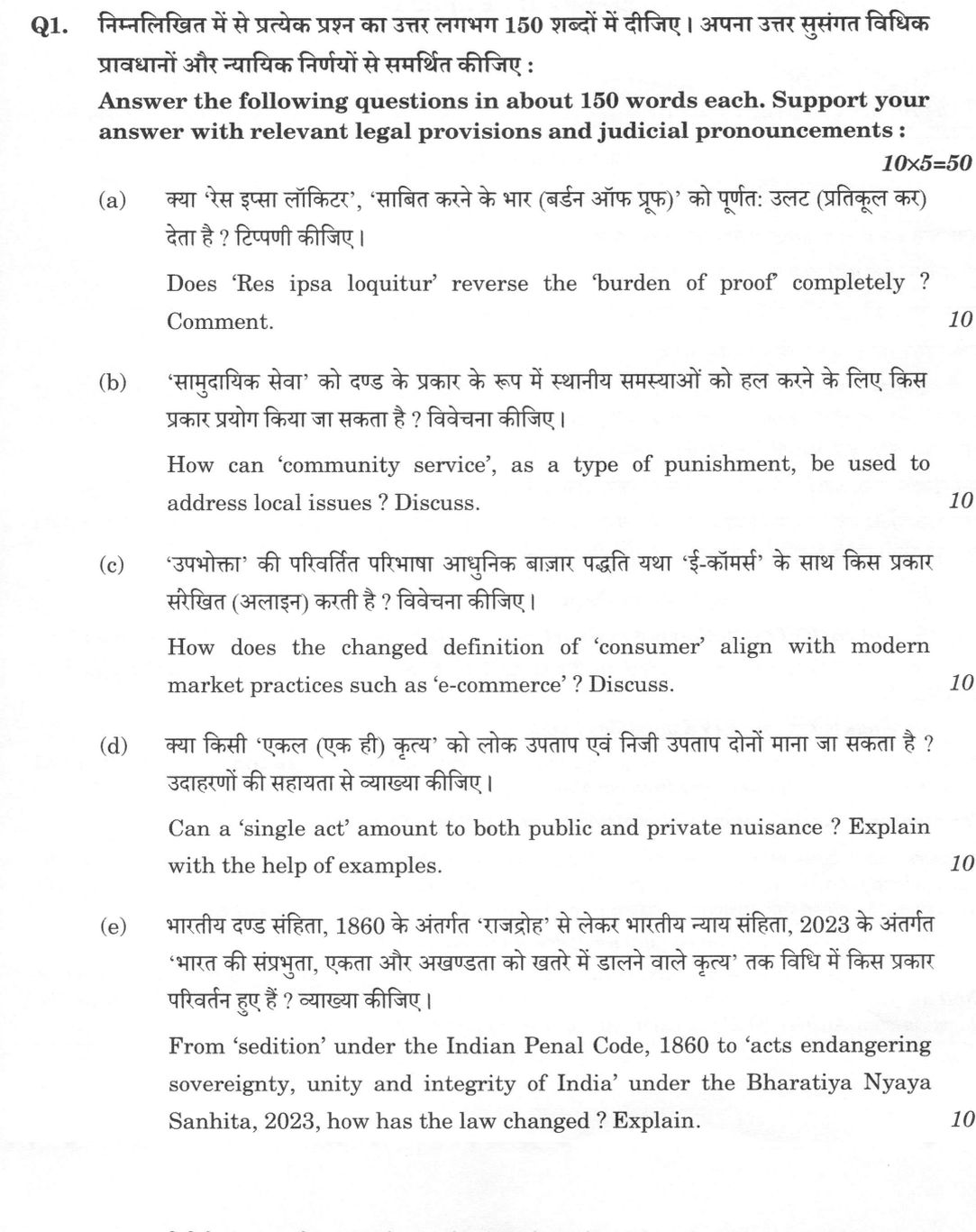
Answer the following questions in about 150 words each. Support your answer with relevant legal provisions and judicial pronouncements :
Does ‘Res ipsa loquitur’ reverse the ‘burden of proof’ completely ? Comment. 10 marks
How can ‘community service’, as a type of punishment, be used to address local issues ? Discuss. 10 marks
How does the changed definition of ‘consumer’ align with modern market practices such as ‘e-commerce’ ? Discuss. 10 marks
Can a ‘single act’ amount to both public and private nuisance ? Explain with the help of examples. 10 marks
From ‘sedition’ under the Indian Penal Code, 1860 to ‘acts endangering sovereignty, unity and integrity of India’ under the Bharatiya Nyaya Sanhita, 2023, how has the law changed ? Explain. 10 marks
हिंदी में प्रश्न पढ़ें
निम्नलिखित में से प्रत्येक प्रश्न का उत्तर लगभग 150 शब्दों में दीजिए। अपना उत्तर सुसंगत विधिक प्रावधानों और न्यायिक निर्णयों से समर्थित कीजिए :
क्या ‘रेस इप्सा लॉकिटर’, ‘साबित करने के भार (बर्डन ऑफ प्रूफ)’ को पूर्णतः उलट (प्रतिकूल कर) देता है ? टिप्पणी कीजिए। (10 अंक)
‘सामुदायिक सेवा’ को दण्ड के प्रकार के रूप में स्थानीय समस्याओं को हल करने के लिए किस प्रकार प्रयोग किया जा सकता है ? विवेचना कीजिए। (10 अंक)
‘उपभोक्ता’ की परिवर्तित परिभाषा आधुनिक बाजार पद्धति यथा ‘ई-कॉमर्स’ के साथ किस प्रकार संरेखित (अलाइन) करती है ? विवेचना कीजिए। (10 अंक)
क्या किसी ‘एकल (एक ही) कृत्य’ को लोक उपताप एवं निजी उपताप दोनों माना जा सकता है ? उदाहरणों की सहायता से व्याख्या कीजिए। (10 अंक)
भारतीय दण्ड संहिता, 1860 के अंतर्गत ‘राजद्रोह’ से लेकर भारतीय न्याय संहिता, 2023 के अंतर्गत ‘भारत की संप्रभुता, एकता और अखण्डता को खतरे में डालने वाले कृत्य’ तक विधि में किस प्रकार परिवर्तन हुए हैं ? व्याख्या कीजिए। (10 अंक)
Model answer
Drafted with AI by UPSC Answer Check against this question's marking rubric, to the 150-word length. UPSC does not publish answers for Mains — this is one way to score well, not an official key. How we build rubrics and answers.
(a) Res Ipsa Loquitur and the Burden of Proof
Res ipsa loquitur ("the thing speaks for itself") lets a court infer negligence where the thing causing harm was under the defendant's management or control, the accident would not ordinarily happen without negligence, and the actual cause is unknown (Scott v. London and St. Katherine Docks Co., 1865; Byrne v. Boadle, 1863).
It does not reverse the burden of proof completely. Under Sections 104 and 105 of the Bharatiya Sakshya Adhiniyam, 2023 (ss. 101 and 102, Indian Evidence Act, 1872), the legal burden of proving negligence stays on the plaintiff. Only the evidential burden (the onus of explaining) shifts, much as Section 109 BSA (s. 106 IEA) casts on a party the burden of facts especially within his knowledge. In Shyam Sunder v. State of Rajasthan (1974) and Municipal Corporation of Delhi v. Subhagwanti (1966), the defendant could discharge it by a reasonable explanation consistent with due care; he need not prove how the accident happened (Pushpabai Purshottam Udeshi, 1977).
It does not apply where the cause is known, is used cautiously in medical negligence (Jacob Mathew v. State of Punjab, 2005), and is unnecessary where liability is absolute (M.C. Mehta, 1987). It is a rule of evidence, not liability.
(b) Community Service as Punishment
Section 4(f) of the Bharatiya Nyaya Sanhita, 2023 adds community service as a new punishment, with no counterpart in the IPC. The Explanation to Section 23 of the Bharatiya Nagarik Suraksha Sanhita, 2023 defines it as unremunerated work that benefits the community, and Section 23 lets Magistrates of the first and second class impose it. It is prescribed for petty offences: theft of property below Rs. 5,000 by a first offender who restores it (proviso to Section 303(2)), misconduct in public by a drunken person (Section 355), defamation (Section 356(2)), a public servant unlawfully engaging in trade (Section 202), non-appearance in response to a proclamation (Section 209) and attempting suicide to compel or restrain a public servant (Section 226).
It can address local problems directly: a drunken brawler can clean the market he disturbed, a petty thief can clean a water body, and offenders can assist in sanitation, plantation or traffic management. It decongests prisons and reflects the reformative theory (Mohd. Giasuddin v. State of A.P., 1977), supplementing probation under the Probation of Offenders Act, 1958 and Section 401 BNSS (s. 360 CrPC). It needs rules on hours and nature of work, supervision, and respect for Articles 21 and 23.
(c) 'Consumer' under the 2019 Act and E-commerce
Section 2(7) of the Consumer Protection Act, 2019, replacing Section 2(1)(d) of the 1986 Act, retains the core definition (a person who buys goods or avails services for consideration, excluding resale or commercial purpose) but adds Explanation (b): buying goods or availing services includes "offline or online transactions through electronic means or by teleshopping or direct selling or multi-level marketing".
The Act builds around this change. It defines "e-commerce" (Section 2(16)) and "electronic service provider" (Section 2(17)); the Consumer Protection (E-Commerce) Rules, 2020 impose duties on marketplace and inventory entities. "Unfair contract" (Section 2(46)) and "unfair trade practice" (Section 2(47)) reach one-sided online terms. The Central Consumer Protection Authority (Sections 10-27) acts against misleading advertisements, including endorsers (Section 21), and issued Guidelines on dark patterns (2023). Complaints may be filed electronically where the complainant resides or works (Sections 34-35), and product liability (Chapter VI; Section 86 on product sellers) reaches sellers in the online chain.
Courts keep the commercial-purpose exclusion narrow: Lilavati Kirtilal Mehta Medical Trust (2020) requires a close nexus with profit-making, and Harsolia Motors (2023) held that a business insuring its assets remains a consumer.
(d) One Act as Public and Private Nuisance
Yes. Public nuisance (Section 270, Bharatiya Nyaya Sanhita, 2023; s. 268 IPC) causes common injury, danger or annoyance to the public; private nuisance is unlawful interference with a person's use or enjoyment of land. The same act is both when, besides harming the public, it causes a particular person special damage over and above that suffered by the public generally.
Examples: A factory discharging effluent into a river is a public nuisance to the community, and a private nuisance to the downstream farmer whose crops are destroyed. An obstruction of a highway is a public nuisance, but the shopkeeper whose access is blocked can sue (Rose v. Miles, 1815; Benjamin v. Storr, 1874; Campbell v. Paddington Corporation, 1911). In Dr. Ram Raj Singh v. Babulal (1982), a brick-grinding machine on a public road whose dust entered a doctor's clinic was held actionable for special damage; Ratlam Municipality v. Vardhichand (1980) treated open drains as public nuisance.
Remedies run together: prosecution under Section 292 BNS (s. 290 IPC); a Magistrate's conditional order under Section 152 BNSS (s. 133 CrPC); a representative suit under Section 91 CPC without proof of special damage; and a private suit by the specially affected person.
(e) From Sedition to Section 152 BNS
Section 124A IPC punished bringing or attempting to bring into hatred or contempt, or exciting disaffection towards, the "Government established by law in India", with imprisonment for life or up to three years. Kedar Nath Singh v. State of Bihar (1962) saved it only by confining it to incitement to violence or tendency to public disorder, and S.G. Vombatkere v. Union of India (May 2022) kept it in abeyance.
Section 152 of the Bharatiya Nyaya Sanhita, 2023 changes the law in five ways. Object: it protects the sovereignty, unity and integrity of India, not the Government. Conduct: exciting secession, armed rebellion or subversive activities, encouraging feelings of separatist activities, or endangering sovereignty, unity and integrity. Means: words, signs, visible representation, electronic communication or use of financial means. Mens rea: "purposely or knowingly". Punishment: imprisonment for life or up to seven years, with liability to fine. Its Explanation saves criticism seeking lawful change.
The change is partly substantive: "disaffection" towards the Government is gone, but "subversive activities" and "feelings of separatist activities" are undefined and potentially wider, and incitement to violence is not expressly required. The Kedar Nath test and Article 19(2) must therefore continue to govern its application.
How this answer will be evaluated
Evaluation rubric
Each sub-part is marked on its own, against the marks and word limit printed on the paper.
- (a) 'Comment' requires a reasoned verdict, not a description: the candidate must state the maxim and its conditions, then answer the specific question asked — whether it reverses the burden of proof COMPLETELY — by distinguishing the legal (persuasive) burden, which stays on the plaintiff, from the evidential burden (onus of adducing evidence), which alone shifts. 10 marks · 150 words
Must cover
- Meaning of the maxim and its three conditions (control, accident not ordinarily without negligence, cause unknown)
- Legal burden stays on the plaintiff — Sections 104 and 105 BSA, 2023 [ss. 101, 102 IEA]
- Only the evidential burden shifts; the defendant discharges it by a reasonable non-negligent explanation
- At least one Indian authority applying the maxim
- Conclusion: no complete reversal; a rule of evidence, not of liability
Loses marks
- Answering 'yes, it reverses the burden' without distinguishing the legal burden from the evidential burden — the question turns entirely on that distinction, so this loses the core marks.
- Reciting the three conditions but never stating the statutory burden-of-proof provision, so the comment has no legal anchor.
- Citing only English cases and no Indian authority, when the stem expressly asks for relevant legal provisions and judicial pronouncements.
- Citing the repealed Indian Evidence Act, 1872 as the law in force instead of the Bharatiya Sakshya Adhiniyam, 2023 (the IEA may be given only as the bracketed equivalent).
- Confusing res ipsa loquitur with strict or absolute liability (Rylands v. Fletcher / M.C. Mehta), where fault is irrelevant altogether.
Earns more
- Notes the boundaries: the maxim has no role where the actual cause of the accident is proved or fully known, or where the defendant is not in exclusive control; it is applied with caution in medical negligence, where Jacob Mathew v. State of Punjab, (2005) 6 SCC 1 and V. Kishan Rao v. Nikhil Super Speciality Hospital, (2010) 5 SCC 513 require the Bolam standard and expert material rather than an automatic inference; and it is redundant under the no-fault regimes of M.C. Mehta v. Union of India, (1987) 1 SCC 395 (absolute liability) and the Public Liability Insurance Act, 1991.
- Concludes analytically that the maxim is a rule of evidence and not a rule of substantive liability, and that the defendant discharges it by offering a reasonable explanation consistent with the absence of negligence — he need not prove how the accident in fact happened; hence a 'complete' reversal would convert negligence into strict liability, which the law does not intend.
Extra mark
- Scott v. London and St. Katherine Docks Co. (1865); Byrne v. Boadle (1863)
- Section 109 BSA [s. 106 IEA]
- Shyam Sunder v. State of Rajasthan (1974); MCD v. Subhagwanti (1966); Pushpabai Udeshi (1977)
- Jacob Mathew (2005) — caution in medical negligence; M.C. Mehta (1987) — absolute liability
- (b) 'Discuss' here has a concrete statutory anchor: community service is a new sixth species of punishment introduced by Section 4(f) of the Bharatiya Nyaya Sanhita, 2023. The candidate must identify the provision and the offences to which it attaches, and then show HOW it can be deployed against local problems — decongesting prisons, repairing civic harm caused by the offence, and reintegrating petty first-time offenders. 10 marks · 150 words
Must cover
- Section 4(f) BNS — community service as a new punishment
- Explanation to Section 23 BNSS [s. 29 CrPC] — unremunerated work benefiting the community; Magistrates' power
- Offences carrying it, e.g. proviso to Section 303(2), Sections 355, 356(2), 202, 209, 226 BNS
- Application to local issues with concrete examples (sanitation, plantation, water bodies, traffic)
- Reformative rationale and limits: Articles 21 and 23; supervision; need for rules
Loses marks
- Writing a general essay on reformative punishment and prison reform without citing Section 4(f) BNS, 2023 at all — the provision is the heart of the question.
- Asserting that community service is available for all offences; it is prescribed for only a small set of petty offences in the BNS and cannot be substituted for imprisonment at large.
- Confusing community service with probation under the Probation of Offenders Act, 1958 or with a condition of bail; it is now an independent substantive sentence.
- Failing to answer the 'local issues' half of the question — listing the statute but giving no concrete civic application (sanitation, water bodies, plantation, traffic, literacy).
- Stating that the convict is paid for the work; the Explanation to Section 23 BNSS [read with Section 4(f) BNS] expressly denies remuneration.
Earns more
- Places the reform in the reformative theory of punishment and cites supporting authority: Mohd. Giasuddin v. State of Andhra Pradesh, (1977) 3 SCC 287 (Krishna Iyer J. — the therapeutic/reformative approach to sentencing); Sunil Batra v. Delhi Administration, (1978) 4 SCC 494; and the pre-existing non-custodial machinery of the Probation of Offenders Act, 1958 and Section 401 BNSS [s. 360 CrPC], which community service now supplements as a sentence in its own right rather than a mere condition of release.
- Notes the safeguards and difficulties: the absence so far of a uniform statutory definition of the hours, nature and place of the service (left largely to State rules and judicial discretion); the constitutional limits of Article 23 (prohibition of forced labour) and Article 21 (dignity), contrasted with State of Gujarat v. Hon'ble High Court of Gujarat, (1998) 4 SCC 575 where prison labour was held to require payment of wages, whereas community service is expressly unremunerated; the need for probation-officer supervision, verifiable reporting and a default sentence on breach; and the risk of arbitrary or trivialising orders if there is no sentencing guideline.
Extra mark
- Mohd. Giasuddin v. State of Andhra Pradesh (1977)
- Probation of Offenders Act, 1958 and Section 401 BNSS [s. 360 CrPC]
- Old IPC equivalents: ss. 379, 510, 500, 168 and 174A
- (c) 'Discuss' with a comparative edge: the candidate must show what specifically CHANGED in the definition of 'consumer' when the Consumer Protection Act, 2019 replaced the 1986 Act, and then demonstrate the alignment of that change with e-commerce — the Explanation to Section 2(7), the definitions of 'e-commerce' and 'electronic service provider', and the supporting machinery (CCPA, e-commerce rules, e-filing, product liability). 10 marks · 150 words
Must cover
- Section 2(7), Consumer Protection Act, 2019, replacing s. 2(1)(d) of the 1986 Act
- Explanation (b) to Section 2(7) — online transactions, teleshopping, direct selling, multi-level marketing
- Section 2(16) 'e-commerce' and Section 2(17) 'electronic service provider'; E-Commerce Rules, 2020
- Supporting machinery: CCPA (Sections 10-27), e-filing and home-forum jurisdiction (Sections 34-35), product liability (Chapter VI)
- Commercial-purpose exclusion and its judicial narrowing
Loses marks
- Reproducing the definition of 'consumer' without identifying what is NEW in 2019 — the question is about the CHANGED definition, so the Explanation on electronic/online transactions must appear.
- Attributing the online-transaction Explanation to the 1986 Act, or citing the repealed 1986 Act as the governing law.
- Writing generally about e-commerce regulation (IT Act, FDI policy, data protection) without anchoring it in Section 2(7) and the 2019 Act.
- Misstating the commercial-purpose exclusion — omitting the livelihood-by-self-employment Explanation, or saying that companies can never be consumers (Harsolia Motors holds otherwise for insurance).
- Quoting outdated pecuniary jurisdiction figures; after the 2021 revision the District Commission's limit is goods/services value up to Rs. 50 lakh, the State Commission above Rs. 50 lakh to Rs. 2 crore and the National Commission above Rs. 2 crore — if unsure, omit the figures rather than state them wrongly.
Earns more
- Shows the procedural alignment that makes online redress workable: the Central Consumer Protection Authority under Sections 10 to 27, with power under Section 21 to issue directions and impose penalties for false or misleading advertisements (including on endorsers); the right under Section 35(1) read with Section 34(2)(d) to file a complaint electronically and at the place where the complainant ordinarily resides or personally works for gain rather than where the seller is located; and product liability under Chapter VI (Sections 82 to 87), which reaches product sellers, including certain platform sellers, under Section 86.
- Adds judicial boundary-setting on who remains a consumer: Lilavati Kirtilal Mehta Medical Trust v. Unique Shanti Developers, (2020) 2 SCC 265 (tests for 'commercial purpose' — a close and direct nexus with a profit-generating activity); National Insurance Co. Ltd. v. Harsolia Motors, (2023) 8 SCC 362 (a commercial entity insuring its assets is still a consumer, since the insurance contract is one of indemnity and not itself a profit-generating activity); Shrikant G. Mantri v. Punjab National Bank, (2022) 5 SCC 42 (a stockbroker availing bank facilities for his business was held not to be a consumer) — and notes remaining gaps on dark patterns, algorithmic pricing and offshore sellers.
Extra mark
- Section 2(46) 'unfair contract'; Section 2(47) 'unfair trade practice'
- Section 21 — misleading advertisements and endorsers; Dark Patterns Guidelines, 2023
- Lilavati Kirtilal Mehta Medical Trust (2020); National Insurance Co. v. Harsolia Motors (2023)
- Section 86 — liability of product sellers
- (d) 'Explain with the help of examples' requires a yes/no answer plus illustration: the candidate must define public and private nuisance separately, answer that a single act CAN constitute both, identify the bridging requirement — special or particular damage over and above that suffered by the public generally — and support it with at least two concrete examples or decided cases. 10 marks · 150 words
Must cover
- Definitions: public nuisance (Section 270 BNS [s. 268 IPC]) and private nuisance
- Answer: a single act can be both
- Special or particular damage as the bridge
- At least two concrete examples
- Remedies: Section 292 BNS [s. 290 IPC]; Section 152 BNSS [s. 133 CrPC]; Section 91 CPC; private suit
Loses marks
- Merely tabulating the differences between public and private nuisance and never answering whether one act can be both.
- Omitting the special-damage requirement, which is the only doctrinal bridge between the two heads.
- Citing Section 268 IPC or Section 133 CrPC as the law currently in force instead of Section 270 BNS, 2023 and Section 152 BNSS, 2023 (the old provisions may be given only in brackets).
- Confusing private nuisance with trespass (direct physical entry, actionable per se) or with the rule in Rylands v. Fletcher (escape of a dangerous thing, strict liability).
- Giving no example at all, when the question expressly asks for examples; or giving an example in which only the public is affected, which does not illustrate the overlap.
Earns more
- Gives at least two concrete worked examples showing the overlap — for instance, a factory discharging smoke or effluent that injures a whole neighbourhood (public nuisance) while specifically damaging the adjoining owner's crops, well or health (private nuisance); a brick-grinding machine on a public road throwing coal dust into a medical practitioner's clinic, held a private nuisance with special damage in Dr. Ram Raj Singh v. Babulal, AIR 1982 All 285; an obstruction on a public highway that also blocks the only access to a particular shop; open drains and public defecation in a municipality, dealt with as public nuisance in Municipal Council, Ratlam v. Vardhichand, (1980) 4 SCC 162.
- Notes the procedural consequences of the dual character: a criminal prosecution under Sections 270 and 292 BNS and a summary abatement order under Section 152 BNSS may run alongside a civil suit for damages and a mandatory or prohibitory injunction; a representative suit for a declaration and injunction in respect of a public nuisance lies under Section 91 of the Code of Civil Procedure, 1908 without proof of special damage; and modern environmental legislation (Water (Prevention and Control of Pollution) Act, 1974; Air (Prevention and Control of Pollution) Act, 1981; Environment (Protection) Act, 1986; National Green Tribunal Act, 2010) now supplies parallel remedies.
Extra mark
- Rose v. Miles (1815); Benjamin v. Storr (1874); Campbell v. Paddington Corporation (1911)
- Dr. Ram Raj Singh v. Babulal (1982)
- Municipal Council, Ratlam v. Vardhichand (1980)
- Environmental statutes and the National Green Tribunal
- (e) 'Explain how the law has changed' demands a point-by-point comparison of Section 124A of the Indian Penal Code, 1860 with Section 152 of the Bharatiya Nyaya Sanhita, 2023 — the protected object, the actus reus, the means, the mens rea, the punishment and the saving Explanation — followed by an assessment of whether the change is substantive or nominal. 10 marks · 150 words
Must cover
- Section 124A IPC: 'Government established by law', 'disaffection'; punishment
- Section 152 BNS: protected object now the sovereignty, unity and integrity of India
- New conduct (secession, armed rebellion, subversive activities, separatist feelings) and means (electronic, financial)
- Mens rea 'purposely or knowingly'; punishment of life or up to seven years, with fine
- Explanation saving lawful criticism
- Kedar Nath Singh (1962) reading down, and an assessment whether the change is substantive
Loses marks
- Claiming that sedition has been 'abolished' — only the label has gone; the conduct is recast and more severely punished under Section 152 BNS.
- Giving the wrong section number: Section 152 BNS is the relevant provision (Section 150 was the number in the Bill as introduced in August 2023; the enacted Sanhita numbers it 152).
- Reproducing both provisions without identifying the changes — the question asks HOW the law has changed, so a comparison, not a transcription, earns the marks.
- Omitting Kedar Nath Singh, or stating that it struck down Section 124A; it upheld the provision while reading it down to incitement to violence or public disorder.
- Misstating the punishment (for example, saying life imprisonment only, or retaining three years) or omitting the new 'financial means' and 'electronic communication' limbs.
Earns more
- Brings in the judicial and institutional background: Kedar Nath Singh v. State of Bihar, AIR 1962 SC 955 upheld Section 124A only by reading it down to acts involving incitement to violence or intention or tendency to create public disorder; Balwant Singh v. State of Punjab, (1995) 3 SCC 214 (casual raising of slogans by two persons, without public response, not sedition); Vinod Dua v. Union of India, 2021 SCC OnLine SC 414 (journalist entitled to the Kedar Nath protection; FIR quashed); S.G. Vombatkere v. Union of India, (2022) 7 SCC 433, where the Supreme Court in May 2022 directed that Section 124A be kept in abeyance and no fresh FIRs be registered pending re-examination; and the 22nd Law Commission's 279th Report (2023), which had recommended retention of sedition with amendments.
- Offers a critical assessment: the reform is partly cosmetic because 'subversive activities' and 'encourages feelings of separatist activities' are undefined and arguably wider than 'disaffection'; the section does not expressly incorporate the incitement-to-violence requirement, so the Kedar Nath reading down and the Article 19(2) heads (sovereignty and integrity of India, security of the State, public order) must continue to control it; the offence is cognizable, non-bailable and triable by a Court of Session; and related provisions — Section 196 BNS [s. 153A IPC] promoting enmity, Section 197 BNS [s. 153B IPC] imputations prejudicial to national integration, and Section 353 BNS [s. 505 IPC] statements conducing to public mischief — remain available.
Extra mark
- Balwant Singh v. State of Punjab (1995)
- S.G. Vombatkere v. Union of India (2022) — s. 124A in abeyance
- Law Commission, 279th Report (2023)
- Sections 196, 197 and 353 BNS [ss. 153A, 153B, 505 IPC]
What "Comment" is asking you to do
Take a position on the statement and support it. Comment usually attaches to a quoted line in the short slots, so the reasoning must be compressed — an opening view, a few load-bearing reasons, and the limit of the claim.
Structure that answers it
Unpack what the statement asserts → your stance → two or three supporting reasons → the qualification that limits it
Where marks are lost
Neutral summary; a comment without a stance has not answered. Equally costly is accepting the quoted line wholesale and never testing where it fails.
Practice this exact question
Write your answer and it is marked point by point against the model answer above — what you covered, what you missed, what you got wrong.
Evaluate my answer →More from Law 2026 Paper II
- Q1 Answer the following questions in about 150 words each. Support your answer with relevant…
- Q2 (a) “Vicarious liability’ is based on public policy rather than fault.” Critically analys…
- Q3 (a) How effectively does the law distinguish between ‘pre-meditated killing’ and ‘murder…
- Q4 (a) 'X', a 25-year-old boy, makes a promise to 'Y', an 18-year-old girl, that he will mar…