Paper II — Q2
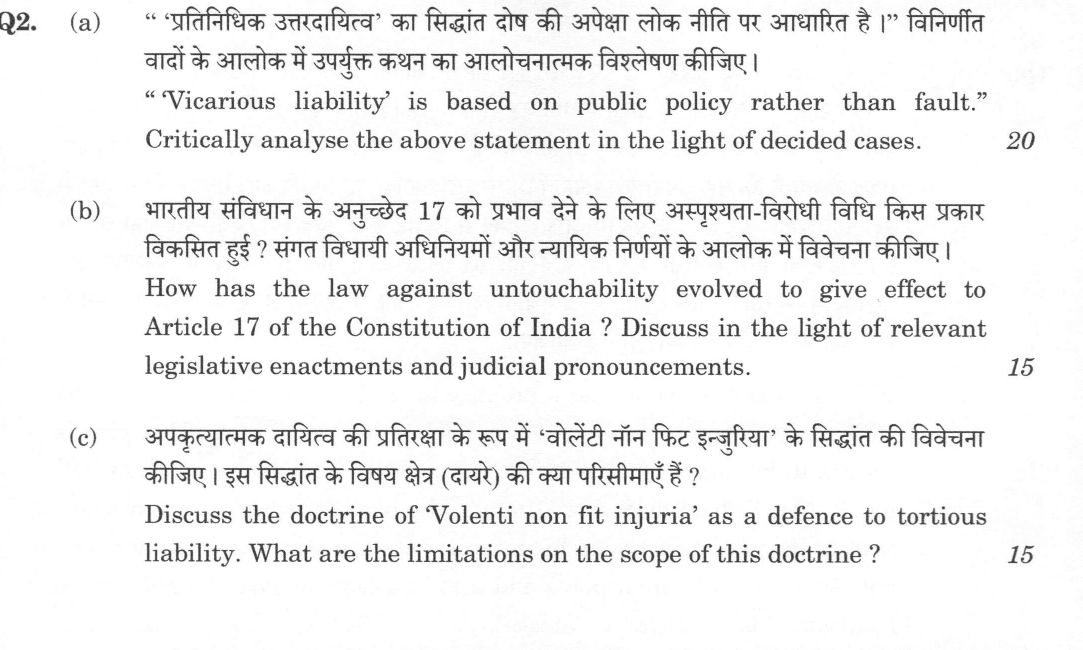
(a) “Vicarious liability’ is based on public policy rather than fault.” Critically analyse the above statement in the light of…
“Vicarious liability’ is based on public policy rather than fault.” Critically analyse the above statement in the light of decided cases. 20 marks
How has the law against untouchability evolved to give effect to Article 17 of the Constitution of India ? Discuss in the light of relevant legislative enactments and judicial pronouncements. 15 marks
Discuss the doctrine of ‘Volenti non fit injuria’ as a defence to tortious liability. What are the limitations on the scope of this doctrine ? 15 marks
हिंदी में प्रश्न पढ़ें
“प्रतिनिधिक उत्तरदायित्व’ का सिद्धांत दोष की अपेक्षा लोक नीति पर आधारित है।” विनिर्णीत वादों के आलोक में उपर्युक्त कथन का आलोचनात्मक विश्लेषण कीजिए। (20 अंक)
भारतीय संविधान के अनुच्छेद 17 को प्रभाव देने के लिए अस्पृश्यता-विरोधी विधि किस प्रकार विकसित हुई ? संगत विधायी अधिनियमों और न्यायिक निर्णयों के आलोक में विवेचना कीजिए। (15 अंक)
अपकृत्यात्मक दायित्व की प्रतिरक्षा के रूप में ‘वोलेंटी नॉन फिट इन्जुरिया’ के सिद्धांत की विवेचना कीजिए। इस सिद्धांत के विषय क्षेत्र (दायरे) की क्या परिसीमाएँ हैं ? (15 अंक)
Model answer
Drafted with AI by UPSC Answer Check against this question's marking rubric, to the expected length. UPSC does not publish answers for Mains — this is one way to score well, not an official key. How we build rubrics and answers.
(a) Vicarious Liability: Policy or Fault
The statement that vicarious liability is based on public policy rather than fault is substantially correct in its justification, though it remains fault-derived in its boundaries. The doctrine of respondeat superior (qui facit per alium facit per se) holds a master liable for the torts of a servant committed in the course of employment, even if the master is personally blameless. The relationship is identified by the control test and, more recently, the organisation or integration test and the multiple test (Ready Mixed Concrete v. Minister of Pensions, 1968), and 'course of employment' is traditionally tested by Salmond's formula: a wrongful act authorised by the master, or a wrongful and unauthorised mode of doing an authorised act. This is fundamentally a policy-driven mechanism rooted in "enterprise risk", the "deep pocket" and "loss distribution", and in the maxim qui sentit commodum sentire debet et onus (who takes the benefit must bear the burden). In Lloyd v. Grace, Smith & Co. [1912] AC 716, the House of Lords held the firm liable for a clerk's fraud, reasoning that the firm, which reaped the benefit of the clerk's services, must bear the risk. Similarly, in Limpus v. London General Omnibus Co. (1862), the company was liable for a driver’s reckless driving despite having issued strict orders against it, illustrating that the master’s personal lack of fault is irrelevant. In Century Insurance Co. v. Northern Ireland Road Transport Board (1942), the employer was liable when a tanker driver's cigarette, lit while unloading petrol, caused an explosion.
The modern expansion of this policy is evident in Lister v. Hesley Hall Ltd. [2002] 1 AC 215, where the "close connection" test replaced the rigid "course of employment" test to hold a school liable for a warden’s abuse. Various Claimants v. Catholic Child Welfare Society (2012) extended liability to relationships 'akin to employment' on openly policy-based factors, and Mohamud v. Wm Morrison Supermarkets (2016) held an employer liable for an attendant's assault on a customer. In India, the Supreme Court in State of Rajasthan v. Vidhyawati (AIR 1962 SC 933) held the State liable for its driver’s negligence, and Pushpabai Purshottam Udeshi v. Ranjit Ginning & Pressing Co. (1977) 2 SCC 745 held a company liable for a manager’s negligent driving. The legislature also supports this policy through the Motor Vehicles Act, 1988 (Section 166) and the Employees' Compensation Act, 1923.
However, the doctrine is not entirely independent of fault. The "course of employment" limitation remains a gatekeeper; in Beard v. London General Omnibus Co. [1900] 2 QB 530 (a conductor driving the bus) and Storey v. Ashton (1869, a "frolic of his own"), acts outside the scope of employment broke the chain of liability. Furthermore, Kasturi Lal Ralia Ram Jain v. State of U.P. (AIR 1965 SC 1039) clarified that the State is not liable for the negligence of its servants in the performance of sovereign functions, a position later narrowed by N. Nagendra Rao v. State of A.P. (1994) 6 SCC 205 and Common Cause v. Union of India (1999). In State Bank of India v. Shyama Devi (1978), the bank was not liable when an employee misappropriated money handed to him personally as a friend, because he was not acting in the course of employment. Thus, while the justification is policy-based, the scope is still defined by the servant’s fault and the relationship of employment. The statement is therefore substantially correct, but overstated if read to make the doctrine wholly independent of the servant's wrongdoing.
(b) Evolution of the Law against Untouchability
The law against untouchability has evolved from a constitutional mandate into a robust legal framework to give effect to Article 17 of the Constitution of India. Article 17, read with Article 35(a)(ii), empowers Parliament to make laws to prevent the practice of untouchability. The first legislative step was the Untouchability (Offences) Act, 1955, which was renamed the Protection of Civil Rights Act, 1955 (PCR Act) in 1976. This Act punishes the enforcement of any disability arising from untouchability — for example, denying entry to places of worship, shops, water sources or public services (Sections 3 to 7) — and later provisions added collective fines and special courts. In Devarajiah v. B. Padmanna (AIR 1958 Mys 84), the court held that "untouchability" must be understood in its historical and social sense, not literally, so that persons kept apart for reasons such as disease or excommunication are not covered. Article 17 is supported by Articles 15(2), 23, 25(2)(b), 46 and 338.
To address the inadequacy of the PCR Act, the Scheduled Castes and the Scheduled Tribes (Prevention of Atrocities) Act, 1989 (POA Act) was enacted. It introduced specific offenses and mandatory minimum sentences. Section 18 excludes anticipatory bail (now Section 482 BNSS; formerly s. 438 CrPC). The Act was significantly strengthened by the 2015 Amendment, which added new offenses, Exclusive Special Courts and Section 15A (rights of victims and witnesses), and the 2018 Amendment, which inserted Section 18A to override the Supreme Court’s decision in Subhash Kashinath Mahajan v. State of Maharashtra (2018) 6 SCC 454, whose directions on preliminary inquiry and prior approval for arrest were also recalled on review in 2019. The validity of these amendments was upheld in Prathvi Raj Chauhan v. Union of India (2020) 4 SCC 727.
Judicial pronouncements have further expanded the scope of Article 17. In People's Union for Democratic Rights v. Union of India (AIR 1982 SC 1473), the Supreme Court held that Articles 17, 23 and 24 are enforceable against private persons as well as the State. In State of Karnataka v. Appa Balu Ingale (AIR 1993 SC 1126), the Court upheld a conviction for preventing SC members from drawing water, describing untouchability as a badge of servitude. The issue of manual scavenging was addressed in Safai Karamchari Andolan v. Union of India (2014) 11 SCC 224, where the Court directed the elimination of the practice and compensation of Rs. 10 lakh for sewer deaths since 1993, raised to Rs. 30 lakh in Dr. Balram Singh v. Union of India (2023). This built on the Prohibition of Employment as Manual Scavengers and their Rehabilitation Act, 2013. Justice D.Y. Chandrachud's concurring opinion in the Sabarimala case (2018) read Article 17 to cover exclusion based on notions of purity and pollution, including menstrual status, though this was not the majority holding. Despite these measures, an enforcement deficit remains — low conviction rates, non-registration of cases and hostile witnesses — with untouchability persisting in segregated seating, separate utensils, denial of water sources and continuing sewer deaths.
(c) Volenti Non Fit Injuria and its Limits
The doctrine of Volenti non fit injuria (to one who is willing, no injury is done) is a complete defense to tortious liability. It operates on the principle that a person who has voluntarily and knowingly consented to a risk cannot sue for the harm that results from that risk. The two essential elements are: (1) knowledge of the risk, and (2) free and voluntary consent to run that risk. This defense is distinct from contributory negligence, which merely reduces damages. Spectators at a sport consent to its ordinary risks: in Hall v. Brooklands Auto Racing Club (1933) a spectator injured when a car crashed into the crowd could not recover, and Wooldridge v. Sumner (1963) held that a competitor is liable only for reckless disregard of spectators' safety. In India, Padmavati v. Dugganaika (1975) is cited for the rule that strangers who voluntarily took a lift in a jeep could not recover when it overturned through a sudden mechanical failure.
However, the scope of this doctrine is strictly limited by several legal principles. First, mere knowledge of a risk is not the same as consent. In Smith v. Baker (1891) AC 325, the House of Lords held that a worker who knew of a danger but was compelled by his employment to continue working had not voluntarily consented to the risk. Second, the consent must be free; if the plaintiff is under duress or has no real choice, the defense fails (Bowater v. Rowley Regis Corporation, 1944). In Dann v. Hamilton (1939), a passenger who accepted a lift from a driver who had been drinking was not held to have consented, as the drunkenness was not so extreme. Third, the doctrine does not apply to rescue cases; a person who rescues another from a peril created by the defendant’s negligence cannot be said to have consented to the risk, as seen in Haynes v. Harwood (1935) 1 KB 146, whereas in Cutler v. United Dairies (1933) the defence succeeded because there was no emergency calling for intervention. Nor can there be consent to an unlawful act, and the defence is not available against a breach of statutory duty by the employer (Wheeler v. New Merton Board Mills, 1933).
Furthermore, consent to a specific act does not amount to consent to the defendant’s negligence. In Slater v. Clay Cross Co. [1956] 2 QB 264, a woman walking through a railway tunnel could not be said to have consented to the negligence of the train driver. The defense is also unavailable in cases of absolute liability under M.C. Mehta v. Union of India (1987), which admits no exception, and it has little room under the no-fault regimes of the Employees' Compensation Act, 1923 and the Motor Vehicles Act, 1988. Finally, in medical contexts, the defense is limited by the requirement of informed consent; consent must be real and informed, and consent to one procedure does not cover another: in Samira Kohli v. Dr. Prabha Manchanda (2008), consent to a diagnostic procedure did not authorise the removal of the patient's reproductive organs. Nor does a patient's consent cover the doctor's failure to exercise reasonable skill. Thus, while volenti is a valid defense, its application is heavily restricted to ensure that defendants cannot escape liability for their own carelessness.
How this answer will be evaluated
Evaluation rubric
Each sub-part is marked on its own, against the marks and word limit printed on the paper.
- (a) 'Critically analyse in the light of decided cases' requires the candidate to test a proposition, not merely describe vicarious liability: state the doctrine and its conditions, marshal the cases showing that a blameless master is held liable (which supports the public-policy thesis), then present the fault-based counter-arguments (control, negligent selection, course-of-employment limits), and arrive at a reasoned conclusion. 20 marks
Must cover
- Doctrine: respondeat superior / qui facit per alium facit per se; master liable though personally blameless
- Tests: the relationship (control, integration, multiple test) and course of employment (Salmond)
- Policy rationales: enterprise risk, deep pocket, loss distribution; qui sentit commodum sentire debet et onus
- Cases showing a blameless master held liable (Lloyd v. Grace, Smith & Co.; Limpus)
- Modern close-connection expansion (Lister v. Hesley Hall, 2002)
- Fault-based limits: course of employment; acts outside its scope ('frolic of his own')
- Indian position including State liability (Vidhyawati; Kasturi Lal; Nagendra Rao)
- Reasoned conclusion: policy in justification, fault-derived in boundaries
Loses marks
- Writing a descriptive account of vicarious liability (relationships, tests, exceptions) without ever engaging the fault-versus-policy proposition that the question sets.
- Citing case names without their facts or holdings, so the cases do not actually prove the policy thesis — Lloyd v. Grace, Smith & Co. and Limpus are the two that do the work and must be explained.
- Confusing vicarious liability with strict liability under Rylands v. Fletcher or absolute liability under M.C. Mehta, which concern the defendant's own activity, not another's tort.
- Ignoring the counter-case entirely — the 'course of employment' limitation and cases like Beard, Storey v. Ashton and Shyama Devi are essential to a critical, as opposed to a one-sided, analysis.
- Treating Kasturi Lal as good law without noting its erosion by N. Nagendra Rao and Common Cause, or omitting the Indian cases altogether in a UPSC answer.
- Ending without a verdict — 'critically analyse' requires the candidate to say whether the statement is accepted, rejected or qualified.
Earns more
- Traces the modern policy-driven expansion and its Indian counterpart: Lister v. Hesley Hall Ltd., [2002] 1 AC 215 replaced the Salmond test with the 'close connection' test, holding a school liable for a warden's sexual abuse of boys; Various Claimants v. Catholic Child Welfare Society, [2012] UKSC 56 extended liability to relationships 'akin to employment' on five openly policy-based factors identified by Lord Phillips; Mohamud v. Wm Morrison Supermarkets plc, [2016] UKSC 11 (petrol-station attendant's assault on a customer). In India, Pushpabai Purshottam Udeshi v. Ranjit Ginning & Pressing Co., (1977) 2 SCC 745 held the company liable for its manager's negligent driving while giving a lift; State of Rajasthan v. Vidhyawati, AIR 1962 SC 933 held the State vicariously liable for its driver's negligence; Kasturi Lal Ralia Ram Jain v. State of U.P., AIR 1965 SC 1039 allowed a sovereign-function immunity that was progressively narrowed in N. Nagendra Rao & Co. v. State of A.P., (1994) 6 SCC 205 and Common Cause v. Union of India, (1999) 6 SCC 667.
- Reaches a reasoned conclusion instead of sitting on the fence, and notes the statutory dimension: the Employees' Compensation Act, 1923 and the Motor Vehicles Act, 1988 (owner's liability under Section 166 and the fixed compensation regime of Section 164, inserted by the Motor Vehicles (Amendment) Act, 2019) confirm that the legislature too proceeds on risk and loss-distribution rather than fault; the fair conclusion is that vicarious liability is policy-based in its justification but fault-derived in its boundaries, so the statement in the question is substantially correct but overstated if read to make the doctrine wholly independent of the servant's wrongdoing and of the scope of employment.
Extra mark
- Ready Mixed Concrete v. Minister of Pensions (1968)
- Century Insurance v. Northern Ireland Road Transport Board (1942)
- Various Claimants v. Catholic Child Welfare Society (2012); Mohamud v. Wm Morrison Supermarkets (2016)
- Beard v. London General Omnibus (1900); Storey v. Ashton (1869); SBI v. Shyama Devi (1978)
- Pushpabai Udeshi (1977); Common Cause (1999)
- Employees' Compensation Act, 1923; Motor Vehicles Act, 1988
- (b) 'Discuss in the light of relevant legislative enactments and judicial pronouncements' requires a chronological account of how Article 17 has been given effect: the constitutional text and its horizontal reach, the Untouchability (Offences) Act, 1955 as renamed the Protection of Civil Rights Act, 1955, the SC and ST (Prevention of Atrocities) Act, 1989 with its 2015 and 2018 amendments, the manual-scavenging statutes, and the case law that has interpreted them. 15 marks
Must cover
- Article 17 and Article 35(a)(ii)
- Untouchability (Offences) Act, 1955, renamed the Protection of Civil Rights Act, 1955 in 1976
- SC/ST (Prevention of Atrocities) Act, 1989 and its 2015 and 2018 amendments
- Subhash Kashinath Mahajan (2018), Section 18A and Prathvi Raj Chauhan (2020)
- Horizontal enforceability (PUDR, 1982) and meaning of untouchability (Devarajiah, 1958)
- Manual scavenging: the 2013 Act and Safai Karamchari Andolan (2014)
- Assessment of the enforcement deficit
Loses marks
- Writing a sociological essay on caste and Ambedkar without naming a single statute or case, when the question expressly demands enactments and pronouncements.
- Confusing the Protection of Civil Rights Act, 1955 with the SC/ST (Prevention of Atrocities) Act, 1989, or dating the renaming wrongly — the 1955 Act was renamed by the 1976 amendment.
- Attempting to define 'untouchability' from the constitutional text; the Constitution leaves it undefined, and Devarajiah is the authority for reading it in its historical sense.
- Omitting Article 35(a)(ii), which explains why the penal legislation is central and why only Parliament could enact it.
- Stating that the Supreme Court's directions in Subhash Kashinath Mahajan remain in force; they were legislatively overridden by Section 18A in 2018 and judicially recalled in 2019, with Section 18A upheld in Prathvi Raj Chauhan (2020).
- Presenting Justice Chandrachud's Article 17 reasoning in Sabarimala as the holding of the Court; it was a concurring opinion.
Earns more
- Cites the interpretive case law with holdings: Devarajiah v. B. Padmanna, AIR 1958 Mys 84 (the Constitution deliberately leaves 'Untouchability' undefined and it must be read in its historical and social sense, not literally, so persons kept apart for reasons such as disease or excommunication are not covered); State of Karnataka v. Appa Balu Ingale, AIR 1993 SC 1126 (conviction under the Protection of Civil Rights Act for preventing Scheduled Caste members from drawing water from a newly dug borewell restored; Ramaswamy J.'s elaborate exposition of untouchability as a badge of servitude and of Article 17 as an instrument of social revolution); Safai Karamchari Andolan v. Union of India, (2014) 11 SCC 224 (directions for the elimination of manual scavenging and compensation of Rs. 10 lakh to the families of those who die in sewers and septic tanks since 1993).
- Adds the contemporary frontier and a critical assessment: the Employment of Manual Scavengers and Construction of Dry Latrines (Prohibition) Act, 1993 and the wider Prohibition of Employment as Manual Scavengers and their Rehabilitation Act, 2013 (prohibition of hazardous cleaning of sewers and septic tanks, survey, identification and rehabilitation); Justice D.Y. Chandrachud's concurring opinion in Indian Young Lawyers Association v. State of Kerala, (2019) 11 SCC 1 (Sabarimala), reading Article 17 to reach exclusion founded on notions of purity and pollution, including menstrual impurity — a concurring and not a majority holding; and the enforcement deficit evidenced by low conviction rates, non-registration and hostile witnesses, with untouchability persisting in segregated seating at mid-day meals, separate utensils, denial of water sources and continuing sewer deaths.
Extra mark
- State of Karnataka v. Appa Balu Ingale (1993)
- Dr. Balram Singh v. Union of India (2023) — compensation raised to Rs. 30 lakh
- Sabarimala (2018) — concurring opinion of Chandrachud J.
- Articles 15(2), 23, 25(2)(b), 46 and 338
- Employment of Manual Scavengers and Construction of Dry Latrines (Prohibition) Act, 1993
- (c) Two mandatory parts: first 'discuss' the defence of volenti non fit injuria — its meaning, its two essentials (knowledge of the risk and free, voluntary consent to run it) and its operation; second, and carrying equal weight, state the limitations on its scope (consent not free, mere knowledge, rescue cases, negligence of the defendant, illegal acts, statutory and no-fault regimes). 15 marks
Must cover
- Meaning; two essentials — knowledge and free, voluntary consent; a complete defence, distinct from contributory negligence
- Illustrations (sports spectators; an Indian example)
- Limitation: knowledge is not consent (Smith v. Baker, 1891)
- Limitation: consent must be free (Bowater v. Rowley Regis, 1944)
- Limitation: rescue cases (Haynes v. Harwood, 1935)
- Limitation: consent to risk is not consent to negligence; unlawful acts; breach of statutory duty
- Limitation: informed consent in medical cases; no defence to absolute liability
Loses marks
- Answering only the first half — explaining the defence at length and then giving one line on limitations, when the second question carries roughly half the marks.
- Treating knowledge of a danger as automatically constituting consent; Smith v. Baker is the authority that this is wrong, and omitting it is the single commonest failure on this question.
- Confusing volenti (a complete defence) with contributory negligence (apportionment) or with the maxim ex turpi causa non oritur actio.
- Citing Dann v. Hamilton as a case where the defence succeeded; it failed on the facts.
- Omitting any Indian authority in a UPSC answer — Padmavati v. Dugganaika and Samira Kohli are the standard Indian illustrations.
- Asserting that consent is a defence to absolute liability under M.C. Mehta; no exception at all is admitted there.
Earns more
- Notes the statutory and doctrinal displacement of the defence: it is no answer to an action for breach of a statutory duty imposed on the employer, Wheeler v. New Merton Board Mills Ltd., [1933] 2 KB 669; the no-fault and fixed-compensation regimes of the Employees' Compensation Act, 1923 and the Motor Vehicles Act, 1988 (Sections 164 and 166) leave no room for it; contractual exclusion of liability is controlled in India by Sections 23 and 28 of the Indian Contract Act, 1872 and by the 'unfair contract' provisions of the Consumer Protection Act, 2019; and under the rule of absolute liability laid down in M.C. Mehta v. Union of India, (1987) 1 SCC 395 no exception or defence, including volenti, is available to an enterprise engaged in a hazardous activity.
Extra mark
- Hall v. Brooklands Auto Racing Club (1933); Wooldridge v. Sumner (1963)
- Padmavati v. Dugganaika (1975)
- Dann v. Hamilton (1939); Cutler v. United Dairies (1933)
- Slater v. Clay Cross (1956); Wheeler v. New Merton Board Mills (1933)
- Samira Kohli (2008); M.C. Mehta (1987)
What "Critically analyse" is asking you to do
Break the subject into its working parts and show how they act on each other. The marks are in the interconnections — which factor drives which, and what the resulting structure explains — not in the inventory of factors. “Critically” is not a section added at the end: name the yardstick you are judging by — the evidence, the stated objective, a constitutional principle, a rival explanation — and let a verdict close each part of the body. Where the question quotes a claim, that verdict must land on the claim itself, accepted, qualified or rejected, and not on the theme in general.
Structure that answers it
Define the whole → separate it into its parts → show which part drives which → what that interaction produces → what the structure implies
Where marks are lost
Merits in one paragraph, demerits in the next, and a conclusion calling for a balanced and holistic approach. That is a survey with the judgement left out and it holds the answer in the middle band. The opposite error is reading “critically” as permission to attack — and with the odd pairings, critically describe or critically explain, the exposition still carries most of the marks, the judgement being a layer on it rather than a substitute for it.
Practice this exact question
Write your answer and it is marked point by point against the model answer above — what you covered, what you missed, what you got wrong.
Evaluate my answer →More from Law 2026 Paper II
- Q1 Answer the following questions in about 150 words each. Support your answer with relevant…
- Q2 (a) “Vicarious liability’ is based on public policy rather than fault.” Critically analys…
- Q3 (a) How effectively does the law distinguish between ‘pre-meditated killing’ and ‘murder…
- Q4 (a) 'X', a 25-year-old boy, makes a promise to 'Y', an 18-year-old girl, that he will mar…
- Q5 Answer the following questions in about 150 words each. Support your answer with relevant…