Paper II — Q3
(a) How effectively does the law distinguish between ‘pre-meditated killing’ and ‘murder as a consequence of a sudden fight’ ?…
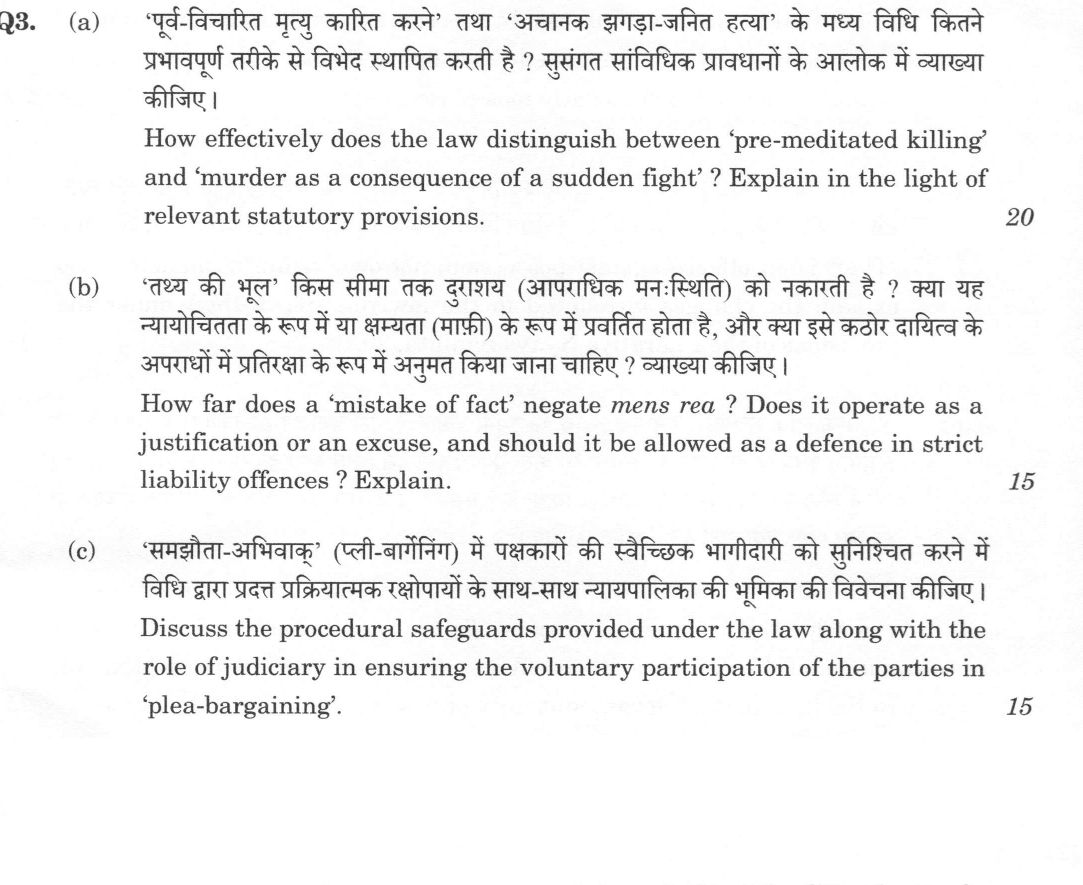
How effectively does the law distinguish between ‘pre-meditated killing’ and ‘murder as a consequence of a sudden fight’ ? Explain in the light of relevant statutory provisions. 20 marks
How far does a ‘mistake of fact’ negate mens rea ? Does it operate as a justification or an excuse, and should it be allowed as a defence in strict liability offences ? Explain. 15 marks
Discuss the procedural safeguards provided under the law along with the role of judiciary in ensuring the voluntary participation of the parties in ‘plea-bargaining’. 15 marks
हिंदी में प्रश्न पढ़ें
‘पूर्व-विचारित मृत्यु कारित करने’ तथा ‘अचानक झगड़ा-जनित हत्या’ के मध्य विधि कितने प्रभावपूर्ण तरीके से विभेद स्थापित करती है ? सुसंगत सांविधिक प्रावधानों के आलोक में व्याख्या कीजिए। (20 अंक)
‘तथ्य की भूल’ किस सीमा तक दुराशय (आपराधिक मनःस्थिति) को नकारती है ? क्या यह न्यायोचितता के रूप में या क्षम्यता (माफी) के रूप में प्रवर्तित होता है, और क्या इसे कठोर दायित्व के अपराधों में प्रतिरक्षा के रूप में अनुमत किया जाना चाहिए ? व्याख्या कीजिए। (15 अंक)
‘समझौता-अभिवाक्’ (प्ली-बार्गेनिंग) में पक्षकारों की स्वैच्छिक भागीदारी को सुनिश्चित करने में विधि द्वारा प्रदत्त प्रक्रियात्मक रक्षोपायों के साथ-साथ न्यायपालिका की भूमिका की विवेचना कीजिए। (15 अंक)
Model answer
Drafted with AI by UPSC Answer Check against this question's marking rubric, to the expected length. UPSC does not publish answers for Mains — this is one way to score well, not an official key. How we build rubrics and answers.
(a) Premeditated Killing and Sudden Fight
The law draws the line through the genus–species relationship between culpable homicide and murder, with Exception 4 to Section 101 BNS, 2023 [Exception 4 to s. 300 IPC] as the statutory valve that converts an intentional killing into culpable homicide not amounting to murder when it flows from a sudden fight. Section 100 BNS [s. 299 IPC] defines culpable homicide as the genus; Section 101 BNS [s. 300 IPC] defines murder as the species (State of A.P. v. Rayavarapu Punnayya, (1976) 4 SCC 382), requiring intention or knowledge of death, or, under the third clause, intention to cause bodily injury sufficient in the ordinary course of nature to cause death (Virsa Singh v. State of Punjab, AIR 1958 SC 465). Murder under Section 103(1) BNS [s. 302 IPC] carries death or life imprisonment, whereas the reduced offence under Section 105 BNS [s. 304 IPC] prescribes life or a term of five to ten years with fine (or up to ten years where there is knowledge but no intention).
Exception 4 reduces murder to culpable homicide not amounting to murder when four cumulative ingredients are met: (i) the death is caused in a sudden fight; (ii) in the heat of passion; (iii) without premeditation; and (iv) without the accused taking undue advantage or acting in a cruel or unusual manner (the Explanation adds that it is immaterial which party offers the provocation or commits the first assault). A "fight" is undefined and requires two parties (Sridhar Bhuyan v. State of Orissa, (2004) 11 SCC 395). The decisive question is whether passions had cooled: the time gap between quarrel and fatal blow is critical (Ghapoo Yadav v. State of M.P., (2003) 3 SCC 528). Intention is inferred from the weapon, whether it was carried or picked up, the part struck, the force used, and post‑act conduct (Pulicherla Nagaraju v. State of A.P., (2006) 11 SCC 444); a single blow in a sudden quarrel without premeditation or undue advantage attracted the exception in Stalin v. State, (2020) 9 SCC 524.
The conceptual line is clear but its application turns on inference, so identical facts can yield murder or Section 105 depending on the view of "undue advantage" and cooling. Premeditation is the real dividing line: where the accused came armed with a plan, or where common intention under Section 3(5) BNS [s. 34 IPC] shows prior concert, Exception 4 is unavailable. Unlike Exception 1 (grave and sudden provocation), Exception 4 contains no express cooling‑time rule; in K.M. Nanavati v. State of Maharashtra, AIR 1962 SC 605 the interval allowed passions to cool and the killing remained murder, marking the boundary. Single‑blow cases have produced inconsistent outcomes, and the stakes are severe given Section 103(1). At sentencing, premeditation and brutality are aggravating factors in the rarest‑of‑rare enquiry (Bachan Singh v. State of Punjab, (1980) 2 SCC 684; Machhi Singh v. State of Punjab, (1983) 3 SCC 470).
In sum, the distinction is workable in principle but fragile in practice, resting on judicial inference rather than a bright‑line rule.
(b) Mistake of Fact and Mens Rea
A mistake of fact negates mens rea to the extent that it demonstrates the absence of a guilty mind, operating on the maxim ignorantia facti excusat, ignorantia juris non excusat.
**(i) How far it negates mens rea.** Under Section 14 BNS [s. 76 IPC] and Section 17 BNS [s. 79 IPC], an act done by one who, by reason of a mistake of fact, in good faith believes himself bound (Section 14) or justified (Section 17) by law is not an offence. But Section 2(11) BNS [s. 52 IPC] confines this to mistakes made in "good faith," i.e. with due care and attention; a careless or reckless mistake will not suffice. The mistake must be about a fact, not the law: in R. v. Prince, (1875) LR 2 CCR 154 the belief that a girl was of age was held no defence because the statute made the fact strict, marking the limit; whereas in R. v. Tolson, (1889) 23 QBD 168 an honest and reasonable belief that her husband was dead negated the mens rea for bigamy. In India, Chirangi v. State (1952) acquitted a man who, with poor eyesight, killed his son believing him to be a tiger, and State of Orissa v. Ram Bahadur Thapa (1960) acquitted an accused who attacked people in the honest belief that they were ghosts.
(ii) Justification or excuse. It operates as an excuse — more precisely a failure‑of‑proof defence — not a justification. It does not render the act lawful; it negates the mental element, so the prosecution's case on mens rea fails.
(iii) Strict‑liability offences. The presumption is that mens rea is an ingredient of every offence, displaced only by clear words or necessary implication (Sherras v. De Rutzen, [1895] 1 QB 918; Sweet v. Parsley, [1970] AC 132). In Nathulal v. State of M.P., AIR 1966 SC 43 the Court acquitted a dealer who bona fide believed his licence was granted, holding mens rea essential; but in State of Maharashtra v. Mayer Hans George, AIR 1965 SC 722 a German national was convicted under the Foreign Exchange Regulation Act notwithstanding ignorance of the notification, the statutory object excluding mens rea. Modern regulatory presumptions (e.g. s. 35 NDPS Act, 1985; ss. 29–30 POCSO Act, 2012) reinforce this. The better solution is the intermediate Canadian category from R. v. City of Sault Ste. Marie, [1978] 2 SCR 1299, allowing exculpation by reasonable care or reasonable mistake, reserving absolute liability for the clearest cases. Under Section 108 BSA, 2023 [s. 105 IEA] the burden lies on the accused, on a preponderance of probabilities.
Mistake of fact should therefore be admitted in strict‑liability offences in the qualified form of a reasonable and diligent mistake, since excluding it altogether punishes the blameless and severs punishment from culpability.
(c) Plea Bargaining: Safeguards and the Judiciary
The plea‑bargaining chapter of the Bharatiya Nagarik Suraksha Sanhita, 2023 (BNSS), Sections 289 to 300 [formerly CrPC 265A–L], builds procedural safeguards around voluntariness, and the judiciary plays a dual role of gatekeeper and verifier.
Statutory safeguards. The scheme, introduced by the Criminal Law (Amendment) Act, 2005 (in force from 5 July 2006) on the recommendations of the Law Commission (142nd, 154th and 177th Reports) and the Malimath Committee (2003), applies only where the maximum punishment does not exceed seven years; offences affecting the socio-economic condition of the country (as notified) and offences against a woman or a child below fourteen are excluded, as is an accused previously convicted of the same offence (Section 289 BNSS [s. 265A CrPC]). The accused must apply with an affidavit that he is doing so voluntarily, and under the BNSS the application must be made within thirty days of the framing of charge (Section 290 BNSS [s. 265B CrPC]). The court must examine the accused in camera to satisfy itself that the plea is voluntary and not extracted under duress (Section 290(4) BNSS). Notice then goes to the Public Prosecutor, the investigating officer and the victim to work out a mutually satisfactory disposition, which may include compensation to the victim (Sections 291-292 BNSS [ss. 265C-265D CrPC]). Under Section 293 BNSS [s. 265E CrPC] the court awards the agreed compensation and may impose half the minimum punishment, or one-fourth of the prescribed punishment where there is no minimum, with further reductions for first-time offenders under the BNSS. The statements made during the process are protected from use against the accused under Section 299 BNSS [s. 265K CrPC], while finality — that the accused shall not be tried again for the same offence — is provided under Section 295 BNSS [s. 265G CrPC], subject only to a special leave petition under Article 136 and writ petitions under Articles 226 and 227. Section 299 also safeguards the protection against self-incrimination in Article 20(3) if the bargain fails.
Role of the judiciary. Before the 2005 amendment the judiciary was hostile, treating compromise as an impermissible barter of justice; in Murlidhar Meghraj Loya v. State of Maharashtra (1976) Krishna Iyer J. condemned plea bargaining in a food-adulteration case, Kasambhai Abdulrehmanbhai Sheikh v. State of Gujarat (1980) called it unconstitutional and contrary to public policy, Thippaswamy v. State of Karnataka (1983) held that inducing a guilty plea by promising leniency violates Article 21, and State of U.P. v. Chandrika (2000) held that a case cannot be disposed of by plea bargaining. After statutory recognition the Gujarat High Court upheld the scheme in State of Gujarat v. Natwar Harchandji Thakor (2005), and the court's role became active and mandatory: it must independently verify voluntariness in camera, ensure the accused understands the consequences, consider the victim's compensation, and refuse the compromise where the plea is induced or the offence falls outside the chapter. This converts plea‑bargaining from a private bargain into a court‑supervised instrument of justice, preventing the powerful from buying immunity. Concerns remain about pressure on undertrials in custody, unequal bargaining power, weak legal aid and the victim's limited voice, which is why the judicial check matters.
The safeguards and the in‑camera judicial verification together ensure that participation is genuinely voluntary and that the public interest in proportionate punishment is preserved.
How this answer will be evaluated
Evaluation rubric
Each sub-part is marked on its own, against the marks and word limit printed on the paper.
- (a) The question asks HOW EFFECTIVELY the law distinguishes premeditated killing (murder under Section 101 BNS, 2023) from a killing in a sudden fight (Exception 4 to Section 101), and requires the answer to be anchored in statutory provisions: the candidate must set out both, apply the four ingredients of Exception 4, and then critically assess the workability of the test. 20 marks
Must cover
- Section 100 BNS [s. 299 IPC] and Section 101 BNS [s. 300 IPC] — genus and species
- Exception 4 to Section 101 BNS [Exception 4 to s. 300 IPC]: four cumulative ingredients and the Explanation
- Punishments: Section 103(1) BNS [s. 302 IPC] and Section 105 BNS [s. 304 IPC]
- Premeditation as the dividing line; intention inferred from weapon, injury and conduct
- Application through decided cases on Exception 4
- Critical assessment of how effectively the line is drawn
Loses marks
- Reproducing the whole of Sections 299 and 300 IPC by rote and never reaching Exception 4, which is the actual subject of the question.
- Citing the IPC as the governing law; the statutes in force are the BNS, 2023 and the BNSS, 2023, and the IPC section may appear only as the bracketed equivalent.
- Stating only two or three ingredients of Exception 4 — all four are cumulative, and 'without undue advantage or cruel or unusual manner' is the one most often dropped.
- Confusing Exception 4 (sudden fight) with Exception 1 (grave and sudden provocation); Nanavati belongs to Exception 1, and the cooling-time discussion arises there.
- Asserting that a single blow always attracts Exception 4, or that it never does; the authorities require examination of premeditation, weapon and undue advantage.
- Omitting the 'how effectively' half of the question — an answer that only describes the provisions, without assessing the workability of the distinction, cannot score at the top.
Earns more
- Applies the leading authorities: Ghapoo Yadav v. State of M.P., (2003) 3 SCC 528 (the four ingredients of Exception 4; the time gap between quarrel and fatal blow and whether passions had cooled are decisive); Sridhar Bhuyan v. State of Orissa, (2004) 11 SCC 395 ('fight' is not defined and takes two to make; there must be no time for the passions to cool and no undue advantage); Pulicherla Nagaraju v. State of A.P., (2006) 11 SCC 444 (setting out the circumstances from which the intention to cause death is inferred — nature of the weapon, whether it was carried or picked up at the spot, whether the blow was aimed at a vital part, the force used, whether the act was in the course of a sudden quarrel or scuffle, and the conduct of the accused afterwards); Stalin v. State, (2020) 9 SCC 524 (a single blow with a knife in a sudden quarrel without premeditation or undue advantage; conviction altered from murder to culpable homicide not amounting to murder). Distinguishes Exception 1 (grave and sudden provocation) and K.M. Nanavati v. State of Maharashtra, AIR 1962 SC 605, where the interval allowed the passions to cool and the killing remained murder.
- Delivers a critical assessment rather than a description: the conceptual line is clear but its application turns on inference, so the same facts can yield murder or Section 105 depending on the view taken of 'undue advantage' and of whether passions had cooled; Exception 4 contains no express cooling-time rule, unlike the jurisprudence under Exception 1; single-blow cases have produced inconsistent outcomes; and the consequences are severe, since Section 103(1) BNS carries death or life imprisonment while Section 105 BNS prescribes imprisonment for life or a term of not less than five years extending to ten years with fine in the first part, and up to ten years with fine where there is knowledge but no intention. Adds the sentencing overlay of Bachan Singh v. State of Punjab, (1980) 2 SCC 684 and Machhi Singh v. State of Punjab, (1983) 3 SCC 470, under which premeditation and brutality are aggravating circumstances in the rarest-of-rare enquiry.
Extra mark
- Virsa Singh (1958); Rayavarapu Punnayya (1976)
- Ghapoo Yadav (2003); Sridhar Bhuyan (2004); Pulicherla Nagaraju (2006); Stalin v. State (2020)
- K.M. Nanavati (1962) — Exception 1 contrasted
- Section 3(5) BNS [s. 34 IPC]; Bachan Singh (1980); Machhi Singh (1983)
- (b) Three distinct sub-questions, all of which must be answered: (i) how far does a mistake of fact negate mens rea; (ii) does it operate as a justification or an excuse; and (iii) should it be allowed as a defence in strict liability offences. Each requires a position supported by statute and authority. 15 marks
Must cover
- Ignorantia facti excusat, ignorantia juris non excusat
- Section 14 BNS [s. 76 IPC] and Section 17 BNS [s. 79 IPC]; good faith under Section 2(11) BNS [s. 52 IPC]
- Illustrative cases on honest mistake (e.g. Tolson; Chirangi)
- Justification v. excuse — mistake as an excuse / failure-of-proof defence
- Strict liability: presumption of mens rea and its displacement, with authority on both sides (Nathulal; Mayer Hans George)
- Reasoned position on allowing the defence in strict-liability offences
Loses marks
- Answering only the first sub-question and ignoring the justification-versus-excuse and strict-liability limbs, each of which carries marks.
- Omitting the 'good faith' requirement in Section 2(11) BNS [s. 52 IPC] and therefore suggesting that any honest mistake, however careless, suffices.
- Confusing mistake of fact with mistake of law, or asserting that mistake of law is a defence in India.
- Reversing the holdings of Nathulal and Mayer Hans George — Nathulal acquitted on the ground that mens rea was essential, Mayer Hans George convicted because the statute excluded it.
- Citing Sections 76 and 79 IPC as the law in force instead of Sections 14 and 17 BNS, 2023 (the IPC sections belong in brackets).
- Asserting that the accused must prove a General Exception beyond reasonable doubt; the standard under Section 108 BSA is preponderance of probabilities.
Earns more
- Answers the strict-liability sub-question with authority on both sides and takes a position: the presumption that mens rea is an ingredient of every offence, displaced only by clear words or necessary implication — Sherras v. De Rutzen, [1895] 1 QB 918; Sweet v. Parsley, [1970] AC 132; and in India Nathulal v. State of M.P., AIR 1966 SC 43 (a foodgrains dealer who stored grain bona fide believing his licence had been granted was acquitted, mens rea being held essential) — set against State of Maharashtra v. Mayer Hans George, AIR 1965 SC 722 (a German national carrying gold in transit was convicted under the Foreign Exchange Regulation Act notwithstanding ignorance of the notification, the statutory object excluding mens rea). Notes the modern regulatory presumptions in Section 35 of the Narcotic Drugs and Psychotropic Substances Act, 1985 and Sections 29 and 30 of the POCSO Act, 2012, and proposes the intermediate Canadian solution from R. v. City of Sault Ste. Marie, [1978] 2 SCR 1299 — a category of strict liability offences in which the accused may exculpate himself by proving reasonable care or reasonable mistake of fact, reserved absolute liability being confined to the clearest statutory cases.
- Adds the evidentiary dimension and a conclusion: Section 108 of the Bharatiya Sakshya Adhiniyam, 2023 [s. 105, Indian Evidence Act, 1872] places on the accused the burden of proving that his case falls within a General Exception, the court presuming the absence of such circumstances; the standard is preponderance of probabilities, not proof beyond reasonable doubt, and it suffices for the accused to raise a reasonable doubt about the existence of the mental element. Concludes that mistake of fact should be admitted in strict-liability offences in the qualified form of a reasonable and diligent mistake, since to exclude it altogether is to punish the blameless and to sever punishment from culpability.
Extra mark
- R. v. Prince (1875); Ram Bahadur Thapa (1960)
- Sherras v. De Rutzen (1895); Sweet v. Parsley (1970)
- R. v. City of Sault Ste. Marie (1978) — due-diligence defence
- Section 108 BSA [s. 105 IEA] — burden on the accused
- Section 35 NDPS Act, 1985; Sections 29-30 POCSO Act, 2012
- (c) Two linked demands: set out the procedural safeguards for voluntariness in the plea bargaining chapter of the Bharatiya Nagarik Suraksha Sanhita, 2023 (Sections 289 to 300), and separately discuss the role of the judiciary — both the pre-2005 hostility to plea bargaining and the court's active statutory duty to verify voluntariness in camera. 15 marks
Must cover
- Sections 289-300 BNSS [ss. 265A-265L CrPC]; Criminal Law (Amendment) Act, 2005
- Section 289 BNSS [s. 265A CrPC] — seven-year ceiling and exclusions
- Section 290 BNSS [s. 265B CrPC] — application with affidavit; thirty-day limit; in-camera examination
- Mutually satisfactory disposition, compensation and reduced sentence (Sections 291-293 BNSS)
- Finality (Section 295 BNSS) and non-use of statements (Section 299 BNSS); Article 20(3)
- Judicial role: pre-2005 hostility (at least two decisions) and the present duty to verify voluntariness
Loses marks
- Citing Sections 265A to 265L of the CrPC as the law in force; the governing provisions are Sections 289 to 300 BNSS, 2023, with the CrPC numbering in brackets only.
- Omitting the in-camera examination under Section 290(4) BNSS, which is the single most important voluntariness safeguard and the heart of the question.
- Stating the applicability threshold wrongly — it is imprisonment not exceeding seven years, not ten years, and offences against a woman or a child below fourteen are excluded.
- Ignoring the judicial-role half of the question, or discussing only the post-2006 position without the earlier line of Supreme Court decisions rejecting plea bargaining.
- Confusing plea bargaining with compounding of offences under Section 359 BNSS [s. 320 CrPC] or with a simple plea of guilty, or with the mediation and compromise powers in civil matters.
- Forgetting Section 299 BNSS [s. 265K CrPC], the non-use protection, which is what makes an unsuccessful bargain safe for the accused.
Earns more
- Discusses the judiciary's role historically and at present: before 2005 the Supreme Court condemned the practice as unconstitutional and contrary to public policy — Murlidhar Meghraj Loya v. State of Maharashtra, (1976) 3 SCC 684; Kasambhai Abdulrehmanbhai Sheikh v. State of Gujarat, (1980) 3 SCC 120; Thippaswamy v. State of Karnataka, (1983) 1 SCC 194 (inducing an accused to plead guilty on an assurance of leniency violates Article 21); State of U.P. v. Chandrika, AIR 2000 SC 164 (a case cannot be disposed of on the basis of plea bargaining, and mere acceptance of guilt is no ground for reducing the sentence). After the statutory scheme, State of Gujarat v. Natwar Harchandji Thakor, 2005 Cri LJ 2957 (Gujarat High Court) upheld it on a purposive reading, noting that every plea of guilty is not plea bargaining, and Vijay Moses Das v. CBI (Uttarakhand High Court, 2010) held that a plea bargaining application should not be rejected on hyper-technical grounds. Recalls the reformist reports that produced the chapter — the Law Commission's 142nd Report (1991), 154th Report (1996) and 177th Report (2001) and the Malimath Committee Report on Reforms of the Criminal Justice System (2003) — and notes the continuing criticisms: risk of coercion of undertrials in custody, unequal bargaining power, weak legal aid, and the victim's limited voice.
Extra mark
- Murlidhar Meghraj Loya (1976); Kasambhai (1980); Thippaswamy (1983); State of U.P. v. Chandrika (2000)
- State of Gujarat v. Natwar Harchandji Thakor (2005)
- Malimath Committee (2003); Law Commission Reports 142, 154 and 177
What "Distinguish" is asking you to do
Name the property that separates the items and say which side holds it. Distinguish is marked exactly as differentiate is, with no difference in expectation, but its stems more often line up three terms rather than two — gender equality, gender equity and empowerment — and every pair in the set has to be separated.
Structure that answers it
The category they all sit in → the property dividing the first pair → the second pair → the third → why the boundary matters in practice
Where marks are lost
Separating the two obviously different items and leaving the middle term unplaced. A description of each side from which the line must be inferred is marked as description, not as a distinction.
Practice this exact question
Write your answer and it is marked point by point against the model answer above — what you covered, what you missed, what you got wrong.
Evaluate my answer →More from Law 2026 Paper II
- Q1 Answer the following questions in about 150 words each. Support your answer with relevant…
- Q2 (a) “Vicarious liability’ is based on public policy rather than fault.” Critically analys…
- Q3 (a) How effectively does the law distinguish between ‘pre-meditated killing’ and ‘murder…
- Q4 (a) 'X', a 25-year-old boy, makes a promise to 'Y', an 18-year-old girl, that he will mar…
- Q5 Answer the following questions in about 150 words each. Support your answer with relevant…
- Q6 (a) “Sharing of profits is only prima facie evidence of the existence of a partnership. T…