Paper II — Q6
(a) “Sharing of profits is only prima facie evidence of the existence of a partnership. The conclusive test is that of…
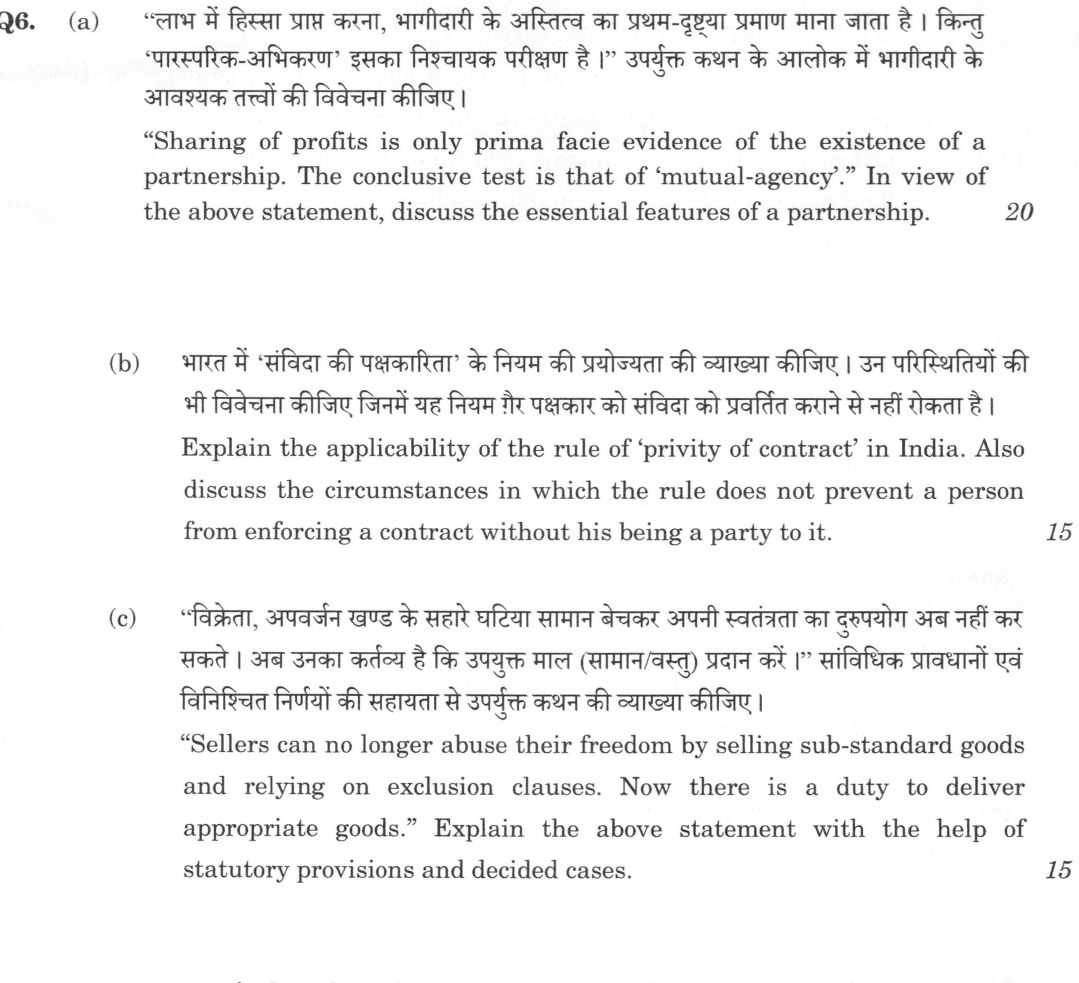
“Sharing of profits is only prima facie evidence of the existence of a partnership. The conclusive test is that of ‘mutual-agency’.” In view of the above statement, discuss the essential features of a partnership. 20 marks
Explain the applicability of the rule of ‘privity of contract’ in India. Also discuss the circumstances in which the rule does not prevent a person from enforcing a contract without his being a party to it. 15 marks
“Sellers can no longer abuse their freedom by selling sub-standard goods and relying on exclusion clauses. Now there is a duty to deliver appropriate goods.” Explain the above statement with the help of statutory provisions and decided cases. 15 marks
हिंदी में प्रश्न पढ़ें
“लाभ में हिस्सा प्राप्त करना, भागीदारी के अस्तित्व का केवल प्रथम-दृष्टया प्रमाण है। किन्तु ‘पारस्परिक-अभिकरण’ इसका निश्चायक परीक्षण है।” उपर्युक्त कथन के आलोक में भागीदारी के आवश्यक तत्वों की विवेचना कीजिए। (20 अंक)
भारत में ‘संविदा की पक्षकारिता’ के नियम की प्रयोज्यता की व्याख्या कीजिए । उन परिस्थितियों की भी विवेचना कीजिए जिनमें यह नियम गैर पक्षकार को संविदा को प्रवर्तित कराने से नहीं रोकता है । (15 अंक)
“विक्रेता, अपवर्जन खण्ड के सहारे घटिया सामान बेचकर अपनी स्वतंत्रता का दुरुपयोग अब नहीं कर सकते । अब उनका कर्तव्य है कि उपयुक्त माल (सामान/वस्तु) प्रदान करें ।” सांविधिक प्रावधानों एवं विनिश्चित निर्णयों की सहायता से उपर्युक्त कथन की व्याख्या कीजिए । (15 अंक)
Model answer
Drafted with AI by UPSC Answer Check against this question's marking rubric, to the expected length. UPSC does not publish answers for Mains — this is one way to score well, not an official key. How we build rubrics and answers.
(a) Mutual Agency and the Essentials of Partnership
The quoted proposition correctly distinguishes between the prima facie evidence of partnership (profit-sharing) and the conclusive test (mutual agency). Under Section 4 of the Indian Partnership Act, 1932, a partnership is defined as the relation between persons who have agreed to share the profits of a business carried on by all or any of them acting for all. This "acting for all" clause establishes mutual agency as the definitive feature. Section 6 directs the court to look at the real relation between the parties as shown by all relevant facts taken together, and its Explanations list persons — joint owners, lenders, employees paid by a share of profits, the widow or child of a deceased partner, and a seller of goodwill — who share profits without becoming partners.
The essential features of a partnership are:
- Contract, not Status: Section 5 mandates that partnership arises from contract, not status. Consequently, members of a Hindu Undivided Family (HUF) or a Burmese Buddhist husband and wife carrying on a family business are not partners. Capacity follows the Indian Contract Act, 1872, so a minor cannot be a partner, though under Section 30 he may be admitted to the benefits of partnership with the consent of all partners.
- Lawful Business: Section 2(b) defines "business" as every trade, occupation, or profession. It must be lawful and actually carried on; a mere agreement to share income from property is insufficient.
- Profit Sharing: While sharing of profits is a strong indicator, it is not conclusive. As held in Cox v. Hickman (1860), creditors who took over a debtor's business under a trust deed and received profits in discharge of the debt were not partners, because the business was not carried on by them or on their behalf; Mollwo, March & Co. v. Court of Wards (1872) similarly held that a lender taking a commission on profits was not a partner. An agreement to share losses is strong evidence but is not essential, though liability to third parties under Section 25 remains joint and several.
- Mutual Agency: This is the "true test." Under Section 18, a partner is the agent of the firm for the purposes of its business; Section 19 gives him implied authority to bind the firm, Section 22 makes acts done in the firm name binding on all, and Section 25 makes every partner jointly and severally liable for the firm's acts. Each partner is thus both principal and agent, which an ordinary agent is not. In K.D. Kamath & Co. v. CIT, the Supreme Court affirmed that control vested in one partner does not negate partnership if the mutual agency exists.
- Legal Status: The firm is not a separate legal entity (Malabar Fisheries Co. v. CIT). The maximum number of partners is 50 under Section 464 of the Companies Act, 2013 read with Rule 10 of the Companies (Miscellaneous) Rules, 2014. By contrast, an LLP under the Limited Liability Partnership Act, 2008 is a body corporate (Section 3), and its partner is an agent of the LLP but not of the other partners (Section 26), which confirms that mutual agency is the hallmark of a firm under the 1932 Act. Registration (Sections 58-59) affects only the right to sue under Section 69, not the existence of the partnership.
In conclusion, while profit-sharing is a starting point, the existence of mutual agency is the "conclusive test" that distinguishes a partnership from other associations.
(b) Privity of Contract in India and its Exceptions
The rule of 'privity of contract' in India is governed by the Indian Contract Act, 1872. It consists of two aspects: privity of consideration and privity of contract. India has adopted a unique position where privity of consideration is not required, but privity of contract is strictly applied.
Applicability of the Rule: Under Section 2(d), consideration may move from the promisee "or any other person." This was established in Chinnaya v. Ramayya (1882), where an old woman gifted property to her daughter on condition that the daughter pay an annuity to the old woman's sister; the daughter promised the aunt to pay it, and the aunt could sue even though the consideration came from her sister, not from her. However, following the English rule in Tweddle v. Atkinson (1861) and Dunlop v. Selfridge (1915), the Privy Council in Jamna Das v. Ram Autar Pande (1911) and the Supreme Court in M.C. Chacko v. State Bank of Travancore (1969) held that a stranger to the contract cannot sue on it, even though a stranger to the consideration can. Thus, a non-party cannot enforce a contract merely because they provided consideration.
Exceptions to the Rule: The rule does not prevent enforcement in the following circumstances:
- Trust or Charge: Under Khwaja Muhammad Khan v. Husaini Begum, a person interested in a trust or charge on immovable property can sue.
- Family Arrangements: A female member can sue for maintenance or marriage expenses provided for her in a family settlement or partition, though not a party to it (Rose Fernandez v. Joseph Gonsalves, 1924; Shuppu Ammal v. Subramaniyan, 1910; see also Rana Uma Nath Bakhsh Singh v. Jang Bahadur, 1938).
- Acknowledgement or Estoppel: Where a party to the contract acknowledges, by conduct or otherwise, that he holds money for a third person, he becomes liable to that person (Devaraja Urs v. Ram Krishniah, 1952).
- Agency and Assignment: Under Section 226, a principal can enforce a contract made through an agent, and contractual benefits can be assigned.
- Covenants Running with Land: As per Tulk v. Moxhay, covenants can be enforced against a successor in title who takes with notice.
- Statutory Provisions: Section 2(7) of the Consumer Protection Act, 2019 includes a beneficiary who uses the goods or services with the buyer's approval as a consumer, allowing him to sue. Section 6 of the Married Women's Property Act, 1874 makes a life policy taken for the benefit of the wife or children a trust they can enforce, and the Motor Vehicles Act, 1988 lets a third-party accident victim recover directly from the insurer. Unlike England, which abolished much of the rule by the Contracts (Rights of Third Parties) Act, 1999, India has no such statute, although the Law Commission's 13th Report (1958) recommended reform.
In conclusion, while the general rule bars non-parties from suing, these specific exceptions and statutory provisions allow for enforcement.
(c) Seller's Duty to Deliver Appropriate Goods
The statement reflects the legal shift from caveat emptor (let the buyer beware) to a statutory duty on sellers to ensure goods are of appropriate quality. This is primarily governed by the Sale of Goods Act, 1930 (SOGA) and the Consumer Protection Act, 2019.
Statutory Provisions: Sections 14 to 17 of the SOGA provide implied conditions and warranties. Section 14 implies a condition of title and warranties of quiet possession and freedom from encumbrances. Section 15 requires goods sold by description to correspond with the description, and Section 17 requires goods sold by sample to correspond with the sample. Section 16(1) implies a condition of fitness for a particular purpose where the buyer makes the purpose known and relies on the seller's skill (excluded where goods are bought by patent or trade name), and Section 16(2) implies a condition of merchantable quality where goods are bought by description from a dealer (excluded for defects that an examination actually made ought to have revealed). Under Sections 12, 13 and 59, the buyer may reject the goods for breach of a condition or claim damages or a reduction in price. These provisions mean that a seller cannot simply sell "sub-standard goods" and rely on the buyer's failure to inspect.
Judicial Techniques and Exclusion Clauses: While Section 62 of the SOGA allows parties to exclude these implied conditions, courts have strictly interpreted such clauses. In Canada Steamship Lines v. The King (1952), the Privy Council held that a general exclusion clause does not cover negligence unless it does so expressly or by clear implication. Courts apply the doctrine of contra proferentem, interpreting exclusion clauses against the party who drafted them. Cases demonstrate the strict application of the implied conditions: in Priest v. Last (1903) a hot-water bottle burst and the purpose was obvious from the article itself; in Frost v. Aylesbury Dairy Co. (1905) milk containing typhoid germs breached the condition even though the seller could not have detected them; in Grant v. Australian Knitting Mills (1936) underwear containing excess sulphite breached both fitness and merchantable quality; and in Baldry v. Marshall (1925) a buyer who asked for a car suitable for touring could reject it. In Wallis, Son & Wells v. Pratt & Haynes (1911), a clause excluding 'warranties' did not exclude a breach of condition. After Photo Production v. Securicor (1980), whether a clause covers even a fundamental breach is a matter of construction, but Indian courts can strike down unfair terms imposed by a stronger party as opposed to public policy under Section 23 of the Contract Act (Central Inland Water Transport Corporation v. Brojo Nath Ganguly, 1986), and under consumer law one-sided terms have been held to be an unfair trade practice (Pioneer Urban Land v. Govindan Raghavan, 2019).
Consumer Protection Act, 2019: The 2019 Act further restricts sellers. Sections 2(10) and 2(11) define 'defect' and 'deficiency', Section 2(46) defines an 'unfair contract', and Sections 49(2) and 59(2) allow the State and National Commissions to declare unfair terms null and void. Where parties of equal standing clearly agree a limitation of liability, however, it may still be enforced (Bharathi Knitting Co. v. DHL Worldwide Express, 1996). Chapter VI (Sections 82-87) introduces "Product Liability," making manufacturers (Section 84), service providers (Section 85) and, in defined cases, sellers (Section 86) liable for harm caused by defective products.
In conclusion, the law now imposes a positive duty on sellers to deliver appropriate goods, and their freedom to contract out of this duty is severely curtailed by judicial interpretation and consumer protection statutes.
How this answer will be evaluated
Evaluation rubric
Each sub-part is marked on its own, against the marks and word limit printed on the paper.
- (a) "Discuss the essential features of a partnership" — but anchored to the quoted proposition, so the answer must do two linked things: set out every essential element of partnership under Sections 4, 5 and 6 of the Indian Partnership Act, 1932, and demonstrate why profit-sharing is only prima facie evidence while mutual agency (the words 'carried on by all or any of them acting for all' in Section 4) is the conclusive or 'true' test. A pure list of essentials without engaging the prima facie / conclusive distinction does not answer the question. 20 marks
Must cover
- Section 4 — definition; 'carried on by all or any of them acting for all' as the source of mutual agency
- Section 6 — real relation of the parties; profit-sharing only prima facie evidence (Explanations)
- Contract, not status (Section 5); capacity; minor admitted to benefits (Section 30)
- Lawful business actually carried on (Section 2(b)); agreement to share profits
- Mutual agency — Sections 18, 19, 22 and 25
- Firm not a separate legal person; reasoned conclusion on the quoted statement
Loses marks
- Listing the essentials as a bare catalogue and never explaining the prima facie versus conclusive distinction the quotation turns on — this is the single commonest way to lose half the marks here.
- Failing to quote or paraphrase the operative words of Section 4, 'carried on by all or any of them acting for all', which are the textual source of the mutual-agency test.
- Confusing the mutual agency between partners with the ordinary law of agency in Chapter X of the Indian Contract Act — a partner is both principal and agent simultaneously, which an ordinary agent is not.
- Asserting that sharing of losses is an essential element; it is not, as between the partners, though liability to third parties under Section 25 is unlimited.
- Treating the firm as a juristic person with a separate legal personality, contrary to Malabar Fisheries and Kelukutty, or confusing it with an LLP under the 2008 Act.
- Stating an obsolete maximum number of partners (10 for banking / 20 for other business under the repealed Section 11 of the Companies Act, 1956) instead of 50 under Section 464 of the Companies Act, 2013 with Rule 10 of the 2014 Rules.
- Misstating Cox v. Hickman as having held the creditors to be partners.
Earns more
- Covers the agreement and capacity essential: Section 5 — the relation of partnership arises from contract and not from status, and in particular the members of a Hindu undivided family carrying on a family business as such, or a Burmese Buddhist husband and wife carrying on business as such, are not partners in such business; partnership is therefore consensual and may be express or implied from conduct; capacity is governed by Sections 10, 11 and 12 of the Indian Contract Act, 1872, so a minor cannot be a partner but may under Section 30 be admitted to the benefits of partnership with the consent of all the partners; a firm as such cannot be a partner in another firm, though its partners may be. Notes the numerical limit — minimum two partners, maximum 50 under Section 464 of the Companies Act, 2013 read with Rule 10 of the Companies (Miscellaneous) Rules, 2014, beyond which the association is illegal.
- Covers the 'business' and 'sharing of profits' essentials with precision: Section 2(b) — 'business' includes every trade, occupation and profession; the business must be lawful and must actually be carried on, so that a mere agreement to share the income of jointly held property is not partnership; a single venture or adventure may constitute a partnership; there must be an agreement to share the profits of that business, and while an agreement to share losses is strong corroborative evidence it is not indispensable, a partner being capable of being indemnified against losses inter se, although as against third parties liability under Section 25 remains unlimited, joint and several.
- Supports the analysis with authority and, where done, a contrast: Cox v. Hickman, (1860) 8 HLC 268 (creditors who under a trust deed took over the business and received its profits in discharge of the debts were held not to be partners; the true question is whether the trade was carried on by or on behalf of the persons sought to be charged); Mollwo, March & Co. v. Court of Wards, (1872) LR 4 PC 419 (a financier taking a commission on profits with a measure of control was held not a partner); K.D. Kamath & Co. v. Commissioner of Income Tax, (1971) 2 SCC 873 (the two essential conditions are an agreement to share profits and the business being carried on by all or any of them acting for all, and control and management being vested in one partner does not negative partnership). Credit also a contrast with the Limited Liability Partnership Act, 2008 — Section 3 (an LLP is a body corporate with perpetual succession and a legal entity separate from its partners) and Section 26 (a partner is the agent of the LLP but not of the other partners), which shows mutual agency is the distinguishing mark of the 1932 Act firm; or with registration under Sections 58–59 and the disabilities of an unregistered firm under Section 69, which affects enforcement but not the existence of the partnership.
Extra mark
- Cox v. Hickman (1860); Mollwo, March & Co. v. Court of Wards (1872)
- K.D. Kamath & Co. v. CIT (1971)
- Malabar Fisheries Co. v. CIT (1979)
- Maximum 50 partners — Section 464, Companies Act, 2013 with Rule 10 of the 2014 Rules
- LLP Act, 2008, Sections 3 and 26 contrasted; registration and Section 69
- (b) Two linked demands: (i) 'explain the applicability of the rule of privity of contract in India' — state the rule, note the critical Indian departure that privity of consideration is NOT required because Section 2(d) of the Indian Contract Act, 1872 allows consideration to move from the promisee 'or any other person', while privity of contract is nonetheless applied; and (ii) 'discuss the circumstances in which the rule does not prevent a person from enforcing a contract without his being a party to it' — the recognised exceptions, each with authority. 15 marks
Must cover
- Section 2(d) — consideration from 'the promisee or any other person': no privity of consideration
- Privity of contract nevertheless applies (Tweddle v. Atkinson; Dunlop v. Selfridge)
- Indian authority on both points (Chinnaya v. Ramayya; M.C. Chacko)
- Exception: trust or charge (Khwaja Muhammad Khan v. Husaini Begum)
- Other exceptions with authority: family arrangements, acknowledgement or estoppel, agency, covenants running with land, assignment
- Statutory exceptions: Section 2(7) CPA, 2019; Section 6, Married Women's Property Act, 1874; third-party motor insurance
Loses marks
- Confusing privity of contract with privity of consideration and asserting that neither applies in India — the correct position is that Section 2(d) abolishes the need for privity of consideration but the courts have nevertheless applied privity of contract.
- Citing only English cases (Tweddle, Dunlop) and omitting the Indian authorities, especially M.C. Chacko, which is the case the examiner is looking for.
- Listing exceptions as bare headings ('trust', 'family settlement', 'estoppel') without the case or the facts that make each exception intelligible.
- Misstating Chinnaya v. Ramayya as a privity-of-contract exception; it is an authority on consideration moving from a third person, and the aunt was in fact a promisee under the deed.
- Ignoring the second half of the question and writing only about the rule, or ignoring the first half and writing only a list of exceptions.
- Asserting that India has enacted a Contracts (Rights of Third Parties) statute; it has not — that is English law of 1999.
Earns more
- Adds at least three of the remaining recognised exceptions with content: (a) marriage settlement, partition or other family arrangement — a female member may sue for maintenance or marriage expenses provided for her in the family arrangement though she is no party (Rose Fernandez v. Joseph Gonsalves, (1924) ILR 48 Bom 673; Shuppu Ammal v. Subramaniyan, (1910) ILR 33 Mad 238); (b) acknowledgement of liability or estoppel — where a party to the contract acknowledges himself, by conduct or otherwise, as agent or trustee of the third party, he becomes liable to him (Devaraja Urs v. Ram Krishniah, AIR 1952 Mys 109); (c) agency — a principal may sue and be sued on a contract made by his agent (Section 226 of the Indian Contract Act, 1872), including an undisclosed principal (Sections 231–232); (d) covenants running with the land — a transferee is bound by restrictive covenants annexed to the land (Tulk v. Moxhay, (1848) 2 Ph 774; Section 40 of the Transfer of Property Act, 1882); (e) assignment of contractual benefits.
- Notes the statutory dilution of the rule, showing awareness that legislation has overtaken much of it: Section 2(7) of the Consumer Protection Act, 2019, under which a 'consumer' includes a beneficiary who uses the goods or avails the services with the approval of the buyer, so the user-beneficiary may complain though he is not a party; compulsory third-party motor insurance and the third party's right of recovery under Chapter XI of the Motor Vehicles Act, 1988; Section 6 of the Married Women's Property Act, 1874, under which a policy effected by a man on his own life for the benefit of his wife or children creates a trust enforceable by them; and the holder in due course of a negotiable instrument. A comparative note that English law has statutorily abandoned the rule by the Contracts (Rights of Third Parties) Act, 1999, whereas India has no such statute and has relied on judicially crafted exceptions, and that the Law Commission of India's 13th Report (1958) recommended a similar reform, also earns this mark.
Extra mark
- Jamna Das v. Ram Autar Pande (1911)
- Rose Fernandez (1924); Shuppu Ammal (1910); Rana Uma Nath Bakhsh Singh (1938)
- Devaraja Urs v. Ram Krishniah (1952); Tulk v. Moxhay (1848)
- Contracts (Rights of Third Parties) Act, 1999 (UK); Law Commission, 13th Report (1958)
- (c) Explain, with statutory provisions and decided cases, how the law has moved from caveat emptor plus freedom to contract out (Sections 16 and 62 of the Sale of Goods Act, 1930) to a positive duty on the seller to deliver goods of the required description, quality and fitness. The answer must cover (i) the implied conditions and warranties, (ii) the seller's freedom under Section 62 to negative them and the judicial techniques that cut exclusion clauses down, and (iii) the statutory overriding of exclusion clauses by the Consumer Protection Act, 2019. 15 marks
Must cover
- Section 16 SGA — caveat emptor and its exceptions: 16(1) fitness (trade-name proviso), 16(2) merchantable quality (examination proviso)
- Sections 14, 15 and 17 — title, description, sample; Sections 12, 13 and 59 — remedies
- Section 62 — freedom to exclude, and judicial control (strict construction, contra proferentem)
- Decided cases on fitness and merchantability (at least two, with facts)
- Consumer Protection Act, 2019: Sections 2(10), 2(11), 2(46); Sections 49(2) and 59(2); product liability (Chapter VI)
- Indian control of unfair terms (Section 23 of the Contract Act)
Loses marks
- Writing a general essay on caveat emptor and its exceptions without ever mentioning Section 62, which is the provision that gives the seller the 'freedom' the question says he can no longer abuse.
- Omitting the Consumer Protection Act, 2019 altogether; the statement in the question ('now there is a duty to deliver appropriate goods') is unanswerable without it, and citing the repealed Consumer Protection Act, 1986 in its place is a further error.
- Confusing the two provisos — the trade-name proviso belongs to Section 16(1) (fitness), the examination proviso to Section 16(2) (merchantable quality).
- Treating merchantable quality and fitness for purpose as the same condition; they arise on different facts and Grant v. Australian Knitting Mills breached both.
- Stating the fundamental-breach doctrine as still an absolute rule of law without noting Photo Production v. Securicor, or, conversely, citing Photo Production for the proposition that exclusion clauses are always effective.
- Naming cases without their facts or holdings, which earns little here because the question expressly asks for 'decided cases'.
Earns more
- Illustrates the duty to deliver appropriate goods with decided cases on fitness and merchantability: Priest v. Last, [1903] 2 KB 148 (hot-water bottle which burst; purpose obvious from the article itself, reliance on the seller's skill inferred); Frost v. Aylesbury Dairy Co. Ltd., [1905] 1 KB 608 (milk containing typhoid germs; the seller's inability to detect the defect by any reasonable skill was no answer); Grant v. Australian Knitting Mills Ltd., [1936] AC 85 (woollen underwear containing an excess of sulphite causing dermatitis; both the fitness and the merchantable-quality conditions broken, and the buyer's reliance inferred even though he asked for the goods by their trade description); and, on the buyer's remedies, Sections 12 and 13 (when a condition may be treated as a breach of warranty) and Section 59 (remedy for breach of warranty — diminution or extinction of the price, or a suit for damages).
- Adds the Indian judicial control of unfair and one-sided terms and recognises the counterweight: Central Inland Water Transport Corporation Ltd. v. Brojo Nath Ganguly, (1986) 3 SCC 156 (an unfair and unreasonable term in a contract between parties of unequal bargaining power may be struck down as opposed to public policy under Section 23 of the Indian Contract Act, 1872); LIC of India v. Consumer Education & Research Centre, (1995) 5 SCC 482 (terms offered by the State or its instrumentality must be just, fair and reasonable, Article 14 informing contractual power); and by way of balance Bharathi Knitting Co. v. DHL Worldwide Express Courier Division of Airfreight Ltd., (1996) 4 SCC 704 (where the parties have expressly agreed to a limitation of liability in clear terms, the consumer forum should ordinarily give effect to it). A candidate who instead cites a modern consumer authority such as Pioneer Urban Land & Infrastructure Ltd. v. Govindan Raghavan, (2019) 5 SCC 725 on one-sided terms should be given this mark equally.
Extra mark
- Priest v. Last (1903); Frost v. Aylesbury Dairy (1905); Grant v. Australian Knitting Mills (1936)
- Baldry v. Marshall (1925); Wallis, Son & Wells v. Pratt & Haynes (1911)
- Canada Steamship Lines v. The King (1952); Photo Production v. Securicor (1980)
- Central Inland Water Transport Corp. v. Brojo Nath Ganguly (1986); Pioneer Urban Land v. Govindan Raghavan (2019); Bharathi Knitting v. DHL (1996)
What "Discuss" is asking you to do
Lay the issue out from more than one side — how it arose, what is claimed for it, what is held against it, and where it now stands. UPSC attaches discuss to broad topics with several live dimensions, so coverage of the dimensions earns more than the strength of your opinion.
Structure that answers it
Set the issue up → the case as it is made → the case against → the dimension both sides leave out → where the balance now lies
Where marks are lost
Listing facts with no thread between them, or arguing one side throughout and calling it a discussion.
Practice this exact question
Write your answer and it is marked point by point against the model answer above — what you covered, what you missed, what you got wrong.
Evaluate my answer →More from Law 2026 Paper II
- Q3 (a) How effectively does the law distinguish between ‘pre-meditated killing’ and ‘murder…
- Q4 (a) 'X', a 25-year-old boy, makes a promise to 'Y', an 18-year-old girl, that he will mar…
- Q5 Answer the following questions in about 150 words each. Support your answer with relevant…
- Q6 (a) “Sharing of profits is only prima facie evidence of the existence of a partnership. T…
- Q7 (a) Can ‘Alternative Dispute Resolution’ (ADR) mechanisms effectively adjudicate disputes…
- Q8 (a) ‘‘Intellectual property laws confer exclusive rights on creators; however, such right…