Paper II — Q7
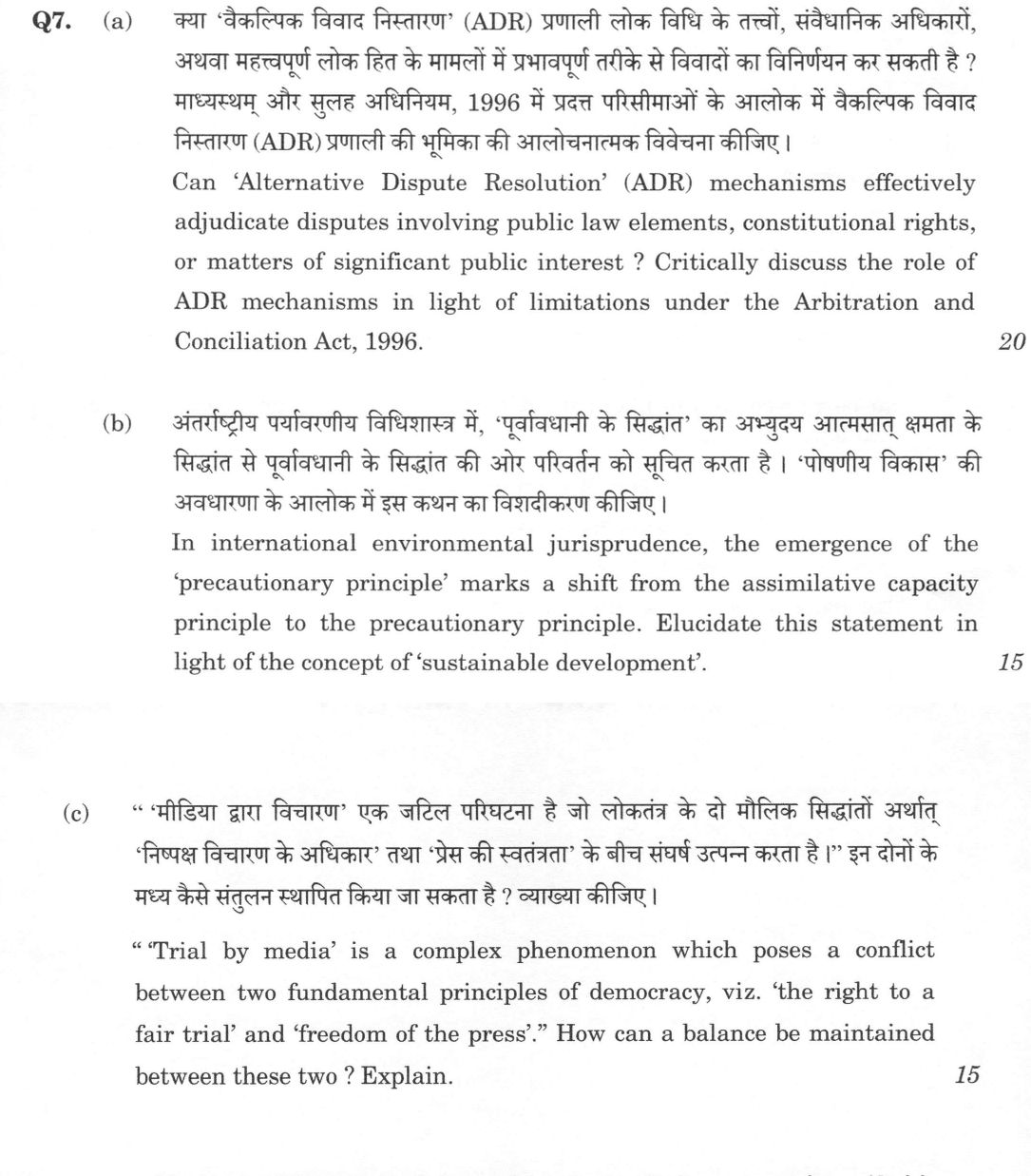
(a) Can ‘Alternative Dispute Resolution’ (ADR) mechanisms effectively adjudicate disputes involving public law elements…
Can ‘Alternative Dispute Resolution’ (ADR) mechanisms effectively adjudicate disputes involving public law elements, constitutional rights, or matters of significant public interest ? Critically discuss the role of ADR mechanisms in light of limitations under the Arbitration and Conciliation Act, 1996. 20 marks
In international environmental jurisprudence, the emergence of the ‘precautionary principle’ marks a shift from the assimilative capacity principle to the precautionary principle. Elucidate this statement in light of the concept of ‘sustainable development’. 15 marks
‘‘Trial by media’ is a complex phenomenon which poses a conflict between two fundamental principles of democracy, viz. ‘the right to a fair trial’ and ‘freedom of the press’.’’ How can a balance be maintained between these two ? Explain. 15 marks
हिंदी में प्रश्न पढ़ें
क्या ‘वैकल्पिक विवाद निस्तारण’ (ADR) प्रणाली लोक विधि के तत्त्वों, संवैधानिक अधिकारों, अथवा महत्त्वपूर्ण लोक हित के मामलों में प्रभावपूर्ण तरीके से विवादों का विनिर्णयन कर सकती है ? माध्यस्थम् और सुलह अधिनियम, 1996 में प्रदत्त परिसीमाओं के आलोक में वैकल्पिक विवाद निस्तारण (ADR) प्रणाली की भूमिका की आलोचनात्मक विवेचना कीजिए । (20 अंक)
अंतर्राष्ट्रीय पर्यावरणीय विधिशास्त्र में, ‘पूर्वावधानी के सिद्धांत’ का अभ्युदय आत्मसात् क्षमता के सिद्धांत से पूर्वावधानी के सिद्धांत की ओर परिवर्तन को सूचित करता है । ‘पोषणीय विकास’ की अवधारणा के आलोक में इस कथन का विशदीकरण कीजिए । (15 अंक)
‘‘मीडिया द्वारा विचारण’ एक जटिल परिघटना है जो लोकतंत्र के दो मौलिक सिद्धांतों अर्थात् ‘निष्पक्ष विचारण के अधिकार’ तथा ‘प्रेस की स्वतंत्रता’ के बीच संघर्ष उत्पन्न करता है।’’ इन दोनों के मध्य कैसे संतुलन स्थापित किया जा सकता है ? व्याख्या कीजिए। (15 अंक)
Model answer
Drafted with AI by UPSC Answer Check against this question's marking rubric, to the expected length. UPSC does not publish answers for Mains — this is one way to score well, not an official key. How we build rubrics and answers.
(a) ADR and Disputes of Public Law and Public Interest
ADR mechanisms can resolve many disputes in which a public body is a party, but they cannot effectively adjudicate disputes whose core is a public law right, a constitutional right or a matter of significant public interest. The core limitation is the doctrine of non-arbitrability. Under Section 2(3) of the Arbitration and Conciliation Act, 1996, a dispute is non-arbitrable if the law expressly or impliedly prohibits it. The Supreme Court in Booz Allen & Hamilton Inc. v. SBI Home Finance Ltd. (2011) established that rights in rem (against the world) and matters affecting sovereign functions are non-arbitrable, while rights in personam are generally arbitrable. This was refined in Vidya Drolia v. Durga Trading Corporation (2021), which introduced a fourfold test: (1) statutory bar, (2) rights in rem, (3) sovereign functions, and (4) erga omnes effect requiring centralised adjudication. For instance, in Emaar MGF Land Ltd. v. Aftab Singh (2019), consumer disputes were held non-arbitrable because consumer fora serve a public purpose. Vidya Drolia also overruled N. Radhakrishnan v. Maestro Engineers (2010): mere allegations of fraud no longer bar arbitration (A. Ayyasamy v. A. Paramasivam, 2016), though serious fraud affecting the public domain may. No arbitral tribunal can exercise writ jurisdiction under Articles 32 or 226 or grant relief binding on the world, such as declaring a statute unconstitutional.
The Act’s limitations are further codified in Section 34(2)(b)(i) (subject-matter not capable of settlement), Section 34(2)(b)(ii) (conflict with the public policy of India), Section 34(2A) (patent illegality in domestic awards) and Section 48(2) for foreign awards. The content of 'public policy' has shifted — widened in ONGC v. Saw Pipes (2003) and ONGC v. Western Geco (2014), and narrowed by the 2015 Amendment and Ssangyong Engineering v. NHAI (2019) — which creates uncertainty. Neutrality is protected by Section 12(5) with the Fifth and Seventh Schedules, and Perkins Eastman v. HSCC (2019) barred a party from unilaterally appointing a sole arbitrator. While Section 5 mandates minimal judicial intervention, the courts retain a residual supervisory role under Articles 226 and 227 of the Constitution. This residual jurisdiction is used only in exceptional cases, where a party is left without remedy or acts in bad faith (Bhaven Construction v. Sardar Sarovar Narmada Nigam, 2022; Deep Industries v. ONGC, 2020). However, ADR serves the public interest indirectly by decongesting the judiciary. Governments and public sector undertakings frequently arbitrate infrastructure, tariff and procurement contracts, provided the dispute concerns contractual rather than sovereign or statutory rights; the identity of the party does not decide arbitrability, the nature of the right does. Other ADR mechanisms face similar bars. Under Section 89 CPC, Afcons Infrastructure v. Cherian Varkey Construction (2010) listed cases unsuitable for ADR, such as representative suits involving public interest, election disputes, probate and guardianship, serious fraud or forgery, claims against minors or persons of unsound mind, and criminal prosecutions. Section 6 of the Mediation Act, 2023, read with its First Schedule, similarly excludes disputes such as those involving criminal prosecution, serious allegations of fraud or forgery, and claims against minors or persons of unsound mind. Lok Adalats under the Legal Services Authorities Act, 1987 can settle only compoundable matters by consent (Sections 20-21), though Permanent Lok Adalats (Section 22B) decide public utility service disputes. On balance, ADR is valuable for the private and commercial side of disputes involving the State, but constitutional and public-law questions must remain with the courts.
(b) From Assimilative Capacity to Precaution
In international environmental jurisprudence, the shift from the assimilative capacity principle to the precautionary principle represents a fundamental change in how environmental risk is managed. The assimilative capacity principle, articulated in Principle 6 of the 1972 Stockholm Declaration, assumed that nature could absorb pollution up to a certain limit. It also assumed that science could identify safe limits and that the regulator should act only once harm was proved. It failed because scientific knowledge proved uncertain, and cumulative or irreversible damage often appeared only after the limits had been crossed. In A.P. Pollution Control Board v. M.V. Nayudu (1999), the Supreme Court expressly described this shift from the assimilative capacity principle to the precautionary principle.
The precautionary principle, formalized in Principle 15 of the 1992 Rio Declaration, states that where there are threats of serious or irreversible damage, lack of full scientific certainty shall not be used as a reason for postponing cost-effective measures. The approach also appears in Article 3(3) of the UNFCCC (1992), the Cartagena Protocol on Biosafety (2000) and, earlier, the Montreal Protocol (1987). This shift is central to sustainable development, defined by the Brundtland Report, Our Common Future (1987), as development that meets the needs of the present without compromising the ability of future generations to meet their own needs. Rio Principles 3 and 4 make environmental protection an integral part of development and require equity between present and future generations, and Principle 16 adds the polluter pays principle. Precaution does not forbid development; it shifts the burden and timing of justification. Indian law has absorbed this shift through the "new burden of proof" stated in M.V. Nayudu, which places the onus on the industrialist to prove that the proposed activity is environmentally safe. In Vellore Citizens' Welfare Forum v. Union of India (1996), the Supreme Court held that sustainable development, with the precautionary principle and the polluter pays principle as its essential features, is part of customary international law and of the law of India, reading them with Articles 21, 47, 48A and 51A(g). Section 20 of the National Green Tribunal Act, 2010 now requires the Tribunal to apply these principles, and they were applied in M.C. Mehta v. Union of India (Taj Trapezium, 1997) and Indian Council for Enviro-Legal Action v. Union of India (1996). Courts have also limited the principle: in Narmada Bachao Andolan v. Union of India (2000) the majority held it applies to uncertain rather than known risks, and in M.K. Ranjitsinh v. Union of India (2024) the Court recognised a right against the adverse effects of climate change under Articles 14 and 21, requiring precaution to be balanced with the clean-energy transition.
(c) Trial by Media: Fair Trial and Press Freedom
'Trial by media' creates a constitutional conflict between the right to a fair trial (Article 21, which includes the presumption of innocence and an impartial hearing, as explained in Zahira Habibulla Sheikh v. State of Gujarat, 2004) and the freedom of the press, which is part of the freedom of speech and expression under Article 19(1)(a) and is subject to Article 19(2), which expressly names contempt of court and defamation as grounds of restriction. While the press has a duty to inform the public, sensationalized reporting can prejudice a fair trial by publishing alleged confessions (which are inadmissible when made to the police or in police custody, Section 23 of the Bharatiya Sakshya Adhiniyam, 2023 [ss. 25-26 Indian Evidence Act]), influencing witnesses, and creating pressure on investigators and courts. In State of Maharashtra v. Rajendra Jawanmal Gandhi (1997) the Court warned that a trial by press or public agitation is the antithesis of the rule of law, and in Sidhartha Vashisht (Manu Sharma) v. State (2010) it cautioned against media reporting that interferes with the administration of justice.
A balance is maintained through the "postponement order" doctrine evolved in Sahara India Real Estate Corpn. Ltd. v. SEBI (2012). The Supreme Court held that a court can postpone publication of reports of proceedings if there is a "real and substantial risk" of prejudice to the trial. This is not a blanket ban on reporting but a temporary measure that must satisfy necessity and proportionality. The balance is further maintained through statutory controls, such as the Contempt of Courts Act, 1971, under which publication that prejudices or interferes with a pending proceeding is criminal contempt (Section 2(c)), while innocent publication and fair and accurate reports are protected (Sections 3 and 4) and, since 2006, truth in the public interest is a defence (Section 13); Sections 72 and 73 of the Bharatiya Nyaya Sanhita, 2023 [s. 228A IPC], which bar disclosure of the identity of victims of sexual offences and unauthorised publication of such proceedings; and Section 366 of the Bharatiya Nagarik Suraksha Sanhita, 2023 [s. 327 CrPC], which provides for in-camera trials in rape cases to protect victims. The Law Commission's 200th Report (2006) recommended treating a criminal case as pending from arrest for contempt purposes and empowering High Courts to postpone publication, and the Bombay High Court in Nilesh Navlakha v. Union of India (2021) issued reporting guidelines for media covering investigations. Regulatory and self-regulatory mechanisms, such as the Press Council of India (which can warn or censure under Sections 13-14 of the Press Council Act, 1978), the Programme Code under the Cable Television Networks Rules, 1994 and the IT (Intermediary Guidelines and Digital Media Ethics Code) Rules, 2021 for digital news, also play a role in ensuring that media coverage remains within the bounds of fairness and objectivity, thus preserving the integrity of the judicial process.
How this answer will be evaluated
Evaluation rubric
Each sub-part is marked on its own, against the marks and word limit printed on the paper.
- (a) A two-part critical question: first answer the question asked — can ADR effectively adjudicate disputes with public law elements, constitutional rights or significant public interest? — and then critically discuss the role of ADR in the light of the limitations built into the Arbitration and Conciliation Act, 1996. 'Critically' requires a reasoned position with both sides: the doctrine of non-arbitrability (rights in rem, erga omnes effect, sovereign functions, statutory bars) and the countervailing case for ADR's efficiency, alongside the residual supervisory role of the constitutional courts. 20 marks
Must cover
- Reasoned answer to the opening question: contractual side arbitrable, public-law core not
- Non-arbitrability: Section 2(3) and Section 34(2)(b)(i); Booz Allen (2011) / Vidya Drolia (2021) fourfold test
- Public policy ground (Section 34(2)(b)(ii), Section 34(2A); Section 48(2)) and its shifting content
- No writ or erga omnes relief from tribunals; residual supervision under Articles 226/227
- Other ADR limits: Section 89 CPC and Afcons; Mediation Act, 2023 (Section 6, First Schedule); Lok Adalats
- Critical balance: efficiency and government-contract arbitration v. exclusion of third parties, cost and neutrality
Loses marks
- Writing a generic 'advantages and disadvantages of ADR' essay without engaging non-arbitrability at all — the doctrinal core of this question.
- Failing to cite Booz Allen or Vidya Drolia; one of the two is indispensable and the fourfold test in Vidya Drolia is the current statement of the law.
- Not citing a single provision of the 1996 Act although the question expressly asks for 'limitations under the Arbitration and Conciliation Act, 1996'.
- Asserting flatly that any dispute involving the Government or a public sector undertaking is non-arbitrable; the test is the nature of the right, not the identity of the party.
- Confusing arbitrability with jurisdiction or with the competence-competence principle in Section 16, or treating Section 34 as an appeal on the merits, which Explanation 2 to Section 34(2)(b) expressly forbids.
- Citing N. Radhakrishnan v. Maestro Engineers, (2010) 1 SCC 72 as good law on fraud; it was overruled in Vidya Drolia, the position now being that mere allegations of fraud do not bar arbitration (A. Ayyasamy v. A. Paramasivam, (2016) 10 SCC 386; Rashid Raza v. Sadaf Akhtar, (2019) 8 SCC 710).
- Giving no view at all, when the question begins with a direct yes-or-no question requiring a reasoned answer.
Earns more
- Extends the analysis beyond arbitration to the rest of the ADR family and shows that the public-interest exclusion is common to all of it: Section 89 of the Code of Civil Procedure, 1908 and Afcons Infrastructure Ltd. v. Cherian Varkey Construction Co. (P) Ltd., (2010) 8 SCC 24, which lists categories normally unsuitable for reference to ADR — representative suits under Order I Rule 8 involving public interest; disputes relating to election to public offices; cases requiring the grant of authority by the court after enquiry, such as probate and guardianship; cases involving serious and specific allegations of fraud, fabrication of documents, forgery, impersonation or coercion; cases requiring protection of the court, such as claims against minors, deities and persons of unsound mind; and cases involving prosecution for criminal offences. Adds Section 6 read with the First Schedule of the Mediation Act, 2023, which lists disputes not fit for mediation, and the Legal Services Authorities Act, 1987 — Section 20 (reference to Lok Adalat), Section 21 (the award is deemed to be a decree of a civil court, final, and no appeal lies) and Section 22B (Permanent Lok Adalats for public utility services). May note the compromise permitted in criminal law through compounding under Section 359 of the Bharatiya Nagarik Suraksha Sanhita, 2023 [old Section 320, Code of Criminal Procedure, 1973] and plea bargaining under Chapter XXIII of the BNSS [old Chapter XXIA, CrPC], both of which are narrowly confined.
- Supplies the critical balance rather than a one-sided condemnation: arbitration serves the public interest indirectly by relieving a docket of tens of millions of pending cases and by giving investors a neutral forum; governments and public sector undertakings are the largest single class of litigants in Indian arbitration, and disputes over infrastructure concessions, tariffs and public procurement are routinely and effectively arbitrated even though a public authority is a party; and the constitutional courts retain a residual supervisory jurisdiction under Articles 226 and 227, which is exercised only in exceptional circumstances or where a party is left remediless or the proceeding is in bad faith (Bhaven Construction v. Executive Engineer, Sardar Sarovar Narmada Nigam Ltd., (2022) 1 SCC 75; Deep Industries Ltd. v. ONGC Ltd., (2020) 15 SCC 706). Notes correctly that the presence of a public body or a statutory contract does not by itself make a dispute non-arbitrable; what matters is the nature of the right asserted.
- Adds at least two concrete institutional criticisms of the 1996 Act regime: the instability of 'public policy' as a ground of challenge, from the wide reading in ONGC Ltd. v. Saw Pipes Ltd., (2003) 5 SCC 705 and ONGC Ltd. v. Western Geco International Ltd., (2014) 9 SCC 263 through Associate Builders v. DDA, (2015) 3 SCC 49, to the narrowing effected by the 2015 Amendment and Ssangyong Engineering & Construction Co. Ltd. v. NHAI, (2019) 15 SCC 131; the independence of arbitrators, addressed by Section 12(5) with the Fifth and Seventh Schedules and by TRF Ltd. v. Energo Engineering Projects Ltd., (2017) 8 SCC 377 and Perkins Eastman Architects DPC v. HSCC (India) Ltd., (2020) 20 SCC 760, which struck at unilateral appointments — a problem of particular acuteness in government contracts; the cost and delay of ad hoc arbitration, only partly addressed by the twelve-month timeline in Section 29A and the costs regime in Section 31A; the absence of any appeal on the merits and the consequent risk in high-value public contracts; and the exclusion of affected third parties, which is precisely why matters of significant public interest sit badly in arbitration.
Extra mark
- Emaar MGF Land v. Aftab Singh (2019) — consumer disputes
- A. Ayyasamy (2016); N. Radhakrishnan (2010) overruled
- ONGC v. Saw Pipes (2003); ONGC v. Western Geco (2014); Ssangyong (2019)
- Section 12(5) with the Fifth and Seventh Schedules; Perkins Eastman (2019)
- Bhaven Construction (2022); Deep Industries (2020)
- (b) 'Elucidate' the doctrinal shift from the assimilative capacity principle to the precautionary principle in international environmental jurisprudence, and connect it to sustainable development. The answer must explain what the assimilative capacity principle was (Stockholm, 1972, Principle 6), why it failed, what the precautionary principle says (Rio, 1992, Principle 15), and how Indian law absorbed both through Vellore Citizens' Welfare Forum and A.P. Pollution Control Board v. M.V. Nayudu, which is the case that expressly describes the shift. 15 marks
Must cover
- Assimilative capacity principle — Stockholm Principle 6 (1972) — and why it failed
- Precautionary principle — Rio Principle 15 (1992): serious or irreversible damage; scientific uncertainty no excuse
- Sustainable development — Brundtland (1987); Rio Principles 3 and 4; inter-generational equity
- Reversal of the burden of proof onto the developer
- Indian absorption: Vellore (1996) and M.V. Nayudu (1999)
- Section 20, NGT Act, 2010; Articles 21, 48A and 51A(g)
Loses marks
- Never explaining what the assimilative capacity principle was, so the 'shift' the question asks about has no starting point — the commonest failure on this question.
- Attributing the precautionary principle to the Stockholm Declaration, 1972 or to Principle 6; Principle 6 is the assimilative capacity provision and the precautionary approach is Principle 15 of Rio, 1992.
- Omitting the reversal of the burden of proof, which is the operative legal consequence of the principle in Indian law and the specific holding of Vellore.
- Confusing the precautionary principle with the preventive principle; prevention responds to known risk, precaution to scientific uncertainty.
- Confusing it with the polluter pays principle, which is Rio Principle 16 and is corrective rather than anticipatory.
- Writing the whole answer on Indian case law with no international material, when the question is expressly about 'international environmental jurisprudence'.
- Reciting the Brundtland definition without connecting sustainable development to the precautionary principle, so the final clause of the question goes unanswered.
Earns more
- Links the shift to sustainable development, which is the concept the question requires: the definition in the Brundtland Commission Report, Our Common Future, 1987 — development that meets the needs of the present without compromising the ability of future generations to meet their own needs; Principle 3 of the Rio Declaration (the right to development must be fulfilled so as equitably to meet developmental and environmental needs of present and future generations) and Principle 4 (environmental protection shall constitute an integral part of the development process and cannot be considered in isolation from it); the twin ideas of intergenerational and intragenerational equity; and the recognition in Vellore that sustainable development is a balancing concept between ecology and development which has been accepted as part of the customary international law, with the precautionary principle and the polluter pays principle as its salient features. Notes that the principle does not forbid development but shifts the burden and timing of justification.
- Shows the principle at work in Indian statutory and constitutional law and acknowledges its limits: Section 20 of the National Green Tribunal Act, 2010, which directs that the Tribunal shall, while passing any order or decision or award, apply the principles of sustainable development, the precautionary principle and the polluter pays principle; Articles 21, 48A and 51A(g) of the Constitution, with Article 47, as the constitutional anchor; the Environment (Protection) Act, 1986 and the Environmental Impact Assessment Notification, 2006 as the procedural vehicle; and illustrative applications — M.C. Mehta v. Union of India (Taj Trapezium), (1997) 2 SCC 353 and Indian Council for Enviro-Legal Action v. Union of India (Bichhri), (1996) 3 SCC 212. Credit equally an answer that notes the counterpoint that the principle is not applied where the risk is known and quantifiable rather than uncertain (Narmada Bachao Andolan v. Union of India, (2000) 10 SCC 664, majority) or that it must be balanced against development (N.D. Jayal v. Union of India, (2004) 9 SCC 362; Bombay Dyeing & Mfg. Co. Ltd. v. Bombay Environmental Action Group, (2006) 3 SCC 434), or that notes the newer climate dimension recognised in M.K. Ranjitsinh v. Union of India (2024), where the Supreme Court articulated a right against the adverse effects of climate change traceable to Articles 14 and 21.
Extra mark
- UNFCCC Article 3(3); Cartagena Protocol (2000); Montreal Protocol (1987)
- Rio Principle 16 — polluter pays
- Taj Trapezium (1997); Indian Council for Enviro-Legal Action (1996)
- Narmada Bachao Andolan (2000); M.K. Ranjitsinh (2024)
- (c) Explain how the conflict between the right to a fair trial (Article 21) and the freedom of the press (Article 19(1)(a)) arising from 'trial by media' can be balanced. The answer must identify the two constitutional rights and their sources, show concretely how media trial prejudices a fair trial, and then set out the balancing mechanisms — principally the postponement order evolved in Sahara India Real Estate Corpn. Ltd. v. SEBI — together with statutory and self-regulatory controls, rather than simply condemning the media. 15 marks
Must cover
- Article 21 fair trial and Article 19(1)(a) press freedom; Article 19(2) names contempt of court and defamation
- How media trial prejudices a fair trial (confessions, witnesses, pressure)
- Sahara v. SEBI (2012) — postponement orders; real and substantial risk; necessity and proportionality
- Contempt of Courts Act, 1971 — Sections 2(c), 3, 4 and 13
- Statutory protections: Sections 72-73 BNS [s. 228A IPC]; Section 366 BNSS [s. 327 CrPC]
- Regulatory and reform measures (Law Commission 200th Report; Press Council; Programme Code; 2021 IT Rules)
Loses marks
- Writing a one-sided denunciation of the media and never explaining how a balance is to be struck, when 'how can a balance be maintained' is the actual question.
- Omitting Sahara v. SEBI, which is the Constitution Bench decision that supplies the balancing device; an answer without it is incomplete however well written.
- Claiming that freedom of the press is a separate fundamental right under Article 19(1); it is a facet of the freedom of speech and expression, as held from Romesh Thappar onwards.
- Forgetting that Article 19(2) expressly names contempt of court and defamation, so restriction of prejudicial publication needs no new constitutional justification.
- Citing the Indian Penal Code, 1860, the Code of Criminal Procedure, 1973 or the Indian Evidence Act, 1872 as the law in force; the governing statutes are the Bharatiya Nyaya Sanhita, 2023, the Bharatiya Nagarik Suraksha Sanhita, 2023 and the Bharatiya Sakshya Adhiniyam, 2023, the old section being at most a bracketed cross-reference.
- Advocating a blanket prior restraint or a ban on crime reporting, which would not survive Article 19(1)(a) scrutiny and misreads Sahara, which requires necessity and proportionality.
- Confusing civil contempt with criminal contempt; media prejudice falls under Section 2(c).
Earns more
- Sets out the statutory and regulatory instruments through which the balance is actually struck: the Contempt of Courts Act, 1971 — Section 2(c), which defines criminal contempt to include publication that prejudices or interferes or tends to interfere with the due course of any judicial proceeding, Section 3, which protects innocent publication where the publisher had no reasonable grounds to believe the proceeding was pending, Section 4, which protects a fair and accurate report of a judicial proceeding, Section 7 on reports of in-camera proceedings, and Section 13 as amended in 2006, which requires a substantial interference with the due course of justice and permits truth as a defence if it is in the public interest and the request for invoking the defence is bona fide; Section 72 of the Bharatiya Nyaya Sanhita, 2023 [old Section 228A, Indian Penal Code, 1860], which punishes disclosure of the identity of the victim of certain sexual offences, and Section 73 of the BNS [old Section 228A(3), IPC], which punishes printing or publishing matter in relation to such court proceedings without the court's permission; Section 356 of the BNS [old Sections 499 and 500, IPC] on defamation; the Programme Code under Rule 6 of the Cable Television Networks Rules, 1994 framed under the Cable Television Networks (Regulation) Act, 1995; Part III of the Information Technology (Intermediary Guidelines and Digital Media Ethics Code) Rules, 2021, which applies a Code of Ethics and a three-tier grievance mechanism to digital news publishers; and Sections 13 and 14 of the Press Council Act, 1978, under which the Press Council may warn, admonish or censure a newspaper.
- Offers a reasoned prescription for balance rather than a bare condemnation of the media, drawing on reform material: the recommendation of the Law Commission of India in Report No. 200 (2006), 'Trial by Media: Free Speech versus Fair Trial under Criminal Procedure (Amendment to the Contempt of Courts Act, 1971)', that for the purposes of contempt a criminal proceeding be treated as pending from the moment of arrest rather than from the filing of the charge-sheet, and that the High Court be empowered to direct postponement of publication; the preference for the least restrictive means — postponement rather than prohibition, specific rather than blanket orders, time limits and a right of appeal; strengthened and enforceable self-regulation through press and broadcaster codes and the norms of journalistic conduct; judicial training and reasoned judgments that visibly disregard extraneous material; and in appropriate cases change of venue, protection of witnesses under a witness protection scheme, and in-camera proceedings. Credit an answer that cites the reporting directions issued by the Bombay High Court in Nilesh Navlakha v. Union of India (2021) or that argues, with reasons, that a post-trial contempt remedy is an inadequate protection because the prejudice is irreversible.
Extra mark
- Zahira Habibulla Sheikh (2004)
- Rajendra Jawanmal Gandhi (1997); Manu Sharma (2010); R.K. Anand (2009)
- Section 23 BSA [ss. 25-26 IEA] — confessions to police inadmissible
- Nilesh Navlakha v. Union of India (Bombay HC, 2021)
What "Critically discuss" is asking you to do
Lay the issue out from more than one side — how it arose, what is claimed for it, what is held against it, and where it now stands. UPSC attaches discuss to broad topics with several live dimensions, so coverage of the dimensions earns more than the strength of your opinion. “Critically” is not a section added at the end: name the yardstick you are judging by — the evidence, the stated objective, a constitutional principle, a rival explanation — and let a verdict close each part of the body. Where the question quotes a claim, that verdict must land on the claim itself, accepted, qualified or rejected, and not on the theme in general.
Structure that answers it
Set the issue up → the case as it is made → the case against → the dimension both sides leave out → where the balance now lies
Where marks are lost
Merits in one paragraph, demerits in the next, and a conclusion calling for a balanced and holistic approach. That is a survey with the judgement left out and it holds the answer in the middle band. The opposite error is reading “critically” as permission to attack — and with the odd pairings, critically describe or critically explain, the exposition still carries most of the marks, the judgement being a layer on it rather than a substitute for it.
Practice this exact question
Write your answer and it is marked point by point against the model answer above — what you covered, what you missed, what you got wrong.
Evaluate my answer →More from Law 2026 Paper II
- Q4 (a) 'X', a 25-year-old boy, makes a promise to 'Y', an 18-year-old girl, that he will mar…
- Q5 Answer the following questions in about 150 words each. Support your answer with relevant…
- Q6 (a) “Sharing of profits is only prima facie evidence of the existence of a partnership. T…
- Q7 (a) Can ‘Alternative Dispute Resolution’ (ADR) mechanisms effectively adjudicate disputes…
- Q8 (a) ‘‘Intellectual property laws confer exclusive rights on creators; however, such right…