Paper II — Q4
(a) 'X', a 25-year-old boy, makes a promise to 'Y', an 18-year-old girl, that he will marry her if she has 'carnal-relations'…
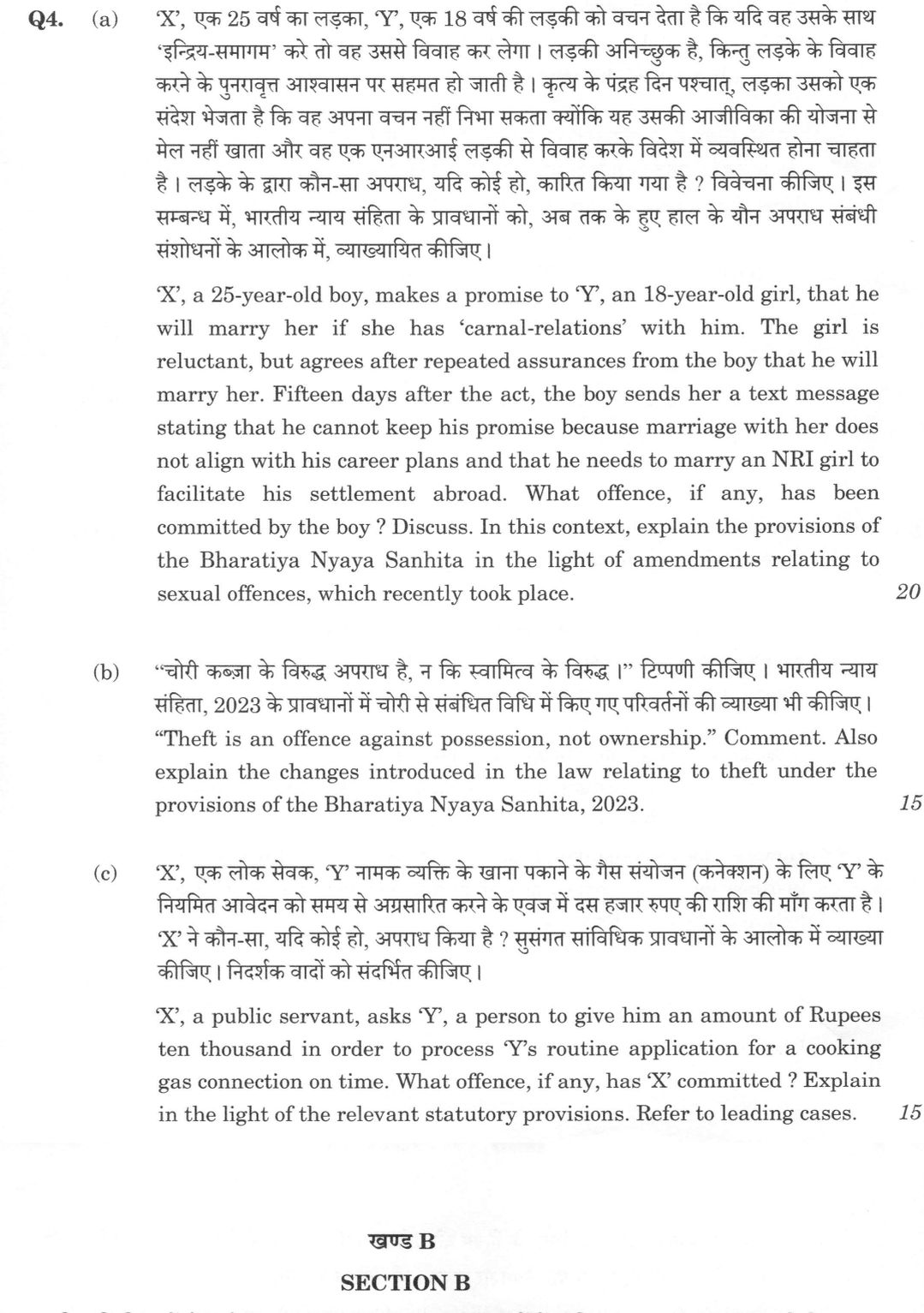
'X', a 25-year-old boy, makes a promise to 'Y', an 18-year-old girl, that he will marry her if she has 'carnal-relations' with him. The girl is reluctant, but agrees after repeated assurances from the boy that he will marry her. Fifteen days after the act, the boy sends her a text message stating that he cannot keep his promise because marriage with her does not align with his career plans and that he needs to marry an NRI girl to facilitate his settlement abroad. What offence, if any, has been committed by the boy ? Discuss. In this context, explain the provisions of the Bharatiya Nyaya Sanhita in the light of amendments relating to sexual offences, which recently took place. 20 marks
"Theft is an offence against possession, not ownership." Comment. Also explain the changes introduced in the law relating to theft under the provisions of the Bharatiya Nyaya Sanhita, 2023. 15 marks
'X', a public servant, asks 'Y', a person to give him an amount of Rupees ten thousand in order to process 'Y's routine application for a cooking gas connection on time. What offence, if any, has 'X' committed ? Explain in the light of the relevant statutory provisions. Refer to leading cases. 15 marks
हिंदी में प्रश्न पढ़ें
'X', एक 25 वर्ष का लड़का, 'Y', एक 18 वर्ष की लड़की को वचन देता है कि यदि वह उसके साथ 'इन्द्रिय-समागम' करे तो वह उससे विवाह कर लेगा। लड़की अनिच्छुक है, किन्तु लड़के के विवाह करने के पुनरावृत्त आश्वासन पर सहमत हो जाती है। कृत्य के पंद्रह दिन पश्चात्, लड़का उसको एक संदेश भेजता है कि वह अपना वचन नहीं निभा सकता क्योंकि यह उसकी आजीविका की योजना से मेल नहीं खाता और वह एक एनआरआई लड़की से विवाह करके विदेश में व्यवस्थित होना चाहता है। लड़के के द्वारा कौन-सा अपराध, यदि कोई हो, कारित किया गया है ? विवेचना कीजिए। इस सम्बन्ध में, भारतीय न्याय संहिता के प्रावधानों को, अब तक के हुए हाल के यौन अपराध संबंधी संशोधनों के आलोक में, व्याख्यायित कीजिए। (20 अंक)
"चोरी कब्ज़ा के विरुद्ध अपराध है, न कि स्वामित्व के विरुद्ध।" टिप्पणी कीजिए। भारतीय न्याय संहिता, 2023 के प्रावधानों में चोरी से संबंधित विधि में किए गए परिवर्तनों की व्याख्या भी कीजिए। (15 अंक)
'X', एक लोक सेवक, 'Y' नामक व्यक्ति के खाना पकाने के गैस संयोजन (कनेक्शन) के लिए 'Y' के नियमित आवेदन को समय से अग्रसारित करने के एवज में दस हजार रुपए की राशि की माँग करता है। 'X' ने कौन-सा, यदि कोई हो, अपराध किया है ? सुसंगत सांविधिक प्रावधानों के आलोक में व्याख्या कीजिए। निर्देशक वादों को संदर्भित कीजिए। (15 अंक)
Model answer
Drafted with AI by UPSC Answer Check against this question's marking rubric, to the expected length. UPSC does not publish answers for Mains — this is one way to score well, not an official key. How we build rubrics and answers.
(a) False Promise of Marriage and the BNS
On the facts, X is most likely liable for sexual intercourse by deceitful means or false promise of marriage under Section 69 of the Bharatiya Nyaya Sanhita (BNS), 2023, provided the prosecution shows that the promise was false when made. Y is 18 years old, meaning she is legally competent to consent; therefore, the age-based prohibitions under Section 63 BNS (rape) and the POCSO Act are not attracted. The offence under Section 69 BNS is distinct, applies where the intercourse does not amount to rape, and carries a punishment of imprisonment up to ten years and fine; its Explanation treats a false promise of employment or promotion, or marrying after suppressing identity, as 'deceitful means' too.
Applying the two-limb test from Pramod Suryabhan Pawar v. State of Maharashtra (2019), a promise of marriage is a "false promise" if it was made with no intention to perform it at the time of making, and not if it was made with the intention to perform but the accused subsequently failed to do so. The Court has drawn the same line in Uday v. State of Karnataka (2003), Deelip Singh v. State of Bihar (2005), Deepak Gulati v. State of Haryana (2013) and Dhruvaram Murlidhar Sonar v. State of Maharashtra (2019): a genuine promise later broken because of circumstances is not an offence. Here, Y agreed only after repeated assurances, and X withdrew within fifteen days citing career plans and a preference for an NRI bride — reasons that existed when he made the promise. This strongly suggests that he never intended to marry her, so Section 69 is attracted. Before the BNS, courts treated such cases as rape under Section 375 IPC, since consent given under a misconception of fact is not consent (now Section 28 BNS read with Explanation 2 to Section 63). A prosecutor may still charge rape under Section 64 BNS (rigorous imprisonment of at least ten years, extendable to life) in an extreme case, but Section 69 is now the specific provision for such facts. If X's promise was genuine when made, he commits no offence.
The BNS, 2023 builds on the recent amendments to sexual offences. The Criminal Law (Amendment) Act, 2013, based on the Justice J.S. Verma Committee report, widened the definition of rape and added sexual harassment, disrobing, voyeurism and stalking (now Sections 75 to 78 BNS [ss. 354A-354D IPC]); the Criminal Law (Amendment) Act, 2018 added higher minimum sentences and the death penalty for the rape of a girl below twelve. The BNS introduced Section 69 as a standalone offence, which had no equivalent in the IPC. It also gave statutory effect to Independent Thought v. Union of India (2017) by raising the age of the wife in the marital exception to eighteen years. Furthermore, it consolidated aggravated offences: Section 65(1) (rape of a woman under sixteen: at least twenty years, extendable to life for the remainder of natural life), Section 65(2) (rape of a woman under twelve: at least twenty years to life, or death) and Section 70(2) (gang rape of a woman under eighteen: life for the remainder of natural life, or death). Section 72 BNS [s. 228A IPC] continues to bar disclosure of the victim's identity. The BNSS, 2023 adds procedural safeguards: the victim's statement is recorded by a woman Magistrate where possible and by audio-video means, medical examination within twenty-four hours, and investigation to be completed within two months.
(b) Theft as an Offence against Possession
The proposition that "theft is an offence against possession, not ownership" is a fundamental principle of criminal law. Under Section 303(1) BNS, 2023 [s. 378 IPC], theft is the dishonest taking of "movable property" out of the possession of another person without their consent. The section protects the right to possession, not the right of title. This is proven by the statutory illustration where an owner who takes his own property from a bailee or pawnee (who has lawful possession) commits theft, even though he is the owner. Cases like Pyare Lal Bhargava v. State of Rajasthan (1963) and K.N. Mehra v. State of Rajasthan (1957) confirm that even a temporary dispossession with dishonest intention constitutes theft.
The BNS, 2023 introduced several changes to the law of theft. First, the definition of "movable property" in Section 2(21) BNS dropped the word "corporeal," broadening the scope of the offence. Second, it created a new, distinct offence of snatching under Section 304 BNS, which previously fell under the general definition of theft; unlike robbery under Section 309 BNS, snatching involves sudden, quick or forcible seizure without causing or threatening hurt. Third, while theft remains punishable with up to three years' imprisonment, fine or both, it introduced a minimum of one year's rigorous imprisonment, extendable to five years, for a second or subsequent conviction under Section 303(2). Finally, the BNS introduced a "Proviso" to Section 303(2) allowing for community service (under Section 4(f)) for first-time offenders who commit petty theft of property worth less than Rs. 5,000 and restore the property.
The contrast with related offences confirms the proposition: in criminal misappropriation (Section 314 BNS [s. 403 IPC]) the accused first comes into possession innocently, in criminal breach of trust (Section 316 BNS [s. 405 IPC]) the property is entrusted to him, and in extortion (Section 308 BNS [s. 383 IPC]) the victim delivers it under fear. Only theft involves taking property out of another's possession without consent.
(c) Demand of Bribe by a Public Servant
X has committed the offence of a public servant being bribed under Section 7 of the Prevention of Corruption Act, 1988, as amended by the 2018 Amendment Act. X, a public servant, demanded Rs. 10,000 from Y to process a routine application for a cooking gas connection. Under Section 7, it is an offence for a public servant to obtain, accept or attempt to obtain an "undue advantage" (any gratification other than legal remuneration, Section 2(d)) with the intention of performing a public duty improperly, or as a reward for doing so. Bribery by public servants is governed exclusively by this Act; the old Sections 161-165A IPC were repealed by Section 31 and have no counterpart in the BNS.
The 2018 Amendment recast the offence around obtaining or "attempting to obtain" an undue advantage. Crucially, Explanation 1 to Section 7 states that the offence is complete even if the public servant performs their duty properly. This means that demanding "speed money" for a legitimate, routine duty is still an offence. Since an attempt to obtain is covered, X's demand alone completes the offence, even if Y never pays. In B. Jayaraj v. State of Andhra Pradesh (2014) and P. Satyanarayana Murthy v. District Inspector of Police (2015), the Supreme Court held that proof of demand is essential and mere recovery of money cannot sustain a conviction. The Constitution Bench in Neeraj Dutta v. State (NCT of Delhi) (2023) held that demand may be proved by circumstantial evidence where the complainant turns hostile or dies.
The punishment for this offence is rigorous imprisonment for a term of not less than three years, which may extend to seven years, and a fine. Under Section 20 of the Act, once acceptance of an undue advantage is proved, the court presumes that it was accepted with the motive required by Section 7, unless the accused rebuts this on a preponderance of probabilities. Procedurally, prior approval under Section 17A is not needed where the public servant is caught on the spot in a trap, but sanction under Section 19 is required for prosecution, and the case is tried by a Special Judge. As for Y, Section 8 makes giving a bribe an offence, but a person compelled to pay is protected if he reports the matter to the authorities within seven days; if Y refuses and complains, he commits no offence.
How this answer will be evaluated
Evaluation rubric
Each sub-part is marked on its own, against the marks and word limit printed on the paper.
- (a) A problem question with two mandatory parts: (i) identify the offence, if any, committed by X on these facts — sexual intercourse obtained from an adult woman on a promise of marriage that is repudiated fifteen days later; and (ii) explain the provisions of the Bharatiya Nyaya Sanhita, 2023 in the light of the recent amendments relating to sexual offences. The answer must reason to a conclusion, not merely list provisions. 20 marks
Must cover
- Section 69 BNS — sexual intercourse by deceitful means or false promise of marriage; up to ten years and fine
- Y is an adult: the age clause of Section 63 BNS [s. 375 IPC] and POCSO not attracted; consent under misconception — Section 28 BNS [s. 90 IPC]
- False promise ab initio v. genuine promise later broken — the Pramod Suryabhan Pawar two-limb test
- Application to the facts and a reasoned conclusion on X's liability
- Recent amendments: Criminal Law (Amendment) Acts, 2013 and 2018
- BNS changes: Section 69, marital-exception age raised to eighteen, Sections 65 and 70(2)
Loses marks
- Failing to cite Section 69 BNS at all and answering the problem entirely on the basis of Section 375/376 IPC — Section 69 is the single most important provision on these facts and the question expressly directs attention to the recent amendments.
- Treating Y's age as decisive; at eighteen she is competent to consent, so the 'seventhly' clause of Section 63 BNS and the POCSO Act, 2012 are not attracted, and an answer that convicts X on the basis of her age misreads the facts.
- Asserting that every breach of a promise to marry is rape; the settled distinction between a false promise made in bad faith at inception and a genuine promise subsequently broken must be drawn.
- Reciting Pramod Suryabhan Pawar without applying its two limbs to these facts — the marks for application are separate from the marks for the test.
- Reaching no conclusion, or offering two conclusions without indicating which is the better view and why.
- Misstating punishment: Section 69 BNS carries imprisonment which may extend to ten years and fine, whereas Section 64 BNS carries rigorous imprisonment of not less than ten years extendable to life.
Earns more
- Answers the second limb by explaining the recent amendment landscape: the Criminal Law (Amendment) Act, 2013, enacted on the recommendations of the Justice J.S. Verma Committee (2013), redefined rape and added the offences of sexual harassment, disrobing, voyeurism and stalking (now Sections 75 to 78 BNS [ss. 354A to 354D IPC]); the Criminal Law (Amendment) Act, 2018 introduced minimum sentences and the death penalty for the rape of a girl below twelve. The BNS, 2023 then (i) created Section 69 as a distinct offence; (ii) retained the marital exception but as Exception 2 to Section 63 raised the wife's age to eighteen years, giving statutory effect to Independent Thought v. Union of India, (2017) 10 SCC 800; (iii) consolidated the aggravated offences — Section 65(1) (rape of a woman under sixteen: rigorous imprisonment not less than twenty years, extendable to imprisonment for life meaning the remainder of natural life, and fine) and Section 65(2) (rape of a woman under twelve: not less than twenty years to life, or death); and Section 70(2) (gang rape of a woman under eighteen: imprisonment for life meaning the remainder of natural life, or death), replacing Sections 376DA and 376DB IPC; (iv) retained Section 72 BNS [s. 228A IPC] on disclosure of the victim's identity. Adds the procedural reinforcement in the BNSS, 2023 — recording of the victim's statement by a woman Magistrate and audio-video recording, medical examination of the victim within twenty-four hours, and completion of the investigation in rape cases within two months.
Extra mark
- Deepak Gulati (2013); Dhruvaram Murlidhar Sonar (2019); Uday (2003); Deelip Singh (2005)
- Independent Thought v. Union of India (2017)
- Section 64 BNS [s. 376 IPC] as an alternative charge
- Section 72 BNS [s. 228A IPC]; BNSS procedural safeguards
- (b) Two parts of roughly equal weight: 'comment' on the proposition that theft protects possession rather than ownership, proving it from the definition, its Explanations and illustrations and decided cases; and then explain what the Bharatiya Nyaya Sanhita, 2023 has changed in the law of theft. 15 marks
Must cover
- Section 303(1) BNS [s. 378 IPC] — definition and ingredients; 'dishonestly' (Section 2(7) BNS [s. 24 IPC])
- Illustration: an owner taking his own property from a bailee or pawnee commits theft
- Temporary dispossession suffices (Pyare Lal Bhargava; K.N. Mehra)
- BNS changes: 'corporeal' dropped from Section 2(21); snatching under Section 304; enhanced punishment for repeat theft under Section 303(2); community-service proviso
- Contrast with criminal misappropriation and criminal breach of trust
Loses marks
- Answering only the first half and omitting the BNS changes, which the question expressly requires and which carry a substantial share of the marks.
- Citing Sections 378 and 379 IPC as the governing provisions; the law in force is Section 303 BNS, 2023, with the IPC numbers in brackets.
- Omitting the illustration of the owner who takes his own property from a bailee or pawnee — it is the strongest single proof of the proposition and costs marks if left out.
- Asserting that theft requires a permanent deprivation; Pyare Lal Bhargava and K.N. Mehra establish that temporary dispossession with dishonest intention suffices.
- Missing the new offence of snatching under Section 304 BNS, or describing it as robbery — robbery under Section 309 BNS [ss. 390, 392 IPC] requires the additional element of death, hurt or wrongful restraint or the fear thereof.
- Confusing theft with criminal breach of trust, where possession is already lawfully with the accused by entrustment.
Earns more
- Draws the confirming contrast with cognate property offences: in criminal misappropriation under Section 314 BNS [s. 403 IPC] the accused comes into possession innocently or casually and afterwards converts the property; in criminal breach of trust under Section 316 BNS [s. 405 IPC] the property is entrusted to the accused and is already lawfully in his possession; in extortion under Section 308 BNS [ss. 383, 384 IPC] the property is delivered by the victim under fear. Only theft involves an invasion of another's possession without consent — which is precisely why possession, and not ownership, is the interest the section protects.
Extra mark
- Robbery under Section 309 BNS distinguished from snatching
- Section 4(f) BNS — community service
- Extortion — Section 308 BNS [s. 383 IPC]
- (c) A problem question: identify the offence committed by X, a public servant who demands Rs. 10,000 for processing a routine and legitimate application, explain it under the relevant statutory provisions — the Prevention of Corruption Act, 1988 as amended in 2018 — and support the analysis with leading cases. 15 marks
Must cover
- Section 7, Prevention of Corruption Act, 1988 (as amended in 2018) — three to seven years and fine
- Explanation 1 to Section 7 — offence even if the duty is performed properly ('speed money')
- Section 2(d) 'undue advantage'; demand or attempt to obtain suffices
- Proof of demand — at least one leading case
- Section 20 presumption; Section 17A (trap proviso) and Section 19 sanction
- Bribery is outside the BNS: ss. 161-165A IPC repealed by Section 31 of the PC Act
Loses marks
- Charging X under the Bharatiya Nyaya Sanhita, 2023 or under Sections 161 or 168 IPC; bribery by public servants is governed exclusively by the Prevention of Corruption Act, 1988.
- Saying that no offence is made out because the application was legitimate and no improper act was contemplated — Explanation 1 to Section 7 is directly against that view.
- Stating that the offence is complete only on acceptance; Section 7 covers an attempt to obtain, so the demand alone is punishable.
- Relying on the pre-2018 text of the Act — Section 13(1)(d) was deleted, Section 7 was substituted, and Sections 7A, 8 (bribe-giver), 10 and 17A were introduced.
- Misstating the sentence — Section 7 carries a minimum of three years and a maximum of seven years with fine, not the old six months to five years.
- Citing none of the authorities on proof of demand (B. Jayaraj, P. Satyanarayana Murthy, Neeraj Dutta), or stating that proof of demand is no longer necessary; it remains necessary, but may be established circumstantially.
Earns more
- Sets out the procedural framework: a complaint to the Anti-Corruption Bureau or the Central Bureau of Investigation followed by a trap laid with a pre-trap panchnama and phenolphthalein-treated currency; Section 17A of the Act, inserted in 2018, requires the prior approval of the appropriate authority before a police officer conducts any enquiry, inquiry or investigation into an offence alleged to have been committed by a public servant relatable to a recommendation made or decision taken in the discharge of his official functions, but its proviso expressly dispenses with such approval in cases involving the arrest of a person on the spot on the charge of accepting or attempting to accept any undue advantage — that is, in trap cases such as this; Section 19 requires previous sanction for prosecution; and the trial lies before a Special Judge appointed under Sections 3 and 4, which also directs an endeavour to conclude the trial within two years.
- Addresses Y's position and the residual provisions: since the Prevention of Corruption (Amendment) Act, 2018 substituted Section 8, the bribe-giver is now expressly punishable with imprisonment up to seven years or fine or both, but the proviso protects a person who was compelled to give the undue advantage provided he reports the matter to the law enforcement authority or investigating agency within seven days of giving it — so if Y refuses and complains he commits no offence, and if he pays under compulsion and reports within seven days he is protected. Section 7A punishes any person, including a middleman, who accepts an undue advantage to induce a public servant by corrupt or illegal means or by the exercise of personal influence. Notes that the old Section 13(1)(d), on obtaining a pecuniary advantage without public interest, was deleted by the 2018 amendment and criminal misconduct under the substituted Section 13 is now confined to misappropriation of entrusted property and illicit enrichment (disproportionate assets), punishable under Section 13(2) with four to ten years and fine — neither being made out on these facts.
Extra mark
- B. Jayaraj (2014); P. Satyanarayana Murthy (2015); Neeraj Dutta (2023)
- Section 8 — bribe-giver and the seven-day proviso
- Section 7A; deletion of old Section 13(1)(d)
What "Discuss" is asking you to do
Lay the issue out from more than one side — how it arose, what is claimed for it, what is held against it, and where it now stands. UPSC attaches discuss to broad topics with several live dimensions, so coverage of the dimensions earns more than the strength of your opinion.
Structure that answers it
Set the issue up → the case as it is made → the case against → the dimension both sides leave out → where the balance now lies
Where marks are lost
Listing facts with no thread between them, or arguing one side throughout and calling it a discussion.
Practice this exact question
Write your answer and it is marked point by point against the model answer above — what you covered, what you missed, what you got wrong.
Evaluate my answer →More from Law 2026 Paper II
- Q1 Answer the following questions in about 150 words each. Support your answer with relevant…
- Q2 (a) “Vicarious liability’ is based on public policy rather than fault.” Critically analys…
- Q3 (a) How effectively does the law distinguish between ‘pre-meditated killing’ and ‘murder…
- Q4 (a) 'X', a 25-year-old boy, makes a promise to 'Y', an 18-year-old girl, that he will mar…
- Q5 Answer the following questions in about 150 words each. Support your answer with relevant…
- Q6 (a) “Sharing of profits is only prima facie evidence of the existence of a partnership. T…
- Q7 (a) Can ‘Alternative Dispute Resolution’ (ADR) mechanisms effectively adjudicate disputes…