Paper II — Q5
(a) How does the Indian Competition Act, 2002, reflect a shift from regulating monopoly to protecting the interests of consumers…
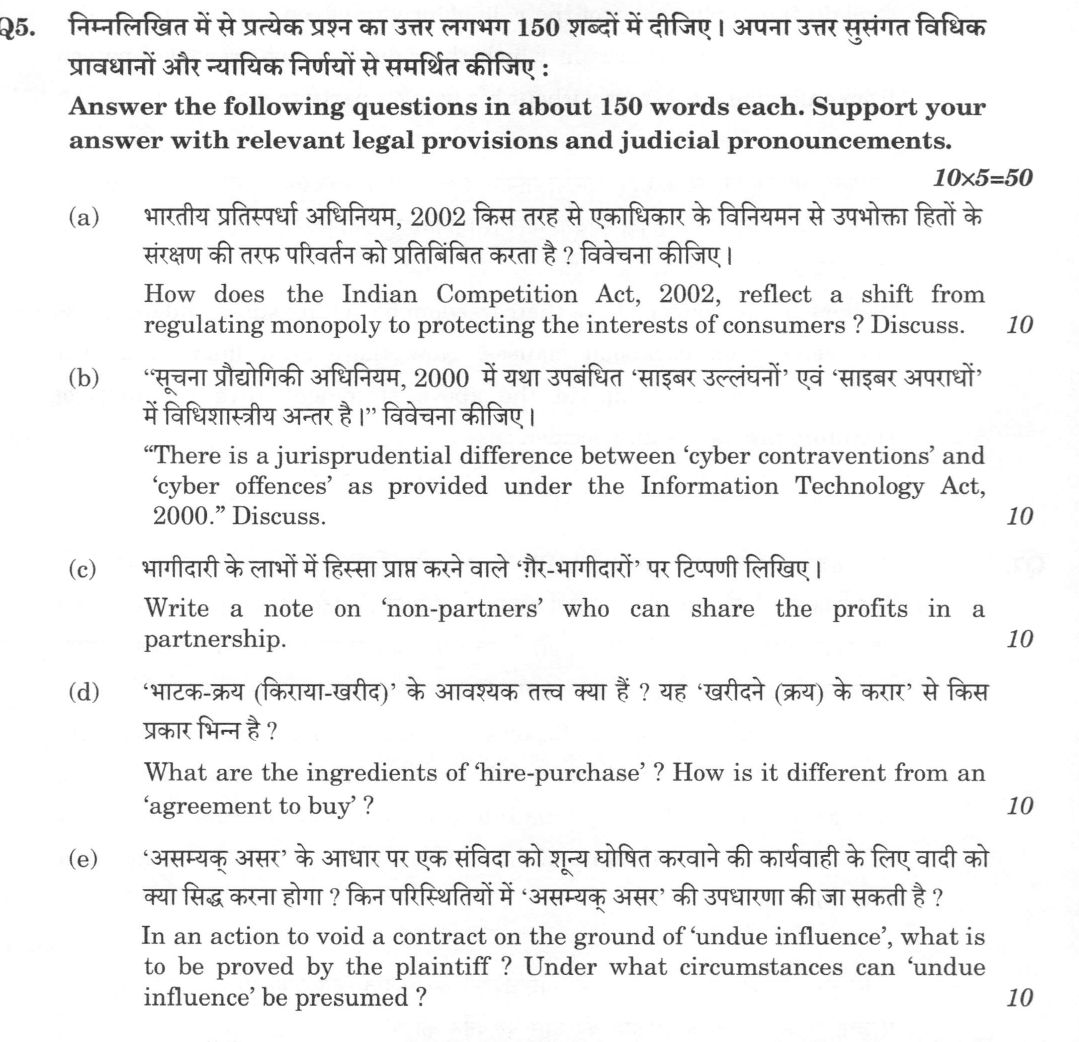
Answer the following questions in about 150 words each. Support your answer with relevant legal provisions and judicial pronouncements.
How does the Indian Competition Act, 2002, reflect a shift from regulating monopoly to protecting the interests of consumers ? Discuss. 10 marks
“There is a jurisprudential difference between ‘cyber contraventions’ and ‘cyber offences’ as provided under the Information Technology Act, 2000.” Discuss. 10 marks
Write a note on ‘non-partners’ who can share the profits in a partnership. 10 marks
What are the ingredients of ‘hire-purchase’ ? How is it different from an ‘agreement to buy’ ? 10 marks
In an action to void a contract on the ground of ‘undue influence’, what is to be proved by the plaintiff ? Under what circumstances can ‘undue influence’ be presumed ? 10 marks
हिंदी में प्रश्न पढ़ें
निम्नलिखित में से प्रत्येक प्रश्न का उत्तर लगभग 150 शब्दों में दीजिए। अपना उत्तर सुसंगत विधिक प्रावधानों और न्यायिक निर्णयों से समर्थित कीजिए :
भारतीय प्रतिस्पर्धा अधिनियम, 2002 किस तरह से एकाधिकार के विनियमन से उपभोक्ता हितों के संरक्षण की तरफ परिवर्तन को प्रतिबिंबित करता है ? विवेचना कीजिए। (10 अंक)
‘सूचना प्रौद्योगिकी अधिनियम, 2000 में यथा उपबंधित ‘साइबर उल्लंघनों’ एवं ‘साइबर अपराधों’ में विधिशास्त्रीय अन्तर है।’ विवेचना कीजिए। (10 अंक)
भागीदारी के लाभों में हिस्सा प्राप्त करने वाले ‘गैर-भागीदारों’ पर टिप्पणी लिखिए। (10 अंक)
‘भाटक-क्रय (किराया-खरीद)’ के आवश्यक तत्व क्या हैं ? यह ‘खरीदने (क्रय) के करार’ से किस प्रकार भिन्न है ? (10 अंक)
‘असम्यक् असर’ के आधार पर एक संविदा को शून्य घोषित करवाने की कार्यवाही के लिए वादी को क्या सिद्ध करना होगा ? किन परिस्थितियों में ‘असम्यक् असर’ की उपधारणा की जा सकती है ? (10 अंक)
Model answer
Drafted with AI by UPSC Answer Check against this question's marking rubric, to the 150-word length. UPSC does not publish answers for Mains — this is one way to score well, not an official key. How we build rubrics and answers.
(a) Competition Act: From Monopoly Control to Consumer Welfare
The Competition Act, 2002, enacted on the Raghavan Committee Report (2000), repealed the MRTP Act, 1969 (Section 66). The MRTP Act controlled size through asset thresholds; the new Act regulates conduct by its effect on competition and consumers.
The Preamble and Section 18 make protecting consumer interests an express object. Section 4 prohibits only the abuse of a dominant position, not dominance itself, with dominance assessed under Section 19(4) and abuses in Section 4(2) including predatory pricing and limiting production to the prejudice of consumers. Section 3(3) presumes that horizontal cartels cause an appreciable adverse effect on competition, while vertical agreements under Section 3(4) face a rule of reason, and Section 19(3) makes the accrual of benefits to consumers a statutory factor. Combinations are reviewed under Sections 5 and 6; Section 27 permits penalties up to ten per cent of average turnover; Section 46 offers leniency; appeals lie to the NCLAT. The Competition (Amendment) Act, 2023 added a deal-value threshold, settlement and commitment, and hub-and-spoke cartels.
In CCI v. Steel Authority of India (2010) the Supreme Court stressed consumer protection as the Act's purpose, and Excel Crop Care v. CCI (2017) tied penalties to relevant turnover.
(b) Cyber Contraventions and Cyber Offences
The IT Act, 2000 separates civil contraventions from criminal offences.
Contraventions (Chapter IX, Sections 43-47) are civil wrongs of strict liability. Section 43 makes a person who, without permission, accesses, downloads, damages or disrupts a computer system liable to pay compensation. An Adjudicating Officer not below the rank of Director (Section 46) decides claims up to Rs. 5 crore on a preponderance of probabilities; appeals lie to the TDSAT.
Offences (Chapter XI, Sections 65-78) are crimes requiring mens rea, investigated by police officers not below the rank of Inspector (Section 78) and tried by criminal courts on proof beyond reasonable doubt. The pairing of Section 43 with Section 66 shows the line: the same acts become an offence only when done "dishonestly or fraudulently". Other offences include identity theft (Section 66C), cheating by personation (Section 66D), cyber terrorism (Section 66F) and obscene material (Sections 67-67B).
Section 77 lets compensation and punishment proceed together; Sections 77A and 77B provide compounding and bailability. Under Section 81 the Act prevails, so Sections 67 and 67A exclude the general obscenity offence (Sharat Babu Digumarti, 2017), and Shreya Singhal v. Union of India (2015) struck down Section 66A.
(c) Non-partners Sharing Profits
Under the Indian Partnership Act, 1932, partnership is an agreement to share profits of a business carried on by all or any of them acting for all (Section 4), judged by the real relation of the parties (Section 6). Profit-sharing is only evidence; mutual agency is the test.
Explanation 2 to Section 6 lists four persons who share profits without becoming partners:
- a lender of money to persons engaged in business;
- a servant or agent receiving a share as remuneration;
- the widow or child of a deceased partner receiving it as an annuity;
- a previous owner or part-owner receiving it as consideration for the sale of the goodwill.
Explanation 1 adds that joint owners sharing the profits or gross returns of property are not thereby partners. A minor admitted to the benefits (Section 30), a transferee of a partner's interest (Section 29) and a sub-partner also share profits without being partners.
In Cox v. Hickman (1860) creditors who ran a debtor's business and took its profits were not partners; Mollwo, March & Co. v. Court of Wards (1872) and K.D. Kamath & Co. v. CIT (1971) confirm that mutual agency is decisive.
(d) Hire-Purchase and Agreement to Buy
Hire-purchase is a bailment with an option to purchase. Its ingredients are: (1) delivery of possession to the hirer, a bailment under Section 148 of the Indian Contract Act, 1872; (2) periodic instalments paid as hire; (3) ownership retained by the owner; (4) an option, not an obligation, to buy, the hirer being free to return the goods; (5) the owner's right to repossess on default; and (6) property passing only when the option is exercised, usually on the last instalment.
In an agreement to buy (Section 4(3)-(4), Sale of Goods Act, 1930), the buyer is bound to buy. Hence in Helby v. Matthews (1895) a hirer of a piano who pledged it passed no title, as he had not "agreed to buy", whereas in Lee v. Butler (1893) a person bound to pay all instalments had agreed to buy and could pass good title under the buyer-in-possession rule (now Section 30(2) SGA).
K.L. Johar & Co. (1965) held that the sale fructifies only when the option is exercised. Repossession on default is not theft (Charanjit Singh Chadha, 2001). The Hire-Purchase Act, 1972 never came into force and was repealed in 2005.
(e) Undue Influence: Burden and Presumption
Under Section 16(1) of the Indian Contract Act, 1872, the plaintiff must prove two things: (i) the other party was in a position to dominate his will, and (ii) he used that position to obtain an unfair advantage. Such a contract is voidable, not void (Section 19A).
Presumption. Section 16(2) deems a person able to dominate another's will where he (a) holds real or apparent authority over him or stands in a fiduciary relation, such as solicitor and client, trustee and beneficiary, guru and disciple, doctor and patient; or (b) contracts with one whose mental capacity is affected by age, illness or mental or bodily distress. Under Section 16(3), if such a person enters into a transaction that appears unconscionable, the burden of proving that it was not induced by undue influence shifts to him.
The court asks in sequence whether domination existed, whether it was used, and whether the bargain is unconscionable (Ladli Prasad Jaiswal, 1963; Subhas Chandra Das Mushib, 1967). For a pardanashin woman the beneficiary must prove the transaction was explained and understood, with independent advice (Kali Baksh Singh, 1913). No presumption arises between husband and wife (Howes v. Bishop, 1909).
How this answer will be evaluated
Evaluation rubric
Each sub-part is marked on its own, against the marks and word limit printed on the paper.
- (a) 'Discuss' a specific proposition: that the Competition Act, 2002 moved Indian law from a structural, size-based control of monopoly (the MRTP Act, 1969) to an effects-based regime whose object is consumer welfare. The answer must prove that shift from the Preamble, Sections 3, 4, 18 and 19, and not merely describe the Act. 10 marks · 150 words
Must cover
- MRTP Act, 1969 repealed (Section 66): structural size control replaced by an effects-based regime
- Preamble and Section 18 — protection of the interests of consumers
- Section 4 — abuse of dominance prohibited, not dominance itself; Section 19(4) factors
- Section 3(3) presumption for horizontal agreements; Section 3(4) rule of reason; Section 19(3) benefits to consumers
- Competition (Amendment) Act, 2023 and enforcement (Section 27, Section 46, appeals to the NCLAT)
Loses marks
- Describing the Competition Act generally without ever demonstrating the shift the question asserts — the contrast with the MRTP Act and the 'abuse, not dominance' point are what earn the marks.
- Stating that dominance or monopoly is itself an offence under Section 4; only its abuse is.
- Confusing the 'consumer' of Section 2(f) of the Competition Act with the consumer under the Consumer Protection Act, 2019 — the former expressly includes a buyer for resale or commercial purpose.
- Treating all agreements alike; Section 3(3) carries a presumption of appreciable adverse effect while Section 3(4) is governed by the rule of reason.
- Omitting the Competition (Amendment) Act, 2023 in a 2026 answer, or attributing to it changes it did not make.
- Referring to the Competition Appellate Tribunal as the present appellate forum; since 2017 the appeal lies to the National Company Law Appellate Tribunal.
Earns more
- Completes the picture with enforcement and recent reform: regulation of combinations under Sections 5 and 6; orders and penalties under Section 27, including a penalty of up to ten per cent of average turnover and, for cartels, up to three times the profit or ten per cent of the turnover for each year of the continuance of the agreement; the lesser-penalty or leniency regime under Section 46; competition advocacy under Section 49; appeals to the National Company Law Appellate Tribunal under Section 53B and to the Supreme Court under Section 53T. Adds the Competition (Amendment) Act, 2023, which introduced a deal-value threshold for combinations, shortened combination timelines, created settlement and commitment mechanisms, extended Section 3(3) to hub-and-spoke arrangements by covering enterprises not engaged in identical trade that participate in the furtherance of the agreement, and widened the turnover base for penalties. Supports with authority: Competition Commission of India v. Steel Authority of India Ltd., (2010) 10 SCC 744 and Excel Crop Care Ltd. v. Competition Commission of India, (2017) 8 SCC 47 (penalty to be computed on relevant turnover, not total turnover).
Extra mark
- Raghavan Committee Report (2000)
- CCI v. Steel Authority of India Ltd. (2010)
- Excel Crop Care Ltd. v. CCI (2017) — relevant turnover
- Combinations (Sections 5-6); competition advocacy (Section 49)
- (b) 'Discuss' a jurisprudential distinction: the candidate must show that contraventions under Chapter IX of the Information Technology Act, 2000 are civil wrongs of strict liability adjudicated by an Adjudicating Officer and compensated in damages, whereas offences under Chapter XI are criminal wrongs requiring mens rea, investigated by the police and tried by criminal courts — and must demonstrate the difference with paired provisions. 10 marks · 150 words
Must cover
- Chapter IX (Sections 43-47) contraventions: civil wrongs, compensation, Adjudicating Officer (Section 46)
- Chapter XI (Sections 65-78) offences: crimes requiring mens rea, police investigation, criminal courts
- Section 43 / Section 66 pairing — 'dishonestly or fraudulently'
- Different standards of proof; Section 77 — both may proceed concurrently
- Illustrative offences (e.g. Sections 66C, 66D, 66F, 67)
Loses marks
- Listing the sections of both chapters without articulating the jurisprudential difference — civil versus criminal, strict liability versus mens rea, compensation versus punishment, adjudicating officer versus criminal court.
- Missing the Section 43 and Section 66 pairing, which is the clearest internal proof of the distinction.
- Citing Section 66A as a live provision; it was struck down as unconstitutional in Shreya Singhal v. Union of India, (2015) 5 SCC 1 for violating Article 19(1)(a) and not being saved by Article 19(2).
- Stating that the Adjudicating Officer's jurisdiction is capped at one crore rupees; Section 43's original cap was removed by the Information Technology (Amendment) Act, 2008 and the adjudicatory limit under Section 46(1A) is five crore rupees.
- Referring to the Cyber Appellate Tribunal as the present appellate forum; its functions have been exercised by the TDSAT since the Finance Act, 2017.
- Asserting that a person cannot face both adjudication and prosecution on the same facts; Section 77 expressly preserves both.
Earns more
- Demonstrates the distinction with the decisive internal illustration and its consequences: the identical conduct described in Section 43 becomes an offence under Section 66 only when it is done 'dishonestly or fraudulently', those expressions bearing the meaning assigned by the general penal law (Sections 2(7) and 2(9) of the Bharatiya Nyaya Sanhita, 2023 [ss. 24 and 25 IPC, 1860]) — so mens rea alone converts a contravention into a crime; and Section 77 provides that no compensation awarded, penalty imposed or confiscation made under the Act shall prevent the award of any other punishment, so that civil adjudication and criminal prosecution may proceed concurrently on the same facts. Adds that Section 81 gives the Act overriding effect, applied in Sharat Babu Digumarti v. Government (NCT of Delhi), (2017) 2 SCC 18, where the special provisions of Sections 67 and 67A were held to exclude recourse to the general obscenity provision of the Penal Code.
Extra mark
- Section 46(1A) — Rs. 5 crore; appeals to the TDSAT
- Sections 77A and 77B — compounding and bailability
- Section 81; Sharat Babu Digumarti (2017)
- Shreya Singhal v. Union of India (2015) — Section 66A struck down
- (c) A note with a precise statutory target: the four categories in Explanation 2 to Section 6 of the Indian Partnership Act, 1932 who may receive a share of profits without becoming partners, together with the other statutory non-partners — the minor admitted to the benefits of partnership, the transferee of a partner's interest and the sub-partner — and the reason, namely that mutual agency and not profit-sharing is the test. 10 marks · 150 words
Must cover
- Mutual agency, not profit-sharing, is the test (Sections 4 and 6)
- Explanation 2 to Section 6 — all four categories
- Explanation 1 — joint owners sharing returns
- Other non-partners: minor admitted to benefits (Section 30), transferee (Section 29), sub-partner
Loses marks
- Giving only two or three of the four categories in Explanation 2 — the widow or child of a deceased partner receiving an annuity and the previous owner receiving consideration for goodwill are the ones most often omitted.
- Writing a general essay on the essentials of partnership instead of identifying the specific non-partner categories the question asks for.
- Citing the wrong statute or section — the provision is Explanation 2 to Section 6 of the Indian Partnership Act, 1932, not Section 4 or Section 5.
- Saying that a minor can be a partner; under Section 30 he is only admitted to the benefits of partnership and is not a partner unless he elects to become one on attaining majority.
- Omitting the reason for the rule — that none of these persons has the power to bind the firm — so the note describes without explaining.
- Treating a lender who receives a share of profits as automatically a partner; Cox v. Hickman decides the contrary.
Earns more
- Supports the proposition with authority: Cox v. Hickman, (1860) 8 HLC 268 (creditors who, under a trust deed, carried on the debtor's business and received the profits in satisfaction of their debts were held not to be partners, the House of Lords establishing that the real test is whether the business is carried on by or on behalf of the person sought to be charged, that is, mutual agency); Mollwo, March & Co. v. Court of Wards, (1872) LR 4 PC 419 (a lender who received a commission on profits and exercised a measure of control was nevertheless held not to be a partner); K.D. Kamath & Co. v. Commissioner of Income Tax, (1971) 2 SCC 873 (the two essential conditions of partnership are an agreement to share profits and the business being carried on by all or any of them acting for all, the latter being the mutual agency requirement).
Extra mark
- Cox v. Hickman (1860)
- Mollwo, March & Co. v. Court of Wards (1872)
- K.D. Kamath & Co. v. CIT (1971)
- (d) Two parts: state the essential ingredients of a hire-purchase transaction, and then distinguish it from an agreement to buy. The pivot is the hirer's option, as opposed to obligation, to purchase, and the consequences of that difference for the passing of property and the power to pass title. 10 marks · 150 words
Must cover
- Hire-purchase as bailment with an option to purchase
- Ingredients: delivery, hire instalments, ownership retained, option, repossession, right to return
- Agreement to buy — obligation to purchase (Sale of Goods Act, 1930)
- Option v. obligation and its consequence for passing title (Section 30(2) SGA; Helby v. Matthews)
- Hire-Purchase Act, 1972 never brought into force (repealed in 2005)
Loses marks
- Treating hire-purchase as identical to an instalment sale or a credit sale; in an instalment sale property passes at once and the seller is only an unpaid creditor.
- Missing the option-versus-obligation distinction, which is the entire basis of Helby v. Matthews and the reason for the different consequences.
- Stating that the Hire-Purchase Act, 1972 governs the transaction; it was enacted but never brought into force, and was repealed by the Hire-Purchase (Repeal) Act, 2005.
- Saying that the hirer can pass a good title to a bona fide purchaser; he cannot, precisely because he has not agreed to buy.
- Listing ingredients without contrasting them with an agreement to buy, when the second half of the question carries substantial marks.
- Confusing hire-purchase with a lease or with a mere hiring; a simple hiring contains no option to purchase at all.
Earns more
- Adds the Indian judicial gloss: K.L. Johar & Co. v. Deputy Commercial Tax Officer, AIR 1965 SC 1082 (a hire-purchase agreement has two elements, a bailment and an element of sale, the sale fructifying only when the option is exercised, so that sales tax is attracted at that point and not at the inception); Sundaram Finance Ltd. v. State of Kerala, AIR 1966 SC 1178 (where the substance of the transaction is a loan secured by a hypothecation of the goods, the label of hire-purchase will not convert it into a sale — the court looks at the real nature of the transaction); Charanjit Singh Chadha v. Sudhir Mehra, (2001) 7 SCC 417 and Magma Fincorp Ltd. v. Rajesh Kumar Tiwari, (2020) 10 SCC 399 (since ownership remains with the financier under a hire-purchase agreement, its repossession of the vehicle on default is not theft or criminal breach of trust and is not, as such, a deficiency in service).
Extra mark
- Lee v. Butler (1893)
- K.L. Johar & Co. (1965); Sundaram Finance (1966)
- Charanjit Singh Chadha (2001) — repossession is not theft
- (e) Two precise questions: what the plaintiff must prove to avoid a contract for undue influence under Section 16 of the Indian Contract Act, 1872, and in what circumstances undue influence is presumed so that the burden shifts to the defendant. The answer should also correct the premise — such a contract is voidable under Section 19A, not void. 10 marks · 150 words
Must cover
- Section 16(1) — two limbs: position to dominate the will and its use to obtain an unfair advantage
- Contract voidable under Section 19A, not void
- Section 16(2)(a) and (b) — when a person is deemed able to dominate
- Section 16(3) — unconscionable transaction shifts the burden
- Pardanashin women; no presumption between husband and wife
Loses marks
- Saying that a contract induced by undue influence is void; Section 19A makes it voidable at the option of the party whose consent was so caused.
- Stating only one limb of the plaintiff's burden — establishing a dominating position is not enough without showing that the position was used to obtain an unfair advantage.
- Confusing the presumption of domination in Section 16(2) with the shifting of the burden of proof in Section 16(3); the latter requires the transaction also to appear unconscionable.
- Asserting a presumption between husband and wife or between landlord and tenant; those relationships require proof of actual influence.
- Confusing undue influence with coercion under Section 15, misrepresentation under Section 18 or fraud under Section 17.
- Omitting the pardanashin-woman rule, which is the standard Indian addition to this question.
Earns more
- Gives concrete categories and the special case of pardanashin women: the presumption arises between solicitor and client, trustee and beneficiary, spiritual adviser or guru and disciple, doctor and patient, guardian and ward, and creditor and a debtor in distress — Shrimati Mannu Singh v. Umadat Pande, (1890) ILR 12 All 523 (a disciple's gift of his whole property to his spiritual preceptor set aside) and Wajid Khan v. Raja Ewaz Ali Khan, (1891) 18 IA 144 — but not, as a matter of course, between husband and wife (Howes v. Bishop, [1909] 2 KB 390) or landlord and tenant, where actual influence must be proved. Where the contracting party is a pardanashin or illiterate woman, the person taking the benefit must additionally prove that the transaction was fully explained to her, that she understood it and that she had the benefit of competent independent advice (Kali Baksh Singh v. Ram Gopal Singh, (1913) 41 IA 23). Notes that the saving in Section 16(3) preserves the operation of the presumption of good faith in transactions of active confidence formerly contained in Section 111 of the Indian Evidence Act, 1872, which now stands re-enacted in the Bharatiya Sakshya Adhiniyam, 2023.
Extra mark
- Ladli Prasad Jaiswal (1963); Subhas Chandra Das Mushib (1967)
- Kali Baksh Singh (1913); Howes v. Bishop (1909)
- Mannu Singh v. Umadat Pande (1890); Wajid Khan v. Ewaz Ali Khan (1891)
What "Discuss" is asking you to do
Lay the issue out from more than one side — how it arose, what is claimed for it, what is held against it, and where it now stands. UPSC attaches discuss to broad topics with several live dimensions, so coverage of the dimensions earns more than the strength of your opinion.
Structure that answers it
Set the issue up → the case as it is made → the case against → the dimension both sides leave out → where the balance now lies
Where marks are lost
Listing facts with no thread between them, or arguing one side throughout and calling it a discussion.
Practice this exact question
Write your answer and it is marked point by point against the model answer above — what you covered, what you missed, what you got wrong.
Evaluate my answer →More from Law 2026 Paper II
- Q2 (a) “Vicarious liability’ is based on public policy rather than fault.” Critically analys…
- Q3 (a) How effectively does the law distinguish between ‘pre-meditated killing’ and ‘murder…
- Q4 (a) 'X', a 25-year-old boy, makes a promise to 'Y', an 18-year-old girl, that he will mar…
- Q5 Answer the following questions in about 150 words each. Support your answer with relevant…
- Q6 (a) “Sharing of profits is only prima facie evidence of the existence of a partnership. T…
- Q7 (a) Can ‘Alternative Dispute Resolution’ (ADR) mechanisms effectively adjudicate disputes…
- Q8 (a) ‘‘Intellectual property laws confer exclusive rights on creators; however, such right…