Paper II — Q8
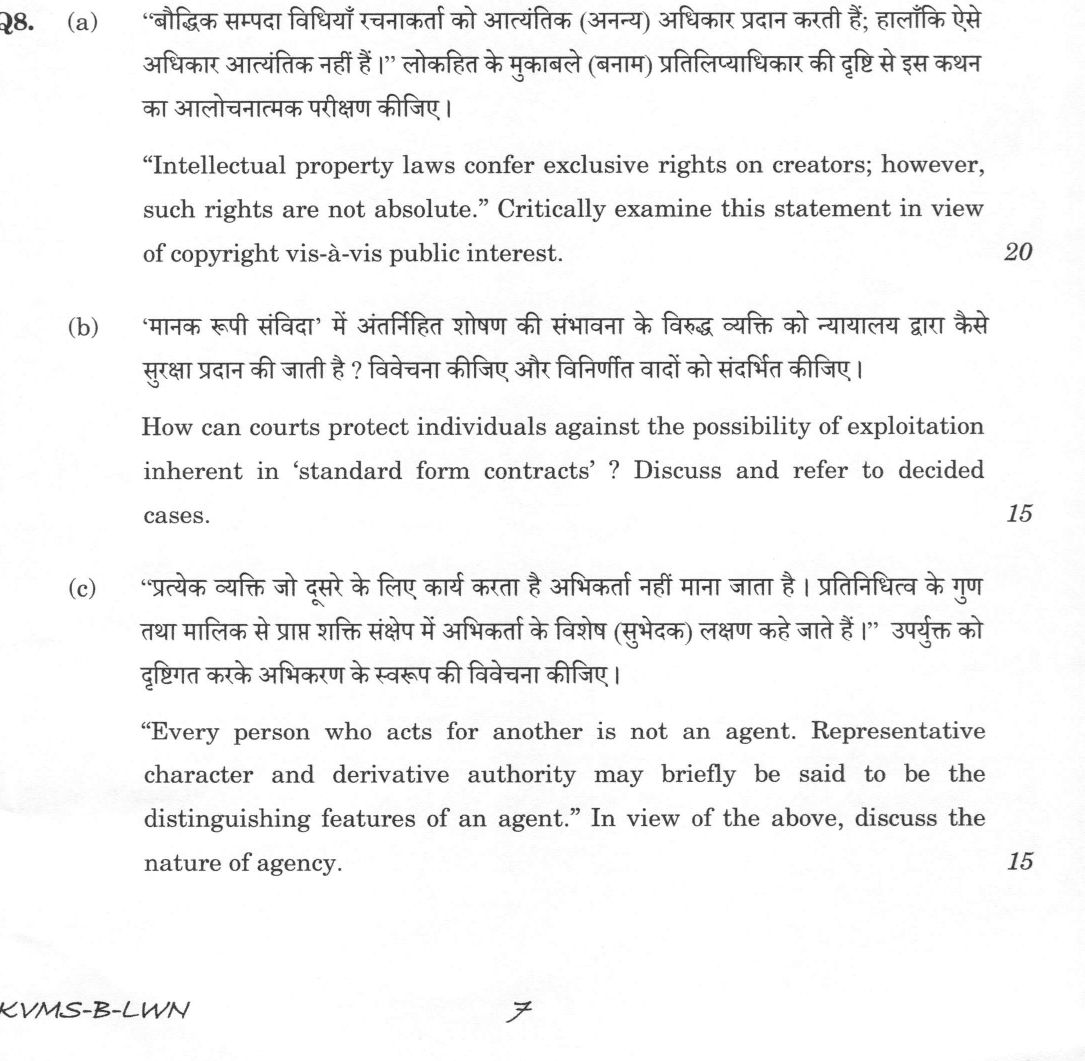
(a) ‘‘Intellectual property laws confer exclusive rights on creators; however, such rights are not absolute.’’ Critically examine…
‘‘Intellectual property laws confer exclusive rights on creators; however, such rights are not absolute.’’ Critically examine this statement in view of copyright vis-à-vis public interest. 20 marks
How can courts protect individuals against the possibility of exploitation inherent in ‘standard form contracts’ ? Discuss and refer to decided cases. 15 marks
‘‘Every person who acts for another is not an agent. Representative character and derivative authority may briefly be said to be the distinguishing features of an agent.’’ In view of the above, discuss the nature of agency. 15 marks
हिंदी में प्रश्न पढ़ें
‘‘बौद्धिक सम्पदा विधियाँ रचनाकर्ता को अनन्य अधिकार प्रदान करती हैं; हालाँकि ऐसे अधिकार आत्यंतिक नहीं हैं।’’ लोकहित के मुकाबले (बनाम) प्रतिलिप्याधिकार की दृष्टि से इस कथन का आलोचनात्मक परीक्षण कीजिए। (20 अंक)
‘मानक रूपी संविदा’ में अंतर्निहित शोषण की संभावना के विरुद्ध व्यक्ति को न्यायालय द्वारा कैसे सुरक्षा प्रदान की जाती है ? विवेचना कीजिए और विनिर्णीत वादों को संदर्भित कीजिए। (15 अंक)
‘‘प्रत्येक व्यक्ति जो दूसरे के लिए कार्य करता है अभिकर्ता नहीं माना जाता है। प्रतिनिधित्व के गुण तथा मालिक से प्राप्त शक्ति संक्षेप में अभिकर्ता के विशेष (सुभेदक) लक्षण कहे जाते हैं।’’ उपर्युक्त को दृष्टिगत करके अभिकरण के स्वरूप की विवेचना कीजिए। (15 अंक)
Model answer
Drafted with AI by UPSC Answer Check against this question's marking rubric, to the expected length. UPSC does not publish answers for Mains — this is one way to score well, not an official key. How we build rubrics and answers.
(a) Copyright and the Public Interest
The statement correctly identifies the dual nature of copyright: it is a statutory exclusive right that is inherently limited by public interest. Under Sections 13, 14, 17, and 22 of the Copyright Act, 1957, the creator is granted exclusive rights to reproduce, adapt, and distribute the work. Infringement is defined in Section 51, and Section 57 adds the author's moral rights. However, Section 16 clarifies that copyright exists only as provided by the Act, so it is a statutory right, not a fundamental or natural right. In Entertainment Network (India) Ltd. v. Super Cassette Industries Ltd. (2008), the Supreme Court stressed that copyright is not an absolute monopoly and must be balanced against the public interest in access.
The non-absolute nature of these rights is demonstrated through internal and external limits. Internally, the "idea–expression dichotomy" (R.G. Anand v. Delux Films, 1978) ensures that only the expression of an idea is protected, keeping raw facts and themes in the public domain. Furthermore, the "sweat of the brow" doctrine was rejected in Eastern Book Company v. D.B. Modak (2008), requiring a threshold of skill and judgment for originality. Section 52 provides a closed list of "fair dealing" exceptions for purposes like research and instruction, as seen in University of Oxford v. Rameshwari Photocopy Services (Delhi High Court, 2016), where photocopied course packs for Delhi University students were held to fall within 'reproduction in the course of instruction' under Section 52(1)(i). Section 52(1)(a) permits fair dealing for private use including research, criticism, review and news reporting, and Section 52(1)(zb), added by the Copyright (Amendment) Act, 2012, allows accessible-format copies for persons with disabilities, in line with the Marrakesh Treaty (2013), which India was the first to ratify. Sections 31 to 32B further limit rights through compulsory licences for works withheld from the public (Section 31), for unpublished or orphan works (Section 31A) and for persons with disabilities (Section 31B), statutory licences for cover versions and broadcasting (Sections 31C and 31D), and licences for translations (Section 32), ensuring access to works even if the owner refuses to license them.
Externally, the term of copyright is limited to the life of the author plus sixty years (Section 22), after which the work enters the public domain. The regime is also constrained by the "three-step test" under the Berne Convention and TRIPS Agreement (which also limits how far a State may widen exceptions), and by competition law, since Section 3(5) of the Competition Act, 2002 protects only reasonable conditions needed to protect an IP right and does not shield abuse of dominance. The balance is not perfect. On one side, India's purpose-based fair dealing list is more rigid than the open-ended American "fair use" standard and struggles with new technologies, and broad 'John Doe' and dynamic website-blocking injunctions can over-protect rights holders. On the other side, statutory licences for broadcasting have been criticised by rights holders as under-rewarding creators. On balance, the Act protects the incentive to create while preserving access to knowledge, which draws support from Articles 19(1)(a) and 21A, though fair dealing needs periodic updating.
(b) Judicial Protection against Standard Form Contracts
Standard form contracts, or contracts of adhesion, are drafted by a party with superior bargaining power and offered on a "take-it-or-leave-it" basis. This inherent imbalance creates a risk of exploitation through surprise or unfair terms. Courts protect individuals through several legal devices.
First, the principle of reasonable notice requires that terms be brought to the attention of the weaker party before or at the time of contracting (Parker v. South Eastern Railway, 1877). In Olley v. Marlborough Court (1949), a notice in a hotel bedroom did not bind a guest because the contract had already been made at the reception desk. In Thornton v. Shoe Lane Parking (1971), a term on a ticket was held ineffective because it was not reasonably brought to the customer's notice. Similarly, Denning L.J.'s "red hand" rule in J. Spurling Ltd. v. Bradshaw (1956), applied in Interfoto Picture Library v. Stiletto Visual Programmes (1989), requires a party to draw specific attention to particularly onerous or unusual clauses. A clause whose effect is misrepresented does not bind the signer (Curtis v. Chemical Cleaning & Dyeing Co., 1951).
Second, the doctrine of contra proferentem is used to interpret ambiguous terms against the party who drafted the contract, and exemption clauses are strictly construed: a clause excluding 'warranties' does not exclude conditions (Wallis, Son & Wells v. Pratt & Haynes, 1911; Baldry v. Marshall, 1925). The doctrine of fundamental breach (Karsales v. Wallis, 1956) once prevented reliance on an exemption clause where the core obligation was broken; after Photo Production v. Securicor (1980) this is a matter of construction rather than a rule of law. Third, the Indian Contract Act, 1872, provides protection against unconscionability and undue influence. Section 16(3) shifts the burden where a dominant party enters into an unconscionable bargain, and Section 28 voids clauses that restrain legal proceedings. In Central Inland Water Transport Corporation Ltd. v. Brojo Nath Ganguly (1986), the Supreme Court held that an unfair and unreasonable term in a contract between parties of grossly unequal bargaining power — there, a rule allowing a government company to dismiss permanent employees on three months' notice — is void under Section 23 as opposed to public policy. In LIC of India v. Consumer Education & Research Centre (1995), the Court held that terms offered by the State or its instrumentalities must be just, fair and reasonable under Article 14.
Finally, the Consumer Protection Act, 2019, provides a statutory remedy. Section 2(46) defines an "unfair contract" (for example, excessive security deposits, disproportionate penalties, or unilateral termination without reasonable cause), and Sections 49(2) and 59(2) allow the State and National Commissions to declare such terms null and void; Section 2(47) covers unfair trade practices. In Pioneer Urban Land and Infrastructure Ltd. v. Govindan Raghavan (2019), the Supreme Court held that a flat buyer could not be bound by the wholly one-sided terms of a builder–buyer agreement, which amounted to an unfair trade practice. Standard forms are not objectionable in themselves: a clear limitation of liability freely accepted may still be enforced (Bharathi Knitting Co. v. DHL Worldwide Express, 1996). Unlike the UK, India has no general unfair terms law outside consumer matters, though the Law Commission recommended one in its 103rd (1984) and 199th (2006) Reports. These tools collectively ensure that the freedom of contract does not become a tool for exploitation.
(c) Nature of Agency
The nature of agency is defined by the relationship between a principal and an agent, where the agent acts on behalf of the principal to create legal relations with third parties. Section 182 of the Indian Contract Act, 1872, defines an agent as a person employed to do any act for another or to represent such other in dealings with third persons.
The two distinguishing features of an agent are "representative character" and "derivative authority." Representative character means the agent acts on behalf of the principal, whether the principal is named or not, and the legal consequences of the agent's actions fall directly on the principal: under Section 226, contracts made by an agent may be enforced as if made by the principal in person, and under Section 230 the agent is ordinarily not personally bound (except where the principal is foreign, undisclosed, or cannot be sued); an undisclosed principal may also intervene (Sections 231-232). Derivative authority means the agent's power is derived from the principal; the agent has no independent authority to bind the principal. Under Section 183 any competent person may employ an agent, while under Section 184 even a minor may be an agent and bind the principal to third parties, though he is not responsible to the principal; and under Section 185 no consideration is needed to create an agency. As the maxim qui facit per alium facit per se suggests, the principal acts through the agent. In Syed Abdul Khader v. Rami Reddy (1979) the Court described an agent as one who represents the principal and can bring him into legal relations with third parties.
Not every person who acts for another is an agent. A servant acts under the direct control and supervision of the master regarding the manner of work, whereas an agent has a degree of independence. An independent contractor is engaged to achieve a specific result and is not bound by the principal's instructions on how to perform the task. A bailee is in possession of goods but does not represent the owner in legal dealings. A trustee holds legal title and contracts in his own name, and the beneficiary is not liable on his contracts. A buyer or distributor buys on his own account, takes the risk and keeps the profit, whereas an agent must account to the principal (Section 218); whether a dealer is an agent depends on the substance of the arrangement (Gordon Woodroffe & Co. v. Sheikh M.A. Majid & Co., 1967). In Lakshminarayan Ram Gopal & Son v. Government of Hyderabad (1954), the Supreme Court held that the power to create contractual relations between the principal and third parties distinguishes an agent from a servant or an independent contractor.
The core of agency is the power to create legal relations between the principal and a third party. This power can be express or implied (Sections 186-188), or arise in an emergency (Section 189). An agent generally cannot delegate (delegatus non potest delegare, Section 190), subject to sub-agents and substituted agents (Sections 191-195). An unauthorised act may be ratified with retrospective effect if the principal has full knowledge and ratifies the whole transaction without harming third parties (Sections 196-200). Where the agent exceeds authority, the principal is bound only by the separable authorised part (Sections 227-228). The principal may also be bound by ostensible or apparent authority (Section 237), where his own conduct leads a third party to believe the agent is authorised. An agency coupled with the agent's own interest cannot be revoked to the agent's prejudice (Section 202). The relationship is founded on the intention to create legal relations, and while consideration is not strictly necessary for the agency relationship itself (Section 185), the agent must act within the scope of their authority to bind the principal.
How this answer will be evaluated
Evaluation rubric
Each sub-part is marked on its own, against the marks and word limit printed on the paper.
- (a) 'Critically examine' — so first establish the premise that copyright confers exclusive rights (Sections 13, 14, 17 and 22 of the Copyright Act, 1957), then demonstrate with precision the internal and external limits that make those rights non-absolute in the public interest: the idea–expression dichotomy and originality threshold, the fair dealing exceptions in Section 52, the compulsory and statutory licences in Sections 31 to 32B, term limits, and competition and constitutional constraints — and finally take a reasoned view on whether the present balance is satisfactory. 20 marks
Must cover
- Exclusive rights: Sections 13, 14 and 17; copyright a statutory right (Section 16)
- Internal limits: idea–expression dichotomy; originality threshold
- Fair dealing — Section 52 with specific clauses (e.g. 52(1)(a), 52(1)(i), 52(1)(zb))
- Compulsory and statutory licences — Sections 31 to 32
- Term limit (life plus sixty years, Section 22) and the public domain; competition law (Section 3(5), Competition Act, 2002)
- Critical evaluation and a reasoned conclusion
Loses marks
- Writing a general introduction to intellectual property covering patents, trade marks and designs; the question is expressly limited to copyright vis-à-vis public interest.
- Mentioning 'fair dealing' without citing Section 52 or identifying any specific clause, which is the commonest way to lose the four marks that clause carries.
- Omitting compulsory and statutory licensing under Sections 31 to 31D, which is the strongest statutory proof that the rights are not absolute.
- Stating the term of copyright as life plus fifty or life plus seventy years; in India Section 22 gives life plus sixty years, counted from the beginning of the calendar year next following the year of the author's death.
- Importing the American four-factor fair use test as though it were Indian law; India has a purpose-based fair dealing regime under Section 52, and the difference is itself a point worth making.
- Describing copyright as a fundamental right or as a natural property right; it is a creature of statute, and Section 16 says so.
- Failing to reach any conclusion, when the directive is 'critically examine' and a reasoned position is required.
Earns more
- Deals with the limits on the subject-matter of protection, which keep raw information in the public domain: the idea–expression dichotomy — there can be no copyright in an idea, subject-matter, theme, plot or historical or legendary fact, and violation is confined to the form, manner, arrangement and expression of the idea, the surest test being whether the reader, spectator or viewer after having read or seen both works is clearly of the opinion and gets an unmistakable impression that the subsequent work appears to be a copy of the original (R.G. Anand v. Delux Films, (1978) 4 SCC 118); and the originality threshold — the work must originate from the author and must involve a minimal degree of creativity, or skill and judgment that is not merely a trivial or mechanical exercise, the 'sweat of the brow' doctrine being rejected, so that raw judgments of courts carry no copyright while original copy-edited inputs, headnotes, paragraph numbering and editorial notes may (Eastern Book Company v. D.B. Modak, (2008) 1 SCC 1). May add that there is no copyright in a title alone (Krishika Lulla v. Shyam Vithalrao Devkatta, (2016) 2 SCC 521).
- Adds external and international constraints and the constitutional dimension: the finite term under Sections 22 to 29, after which the work falls into the public domain, which is itself a public-interest limitation; the three-step test in Article 9(2) of the Berne Convention and Article 13 of the TRIPS Agreement, under which limitations and exceptions must be confined to certain special cases which do not conflict with a normal exploitation of the work and do not unreasonably prejudice the legitimate interests of the rights holder — a constraint that cuts the other way, limiting how far a State may expand exceptions; the Marrakesh Treaty to Facilitate Access to Published Works for Persons Who Are Blind, Visually Impaired or Otherwise Print Disabled, 2013, which India ratified and which Sections 31B and 52(1)(zb) implement; the subordination of intellectual property to competition law, an exclusive right not conferring immunity from scrutiny for abuse of dominance under the Competition Act, 2002, the exemption in Section 3(5) being confined to reasonable conditions necessary for protecting the right; and the constitutional point that copyright in India is a statutory and not a fundamental right, while access to knowledge draws support from Articles 19(1)(a) and 21A.
- Delivers the critical judgment the directive 'critically examine' requires, taking a reasoned position with at least two concrete points of criticism on either side: for example, that Indian fair dealing under Section 52(1)(a) is confined to an enumerated list of purposes rather than the open-ended fair use standard of the United States, which makes the regime rigid in the face of new technologies; that strong criminal enforcement under Sections 63 and 63A and the practice of granting John Doe or Ashok Kumar injunctions and dynamic website-blocking orders can over-deter lawful uses; that technological protection measures under Section 65A and rights management information under Section 65B can in practice defeat exceptions that the statute grants; that the royalty provisos inserted into Sections 18 and 19 by the Copyright (Amendment) Act, 2012 and the performers' rights in Sections 38A and 38B redistribute value towards authors and performers and away from producers, which is itself a public-interest intervention in private bargaining; and, on the other side, that exceptions too widely drawn would destroy the incentive the system exists to create. The candidate must reach a conclusion, not merely list.
Extra mark
- R.G. Anand v. Delux Films (1978); Eastern Book Company v. D.B. Modak (2008)
- Entertainment Network v. Super Cassette Industries (2008)
- University of Oxford v. Rameshwari Photocopy Services (Delhi HC, 2016)
- Three-step test (Berne Article 9(2); TRIPS Article 13); Marrakesh Treaty (2013)
- Articles 19(1)(a) and 21A
- (b) Two express demands: identify the exploitation inherent in standard form contracts (contracts of adhesion offered on a take-it-or-leave-it basis by a party with superior bargaining power), and then discuss, with decided cases, the protective devices courts use — reasonable notice, notice of onerous or unusual terms, contra proferentem and strict construction, fundamental breach, non est factum and misrepresentation, undue influence and unconscionability under Sections 16(3) and 23 of the Indian Contract Act, 1872 — supplemented by the statutory protection now available under the Consumer Protection Act, 2019. Cases are compulsory: 'refer to decided cases'. 15 marks
Must cover
- Nature of standard form contracts and the risk of exploitation
- Reasonable notice and special notice of onerous terms, with cases (e.g. Olley; Thornton; Spurling v. Bradshaw)
- Contra proferentem and strict construction; fundamental breach after Photo Production
- Indian Contract Act: Sections 16(3), 23 and 28; Brojo Nath Ganguly (1986)
- Consumer Protection Act, 2019: Sections 2(46), 2(47), 49(2) and 59(2)
- Balance: standard forms not objectionable per se; no general unfair-terms law in India
Loses marks
- Listing the protective devices without a single decided case, when the question expressly directs the candidate to 'refer to decided cases'.
- Omitting Central Inland Water Transport Corporation v. Brojo Nath Ganguly, which is the leading Indian authority on unconscionable terms in unequal bargains and is what the examiner is chiefly looking for.
- Citing only English cases and treating Indian law as identical; India has no Unfair Contract Terms Act and reaches the same result through Sections 16(3) and 23 of the Indian Contract Act, 1872 and the Consumer Protection Act, 2019.
- Referring to the repealed Consumer Protection Act, 1986 instead of the Consumer Protection Act, 2019, or failing to mention the statutory power under Sections 49(2) and 59(2) to declare an unfair term null and void.
- Misstating Olley v. Marlborough Court as a case about unreasonableness; it turned on the timing of notice, the contract having already been concluded at the reception desk.
- Presenting fundamental breach as an inflexible rule of law without noting Photo Production v. Securicor, or asserting that Indian courts will strike down every exemption clause — Bharathi Knitting Co. v. DHL shows they will not.
- Confusing an exemption clause with a liquidated damages clause under Section 74.
Earns more
- Brings in the statutory protection now available, without which the modern answer is incomplete: the Consumer Protection Act, 2019 — Section 2(46), which defines an 'unfair contract' as a contract between a manufacturer or trader or service provider on the one hand and a consumer on the other having such terms as cause a significant change in the rights of the consumer, including requiring the payment of excessive security deposits, imposing a penalty disproportionate to the loss, refusing to accept early repayment of debts on payment of applicable penalty, entitling a party unilaterally to terminate the contract without reasonable cause, permitting assignment of the contract to the detriment of the other party without his consent, or imposing any unreasonable charge, obligation or condition which puts the consumer at a disadvantage; and Sections 49(2) and 59(2), which expressly empower the State Commission and the National Commission respectively to declare any term of a contract which is unfair to a consumer to be null and void. Adds Section 2(47) on unfair trade practices, the Central Consumer Protection Authority under Sections 10 and 18, and Section 28 of the Indian Contract Act, 1872, which avoids agreements in restraint of legal proceedings. Illustrates with Pioneer Urban Land & Infrastructure Ltd. v. Govindan Raghavan, (2019) 5 SCC 725, where the Supreme Court held that a builder could not compel an apartment buyer to be bound by one-sided terms of a builder–buyer agreement, such terms constituting an unfair trade practice; Ireo Grace Realtech (P) Ltd. v. Abhishek Khanna, (2021) 3 SCC 241 is an acceptable alternative.
- Supplies balance and the reform dimension: standardisation is not inherently objectionable — it reduces transaction costs and is indispensable to mass commerce, and a freely negotiated limitation of liability in clear terms between commercial parties will be enforced (M/s. Bharathi Knitting Co. v. DHL Worldwide Express Courier Division of Airfreight Ltd., (1996) 4 SCC 704), while Section 62 of the Sale of Goods Act, 1930 still permits implied terms to be negatived by express agreement; the objection is to inequality of bargaining power and surprise, not to printed forms as such. Notes that India, unlike the United Kingdom with its Unfair Contract Terms Act, 1977 and Consumer Rights Act, 2015, has no general legislation on unfair terms outside consumer law, and that the Law Commission of India recommended such legislation twice — in its 103rd Report (1984) on 'Unfair Terms in Contract', proposing the insertion of a new Section 67A into the Indian Contract Act, 1872 enabling a court to refuse to enforce an unconscionable term, and in its 199th Report (2006) on 'Unfair (Procedural and Substantive) Terms in Contract' — neither of which has been enacted, so protection outside the consumer sphere remains judge-made and case-by-case.
Extra mark
- Parker v. South Eastern Railway (1877); Interfoto (1989); Curtis v. Chemical Cleaning (1951)
- Wallis v. Pratt & Haynes (1911); Baldry v. Marshall (1925); Karsales v. Wallis (1956)
- LIC v. Consumer Education & Research Centre (1995)
- Pioneer Urban Land v. Govindan Raghavan (2019); Bharathi Knitting v. DHL (1996)
- Law Commission, 103rd (1984) and 199th (2006) Reports
- (c) 'Discuss the nature of agency' in the light of the quoted proposition that representative character and derivative authority are the distinguishing features of an agent. The answer must therefore do three things: state the statutory definition and essentials of agency under the Indian Contract Act, 1872; establish that the true test is the agent's power to create legal relations between the principal and third persons; and use that test to distinguish an agent from others who act for another — a servant, an independent contractor, a bailee, a trustee, a buyer or distributor. 15 marks
Must cover
- Section 182 — agent and principal; qui facit per alium facit per se
- Representative character: Sections 226, 230 and 231-232
- Derivative authority: Sections 183-185; express, implied and emergency authority (Sections 186-189)
- True test: power to create legal relations with third parties
- Agent distinguished from servant, independent contractor, bailee, trustee and buyer/distributor
- Delegation, ratification, ostensible authority and irrevocable agency (Sections 190-200, 237, 202)
Loses marks
- Reproducing the whole of Chapter X as a catalogue of the agent's duties and rights (Sections 211 to 225) instead of addressing the nature of agency, which is what the question asks.
- Never stating the true test — the power to create legal relations between the principal and third persons — although the quotation is built entirely around it.
- Failing to distinguish an agent from a servant, an independent contractor or a buyer, when the first sentence of the quotation ('every person who acts for another is not an agent') demands exactly that distinction.
- Omitting Section 226, which is the statutory expression of representative character, or Section 230, which explains why the agent drops out of the transaction.
- Saying that a minor cannot be an agent; under Section 184 a minor may be an agent and bind the principal as against third persons, though he is not responsible to his principal.
- Asserting that consideration is necessary to create an agency, contrary to Section 185, or that agency must be created by a written or formal instrument.
- Confusing ratification with ostensible authority; ratification under Sections 196 to 200 operates retrospectively on an unauthorised act adopted by the principal, whereas Section 237 binds the principal by estoppel on the faith of an appearance he himself created.
Earns more
- Applies the test to distinguish an agent from others who act for another, which is what the opening words of the quotation require: a servant works under the direct control and supervision of the master as to the manner of doing the work and ordinarily has no authority to make contracts binding the master, whereas an agent, though he may be bound by instructions, exercises a discretion in dealing with third persons and binds the principal by contract; an independent contractor undertakes to produce a given result and is not subject to control as to the mode of performance, and does not bind his employer contractually; a bailee under Section 148 has possession but no power to bind the bailor; a trustee holds the legal title and contracts in his own name for the beneficiary, who is not liable on his contracts; and a buyer, dealer or distributor purchases on his own account, takes the property and the risk and keeps the profit, whereas an agent holds the goods and the proceeds for the principal and must account for them under Section 218. Cites Lakshminarayan Ram Gopal & Son Ltd. v. Government of Hyderabad, AIR 1954 SC 364 (an agent has the authority to create contractual relations between the principal and a third party, which distinguishes him from a servant and from an independent contractor); Gordon Woodroffe & Co. (Madras) Ltd. v. Sheikh M.A. Majid & Co., AIR 1967 SC 181 and Bhopal Sugar Industries Ltd. v. Sales Tax Officer, AIR 1977 SC 1275 (whether a dealer is an agent or a purchaser depends on the substance of the transaction, in particular whether he accounts to the other party for the sale price or keeps the difference as his own profit). A candidate may add Section 18 of the Indian Partnership Act, 1932, under which a partner is the agent of the firm, as an instance of statutory mutual agency.
- Completes the picture with the cases in which the principal is bound although actual authority is absent or exceeded, showing how far the representative character extends: Section 227 — where an agent does more than he is authorised to do and the part within his authority can be separated from the part beyond it, so much only as is within his authority is binding between him and his principal; Section 228 — where the two cannot be separated, the principal is not bound to recognise the transaction; Sections 196 to 200 — ratification, by which a principal may accept an unauthorised act done on his behalf, the act being validated retrospectively, subject to the conditions that the person ratifying must have been in existence and competent and must have had full knowledge of the material facts under Section 198, that the whole transaction must be ratified under Section 199, and that ratification cannot be so as to subject a third person to damages or terminate any right or interest of a third person under Section 200; and Section 237 — when an agent has, without authority, done acts or incurred obligations to third persons on behalf of his principal, the principal is bound by such acts or obligations if he has by his words or conduct induced such third persons to believe that such acts and obligations were within the scope of the agent's authority, which is ostensible or apparent authority and rests on estoppel (Section 121 of the Bharatiya Sakshya Adhiniyam, 2023 [old Section 115, Indian Evidence Act, 1872]); with Section 238 on the effect of an agent's misrepresentation or fraud committed in the course of his business. Freeman & Lockyer v. Buckhurst Park Properties (Mangal) Ltd., [1964] 2 QB 480 on apparent authority and Watteau v. Fenwick, [1893] 1 QB 346 on the undisclosed principal are apt English illustrations.
Extra mark
- Syed Abdul Khader v. Rami Reddy (1979)
- Lakshminarayan Ram Gopal & Son v. Government of Hyderabad (1954)
- Gordon Woodroffe & Co. v. Sheikh M.A. Majid & Co. (1967)
- Sections 227-228 — excess of authority
What "Critically examine" is asking you to do
Test the proposition the question puts to you and return a finding on how far it holds. Examine stems carry a claim, or ask whether something has happened, and expect evidence weighed both ways before the extent is stated — often with remedial measures attached. “Critically” is not a section added at the end: name the yardstick you are judging by — the evidence, the stated objective, a constitutional principle, a rival explanation — and let a verdict close each part of the body. Where the question quotes a claim, that verdict must land on the claim itself, accepted, qualified or rejected, and not on the theme in general.
Structure that answers it
Restate the claim as the question frames it → evidence that supports it → evidence that undercuts it → the conditions under which it holds → verdict on how far it stands
Where marks are lost
Merits in one paragraph, demerits in the next, and a conclusion calling for a balanced and holistic approach. That is a survey with the judgement left out and it holds the answer in the middle band. The opposite error is reading “critically” as permission to attack — and with the odd pairings, critically describe or critically explain, the exposition still carries most of the marks, the judgement being a layer on it rather than a substitute for it.
Practice this exact question
Write your answer and it is marked point by point against the model answer above — what you covered, what you missed, what you got wrong.
Evaluate my answer →More from Law 2026 Paper II
- Q5 Answer the following questions in about 150 words each. Support your answer with relevant…
- Q6 (a) “Sharing of profits is only prima facie evidence of the existence of a partnership. T…
- Q7 (a) Can ‘Alternative Dispute Resolution’ (ADR) mechanisms effectively adjudicate disputes…
- Q8 (a) ‘‘Intellectual property laws confer exclusive rights on creators; however, such right…