Paper I — Q1
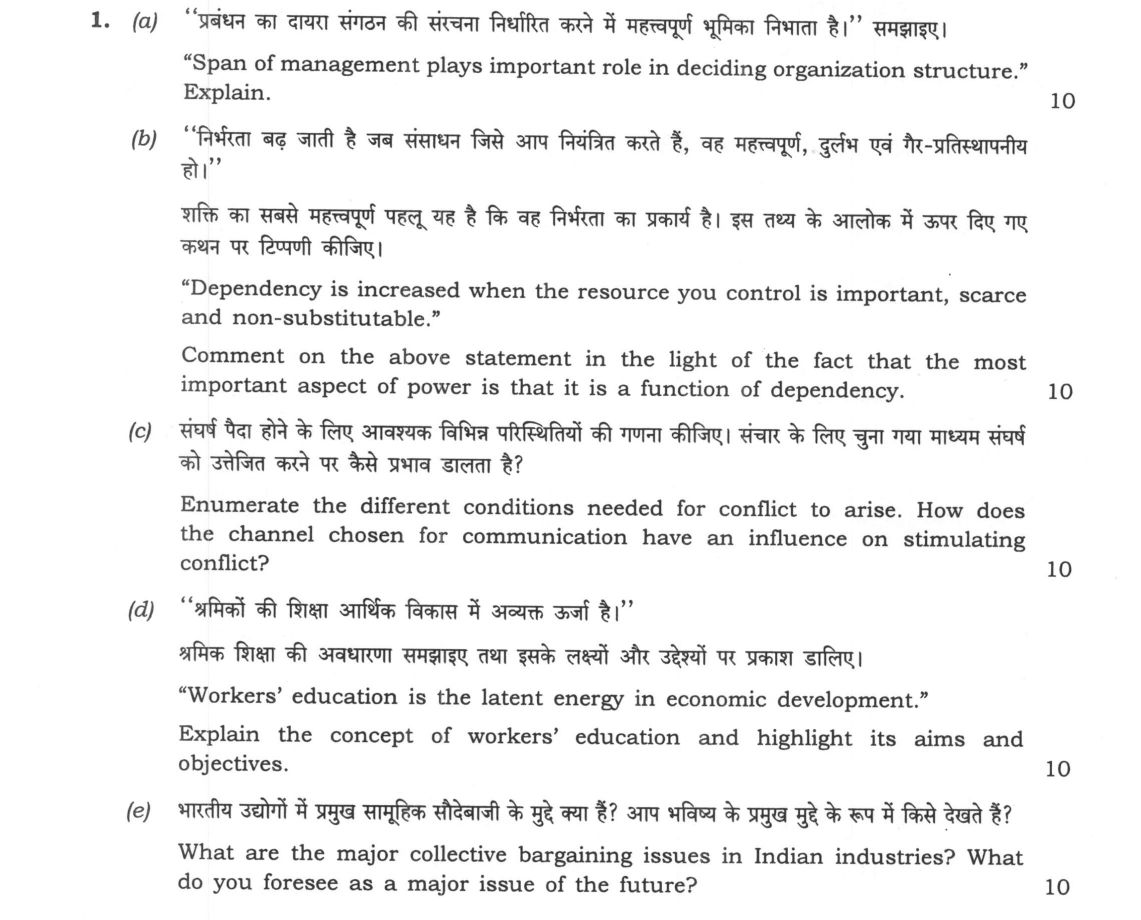
(a) "Span of management plays important role in deciding organization structure." Explain. (10 marks) (b) "Dependency is…
"Span of management plays important role in deciding organization structure." Explain. 10 marks
"Dependency is increased when the resource you control is important, scarce and non-substitutable." Comment on the above statement in the light of the fact that the most important aspect of power is that it is a function of dependency. 10 marks
Enumerate the different conditions needed for conflict to arise. How does the channel chosen for communication have an influence on stimulating conflict? 10 marks
"Workers' education is the latent energy in economic development." Explain the concept of workers' education and highlight its aims and objectives. 10 marks
What are the major collective bargaining issues in Indian industries? What do you foresee as a major issue of the future? 10 marks
हिंदी में प्रश्न पढ़ें
"प्रबंध का दायरा संगठन की संरचना निर्धारित करने में महत्वपूर्ण भूमिका निभाता है।" समझाइए। (10 अंक)
"निर्भरता बढ़ जाती है जब संसाधन जिसे आप नियंत्रित करते हैं, वह महत्वपूर्ण, दुर्लभ एवं गैर-प्रतिस्थापनीय हो।" शक्ति का सबसे महत्वपूर्ण पहलू यह है कि वह निर्भरता का प्रकार्य है। इस तथ्य के आलोक में उपर दिए गए कथन पर टिप्पणी कीजिए। (10 अंक)
संघर्ष पैदा होने के लिए आवश्यक विभिन्न परिस्थितियों की गणना कीजिए। संचार के लिए चुना गया माध्यम संघर्ष को उत्तेजित करने पर कैसे प्रभाव डालता है? (10 अंक)
"श्रमिकों की शिक्षा आर्थिक विकास में अव्यक्त ऊर्जा है।" श्रमिक शिक्षा की अवधारणा समझाइए तथा इसके लक्ष्यों और उद्देश्यों पर प्रकाश डालिए। (10 अंक)
भारतीय उद्योगों में प्रमुख सामूहिक सौदेबाजी के मुद्दे क्या हैं? आप भविष्य के प्रमुख मुद्दे के रूप में किसे देखते हैं? (10 अंक)
Model answer
Written by UPSC Answer Check against this question's marking rubric, to the expected length. UPSC does not publish answers for Mains — this is one way to score well, not an official key.
(a) Span of Management and Organizational Structure
The span of management, or span of control, refers to the number of subordinates who report directly to a given manager. It serves as a primary determinant of organizational architecture because it directly dictates the scalar chain's length, the number of hierarchical levels, and the administrative expense of supervision.
V. A. Graicunas mathematically demonstrated that an arithmetic increase in subordinates yields a geometric increase in managerial relationships. Using the formula R = n(2ⁿ⁻¹ + n - 1), where n represents the number of subordinates and R represents total direct single, direct group, and cross-relationships, Graicunas proved that managerial complexity escalates exponentially with wider spans.
The optimal span is governed by situational determinants, including the competence of superiors and subordinates, task complexity, degree of standardisation, and communication effectiveness. A narrow span produces a tall organizational structure characterised by multiple supervisory tiers, elongated scalar chains, higher administrative overhead, and potential distortion of upward and downward communication. Conversely, a wide span creates a flat organizational structure with fewer hierarchical layers, lower managerial costs, faster decision-making, and greater subordinate empowerment, though it risks managerial overload if tasks are non-routine.
(b) Power-Dependency Nexus and Resource Control
Power in organizational theory is fundamentally relational rather than absolute. Richard Emerson’s Power-Dependence Theory establishes that the power of Actor A over Actor B is equal to the dependency of Actor B upon Actor A (P_AB = D_BA). Dependency arises when one party relies on another for resources necessary to achieve goals.
Pfeffer and Salancik’s Resource Dependence Theory, complemented by Hickson’s Strategic Contingencies Theory, demonstrates that this dependency is magnified under three specific conditions:
Importance: A resource must be critical to the dependent actor's survival or operational performance. If an organizational subunit controls a resource central to core revenue generation or uncertainty reduction, other units become inherently reliant upon it.
Scarcity: If a resource is abundant, alternative supply routes nullify power. Power emerges when a resource is controlled by a limited number of actors, forcing dependent parties to accept unilateral terms.
Non-substitutability: When no viable functional alternatives exist to replace the resource, the dependent actor cannot bypass the controlling party.
When a resource satisfies all three criteria simultaneously, it creates an acute structural asymmetry. The actor monopolising this resource possesses significant organizational leverage, transforming resource control into exercised organizational power.
(c) Antecedents of Conflict and Communication Channels
According to Louis Pondy’s organizational conflict model, conflict manifests through distinct episodes originating from specific antecedent conditions. These conditions include: goal incompatibility, where functional departments pursue mutually conflicting ends; differentiation, where sub-units develop divergent cognitive orientations and values; task interdependence, particularly sequential or reciprocal interdependence where one unit’s performance depends on another; and shared resource scarcity, where departments compete for finite budgetary, technical, or human capital allocations.
Communication channels significantly influence the stimulation and escalation of conflict, a dynamic explained by Daft and Lengel’s Media Richness Theory. The utilization of lean communication channels (such as formal memoranda, circulars, or text-based electronic messages) for complex or ambiguous issues restricts non-verbal cues and immediate feedback. This lean transmission promotes misattribution, semantic distortion, and the escalation of perceived threats.
Furthermore, elongated hierarchical channels induce deliberate or unintentional filtering, gatekeeping, and information loss. Such informational asymmetry between vertical tiers or horizontal functional silos creates mistrust and misunderstanding, transforming latent structural friction into active, manifest conflict.
(d) Concept, Aims, and Objectives of Workers' Education
Workers' education refers to a systematic, continuous educational process designed to develop workers' civic, industrial, and socioeconomic consciousness. It extends beyond technical vocational training to encompass the institutional, legal, and operational dimensions of the industrial ecosystem. The concept is globally reinforced by ILO Convention 140 on Paid Educational Leave and recognised domestically under Section 15 of the Indian Trade Unions Act, 1926, which permits the expenditure of general trade union funds on educational provisions. In India, it is primarily operationalised through the Dattopant Thengadi National Board for Workers Education and Development (formerly CBWE).
The primary aims of workers' education are consciousness-raising regarding labour rights and duties, fostering democratic participation in enterprise governance, enhancing functional literacy, and nurturing disciplined, indigenous trade union leadership capable of constructive industrial relations.
Its specific objectives include: building capacity for informed collective bargaining; training worker representatives in the mechanics of productivity measurement and workplace occupational health and safety; instilling knowledge of labour legislation to resolve grievances through constitutional mechanisms; and fostering industrial democracy, thereby converting the latent energy of the workforce into sustained economic development.
(e) Collective Bargaining: Current Landscape and Emerging Horizons
Collective bargaining in Indian industries has traditionally revolved around distributive and statutory concerns. Key contemporary issues include:
Wage Revision and Allowances: Structuring Dearness Allowance (DA) linked to the All India Consumer Price Index (AICPI), basic pay adjustments, and performance-linked incentives.
Statutory Bonus and Profit-Sharing: Negotiations surrounding the calculation of allocable surplus beyond the statutory minimum under the Payment of Bonus Act, 1965.
Job Security and Restructuring: Bargaining over Voluntary Retirement Schemes (VRS), retrenchment compensation, and rationalisation of work norms.
Contract Labour Regularisation: Tensions regarding the wage parity of contract workers with permanent employees under the Contract Labour (Regulation and Abolition) Act, 1970, alongside demands for absorption into the regular workforce.
For the future, the primary collective bargaining issue will center on the formalisation, algorithmic governance, and social security of gig and platform workers. As standard employment contracts yield to platform-mediated, on-demand labor, traditional plant-level bargaining units become obsolete. Future bargaining will focus on algorithmic transparency (disputing arbitrary deactivation and automated performance metrics), guaranteed minimum earnings per task, cross-enterprise portable social security contributions under the Code on Social Security, 2020, and continuous reskilling funds to mitigate technological and Artificial Intelligence-induced displacement. Addressing these frontier issues will determine the future stability of India's industrial relations landscape.
What "Explain" is asking you to do
Make the working of something clear — what sets it off, what follows from what, and what it produces. Explain is the Commission's mechanism word: it dominates the technical papers and the “explain why” stems, where the marks sit in the causal chain and not in the label.
Structure that answers it
State what it is → the initiating condition → the chain of cause, step by step → an instance where it plays out → what the chain produces
Where marks are lost
Describing what something looks like instead of why it works that way. Naming the stages without linking them reads as description too.
How this answer will be evaluated
Approach
Framework: null. (a) explain: definition/context > points in order > small example > short close | (b) comment: context > arguments both sides > judgment > close | (c) enumerate: list the items in order > one line each > no commentary | (d) explain: definition/context > points in order > small example > short close | (e) discuss: intro > 3-4 dimensions > example > balanced close Full marks: Comprehensive, well-structured, with clear application and critical analysis.
Key points expected
- Define span of management
- Link span to number of management levels
- Distinguish tall vs flat structures
- Mention factors affecting span (e.g., complexity)
- Define power as a function of dependency
- Explain importance of the resource
- Explain scarcity of the resource
- Explain non-substitutability of the resource
Evaluation rubric
Each sub-part is marked on its own, against the marks and word limit printed on the paper.
- (a) Explain the link between span of management and organizational structure. 10 marks
explain— definition/context → points in order → small example → short close
Must cover
- Define span of management
- Link span to number of management levels
- Distinguish tall vs flat structures
- Mention factors affecting span (e.g., complexity)
Loses marks
- Confusing span of control with span of management
- No link to organizational structure
- Textbook definition without application
Earns more
- Reference to Fayol or Gulick
- Example of a specific industry structure
- Discussion of span in modern flat organizations
Extra mark
- Reference to a specific company's structure
- Mention of recent organizational changes
- (b) Comment on the relationship between dependency and power. 10 marks
comment— context → arguments both sides → judgment → close
Must cover
- Define power as a function of dependency
- Explain importance of the resource
- Explain scarcity of the resource
- Explain non-substitutability of the resource
Loses marks
- No link to dependency
- Vague discussion of power
- Ignoring the specific conditions (importance, scarcity, non-substitutability)
Earns more
- Reference to French and Raven's bases of power
- Example of a specific resource (e.g., technology)
- Discussion of power dynamics in a specific context
Extra mark
- Reference to a specific case study
- Mention of a recent regulatory change
- (c) Enumerate conditions for conflict and the influence of communication channels. 10 marks
enumerate— list the items in order → one line each → no commentary
Must cover
- List conditions for conflict (e.g., competition, incompatibility)
- Explain the role of communication channels
- Link channel choice to conflict stimulation
- Provide examples of different channels
Loses marks
- No enumeration of conditions
- No link to communication channels
- Vague discussion of conflict
Earns more
- Reference to a specific conflict model
- Example of a specific communication channel
- Discussion of the impact of channel on conflict resolution
Extra mark
- Reference to a specific case study
- Mention of a recent communication technology
- (d) Explain the concept of workers' education and its aims and objectives. 10 marks
explain— definition/context → points in order → small example → short close
Must cover
- Define workers' education
- Explain its role in economic development
- List aims of workers' education
- List objectives of workers' education
Loses marks
- No definition of workers' education
- No link to economic development
- Vague discussion of aims and objectives
Earns more
- Reference to a specific educational program
- Example of a specific industry
- Discussion of the impact of workers' education on productivity
Extra mark
- Reference to a specific government initiative
- Mention of a recent policy change
- (e) Discuss major collective bargaining issues in Indian industries and future issues. 10 marks
discuss— intro → 3-4 dimensions → example → balanced close
Must cover
- List major collective bargaining issues
- Explain the context of Indian industries
- Identify a major future issue
- Provide reasoning for the future issue
Loses marks
- No list of major issues
- No link to Indian industries
- No discussion of future issues
Earns more
- Reference to a specific industry
- Example of a specific collective bargaining agreement
- Discussion of the impact of globalization
Extra mark
- Reference to a specific case study
- Mention of a recent labor law change
Practice this exact question
Write your answer and it is marked point by point against the model answer above — what you covered, what you missed, what you got wrong.
Evaluate my answer →More from Management 2023 Paper I
- Q1 (a) "Span of management plays important role in deciding organization structure." Explain…
- Q2 (a) How do mission, vision and values help in developing good plan for an organization? E…
- Q3 (a) "A person can have thousands of attitudes but organizational behaviour focuses its at…
- Q4 (a) Highlight the key differences between human resource information system, human resour…