Paper I — Q5
(a) Discuss on the objectives and categories of decisions of the finance function in an organization. (10 marks) (b) Elaborate…
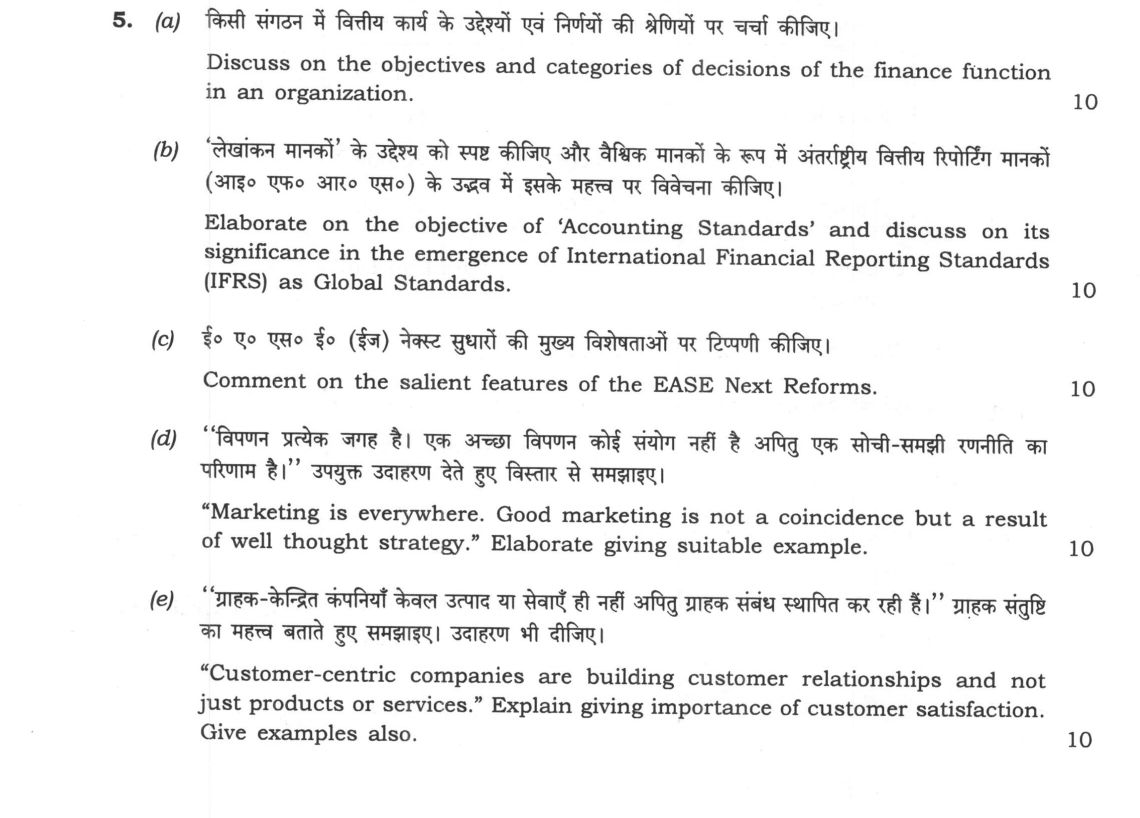
Discuss on the objectives and categories of decisions of the finance function in an organization. 10 marks
Elaborate on the objective of 'Accounting Standards' and discuss on its significance in the emergence of International Financial Reporting Standards (IFRS) as Global Standards. 10 marks
Comment on the salient features of the EASE Next Reforms. 10 marks
"Marketing is everywhere. Good marketing is not a coincidence but a result of well thought strategy." Elaborate giving suitable example. 10 marks
"Customer-centric companies are building customer relationships and not just products or services." Explain giving importance of customer satisfaction. Give examples also. 10 marks
हिंदी में प्रश्न पढ़ें
किसी संगठन में वित्तीय कार्य के उद्देश्यों एवं निर्णयों की श्रेणियों पर चर्चा कीजिए। (10 अंक)
'लेखांकन मानकों' के उद्देश्य को स्पष्ट कीजिए और वैश्विक मानकों के रूप में अंतर्राष्ट्रीय वित्तीय रिपोर्टिंग मानकों (आई० एफ० आर० एस०) के उद्भव में इसके महत्व पर विवेचना कीजिए। (10 अंक)
ई० ए० एस० ई० (ईज) नेक्स्ट सुधारों की मुख्य विशेषताओं पर टिप्पणी कीजिए। (10 अंक)
"विपणन प्रत्येक जगह है। एक अच्छा विपणन कोई संयोग नहीं है अपितु एक सोची-समझी रणनीति का परिणाम है।" उपयुक्त उदाहरण देते हुए विस्तार से समझाइए। (10 अंक)
"ग्राहक-केंद्रित कंपनियां केवल उत्पाद या सेवाएं ही नहीं अपितु ग्राहक संबंध स्थापित कर रही हैं।" ग्राहक संतुष्टि का महत्व बताते हुए समझाइए। उदाहरण भी दीजिए। (10 अंक)
Model answer
Written by UPSC Answer Check against this question's marking rubric, to the expected length. UPSC does not publish answers for Mains — this is one way to score well, not an official key.
Modern enterprise management relies on the continuous integration of finance, accounting integrity, institutional governance, and customer-centric marketing to create sustainable stakeholder value and maintain competitive advantage.
(a) Objectives and Categories of Decisions of the Finance Function
The finance function governs the procurement and optimal utilization of funds to achieve overarching corporate goals. Traditionally, financial management focused on short-term profit maximization. However, contemporary theory prioritizes shareholder wealth maximization, operationalized through maximizing the net present value (NPV) of future cash flows and market capitalization. Complementing this primary objective are operational goals: maintaining liquidity to honor financial commitments, minimizing the overall cost of capital, and balancing the fundamental risk-return trade-off, where higher expected returns necessitate prudent risk tolerance.
Decision-making in corporate finance spans four interdependent categories, categorized into strategic (long-term) and tactical (short-term) domains. Strategic decisions include Investment Decisions (capital budgeting), which determine capital allocation across fixed assets, R&D, and expansion projects based on discounted cash flow techniques, and Financing Decisions, which establish the optimal capital structure by balancing low-cost debt against equity dilution to lower the Weighted Average Cost of Capital (WACC). Dividend Decisions strategically allocate net earnings between shareholder distributions and retained earnings for internal growth. Conversely, Working Capital Decisions represent tactical and operational management, optimizing the trade-off between liquidity and profitability across cash, receivables, and inventory cycles.
(b) Objectives of Accounting Standards and the Emergence of IFRS
Accounting Standards establish standardized principles, bases, conventions, and rules for financial reporting. Their primary objective is to enhance the comparability, reliability, consistency, and transparency of financial statements across periods and entities. By enforcing uniform disclosure norms, they mitigate information asymmetry between corporate insiders and external stakeholders such as investors, creditors, and regulators, thereby curbing creative accounting practices and fostering capital market efficiency.
With the globalization of trade and cross-border capital flows, the divergence of national GAAP regimes imposed significant reconciliation costs and compliance burdens on multinational corporations. This propelled the emergence of International Financial Reporting Standards (IFRS), formulated by the International Accounting Standards Board (IASB), as the single global financial reporting language. IFRS adoption democratizes access to international capital markets, reduces the cost of foreign capital, and standardizes valuation methodologies.
In India, the Ministry of Corporate Affairs (MCA), in consultation with the Institute of Chartered Accountants of India (ICAI), steered the convergence towards IFRS by notifying the Indian Accounting Standards (Ind AS). Ind AS maintains high convergence with IFRS while incorporating select "carve-outs" and "carve-ins" to address domestic legal and economic realities. Despite transition hurdles, such as fair value volatility and complex IT infrastructure requirements, Ind AS has significantly enhanced the global credibility of Indian corporate balance sheets.
(c) Salient Features of the EASE Next Reforms
The Enhanced Access and Service Excellence (EASE) reforms agenda, spearheaded by the Ministry of Finance and the Indian Banks' Association (IBA), serves as a transformative blueprint for Public Sector Banks (PSBs). EASE Next, encompassing EASE 5.0 and beyond, transitions from foundational clean-up and recapitalization towards a comprehensive, multi-year strategic roadmap focused on digital innovation, customer-centricity, and operational resilience.
A salient feature of EASE Next is deep digital transformation, emphasizing end-to-end digital straight-through processing (STP) for retail and MSME lending, automated underwriting via account aggregators, and artificial intelligence-driven predictive credit monitoring to preempt non-performing assets (NPAs). Customer-centricity is operationalized through omni-channel banking, vernacular user interfaces, 24x7 digital service delivery, and modernized grievance redressal systems.
Furthermore, EASE Next embeds Environmental, Social, and Governance (ESG) frameworks into core credit appraisal processes, encouraging green financing aligned with national climate commitments. The reform matrix also emphasizes human capital transformation through specialized talent acquisition, dynamic performance management systems, and shared platform architectures among PSBs for common services, thereby driving scale efficiencies and restoring competitive parity with private sector peers.
(d) Strategic Marketing: Theory and Application
Marketing transcends ubiquitous promotional activities; it is a systematic, organizational process that designs, delivers, and communicates superior customer value. As conceptualized by Philip Kotler, sound marketing is not an accidental outcome of creative advertising, but the deliberate execution of an analytical process comprising research, Segmentation, Targeting, and Positioning (STP), translated through an integrated Marketing Mix (the 4Ps/7Ps).
A compelling Indian illustration of deliberate strategic marketing is Tata Tea’s 'Jaago Re' campaign. In the late 2000s, tea was a commoditized product competing primarily on functional attributes like taste, aroma, and price. Tata Tea undertook rigorous market analysis and identified an urban consumer base seeking meaningful engagement. Rather than executing conventional product-centric advertising, the brand repositioned tea from a mere physical wake-up stimulant to an instrument of social awakening.
The campaign linked the morning cup of tea to civic responsibility, anti-corruption, and voter awareness. This value proposition aligned with target consumers' socio-political aspirations, supported by distribution depth and accessible price points. By executing a strategy based on differentiated positioning rather than tactical promotions, Tata Tea achieved durable brand equity, market leadership, and sustainable margin growth.
(e) Customer-Centricity and Relationship Building
Traditional transaction-oriented marketing focuses primarily on closing single sales, often neglecting the customer post-purchase. In contrast, customer-centric organizations prioritize building long-term, mutually beneficial customer relationships. Recognizing that customer acquisition costs substantially exceed retention costs, customer-centricity shifts strategic focus toward maximizing Customer Lifetime Value (CLV) through trust, hyper-personalization, and proactive service recovery.
Customer satisfaction serves as the foundation of relationship marketing. Highly satisfied customers demonstrate lower price sensitivity, higher repeat purchase rates, and serve as organic brand advocates. Organizations systematically track satisfaction through structured metrics, including Net Promoter Score (NPS) to measure advocacy, Customer Satisfaction Score (CSAT) to gauge transactional touchpoints, and Customer Effort Score (CES) to assess ease of resolution.
In India, Amazon India exemplifies this philosophy through its "customer obsession" framework, which prioritizes seamless delivery logistics, localized interfaces, and immediate returns over short-term transaction profitability. Similarly, HDFC Bank leverages advanced CRM analytics and relationship banking architectures to anticipate retail client needs across life stages. By transforming transactional touchpoints into relationship-building opportunities, such organizations build enduring brand loyalty and sustainable competitive barriers.
Way Forward
To achieve long-term resilience and sustained value creation, Indian enterprises must holistically align these functional disciplines. Modern financial management, governed by transparent accounting standards and robust institutional banking support, provides the capital efficiency and governance framework necessary to fund market-oriented, customer-centric strategies in an increasingly competitive global economy.
What "Discuss" is asking you to do
Lay the issue out from more than one side — how it arose, what is claimed for it, what is held against it, and where it now stands. UPSC attaches discuss to broad topics with several live dimensions, so coverage of the dimensions earns more than the strength of your opinion.
Structure that answers it
Set the issue up → the case as it is made → the case against → the dimension both sides leave out → where the balance now lies
Where marks are lost
Listing facts with no thread between them, or arguing one side throughout and calling it a discussion.
How this answer will be evaluated
Approach
Framework: Finance Decision Categories (Investment, Financing, Dividend). (a) discuss: intro > 3-4 dimensions > example > balanced close | (b) discuss: intro > 3-4 dimensions > example > balanced close | (c) comment: context > arguments both sides > judgment > close | (d) explain: definition/context > points in order > small example > short close | (e) explain: definition/context > points in order > small example > short close Full marks: Comprehensive coverage of all points with specific examples and frameworks.
Key points expected
- State primary objective (wealth maximization)
- Identify Investment decisions
- Identify Financing decisions
- Identify Dividend decisions
- Define objective of Accounting Standards (comparability)
- Explain emergence of IFRS
- Discuss IFRS as global standards
- Highlight significance of standardization
Evaluation rubric
Each sub-part is marked on its own, against the marks and word limit printed on the paper.
- (a) Objectives and categories of finance function decisions. 10 marks
discuss— intro → 3-4 dimensions → example → balanced close
Must cover
- State primary objective (wealth maximization)
- Identify Investment decisions
- Identify Financing decisions
- Identify Dividend decisions
Loses marks
- Confusing finance with accounting
- Listing decisions without explaining their purpose
Earns more
- Mention Working Capital management
- Link decisions to organizational goals
Extra mark
- Reference specific financial models (NPV, WACC)
- (b) Objectives of Accounting Standards and significance of IFRS. 10 marks
discuss— intro → 3-4 dimensions → example → balanced close
Must cover
- Define objective of Accounting Standards (comparability)
- Explain emergence of IFRS
- Discuss IFRS as global standards
- Highlight significance of standardization
Loses marks
- Focusing only on bookkeeping rules
- Ignoring the 'global' aspect of IFRS
Earns more
- Mention IASB role
- Reference specific standards (e.g., IAS 1)
Extra mark
- Mention specific country adoption (e.g., India's Ind AS)
- (c) Salient features of EASE Next Reforms. 10 marks
comment— context → arguments both sides → judgment → close
Must cover
- Identify EASE Next (Ease of Doing Business)
- List key features (e.g., single window)
- Mention impact on MSMEs
- Provide a judgment on the reforms
Loses marks
- Confusing with general economic policy
- Listing features without context
Earns more
- Reference specific ministry (MSME Ministry)
- Mention specific reforms (e.g., credit guarantee)
Extra mark
- Cite specific year of launch (2020)
- (d) Elaborate on marketing strategy with a suitable example. 10 marks
explain— definition/context → points in order → small example → short close
Must cover
- Define marketing strategy
- Explain 'well thought strategy' components
- Provide a suitable example
- Link strategy to market success
Loses marks
- Generic definition without example
- Example not linked to strategy
Earns more
- Use a real company example (e.g., Apple, Nike)
- Mention specific marketing mix elements
Extra mark
- Reference a specific marketing framework (4Ps, STP)
- (e) Explain customer-centricity and importance of satisfaction. 10 marks
explain— definition/context → points in order → small example → short close
Must cover
- Define customer-centric companies
- Explain building relationships
- State importance of customer satisfaction
- Provide examples
Loses marks
- Focusing only on product features
- Ignoring the 'relationship' aspect
Earns more
- Mention Customer Lifetime Value (CLV)
- Reference specific customer service strategies
Extra mark
- Cite a specific customer satisfaction metric (NPS)
Practice this exact question
Write your answer and it is marked point by point against the model answer above — what you covered, what you missed, what you got wrong.
Evaluate my answer →More from Management 2023 Paper I
- Q2 (a) How do mission, vision and values help in developing good plan for an organization? E…
- Q3 (a) "A person can have thousands of attitudes but organizational behaviour focuses its at…
- Q4 (a) Highlight the key differences between human resource information system, human resour…
- Q5 (a) Discuss on the objectives and categories of decisions of the finance function in an o…
- Q6 (a) Given below is the data of two firms in the same industry: | Particulars | Firm A (₹)…
- Q7 (a) A Ltd's EBIT is ₹ 10,00,000. The company has 12%, ₹ 30 lakhs debentures. The equity c…
- Q8 (a) During a month, 4500 units were introduced into process A. The normal loss was estima…