Paper I — Q6
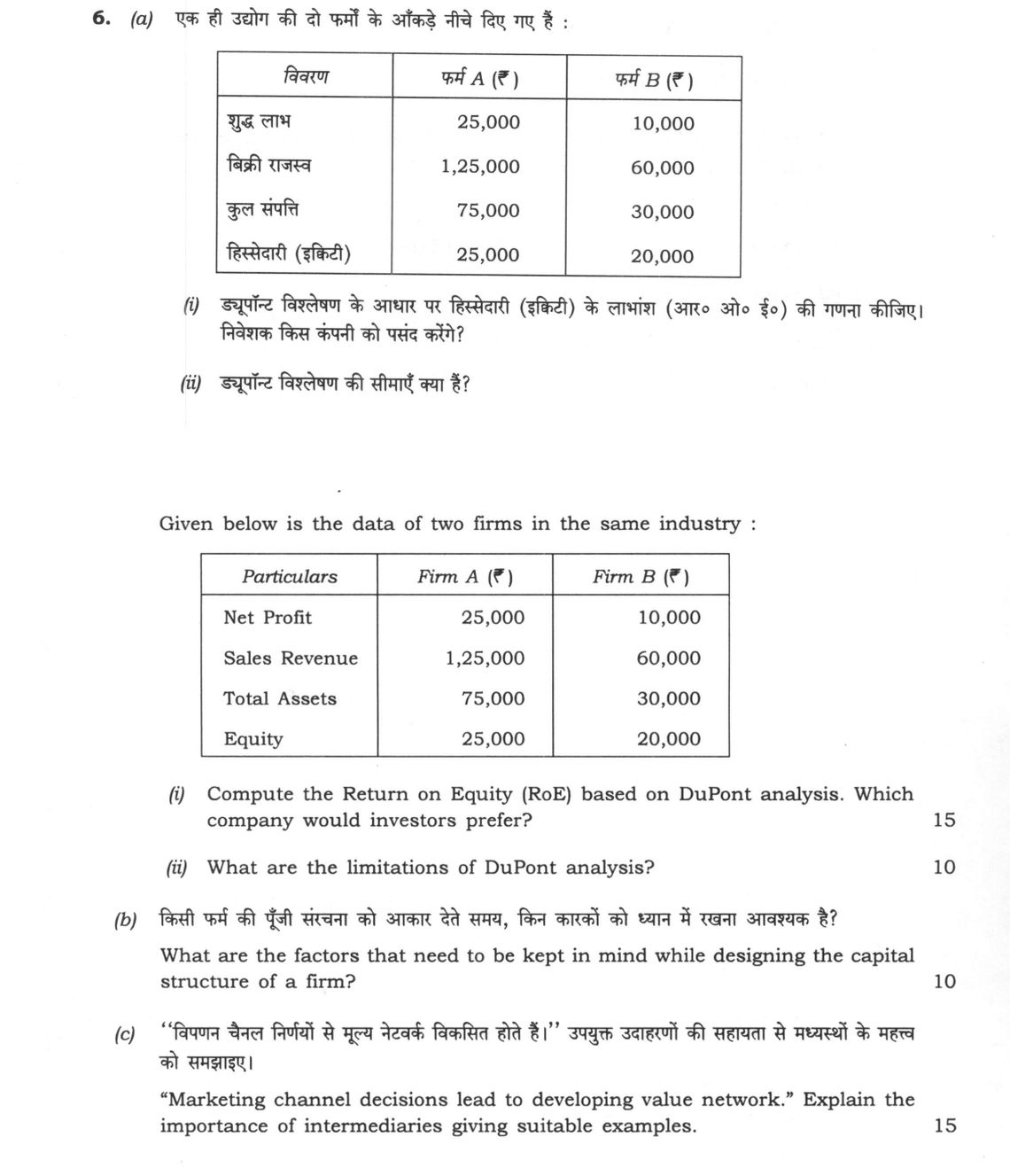
(a) Given below is the data of two firms in the same industry: | Particulars | Firm A (₹) | Firm B (₹)…
Given below is the data of two firms in the same industry:
| Particulars | Firm A (₹) | Firm B (₹) |
|---|---|---|
| Net Profit | 25,000 | 10,000 |
| Sales Revenue | 1,25,000 | 60,000 |
| Total Assets | 75,000 | 30,000 |
| Equity | 25,000 | 20,000 |
Compute the Return on Equity (RoE) based on DuPont analysis. Which company would investors prefer? 15 marks
What are the limitations of DuPont analysis? 10 marks
What are the factors that need to be kept in mind while designing the capital structure of a firm? 10 marks
"Marketing channel decisions lead to developing value network." Explain the importance of intermediaries giving suitable examples. 15 marks
हिंदी में प्रश्न पढ़ें
एक ही उद्योग की दो फर्मों के आंकड़े नीचे दिए गए हैं:
| विवरण | फर्म A (₹) | फर्म B (₹) |
|---|---|---|
| शुद्ध लाभ | 25,000 | 10,000 |
| बिक्री राजस्व | 1,25,000 | 60,000 |
| कुल संपत्ति | 75,000 | 30,000 |
| हिस्सेदारी (इक्विटी) | 25,000 | 20,000 |
ड्यूपॉन्ट विश्लेषण के आधार पर हिस्सेदारी (इक्विटी) के लाभांश (आर० ओ० ई०) की गणना कीजिए। निवेशक किस कंपनी को पसंद करेंगे? (15 अंक)
ड्यूपॉन्ट विश्लेषण की सीमाएं क्या हैं? (10 अंक)
किसी फर्म की पूँजी संरचना को आकार देते समय, किन कारकों को ध्यान में रखना आवश्यक है? (10 अंक)
"विपणन चैनल निर्णयों से मूल्य नेटवर्क विकसित होते हैं।" उपयुक्त उदाहरणों की सहायता से मध्यस्थों के महत्व को समझाइए। (15 अंक)
The figure this question refers to, in words
The question paper is a scan and the diagram did not survive as text. This is the figure as read from the original page — every component, value and label — so the question can be worked from the text below.
(a) Table with 3 columns and 5 rows: Particulars | Firm A (₹) | Firm B (₹) Net Profit | 25,000 | 10,000 Sales Revenue | 1,25,000 | 60,000 Total Assets | 75,000 | 30,000 Equity | 25,000 | 20,000
Model answer
Written by UPSC Answer Check against this question's marking rubric, to the expected length. UPSC does not publish answers for Mains — this is one way to score well, not an official key.
(a)(i) Using the DuPont identity: RoE = Net Profit Margin × Total Asset Turnover × Equity Multiplier = (Net Profit/Sales Revenue) × (Sales Revenue/Total Assets) × (Total Assets/Equity). This three-factor form is used because the data do not give EBIT, interest, or tax. It requires positive equity and accounting figures.
Firm A
- Net Profit Margin = ₹25,000/₹1,25,000 = 1/5 = 20%.
- Total Asset Turnover = ₹1,25,000/₹75,000 = 5/3 ≈ 1.67 times.
- Equity Multiplier = ₹75,000/₹25,000 = 3 times.
- RoE = (1/5) × (5/3) × 3 = 1 = 100%.
- Check: ₹25,000/₹25,000 = 100%.
Firm B
- Net Profit Margin = ₹10,000/₹60,000 = 1/6 ≈ 16.67%.
- Total Asset Turnover = ₹60,000/₹30,000 = 2 times.
- Equity Multiplier = ₹30,000/₹20,000 = 3/2 = 1.5 times.
- RoE = (1/6) × 2 × (3/2) = 1/2 = 50%.
- Check: ₹10,000/₹20,000 = 50%.
Investors would prefer Firm A on a pure return basis because its RoE is 100% against Firm B’s 50%. But DuPont shows that both firms have the same Return on Assets: A = ₹25,000/₹75,000 = 1/3 ≈ 33.33%; B = ₹10,000/₹30,000 = 1/3 ≈ 33.33%. A’s higher margin (20% vs 16.67%) is exactly offset by B’s better asset turnover (2 times vs 1.67 times), so their ROA is equal. Therefore A’s higher RoE is entirely leverage-driven (equity multiplier 3 vs 1.5). A risk-averse investor may prefer B despite lower RoE. Condition: positive equity; DuPont is an accounting identity, not a risk-adjusted market measure.
(a)(ii) Limitations of DuPont analysis:
- Uses historical accounting data, distorted by accounting policies, depreciation, inventory valuation, and one-off items.
- High RoE from a high equity multiplier may reflect financial risk, not superior performance.
- Ignores cost of capital; does not show whether return exceeds WACC or creates economic value.
- Ignores cash flow quality, liquidity, working capital, and off-balance-sheet liabilities.
- Single-period snapshot; unreliable for cyclical, seasonal, start-up, or negative-equity firms.
- Comparability problems across firms due to different accounting methods, asset ages, and capital structures.
- Not causal: shows drivers but not why they changed or whether sustainable.
- Narrow shareholder focus; ignores customers, employees, ESG, innovation, and market share.
- Window dressing and creative accounting can inflate ratios.
- Three-step form hides interest burden and tax burden, which five-step DuPont captures.
(b) Factors to be kept in mind while designing capital structure:
- Cost of capital: choose mix that minimises weighted average cost of capital; compare after-tax debt cost with equity cost.
- Risk: balance business risk and financial risk; stable cash flows support more debt, cyclical firms need less.
- Tax shield: interest is tax-deductible, so tax rate and non-debt tax shields matter.
- Control and dilution: equity dilutes ownership; debt avoids dilution but brings fixed obligations and covenants.
- Flexibility: preserve unused debt capacity for future investment and avoid restrictive covenants.
- Cash flow coverage: interest coverage, debt-service coverage, liquidity, and maturity matching must be adequate.
- Asset structure: tangible assets can collateralise debt; intangible-heavy firms rely more on equity.
- Market conditions: interest rates, credit availability, investor sentiment, and issue costs.
- Firm characteristics: size, age, growth, life-cycle stage, profitability, ownership pattern, and dividend policy.
- Regulatory and industry norms, signalling effects, pecking order, and lender conditions.
(c) Marketing channel decisions lead to developing a value network because a firm does not merely select distributors; it designs a system of interdependent partners who co-create value. Intermediaries bridge gaps of time, place, possession, information, and assortment.
Importance of intermediaries:
- Specialisation: producers focus on manufacturing while intermediaries handle distribution. HUL reaches millions of kirana stores through wholesalers and distributors.
- Reduced transactions: a wholesaler links many producers to many retailers, lowering contact and search costs.
- Assortment and breaking bulk: wholesalers and retailers break bulk and offer variety. Big Bazaar, Reliance Retail, and Amazon perform this role.
- Logistics and cold chain: warehouses, transport, and inventory management add place and time utility. Coca-Cola bottlers and Amul’s cold chain are examples.
- Market information: retailers provide demand feedback for forecasting and new launches. P&G uses retailer sales data.
- Risk bearing and finance: intermediaries take title, bear inventory risk, and extend credit.
- Promotion and service: shelf display, sales force, installation, and after-sales service. Samsung displays in Croma; car dealers provide service.
- Value network: partners integrate digitally with suppliers, channel members, and customers. Amazon, Flipkart, Zomato, Swiggy, and Uber are examples.
- Channel governance: aligning incentives reduces conflict, improves coverage, and enhances customer experience.
Thus intermediaries add utility and turn channel decisions into a collaborative value network that delivers superior customer value.
What "Calculate" is asking you to do
Apply the standard formula or schedule to data the question has already supplied — a table of readings, cost records, a balance sheet — and produce the number. The method is rarely in doubt; the marks sit in the named intermediate quantities, each of which has to appear as a labelled line.
Structure that answers it
Data as given → formula or standard treatment, named → substitution → each intermediate, labelled → result with units
Where marks are lost
Omitting an intermediate the marking scheme pays for separately, or rounding at an intermediate line so the final figure drifts. In commerce and accountancy, any figure in a statement that no numbered working note supports is treated as unearned.
How this answer will be evaluated
Approach
Framework: DuPont Analysis. (a(i)) calculate: given > formula > substitution > result with units > interpretation | (a(ii)) highlight: name the salient points > one line of substance each > close | (b) highlight: name the salient points > one line of substance each > close | (c) explain: definition/context > points in order > small example > short close Full marks: Accurate calculations with clear DuPont breakdown; comprehensive list of limitations; well-structured factors for capital structure; clear explanation of intermediaries with strong examples.
Key points expected
- Calculate Net Profit Margin (NPM) for both firms
- Calculate Total Asset Turnover (TAT) for both firms
- Calculate Equity Multiplier (EM) for both firms
- Derive RoE and provide a comparative verdict
- Mention that it ignores the time value of money
- Notes that it relies on accounting data (not market values)
- States that it is a static snapshot, not a dynamic tool
- Mention the cost of capital (WACC minimization)
Evaluation rubric
Each sub-part is marked on its own, against the marks and word limit printed on the paper.
- (a(i)) Compute RoE for both firms using DuPont components and state investor preference. 15 marks
calculate— given → formula → substitution → result with units → interpretation
Must cover
- Calculate Net Profit Margin (NPM) for both firms
- Calculate Total Asset Turnover (TAT) for both firms
- Calculate Equity Multiplier (EM) for both firms
- Derive RoE and provide a comparative verdict
Loses marks
- Calculates only the final RoE without showing components
- Fails to provide a comparative judgment between firms
Earns more
- Explicitly labels the three DuPont components
- Correctly identifies Firm A as the preferred investment
- Shows the multiplication of components to reach RoE
Extra mark
- Provides a brief interpretation of why Firm A is superior
- (a(ii)) List the specific limitations of the DuPont analysis framework. 10 marks
highlight— name the salient points → one line of substance each → close
Must cover
- Mention that it ignores the time value of money
- Notes that it relies on accounting data (not market values)
- States that it is a static snapshot, not a dynamic tool
Loses marks
- Provides generic limitations of financial ratios instead of DuPont-specific ones
- Fails to mention the reliance on accounting data
Earns more
- Mentions that it does not account for risk or volatility
- Notes that it can be manipulated by accounting policies
Extra mark
- Suggests a complementary tool like EVA or ROIC
- (b) Identify the key factors to consider when designing a firm's capital structure. 10 marks
highlight— name the salient points → one line of substance each → close
Must cover
- Mention the cost of capital (WACC minimization)
- Mention the degree of financial risk/leverage
- Mention the tax benefits of debt (shielding)
Loses marks
- Confuses capital structure with capital budgeting
- Lists only sources of funds without considering the 'design' factors
Earns more
- Mention the impact on control/ownership dilution
- Mention the stability of earnings (operating leverage)
Extra mark
- References a specific theory like Modigliani-Miller or Trade-off theory
- (c) Explain the importance of intermediaries in developing a value network with examples. 15 marks
explain— definition/context → points in order → small example → short close
Must cover
- Defines the role of intermediaries in the value network
- Explains how they reduce transaction costs or increase efficiency
- Provides a suitable example of an intermediary (e.g., wholesaler, retailer)
Loses marks
- Focuses only on the definition of marketing channels without explaining 'importance'
- Fails to provide any concrete examples
Earns more
- Discusses the concept of 'value added' by intermediaries
- Mention specific functions like storage, financing, or risk bearing
Extra mark
- References a specific modern example like Amazon or Flipkart
Practice this exact question
Write your answer and it is marked point by point against the model answer above — what you covered, what you missed, what you got wrong.
Evaluate my answer →More from Management 2023 Paper I
- Q3 (a) "A person can have thousands of attitudes but organizational behaviour focuses its at…
- Q4 (a) Highlight the key differences between human resource information system, human resour…
- Q5 (a) Discuss on the objectives and categories of decisions of the finance function in an o…
- Q6 (a) Given below is the data of two firms in the same industry: | Particulars | Firm A (₹)…
- Q7 (a) A Ltd's EBIT is ₹ 10,00,000. The company has 12%, ₹ 30 lakhs debentures. The equity c…
- Q8 (a) During a month, 4500 units were introduced into process A. The normal loss was estima…