Paper I — Q3
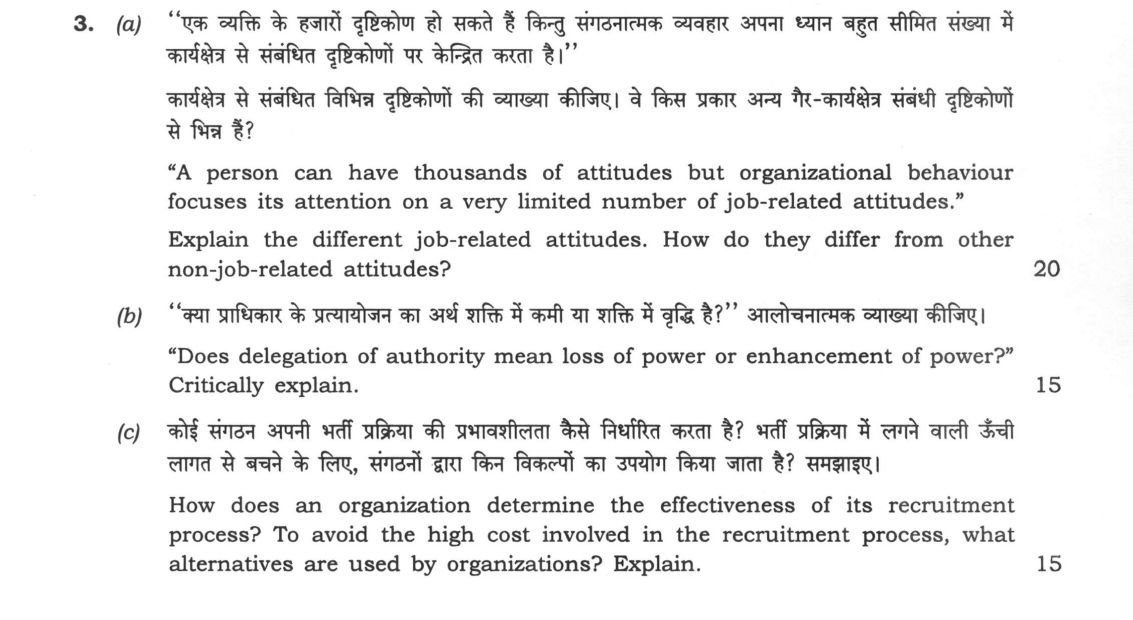
(a) "A person can have thousands of attitudes but organizational behaviour focuses its attention on a very limited number of…
"A person can have thousands of attitudes but organizational behaviour focuses its attention on a very limited number of job-related attitudes." Explain the different job-related attitudes. How do they differ from other non-job-related attitudes? 20 marks
"Does delegation of authority mean loss of power or enhancement of power?" Critically explain. 15 marks
How does an organization determine the effectiveness of its recruitment process? To avoid the high cost involved in the recruitment process, what alternatives are used by organizations? Explain. 15 marks
हिंदी में प्रश्न पढ़ें
"एक व्यक्ति के हजारों दृष्टिकोण हो सकते हैं किन्तु संगठनात्मक व्यवहार अपना ध्यान बहुत सीमित संख्या में कार्यक्षेत्र से संबंधित दृष्टिकोणों पर केंद्रित करता है।" कार्यक्षेत्र से संबंधित विभिन्न दृष्टिकोणों की व्याख्या कीजिए। वे किस प्रकार अन्य गैर-कार्यक्षेत्र संबंधी दृष्टिकोणों से भिन्न हैं? (20 अंक)
"क्या प्राधिकार के प्रत्यायोजन का अर्थ शक्ति में कमी या शक्ति में वृद्धि है?" आलोचनात्मक व्याख्या कीजिए। (15 अंक)
कोई संगठन अपनी भर्ती प्रक्रिया की प्रभावशीलता कैसे निर्धारित करता है? भर्ती प्रक्रिया में लगने वाली ऊँची लागत से बचने के लिए, संगठनों द्वारा किन विकल्पों का उपयोग किया जाता है? समझाइए। (15 अंक)
Model answer
Written by UPSC Answer Check against this question's marking rubric, to the expected length. UPSC does not publish answers for Mains — this is one way to score well, not an official key.
Job-Related Attitudes and Non-Job Attitudes
Attitudes are evaluative statements—either favorable or unfavorable—concerning objects, people, or events. In the Robbins and Judge framework, attitudes comprise a three-component model: cognitive (belief/evaluation), affective (feeling/emotion), and behavioral (intention to act). While an individual harbors thousands of general attitudes, organizational behavior isolates job-related attitudes due to their direct causal impact on workplace behaviors.
Fred Luthans and organizational theorists primarily emphasize three central job-related attitudes. First, Job Satisfaction represents a pleasurable or positive emotional state resulting from the appraisal of one’s job experiences. Second, Organizational Commitment reflects an employee’s identification with particular organizational goals and desire to maintain membership, spanning affective (emotional attachment), continuance (economic necessity), and normative (moral obligation) dimensions. Third, Employee Engagement captures an individual's complete cognitive, emotional, and physical immersion and enthusiasm for work.
Job-related attitudes differ fundamentally from non-job-related attitudes (such as political ideologies, religious beliefs, or social stances) across three criteria: Specificity and Target: Job attitudes target immediate work facets—supervision, pay, task variety, and peer relations—whereas non-job attitudes target broad societal, moral, or philosophical domains. Measurability and Controllability: Job attitudes are systematically quantifiable through psychometric instruments like the Job Descriptive Index (JDI) or Minnesota Satisfaction Questionnaire (MSQ) and can be modified through HR interventions, whereas non-job attitudes remain external to managerial control. Behavioral Impact: Job attitudes exhibit strong predictive validity for core workplace outcomes like organizational citizenship behavior (OCB), absenteeism, turnover, and counterproductive work behavior (CWB), whereas non-job attitudes rarely correlate directly with task performance.
Delegation of Authority: Loss or Enhancement of Power
Delegation is the downward transfer of formal authority and responsibility from a manager to a subordinate. While classical views perceive power as a zero-sum resource where delegation signifies a loss of control, contemporary organizational theory views delegation as a non-zero-sum power multiplier.
Analyzed through French and Raven’s bases of power, delegation involves relinquishing a portion of formal legitimate power over routine decisions. However, this redistribution substantially enhances the delegator’s expert power and referent power. By entrusting autonomy, managers foster high-trust relationships, elicit reciprocal commitment, and gain time to focus on strategic initiatives.
Chester Barnard’s Acceptance Theory of Authority affirms that true authority resides in the subordinate's willingness to accept communication; delegation broadens the subordinate's "zone of indifference," translating into unforced compliance. As Peter Drucker highlighted in The Effective Executive, delegation generates a multiplier effect: executives multiply their capacity through others rather than remaining operational bottlenecks. For instance, the Tata Group's institutionalized leadership grooming (such as the Tata Administrative Services) relies on decentralizing operational authority to business unit leaders, thereby enhancing the overarching strategic agility and referent power of top leadership. Delegation, therefore, trades low-level operational control for elevated organizational influence.
Recruitment Effectiveness and Cost-Effective Alternatives
An organization determines the effectiveness of its recruitment process using quantifiable metrics analyzed via cost-benefit frameworks. Key indices include: Yield Ratio: The percentage of applicants progressing from one stage of the selection pipeline to the next, indicating source quality. Cost-per-Hire: Total recruitment costs (advertising, agency fees, recruiter salaries) divided by the number of hires. Time-to-Fill: The total days elapsed between job requisition and candidate acceptance. Quality-of-Hire: Evaluated post-onboarding through performance appraisal scores, cultural assimilation, and first-year retention rates.
To circumvent the prohibitive costs and disruptions of external recruitment, organizations leverage several alternatives: Internal Mobility and Succession Planning: Utilizing Internal Job Postings (IJPs)—such as Infosys’s internal talent marketplace—and succession planning retains tacit institutional knowledge, eliminates agency fees, and accelerates onboarding. Job Rotation and Enrichment: Repurposing existing employees into cross-functional roles builds operational agility without expanding headcount. Employee Referral Programs: Leveraging internal social capital produces higher candidate quality, faster fill times, and lower attrition at minimal cost. Campus Partnerships: Initiatives like TCS’s Campus Connect institutionalize direct industry-academia pipelines, lowering per-candidate sourcing costs through economies of scale. Contingent Staffing and Outsourcing: Deploying temp-to-perm contracts and Recruitment Process Outsourcing (RPO) cushions against demand volatility without incurring long-term overheads.
Ultimately, organizational effectiveness depends on aligning cost-efficient recruitment pipelines with high-autonomy delegation structures, which collectively cultivate the positive job attitudes essential for sustained performance.
What "Explain" is asking you to do
Make the working of something clear — what sets it off, what follows from what, and what it produces. Explain is the Commission's mechanism word: it dominates the technical papers and the “explain why” stems, where the marks sit in the causal chain and not in the label.
Structure that answers it
State what it is → the initiating condition → the chain of cause, step by step → an instance where it plays out → what the chain produces
Where marks are lost
Describing what something looks like instead of why it works that way. Naming the stages without linking them reads as description too.
How this answer will be evaluated
Approach
Framework: Job-Related Attitudes (Job Satisfaction, Organizational Commitment, Job Involvement, Perceived Organizational Support, Employee Turnover Intention). (a) explain: definition/context > points in order > small example > short close | (b) critically evaluate: positives > negatives/limits > conditions/safeguards > conclusion | (c) explain: definition/context > points in order > small example > short close Full marks: Comprehensive, well-structured, uses named frameworks, provides concrete examples, and offers a balanced critical judgment.
Key points expected
- Define job-related attitudes (satisfaction, commitment, involvement, etc.)
- Define non-job-related attitudes (e.g., political, religious)
- Explain the specific focus of Organizational Behavior (OB)
- Provide a clear distinction between the two categories
- Define delegation of authority
- Analyze the 'loss of power' argument (loss of control)
- Analyze the 'enhancement of power' argument (leverage, focus)
- Provide a balanced judgment on the net effect
Evaluation rubric
Each sub-part is marked on its own, against the marks and word limit printed on the paper.
- (a) Define and distinguish job-related attitudes from non-job-related attitudes. 20 marks
explain— definition/context → points in order → small example → short close
Must cover
- Define job-related attitudes (satisfaction, commitment, involvement, etc.)
- Define non-job-related attitudes (e.g., political, religious)
- Explain the specific focus of Organizational Behavior (OB)
- Provide a clear distinction between the two categories
Loses marks
- Confusing attitudes with behaviors or perceptions
- Failing to distinguish job-related from non-job-related
- Providing only definitions without explanation
Earns more
- Mention specific dimensions of job satisfaction (pay, promotion, supervision)
- Reference specific commitment types (affective, continuance, normative)
- Use a concrete example of a job-related attitude in action
Extra mark
- Cite a specific study or model (e.g., Meyer & Allen's commitment model)
- Reference a specific regulatory change affecting job satisfaction
- (b) Critically analyze whether delegation of authority is a loss or enhancement of power. 15 marks
critically evaluate— positives → negatives/limits → conditions/safeguards → conclusion
Must cover
- Define delegation of authority
- Analyze the 'loss of power' argument (loss of control)
- Analyze the 'enhancement of power' argument (leverage, focus)
- Provide a balanced judgment on the net effect
Loses marks
- Treating delegation as a simple transfer of power
- Ignoring the concept of accountability
- Failing to provide a critical judgment
Earns more
- Discuss the difference between delegation and abdication
- Mention the role of accountability in delegation
- Reference a specific management theory (e.g., Fiedler's Contingency Theory)
Extra mark
- Cite a specific case study of successful/failed delegation
- Reference a specific legal or regulatory framework on delegation
- (c) Explain how to determine recruitment effectiveness and cost-saving alternatives. 15 marks
explain— definition/context → points in order → small example → short close
Must cover
- Define recruitment effectiveness (quality, cost, time)
- Explain methods to measure effectiveness (e.g., cost-per-hire, time-to-fill)
- List alternatives to reduce recruitment costs (e.g., internal hiring, referrals)
- Explain how these alternatives work
Loses marks
- Confusing recruitment with selection
- Failing to provide specific metrics for effectiveness
- Listing alternatives without explaining how they save cost
Earns more
- Mention specific metrics (e.g., offer acceptance rate, retention rate)
- Discuss the pros and cons of internal vs. external recruitment
- Reference a specific technology used for cost reduction (e.g., AI in screening)
Extra mark
- Cite a specific statistic on recruitment costs
- Reference a specific company's recruitment strategy
Practice this exact question
Write your answer and it is marked point by point against the model answer above — what you covered, what you missed, what you got wrong.
Evaluate my answer →More from Management 2023 Paper I
- Q1 (a) "Span of management plays important role in deciding organization structure." Explain…
- Q2 (a) How do mission, vision and values help in developing good plan for an organization? E…
- Q3 (a) "A person can have thousands of attitudes but organizational behaviour focuses its at…
- Q4 (a) Highlight the key differences between human resource information system, human resour…
- Q5 (a) Discuss on the objectives and categories of decisions of the finance function in an o…
- Q6 (a) Given below is the data of two firms in the same industry: | Particulars | Firm A (₹)…