Paper I — Q8
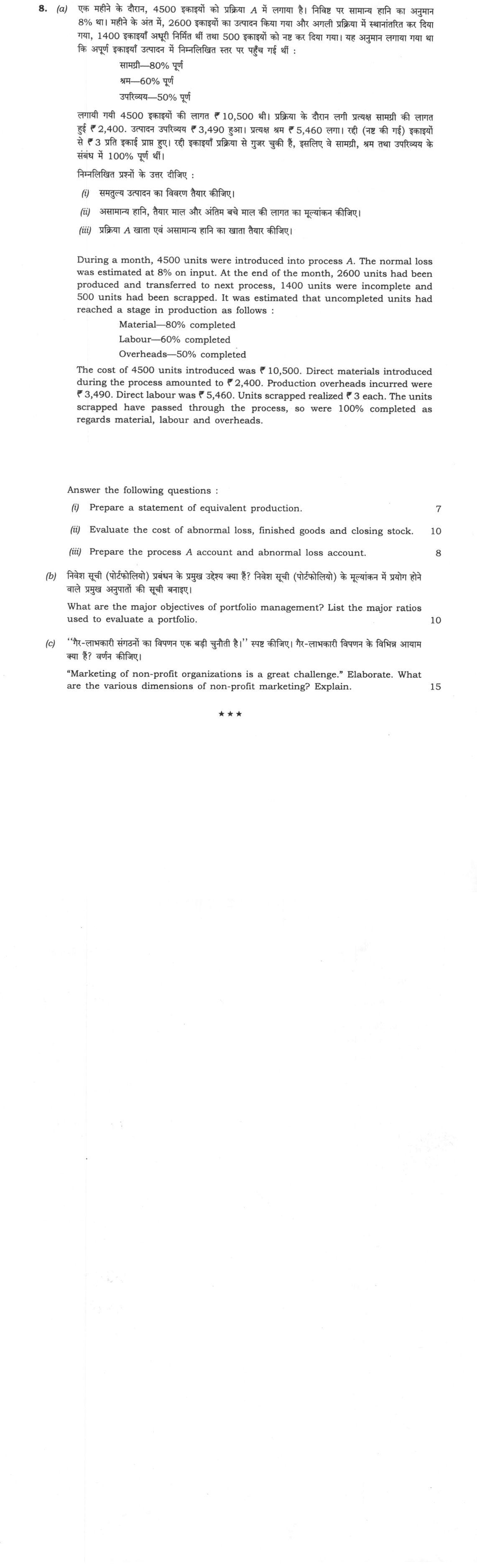
(a) During a month, 4500 units were introduced into process A. The normal loss was estimated at 8% on input. At the end of the…
During a month, 4500 units were introduced into process A. The normal loss was estimated at 8% on input. At the end of the month, 2600 units had been produced and transferred to next process, 1400 units were incomplete and 500 units had been scrapped. It was estimated that uncompleted units had reached a stage in production as follows:
Material—80% completed Labour—60% completed Overheads—50% completed
The cost of 4500 units introduced was ₹ 10,500. Direct materials introduced during the process amounted to ₹ 2,400. Production overheads incurred were ₹ 3,490. Direct labour was ₹ 5,460. Units scrapped realized ₹ 3 each. The units scrapped have passed through the process, so were 100% completed as regards material, labour and overheads.
Answer the following questions:
Prepare a statement of equivalent production. 7 marks
Evaluate the cost of abnormal loss, finished goods and closing stock. 10 marks
Prepare the process A account and abnormal loss account. 8 marks
What are the major objectives of portfolio management? List the major ratios used to evaluate a portfolio. 10 marks
"Marketing of non-profit organizations is a great challenge." Elaborate. What are the various dimensions of non-profit marketing? Explain. 15 marks
हिंदी में प्रश्न पढ़ें
एक महीने के दौरान, 4500 इकाइयों को प्रक्रिया A में लगाया है। निवेश पर सामान्य हानि का अनुमान 8% था। महीने के अंत में, 2600 इकाइयों का उत्पादन किया गया और अगली प्रक्रिया में स्थानांतरित कर दिया गया, 1400 इकाइयाँ अधूरी निर्मित थीं तथा 500 इकाइयों को नष्ट कर दिया गया। यह अनुमान लगाया गया था कि अपूर्ण इकाइयाँ उत्पादन में निम्नलिखित स्तर पर पहुँच गई थीं:
सामग्री—80% पूर्ण श्रम—60% पूर्ण उपरिव्यय—50% पूर्ण
लगाई गई 4500 इकाइयों की लागत ₹ 10,500 थी। प्रक्रिया के दौरान लगी प्रत्यक्ष सामग्री की लागत हुई ₹ 2,400। उत्पादन उपरिव्यय ₹ 3,490 हुआ। प्रत्यक्ष श्रम ₹ 5,460 लगा। रद्दी (नष्ट की गई) इकाइयों से ₹ 3 प्रति इकाई प्राप्त हुए। रद्दी इकाइयाँ प्रक्रिया से गुजर चुकी हैं, इसलिए वे सामग्री, श्रम तथा उपरिव्यय के संबंध में 100% पूर्ण थीं।
निम्नलिखित प्रश्नों के उत्तर दीजिए:
समतुल्य उत्पादन का विवरण तैयार कीजिए। (7 अंक)
असामान्य हानि, तैयार माल और अंतिम बचे माल की लागत का मूल्यांकन कीजिए। (10 अंक)
प्रक्रिया A खाता एवं असामान्य हानि का खाता तैयार कीजिए। (8 अंक)
निवेश सूची (पोर्टफोलियो) प्रबंधन के प्रमुख उद्देश्य क्या हैं? निवेश सूची (पोर्टफोलियो) के मूल्यांकन में प्रयोग होने वाले प्रमुख अनुपातों की सूची बनाइए। (10 अंक)
"गैर-लाभकारी संगठनों का विपणन एक बड़ी चुनौती है।" स्पष्ट कीजिए। गैर-लाभकारी विपणन के विभिन्न आयाम क्या हैं? वर्णन कीजिए। (15 अंक)
What "Calculate" is asking you to do
Apply the standard formula or schedule to data the question has already supplied — a table of readings, cost records, a balance sheet — and produce the number. The method is rarely in doubt; the marks sit in the named intermediate quantities, each of which has to appear as a labelled line.
Structure that answers it
Data as given → formula or standard treatment, named → substitution → each intermediate, labelled → result with units
Where marks are lost
Omitting an intermediate the marking scheme pays for separately, or rounding at an intermediate line so the final figure drifts. In commerce and accountancy, any figure in a statement that no numbered working note supports is treated as unearned.
How this answer will be evaluated
Approach
Framework: Process Costing (Equivalent Production Method). (a) evaluate: criteria > evidence > balanced judgment | (b) explain: definition/context > points in order > small example > short close | (c) explain: definition/context > points in order > small example > short close Full marks: Accurate calculations with clear accounts; precise financial ratios; deep insight into non-profit constraints.
Key points expected
- Equivalent Production Statement
- Abnormal Loss Account
- Sharpe Ratio
- Non-profit marketing dimensions
Evaluation rubric
Each sub-part is marked on its own, against the marks and word limit printed on the paper.
- (a) Calculate equivalent units, cost per unit, and value of abnormal loss, finished goods, and closing stock.
evaluate— criteria → evidence → balanced judgment
Must cover
- Statement of equivalent production (Material, Labour, Overheads)
- Calculation of cost per equivalent unit
- Valuation of abnormal loss and finished goods
- Process A and Abnormal Loss T-accounts
Loses marks
- Omitting equivalent production statement
- Incorrect calculation of abnormal loss units
Earns more
- Correct identification of normal vs abnormal loss
- Accurate application of scrap value (₹3/unit)
Extra mark
- Clear tabular presentation of accounts
- (b) Explain the objectives of portfolio management and list the major evaluation ratios. 10 marks
explain— definition/context → points in order → small example → short close
Must cover
- Objectives: Risk diversification and return maximization
- Ratios: Sharpe Ratio and Treynor Ratio
- Ratios: Alpha and Beta
- Brief explanation of each ratio's utility
Loses marks
- Listing ratios without explaining their meaning
- Ignoring the 'objectives' part of the question
Earns more
- Mention of Information Ratio or Jensen's Alpha
- Contextualizing ratios for different risk profiles
Extra mark
- Reference to CAPM or Markowitz theory
- (c) Elaborate on the challenges of non-profit marketing and explain its various dimensions. 15 marks
explain— definition/context → points in order → small example → short close
Must cover
- Challenges: Lack of profit motive and resource constraints
- Dimensions: Cause marketing and social responsibility
- Dimensions: Fundraising and volunteer management
- Explanation of the 'marketing mix' in non-profit context
Loses marks
- Treating it as standard commercial marketing
- Failing to elaborate on the 'challenge' aspect
Earns more
- Example of a specific non-profit campaign
- Discussion of 'cause-related' vs 'cause-driven' marketing
Extra mark
- Reference to Kotler's non-profit marketing framework
Model answer coming soon
Every evaluation on this site is marked against a verified model answer. This question's answer is still being written; evaluation opens the moment it lands.
More from Management 2023 Paper I
- Q5 (a) Discuss on the objectives and categories of decisions of the finance function in an o…
- Q6 (a) Given below is the data of two firms in the same industry: | Particulars | Firm A (₹)…
- Q7 (a) A Ltd's EBIT is ₹ 10,00,000. The company has 12%, ₹ 30 lakhs debentures. The equity c…
- Q8 (a) During a month, 4500 units were introduced into process A. The normal loss was estima…