Paper I — Q4
(a) Highlight the key differences between human resource information system, human resource analytics and enterprise resource…
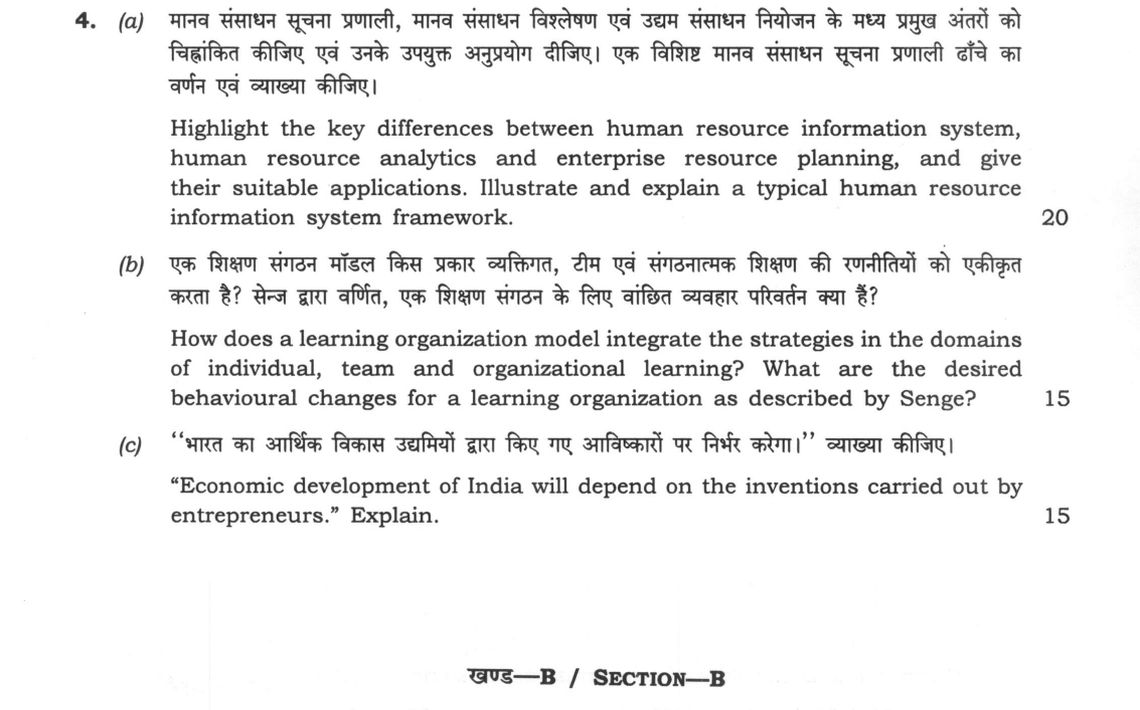
Highlight the key differences between human resource information system, human resource analytics and enterprise resource planning, and give their suitable applications. Illustrate and explain a typical human resource information system framework. 20 marks
How does a learning organization model integrate the strategies in the domains of individual, team and organizational learning? What are the desired behavioural changes for a learning organization as described by Senge? 15 marks
"Economic development of India will depend on the inventions carried out by entrepreneurs." Explain. 15 marks
हिंदी में प्रश्न पढ़ें
मानव संसाधन सूचना प्रणाली, मानव संसाधन विश्लेषण एवं उद्यम संसाधन नियोजन के मध्य प्रमुख अंतरों को चिह्नित कीजिए एवं उनके उपयुक्त अनुप्रयोग दीजिए। एक विशिष्ट मानव संसाधन सूचना प्रणाली ढाँचे का वर्णन एवं व्याख्या कीजिए। (20 अंक)
एक शिक्षण संगठन मॉडल किस प्रकार व्यक्तिगत, टीम एवं संगठनात्मक शिक्षण की रणनीतियों को एकीकृत करता है? सेंज द्वारा वर्णित, एक शिक्षण संगठन के लिए वांछित व्यवहार परिवर्तन क्या हैं? (15 अंक)
"भारत का आर्थिक विकास उद्यमियों द्वारा किए गए अविष्कारों पर निर्भर करेगा।" व्याख्या कीजिए। (15 अंक)
Model answer
Written by UPSC Answer Check against this question's marking rubric, to the expected length. UPSC does not publish answers for Mains — this is one way to score well, not an official key.
Organizational capability and national competitiveness hinge on technological integration, adaptive human capital, and entrepreneurial dynamism.
HRIS, HRA, and ERP: Key Differences and Applications
Human Resource Information System (HRIS) is a dedicated software designed to store, manage, and track core employee records and routine personnel workflows. Its primary application lies in administrative and transactional operations, such as payroll processing, attendance tracking, and statutory compliance reporting (e.g., EPFO and ESIC).
Human Resource Analytics (HRA) applies statistical tools, predictive modeling, and data science to workforce data to uncover patterns and optimize strategic talent decisions. Its applications include flight-risk modeling, predictive attrition analysis, competency-gap forecasting, and evaluating leadership development return on investment.
Enterprise Resource Planning (ERP) is a comprehensive, enterprise-wide software architecture that integrates HR with cross-functional business modules like finance, procurement, and manufacturing. Its application lies in holistic business optimization, such as dynamically aligning project staffing with revenue forecasts and inventory constraints using integrated suites like SAP or Oracle.
Human Resource Information System Framework
An HRIS functions through an open-system input-process-output architecture:
- Inputs: Employee biodata, attendance logs, performance ratings, job requisitions, and statutory rules.
- Transformation / Subsystems: Central Relational Database Management System (RDBMS) integrating Core Modules: Recruitment & Selection, Payroll & Compensation, Performance Appraisal, Learning & Development, and Benefits Administration.
- Outputs: Operational reports, statutory compliance summaries, workforce dashboards, and appraisal dossiers.
- Feedback Loop: Output metrics feed back into strategic HR planning and system continuous improvement.
Learning Organization: Integration and Behavioural Changes
Peter Senge’s model synthesizes learning across three interdependent tiers using Five Disciplines:
- Individual Learning: Anchored in Personal Mastery (expanding individual capacity) and Mental Models (reflecting on internal worldviews).
- Team Learning: Bridges individual insights into group capacity through Team Learning (collective alignment via generative dialogue).
- Organizational Learning: Integrates the enterprise through a Shared Vision (collective sense of purpose), with Systems Thinking acting as the overarching discipline that views the organization as an interconnected whole.
Senge prescribes fundamental behavioural shifts across these disciplines:
- Personal Mastery: Transitioning from passive career stagnation to lifelong learning and a relentless commitment to objective truth.
- Mental Models: Moving from defensive advocacy to active inquiry, utilizing techniques like the "left-hand column" to surface hidden assumptions and cognitive biases.
- Shared Vision: Shifting from coerced compliance to authentic enrollment, where employees co-create organizational destiny.
- Team Learning: Replacing combative debate with collective dialogue by actively suspending assumptions and embracing divergent perspectives.
- Systems Thinking: Abandoning linear, blame-shifting mindsets to recognize structural delays, feedback loops, and holistic interconnections.
Entrepreneurial Inventions and Economic Development
Joseph Schumpeter positioned the entrepreneur as the primary catalyst of economic development through "creative destruction," translating raw scientific inventions into market-viable innovations. In India, entrepreneurial inventions drive structural economic transformation by generating formal employment, enhancing total factor productivity, expanding export baskets, and spurring balanced regional development.
A critical distinction exists between invention (the creation of a novel process or product) and innovation (its commercial execution). Inventions accelerate development only when commercialized effectively. For example, indigenous financial technology inventions underpinning the Unified Payments Interface (NPCI) revolutionized transactional velocity and financial inclusion. Similarly, private space-tech enterprises commercializing ISRO’s spin-off technologies are building high-value export capabilities, while grassroots mechanical inventions fostered by the Honey Bee Network upgrade rural productivity.
However, inventions alone are insufficient without an enabling ecosystem. Sustainable economic development requires robust intellectual property protection, venture financing, physical infrastructure, and policy frameworks such as Startup India and the Atal Innovation Mission to build national absorptive capacity.
Conclusion
Modern HRIS and predictive HRA provide the data backbone essential for cultivating Senge’s continuous learning organizations. These adaptive enterprises foster the talent ecosystems necessary to translate entrepreneurial inventions into scalable innovations, ultimately driving India's long-term economic transformation.
What "Highlight" is asking you to do
Bring the notable features of the named material forward and make their weight visible — what each feature is, and what gives it importance. Highlight expects substantive coverage of the features, not a thin selection from them.
Structure that answers it
The material and what makes a feature notable within it → feature, with the point that gives it weight → the same for each further feature → the composite picture they form
Where marks are lost
Naming features flatly as a list and never showing why any one of them signifies.
How this answer will be evaluated
Approach
Framework: Senge's Five Disciplines. (a) highlight: name the salient points > one line of substance each > close | (b) explain: definition/context > points in order > small example > short close | (c) explain: definition/context > points in order > small example > short close Full marks: Comprehensive, well-structured, with specific examples and clear frameworks.
Key points expected
- Distinguish HRIS, HR Analytics, and ERP functions
- Provide suitable applications for each system
- Illustrate a typical HRIS framework
- Explain the components of the HRIS framework
- Explain integration of individual, team, and organizational learning
- Describe Senge's desired behavioural changes
- Link individual learning to organizational goals
- Mention specific disciplines (e.g., systems thinking)
Evaluation rubric
Each sub-part is marked on its own, against the marks and word limit printed on the paper.
- (a) Distinguish HRIS, HR Analytics, and ERP; illustrate a typical HRIS framework. 20 marks
highlight— name the salient points → one line of substance each → close
Must cover
- Distinguish HRIS, HR Analytics, and ERP functions
- Provide suitable applications for each system
- Illustrate a typical HRIS framework
- Explain the components of the HRIS framework
Loses marks
- Confusing HRIS with general ERP
- Failing to distinguish analytics from basic reporting
- No diagram or framework illustration
Earns more
- Use a table for comparison
- Mention specific modules (e.g., payroll, recruitment)
- Discuss data flow in the framework
- Reference specific software (e.g., SAP, Oracle)
Extra mark
- Mention recent regulatory changes (e.g., GDPR, DPDP Act)
- Provide a real company example
- (b) Explain integration of learning strategies and Senge's desired behavioural changes. 15 marks
explain— definition/context → points in order → small example → short close
Must cover
- Explain integration of individual, team, and organizational learning
- Describe Senge's desired behavioural changes
- Link individual learning to organizational goals
- Mention specific disciplines (e.g., systems thinking)
Loses marks
- Treating the three levels as isolated
- Failing to mention Senge's specific disciplines
- Vague description of behavioural changes
Earns more
- Use a diagram showing the three levels
- Mention 'Personal Mastery' and 'Mental Models'
- Discuss 'Shared Vision' and 'Team Learning'
- Reference 'Systems Thinking' as the integrating discipline
Extra mark
- Mention a specific company implementing learning organization
- Reference a specific case study
- (c) Explain the dependence of India's economic development on entrepreneurial inventions. 15 marks
explain— definition/context → points in order → small example → short close
Must cover
- Explain the role of inventions in economic development
- Link entrepreneurial activity to innovation
- Provide examples of Indian entrepreneurs
- Discuss the impact on GDP and employment
Loses marks
- General statements without specific examples
- Failing to link inventions to economic growth
- Ignoring the role of entrepreneurs
Earns more
- Mention specific sectors (e.g., IT, manufacturing)
- Reference government policies (e.g., Startup India)
- Discuss the role of R&D
- Mention specific companies (e.g., TCS, Infosys)
Extra mark
- Mention a specific recent invention
- Reference a specific government scheme
Practice this exact question
Write your answer and it is marked point by point against the model answer above — what you covered, what you missed, what you got wrong.
Evaluate my answer →More from Management 2023 Paper I
- Q1 (a) "Span of management plays important role in deciding organization structure." Explain…
- Q2 (a) How do mission, vision and values help in developing good plan for an organization? E…
- Q3 (a) "A person can have thousands of attitudes but organizational behaviour focuses its at…
- Q4 (a) Highlight the key differences between human resource information system, human resour…
- Q5 (a) Discuss on the objectives and categories of decisions of the finance function in an o…
- Q6 (a) Given below is the data of two firms in the same industry: | Particulars | Firm A (₹)…
- Q7 (a) A Ltd's EBIT is ₹ 10,00,000. The company has 12%, ₹ 30 lakhs debentures. The equity c…