Paper I — Q7
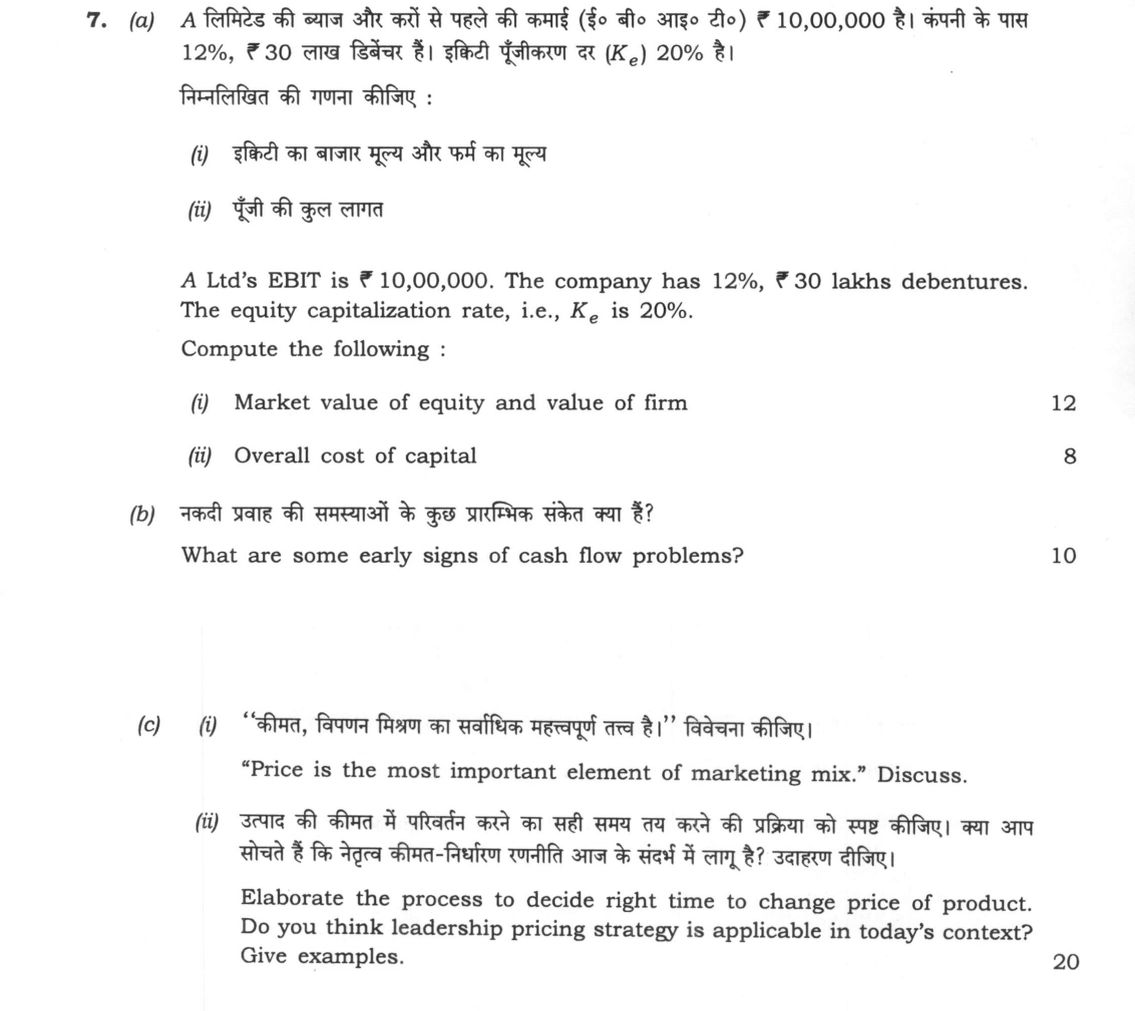
(a) A Ltd's EBIT is ₹ 10,00,000. The company has 12%, ₹ 30 lakhs debentures. The equity capitalization rate, i.e., Kₑ is…
A Ltd's EBIT is ₹ 10,00,000. The company has 12%, ₹ 30 lakhs debentures. The equity capitalization rate, i.e., Kₑ is 20%.
Compute the following:
Market value of equity and value of firm 12 marks
Overall cost of capital 8 marks
What are some early signs of cash flow problems? 10 marks
"Price is the most important element of marketing mix." Discuss. 10 marks
Elaborate the process to decide right time to change price of product. Do you think leadership pricing strategy is applicable in today's context? Give examples. 10 marks
हिंदी में प्रश्न पढ़ें
A लिमिटेड की ब्याज और करों से पहले की कमाई (ई० बी० आई० टी०) ₹ 10,00,000 है। कंपनी के पास 12%, ₹ 30 लाख डिबेंचर हैं। इक्विटी पूँजीकरण दर (Kₑ) 20% है।
निम्नलिखित की गणना कीजिए:
इक्विटी का बाजार मूल्य और फर्म का मूल्य (12 अंक)
पूँजी की कुल लागत (8 अंक)
नकदी प्रवाह की समस्याओं के कुछ प्रारंभिक संकेत क्या हैं? (10 अंक)
"कीमत, विपणन मिश्रण का सर्वाधिक महत्वपूर्ण तत्व है।" विवेचना कीजिए। (10 अंक)
उत्पाद की कीमत में परिवर्तन करने का सही समय तय करने की प्रक्रिया को स्पष्ट कीजिए। क्या आप सोचते हैं कि नेतृत्व कीमत-निर्धारण रणनीति आज के संदर्भ में लागू है? उदाहरण दीजिए। (10 अंक)
Model answer
Written by UPSC Answer Check against this question's marking rubric, to the expected length. UPSC does not publish answers for Mains — this is one way to score well, not an official key.
(a)(i) The Net Income (NI) Approach is used here because Kₑ and K_d are given/assumed constant and no corporate tax is mentioned. Under this approach, debt is assumed perpetual and its market value equals book value unless stated otherwise. Interest on debentures = 12% × ₹30,00,000 = ₹3,60,000 per annum.
Earnings available to equity shareholders = EBIT − Interest = ₹10,00,000 − ₹3,60,000 = ₹6,40,000 per annum.
Market value of equity, S = (EBIT − I)/Kₑ = ₹6,40,000 ÷ 0.20 = ₹32,00,000.
Market value of debt, B = ₹30,00,000.
Value of firm, V = S + B = ₹32,00,000 + ₹30,00,000 = ₹62,00,000.
Interpretation: equity shareholders capitalise the residual earnings of ₹6.40 lakh at 20%, giving ₹32 lakh; adding debt of ₹30 lakh gives total firm value of ₹62 lakh.
Final: Market value of equity = ₹32,00,000 (₹32 lakhs); value of firm = ₹62,00,000 (₹62 lakhs). Validity condition: no corporate tax, perpetual debt, and unchanged Kₑ and K_d.
(a)(ii) Under the NI Approach, the overall cost of capital is K₀ = EBIT ÷ V.
K₀ = ₹10,00,000 ÷ ₹62,00,000 = 10/62 = 5/31 = 0.161290… = 500/31% ≈ 16.13% per annum.
Check by weighted average cost of capital: K₀ = Kₑ(S/V) + K_d(B/V) = 20% × (32/62) + 12% × (30/62) = 640/62% + 360/62% = 1000/62% = 500/31% ≈ 16.13% per annum.
Final: Overall cost of capital = 5/31 ≈ 16.13% per annum. Since tax rate is not given, K_d is pre-tax; with tax, K_d(1 − t) would be used.
(b) Early signs of cash flow problems:
- Operating cash flow turns negative or remains consistently below net profit.
- Debtor days and the cash conversion cycle lengthen; collections become slower.
- Inventory piles up, including slow-moving or obsolete stock.
- Payments to suppliers, wages, rent, or statutory dues are delayed.
- Frequent bank overdrafts, breach of limits, or rollover of short-term loans.
- Sales grow but cash does not; long-term needs are funded by short-term debt.
- Gross margin falls, finance cost rises, and interest coverage weakens.
- Suppliers demand advance payment or cash-and-carry terms.
- Persistent cash budget deficits, delayed capital expenditure, or asset sales to fund working capital.
- Dividend cuts, mounting payables, and legal notices for non-payment.
These symptoms usually appear before profits collapse, so cash-flow forecasting, ratio monitoring, and ageing schedules are essential.
(c)(i) Price is often called the most important element of the marketing mix because it is the only “P” that directly generates revenue; product, place, promotion, people, process, and physical evidence mostly create costs. Price determines demand through elasticity, affects margins and break-even, signals quality and positioning, and can be changed faster than product or distribution. In commodity, telecom, airline, and e-commerce markets, price is decisive.
However, “most important” is context-specific. A superior product (Apple), distribution (Coca-Cola), promotion (Zomato/Swiggy), or service experience can dominate. Price wars destroy value, while regulated goods, ethical drugs, B2B relationships, switching costs, and brand loyalty limit price power. The marketing mix is an integrated system: price must align with product, place, promotion, people, process, and physical evidence. Thus price is the most visible and flexible lever, but not universally the most important.
(c)(ii) Process to decide the right time to change price:
- Define objective: volume, market share, margin, survival, or leadership.
- Scan triggers: cost inflation, demand shift, competitor move, product life-cycle stage, regulation, exchange rate, capacity.
- Estimate demand: price elasticity, cross elasticity, customer willingness to pay, and value perception.
- Analyse cost and break-even: contribution margin, fixed cost recovery, and target return.
- Anticipate competitor, channel, and legal response, including antitrust risk.
- Choose timing: cost pass-through, festival or season, new launch, after competitor action, inventory clearance, or technology shift.
- Select mechanism: list-price change, discount, bundling, surcharge, or loyalty pricing.
- Communicate value and train channel partners; then monitor sales, margin, share, and churn.
- Review and revise if actual response differs from expected.
Price leadership occurs when a dominant firm sets price and others follow. It is only partly applicable today. Digital transparency, rapid imitation, DTC brands, algorithmic pricing, consumer switching, and antitrust scrutiny weaken it. Yet it survives in oligopolies with high entry barriers and homogeneous products: telecom (Jio, Airtel, Vi), aviation (IndiGo), cement, petroleum, and e-commerce sale events (Amazon, Flipkart). Premium leadership pricing also works for brands such as Apple and Mercedes. Hence leadership pricing is selective, not universal; it works when the leader has cost advantage, credible capacity, strong distribution, and regulatory tolerance.
What "Calculate" is asking you to do
Apply the standard formula or schedule to data the question has already supplied — a table of readings, cost records, a balance sheet — and produce the number. The method is rarely in doubt; the marks sit in the named intermediate quantities, each of which has to appear as a labelled line.
Structure that answers it
Data as given → formula or standard treatment, named → substitution → each intermediate, labelled → result with units
Where marks are lost
Omitting an intermediate the marking scheme pays for separately, or rounding at an intermediate line so the final figure drifts. In commerce and accountancy, any figure in a statement that no numbered working note supports is treated as unearned.
How this answer will be evaluated
Approach
Framework: Modigliani-Miller (MM) Proposition I (No Tax). (a(i)) calculate: given > formula > substitution > result with units > interpretation | (a(ii)) calculate: given > formula > substitution > result with units > interpretation | (b) highlight: name the salient points > one line of substance each > close | (c(i)) discuss: intro > 3-4 dimensions > example > balanced close | (c(ii)) explain: definition/context > points in order > small example > short close Full marks: Accurate calculations with clear steps; comprehensive list of cash flow signs; nuanced discussion of price with strong examples.
Key points expected
- Calculate interest on debentures (₹3,60,000)
- Determine Earnings to Equity (EBIT - Interest)
- Calculate Market Value of Equity (Earnings / Ke)
- Calculate Value of Firm (Equity + Debt)
- Calculate weight of equity (E/V)
- Calculate weight of debt (D/V)
- Apply WACC formula (Ke*We + Kd*Wd)
- State final percentage
Evaluation rubric
Each sub-part is marked on its own, against the marks and word limit printed on the paper.
- (a(i)) Compute market value of equity and total value of firm using MM theory. 12 marks
calculate— given → formula → substitution → result with units → interpretation
Must cover
- Calculate interest on debentures (₹3,60,000)
- Determine Earnings to Equity (EBIT - Interest)
- Calculate Market Value of Equity (Earnings / Ke)
- Calculate Value of Firm (Equity + Debt)
Loses marks
- Using WACC instead of MM theory
- Arithmetic errors in interest or equity calculation
Earns more
- Explicitly stating the MM Proposition I formula
- Showing the step-by-step arithmetic clearly
Extra mark
- Mentioning the assumption of no corporate tax
- (a(ii)) Compute the overall cost of capital (WACC). 8 marks
calculate— given → formula → substitution → result with units → interpretation
Must cover
- Calculate weight of equity (E/V)
- Calculate weight of debt (D/V)
- Apply WACC formula (Ke*We + Kd*Wd)
- State final percentage
Loses marks
- Using book values instead of market values for weights
- Incorrect application of the WACC formula
Earns more
- Showing the weight calculation explicitly
Extra mark
- Verifying that WACC equals Ke in a no-tax MM world
- (b) List and explain early warning signs of cash flow problems. 10 marks
highlight— name the salient points → one line of substance each → close
Must cover
- Mention delayed payments to suppliers
- Mention increased reliance on short-term borrowing
- Mention difficulty in meeting payroll or fixed costs
- Mention declining cash reserves
Loses marks
- Confusing cash flow problems with general insolvency
- Listing only one or two signs without explanation
Earns more
- Mentioning increased bad debts or slow collections
- Mentioning frequent overdraft usage
Extra mark
- Citing a specific financial ratio (e.g., quick ratio) as a sign
- (c(i)) Discuss the argument that price is the most important marketing mix element. 10 marks
discuss— intro → 3-4 dimensions → example → balanced close
Must cover
- Acknowledge price as the only revenue-generating element
- Discuss price elasticity and consumer perception
- Contrast with Product, Place, and Promotion
- Provide a balanced conclusion on its relative importance
Loses marks
- Agreeing with the statement without counter-arguments
- Ignoring the interdependence of the 4 Ps
Earns more
- Mentioning price as a dynamic variable vs static product
- Using a real-world example of price sensitivity
Extra mark
- Referencing a specific pricing theory (e.g., Veblen goods)
- (c(ii)) Explain the process of timing price changes and the applicability of leadership pricing. 10 marks
explain— definition/context → points in order → small example → short close
Must cover
- Outline steps to decide the right time (cost, demand, competition)
- Define leadership pricing strategy
- Assess its applicability in today's context
- Provide examples of companies using leadership pricing
Loses marks
- Failing to address the 'right time' aspect of the question
- Defining leadership pricing incorrectly
Earns more
- Mentioning the role of technology in real-time pricing
- Discussing the risks of leadership pricing (price wars)
Extra mark
- Citing a specific recent example (e.g., Apple or Amazon)
Practice this exact question
Write your answer and it is marked point by point against the model answer above — what you covered, what you missed, what you got wrong.
Evaluate my answer →More from Management 2023 Paper I
- Q4 (a) Highlight the key differences between human resource information system, human resour…
- Q5 (a) Discuss on the objectives and categories of decisions of the finance function in an o…
- Q6 (a) Given below is the data of two firms in the same industry: | Particulars | Firm A (₹)…
- Q7 (a) A Ltd's EBIT is ₹ 10,00,000. The company has 12%, ₹ 30 lakhs debentures. The equity c…
- Q8 (a) During a month, 4500 units were introduced into process A. The normal loss was estima…