Paper I — Q2
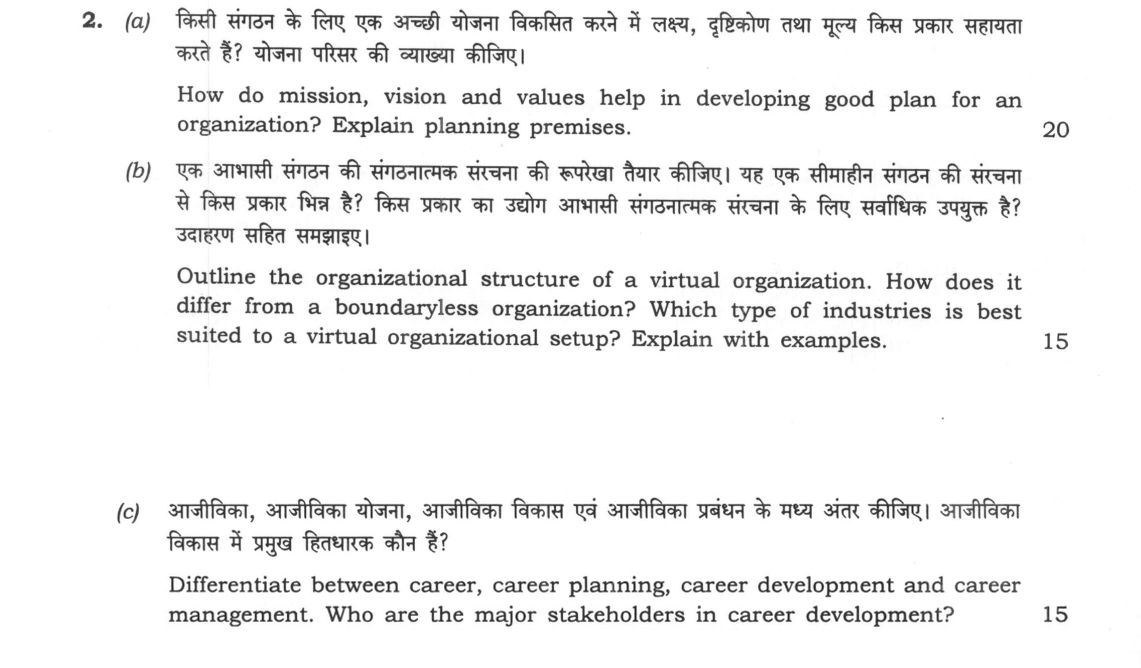
(a) How do mission, vision and values help in developing good plan for an organization? Explain planning premises. (20…
How do mission, vision and values help in developing good plan for an organization? Explain planning premises. 20 marks
Outline the organizational structure of a virtual organization. How does it differ from a boundaryless organization? Which type of industries is best suited to a virtual organizational setup? Explain with examples. 15 marks
Differentiate between career, career planning, career development and career management. Who are the major stakeholders in career development? 15 marks
हिंदी में प्रश्न पढ़ें
किसी संगठन के लिए एक अच्छी योजना विकसित करने में लक्ष्य, दृष्टिकोण तथा मूल्य किस प्रकार सहायता करते हैं? योजना परिसर की व्याख्या कीजिए। (20 अंक)
एक आभासी संगठन की संगठनात्मक संरचना की रूपरेखा तैयार कीजिए। यह एक सीमाहीन संगठन की संरचना से किस प्रकार भिन्न है? किस प्रकार का उद्योग आभासी संगठनात्मक संरचना के लिए सर्वाधिक उपयुक्त है? उदाहरण सहित समझाइए। (15 अंक)
आजीविका, आजीविका योजना, आजीविका विकास एवं आजीविका प्रबंधन के मध्य अंतर कीजिए। आजीविका विकास में प्रमुख हितधारक कौन हैं? (15 अंक)
Model answer
Written by UPSC Answer Check against this question's marking rubric, to the expected length. UPSC does not publish answers for Mains — this is one way to score well, not an official key.
Strategic planning derives its coherence from the organization’s foundational philosophy. Vision defines the aspirational future state, providing a long-term target that drives objective-setting. Mission specifies the core purpose, scope of operations, and value proposition, establishing boundaries for what the firm will and will not pursue. Values act as an ethical compass and behavioral filter, ensuring strategic choices align with organizational integrity. Together, they guide planning by providing criteria to prioritize resource allocation, resolve trade-offs, and prevent strategic drift.
Planning Premises are the critical, evidence-based assumptions about the expected operating environment within which plans execute. They fall into three primary dimensions:
- Internal vs. External: Internal premises involve organizational variables such as cash flow, technological capability, and operational capacity, whereas external premises involve macro-factors such as government policy changes, taxation norms, and demographic shifts.
- Tangible vs. Intangible: Tangible premises are quantifiable, such as sales forecasts, capital expenditure limits, and raw material costs; intangible premises involve qualitative aspects like brand equity, employee morale, and customer goodwill.
- Controllable, Semi-controllable, and Uncontrollable: Controllable factors include marketing mix and cost structures; semi-controllable include employee turnover and trade union dynamics; uncontrollable include geopolitical shocks, inflation, and regulatory interventions. Accurate premise formulation reduces environmental uncertainty, ensuring plans remain robust against disruptions.
Virtual Organizations and Industry Suitability A virtual organization consists of a small, core hub that retains distinctive competencies—typically strategic planning, brand management, and research and development—while outsourcing almost all non-core operational functions (manufacturing, distribution, customer care) to independent external partners via advanced information technology networks.
This model differs fundamentally from Jack Welch’s boundaryless organization. A boundaryless organization seeks to dismantle internal vertical hierarchies and horizontal department silos within a single enterprise, while smoothing relations with external partners. In contrast, a virtual organization is structurally fragmented, replacing permanent internal organizational units with dynamic, contractual external partnerships.
Virtual structures thrive in fast-evolving, asset-light industries requiring high strategic flexibility, rapid cycle times, and minimal fixed capital:
- Fashion and Footwear: Nike retains brand strategy and design while outsourcing global manufacturing and retail logistics.
- Information Technology & Software: Indian IT enterprises (such as Infosys and TCS) leverage virtual distributed development models to configure flexible project teams across global time zones.
- Biotechnology & Pharmaceuticals: Niche discovery firms develop molecules in-house while licensing clinical trials and large-scale manufacturing to specialized contract research organizations.
Career Systems and Stakeholders The career ecosystem requires clear distinction among four interrelated concepts:
- Career: The lifelong, cumulative sequence of work experiences, roles, and psychological orientations an individual undergoes across their working life.
- Career Planning: The personally driven, proactive process wherein an individual assesses their strengths, weaknesses, and aspirations, setting specific career objectives and development paths.
- Career Development: The continuous, programmatic interventions—including targeted training, mentorship, job rotation, and tuition assistance—provided by the employer to enhance employee competencies for future roles.
- Career Management: The overarching, strategic human resource process that forecasts organizational talent needs, tracks succession pipelines, and matches employee career plans with organizational manpower requirements.
The major stakeholders in career development comprise:
- The Individual Employee: Holds primary ownership of self-assessment, skill acquisition, and career path execution.
- Immediate Managers: Act as coaches, providing real-time performance feedback, identifying developmental needs, and sponsoring advancement.
- Human Resource Specialists: Design systemic pathways, maintain appraisal frameworks, succession grids, and training infrastructure.
- Educational Institutions: Supply the foundational skills, professional certifications, and lifelong upskilling programs aligned with market demand.
- Family and Social Networks: Provide the socio-emotional support and work-life balance necessary for sustained professional growth.
When strategic planning premises accurately anticipate volatile markets, they necessitate flexible designs like virtual organizations. In turn, these fluid, network-based structures rely on modern career management systems that empower autonomous, self-directed talent in the evolving gig economy and post-pandemic landscape.
What "Explain" is asking you to do
Make the working of something clear — what sets it off, what follows from what, and what it produces. Explain is the Commission's mechanism word: it dominates the technical papers and the “explain why” stems, where the marks sit in the causal chain and not in the label.
Structure that answers it
State what it is → the initiating condition → the chain of cause, step by step → an instance where it plays out → what the chain produces
Where marks are lost
Describing what something looks like instead of why it works that way. Naming the stages without linking them reads as description too.
How this answer will be evaluated
Approach
Framework: null. (a) explain: definition/context > points in order > small example > short close | (b) compare: paired headings or table > key differences > significance > conclusion | (c) compare: paired headings or table > key differences > significance > conclusion Full marks: Comprehensive, well-structured, with clear distinctions and concrete examples.
Key points expected
- Define mission, vision, and values
- Link M/V/V to strategic planning process
- Define planning premises (internal/external)
- Explain how premises guide plan formulation
- Outline virtual organization structure
- Differentiate virtual vs boundaryless
- Identify industries suited to virtual setup
- Provide examples of virtual organizations
Evaluation rubric
Each sub-part is marked on its own, against the marks and word limit printed on the paper.
- (a) Explain the role of M/V/V in planning and define planning premises. 20 marks
explain— definition/context → points in order → small example → short close
Must cover
- Define mission, vision, and values
- Link M/V/V to strategic planning process
- Define planning premises (internal/external)
- Explain how premises guide plan formulation
Loses marks
- Textbook definitions without application
- Confusing premises with objectives
- Ignoring the 'values' component
Earns more
- Mention specific planning models (e.g., SWOT)
- Discuss the dynamic nature of premises
- Provide a concrete organizational example
Extra mark
- Reference to a specific company's M/V/V
- Mention of a recent regulatory change affecting premises
- (b) Outline virtual structure, compare with boundaryless, and identify suitable industries. 15 marks
compare— paired headings or table → key differences → significance → conclusion
Must cover
- Outline virtual organization structure
- Differentiate virtual vs boundaryless
- Identify industries suited to virtual setup
- Provide examples of virtual organizations
Loses marks
- Confusing virtual with boundaryless
- No examples provided
- Vague description of structure
Earns more
- Mention specific technologies enabling virtual orgs
- Discuss pros/cons of virtual structure
- Reference specific industry examples (e.g., IT, consulting)
Extra mark
- Reference to a specific virtual company (e.g., Dell, Nike)
- Mention of a specific boundaryless company (e.g., GE)
- (c) Differentiate career concepts and identify stakeholders in career development. 15 marks
compare— paired headings or table → key differences → significance → conclusion
Must cover
- Differentiate career, planning, development, management
- Identify major stakeholders in career development
- Explain the role of each stakeholder
- Provide a clear distinction between the four terms
Loses marks
- Confusing career planning with career development
- Ignoring the 'management' aspect
- Vague identification of stakeholders
Earns more
- Mention specific career development tools
- Discuss the changing nature of careers
- Reference to specific stakeholder roles (e.g., HR, mentor)
Extra mark
- Reference to a specific career development framework
- Mention of a specific stakeholder (e.g., EAP provider)
Practice this exact question
Write your answer and it is marked point by point against the model answer above — what you covered, what you missed, what you got wrong.
Evaluate my answer →More from Management 2023 Paper I
- Q1 (a) "Span of management plays important role in deciding organization structure." Explain…
- Q2 (a) How do mission, vision and values help in developing good plan for an organization? E…
- Q3 (a) "A person can have thousands of attitudes but organizational behaviour focuses its at…
- Q4 (a) Highlight the key differences between human resource information system, human resour…
- Q5 (a) Discuss on the objectives and categories of decisions of the finance function in an o…