Paper II — Q3
(a) State the different forms of waste management. 15 marks (b) State the various factors affecting plant location. 15…
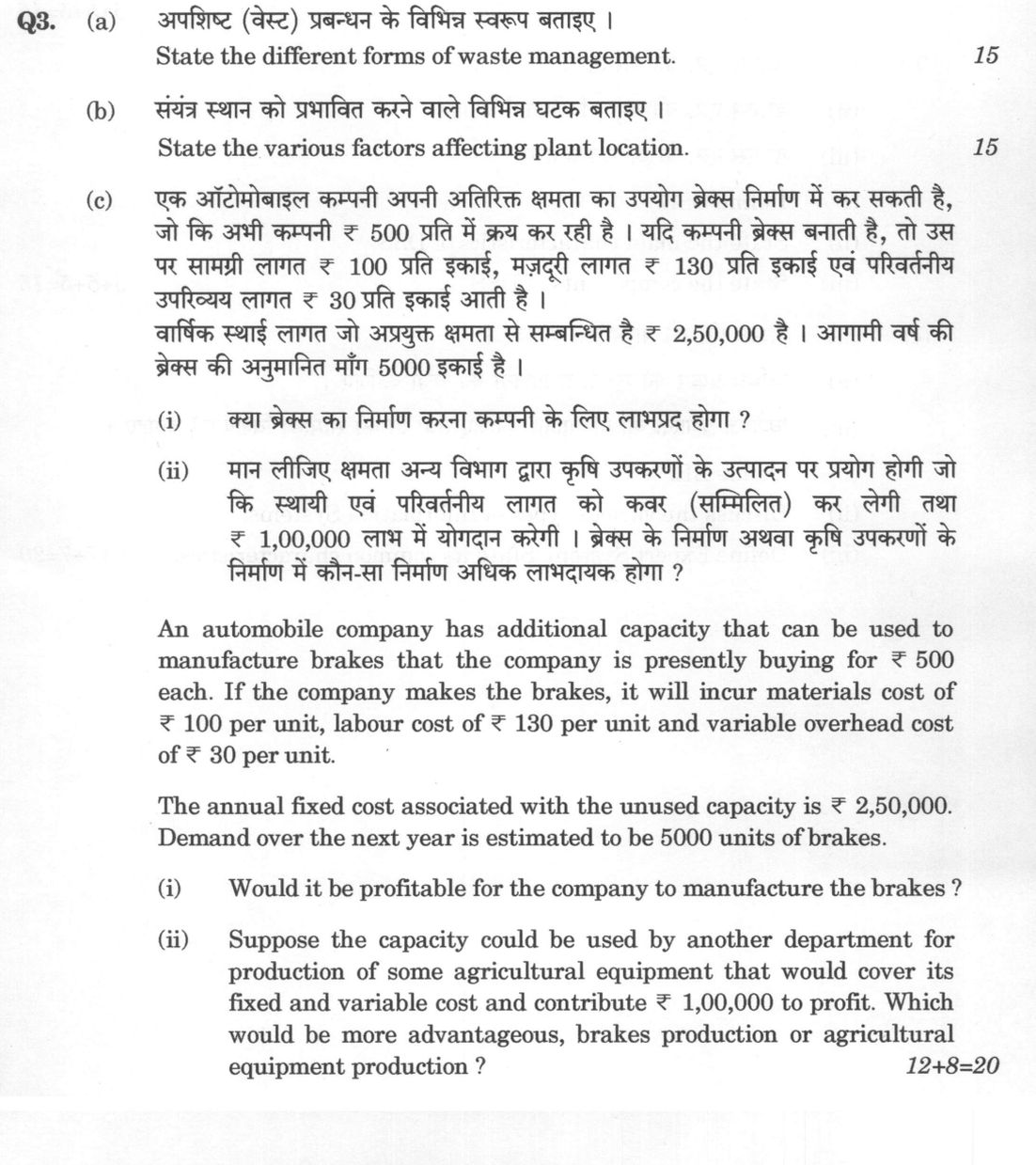
State the different forms of waste management. 15 marks
State the various factors affecting plant location. 15 marks
An automobile company has additional capacity that can be used to manufacture brakes that the company is presently buying for ₹ 500 each. If the company makes the brakes, it will incur materials cost of ₹ 100 per unit, labour cost of ₹ 130 per unit and variable overhead cost of ₹ 30 per unit.
The annual fixed cost associated with the unused capacity is ₹ 2,50,000. Demand over the next year is estimated to be 5000 units of brakes.
Would it be profitable for the company to manufacture the brakes ?
Suppose the capacity could be used by another department for production of some agricultural equipment that would cover its fixed and variable cost and contribute ₹ 1,00,000 to profit. Which would be more advantageous, brakes production or agricultural equipment production ? 12+8=20 marks
हिंदी में प्रश्न पढ़ें
अपशिष्ट (वेस्ट) प्रबंधन के विभिन्न स्वरूप बताइए । 15
संयंत्र स्थान को प्रभावित करने वाले विभिन्न घटक बताइए । 15
एक ऑटोमोबाइल कंपनी अपनी अतिरिक्त क्षमता का उपयोग ब्रेक्स निर्माण में कर सकती है, जो कि अभी कंपनी ₹ 500 प्रति में क्रय कर रही है । यदि कंपनी ब्रेक्स बनाती है, तो उस पर सामग्री लागत ₹ 100 प्रति इकाई, मजदूरी लागत ₹ 130 प्रति इकाई एवं परिवर्तनीय उपरिव्यय लागत ₹ 30 प्रति इकाई आती है ।
वार्षिक स्थायी लागत जो अप्रयुक्त क्षमता से संबंधित है ₹ 2,50,000 है । आगामी वर्ष की ब्रेक्स की अनुमानित मांग 5000 इकाई है ।
क्या ब्रेक्स का निर्माण करना कंपनी के लिए लाभप्रद होगा ?
मान लीजिए क्षमता अन्य विभाग द्वारा कृषि उपकरणों के उत्पादन पर प्रयोग होगी जो कि स्थायी एवं परिवर्तनीय लागत को कवर (सम्मिलित) कर लेगी तथा ₹ 1,00,000 लाभ में योगदान करेगी । ब्रेक्स के निर्माण अथवा कृषि उपकरणों के निर्माण में कौन-सा निर्माण अधिक लाभदायक होगा ? 12+8=20
Model answer
Written by UPSC Answer Check against this question's marking rubric, to the expected length. UPSC does not publish answers for Mains — this is one way to score well, not an official key.
Waste management forms. Waste management can be classified by source and by treatment. By source, industrial waste includes hazardous waste such as toxic chemicals, solvents, heavy-metal sludges and spent catalysts, and non-hazardous waste such as scrap metal, paper, wood and packaging; municipal waste includes solid waste like household garbage, market waste and street sweepings, and liquid waste such as sewage and trade effluent; biomedical waste includes infectious, pathological, sharps and pharmaceutical waste from hospitals; and e-waste includes discarded computers, batteries, telephones and electronic components. By treatment, the main forms are landfilling, where segregated non-hazardous waste is buried in engineered sites; incineration, where waste is burned to reduce volume and sometimes recover heat; recycling, where metals, paper, glass and plastics are recovered for reuse; composting, where organic waste is biologically decomposed into manure; and waste-to-energy, where combustible waste is converted into electricity or heat. In India, these forms are applied under the Solid Waste Management Rules, Hazardous Waste Rules, Biomedical Waste Rules and E-waste Rules, with segregation at source, collection, transport, processing and safe disposal.
Plant location factors. Plant location is a strategic decision because it fixes long-run costs and service capability. The principal factors are proximity to raw materials and markets, which reduces transport cost and delivery time; labour availability and cost, including skill, wage rates, labour relations and training facilities; transportation infrastructure, such as roads, railways, ports, airports and logistics connectivity; power and water supply, which must be reliable, adequate and affordable; government policies and incentives, including industrial policy, land rates, tax holidays, subsidies, single-window clearance and special economic zones; environmental regulations, such as pollution control, effluent standards, noise limits and environmental clearances; and agglomeration economies, where clusters provide shared suppliers, skilled labour, services, technology spillovers and market access. For an automobile plant, for example, proximity to component suppliers, port access for exports, skilled labour and industrial infrastructure may outweigh cheap land.
Make-or-buy decision. For brakes, the relevant cost of making is the incremental variable cost: materials ₹100, labour ₹130 and variable overhead ₹30, giving ₹260 per unit. For 5,000 units, variable manufacturing cost is ₹13,00,000. Buying cost is 5,000 × ₹500 = ₹25,00,000. The annual fixed cost of ₹2,50,000 associated with the existing unused capacity is not an incremental cost of making brakes, because it is incurred whether the capacity is used for brakes or left unused; it is therefore a common or sunk cost for this decision. On a relevant-cost basis, making saves ₹500 − ₹260 = ₹240 per unit, or ₹12,00,000 per year. If the fixed cost were wrongly added, total manufacturing cost would appear to be ₹28,50,000 against a buying cost of ₹25,00,000, suggesting a loss of ₹3,50,000; but that comparison is misleading because the fixed cost does not change with the decision. Hence, before considering the alternative use, it would be profitable for the company to manufacture the brakes.
Opportunity cost comparison. If the same capacity can be used by another department to produce agricultural equipment that contributes ₹1,00,000 to profit after covering its own fixed and variable costs, the brakes decision must be compared with that alternative. The brakes option gives a contribution of ₹12,00,000, while the agricultural equipment option gives ₹1,00,000. Since the fixed cost of the capacity is incurred in either case, it should not be deducted from either option. The brakes production is therefore more advantageous by ₹11,00,000. The decision illustrates the operations-management principle that make-or-buy and capacity-allocation decisions should be based on relevant, avoidable costs and opportunity costs, not on allocated common fixed costs. Thus, the company should use the additional capacity for brake manufacture rather than agricultural equipment.
What "State" is asking you to do
Give the formulation itself — the theorem, rule, statutory provision or position — worded accurately. Precision of wording is the whole of the mark; no background or justification is being asked for.
Structure that answers it
The statement in full, complete in itself → the conditions under which it holds → an illustration only where the stem asks for one
Where marks are lost
Approximating the wording. A theorem or a provision stated loosely forfeits the mark that exact statement would have carried.
How this answer will be evaluated
Approach
Framework: Make-or-Buy Decision Analysis. (a) enumerate: list the items in order > one line each > no commentary | (b) enumerate: list the items in order > one line each > no commentary | (c(i)) calculate: given > formula > substitution > result with units > interpretation | (c(ii)) calculate: given > formula > substitution > result with units > interpretation Full marks: Accurate calculations with clear logic; comprehensive lists for theory parts.
Key points expected
- Source reduction and reuse
- Recycling and composting
- Energy recovery (Waste-to-Energy)
- Sanitary landfilling
- Proximity to raw materials
- Access to market and transport
- Availability of labor and power
- Government policy and incentives
Evaluation rubric
Each sub-part is marked on its own, against the marks and word limit printed on the paper.
- (a) List the different forms of waste management. 15 marks
enumerate— list the items in order → one line each → no commentary
Must cover
- Source reduction and reuse
- Recycling and composting
- Energy recovery (Waste-to-Energy)
- Sanitary landfilling
Loses marks
- Listing only disposal methods
- Vague descriptions without specific forms
Earns more
- Mention of the Waste Hierarchy
- Distinction between hazardous and non-hazardous waste
Extra mark
- Reference to specific regulatory frameworks (e.g., EPR)
- (b) List the various factors affecting plant location. 15 marks
enumerate— list the items in order → one line each → no commentary
Must cover
- Proximity to raw materials
- Access to market and transport
- Availability of labor and power
- Government policy and incentives
Loses marks
- Listing only cost factors
- Ignoring logistical or social factors
Earns more
- Mention of land cost and expansion potential
- Reference to community attitude
Extra mark
- Reference to specific location models (e.g., Weber's)
- (c(i)) Determine if manufacturing brakes is profitable compared to buying. 12 marks
calculate— given → formula → substitution → result with units → interpretation
Must cover
- Calculate total cost to make (₹1,00,00,000)
- Calculate total cost to buy (₹2,50,00,000)
- Compare the two totals
- Conclude that making is profitable
Loses marks
- Ignoring the fixed cost of ₹2,50,000
- Comparing per-unit costs without total volume
Earns more
- Explicit calculation of per-unit savings (₹240)
Extra mark
- Mention of qualitative benefits of in-house production
- (c(ii)) Compare the advantage of brake production vs. agricultural equipment. 8 marks
calculate— given → formula → substitution → result with units → interpretation
Must cover
- Identify opportunity cost of ₹1,00,000
- Calculate net benefit of making brakes (₹1,50,00,000)
- Compare net benefit to opportunity cost
- Conclude that brake production is more advantageous
Loses marks
- Comparing gross savings to opportunity cost
- Failing to subtract the opportunity cost from the benefit
Earns more
- Explicit statement of the 'opportunity cost' concept
Extra mark
- Discussion of strategic fit or long-term capacity
Practice this exact question
Write your answer and it is marked point by point against the model answer above — what you covered, what you missed, what you got wrong.
Evaluate my answer →More from Management 2023 Paper II
- Q1 (a) State the chief characteristics of Index Numbers. (10 marks) (b) What do you mean by…
- Q2 (a) The following table gives the production in three shifts and the corresponding number…
- Q3 (a) State the different forms of waste management. 15 marks (b) State the various factors…
- Q4 (a) (i) Define e-Governance. (ii) State the advantages of e-Governance. (iii) State the e…
- Q5 (a) Examine the impact of privatisation of PSUs on the economic development of India. 10…
- Q6 (a) (i) "The role of Board of Directors is to govern and not to manage." Comment on the s…