Paper II — Q7
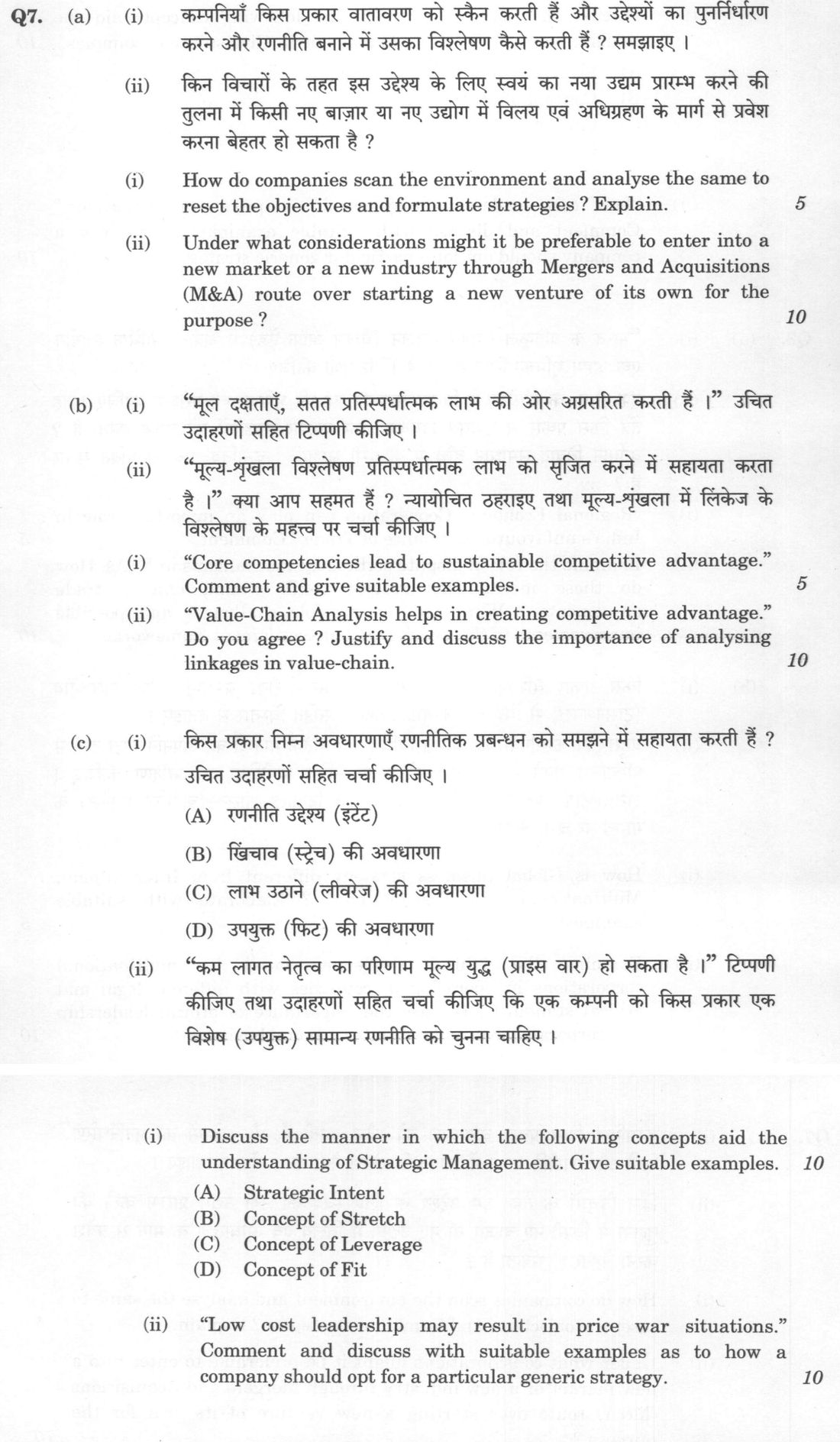
(a) (i) How do companies scan the environment and analyse the same to reset the objectives and formulate strategies ? Explain. 5…
How do companies scan the environment and analyse the same to reset the objectives and formulate strategies ? Explain. 5 marks
Under what considerations might it be preferable to enter into a new market or a new industry through Mergers and Acquisitions (M&A) route over starting a new venture of its own for the purpose? 10 marks
"Core competencies lead to sustainable competitive advantage." Comment and give suitable examples. 5 marks
"Value-Chain Analysis helps in creating competitive advantage." Do you agree ? Justify and discuss the importance of analysing linkages in value-chain. 10 marks
Discuss the manner in which the following concepts aid the understanding of Strategic Management. Give suitable examples. 10 marks (A) Strategic Intent (B) Concept of Stretch (C) Concept of Leverage (D) Concept of Fit
"Low cost leadership may result in price war situations." Comment and discuss with suitable examples as to how a company should opt for a particular generic strategy. 10 marks
हिंदी में प्रश्न पढ़ें
कम्पनियाँ किस प्रकार वातावरण को स्कैन करती हैं और उद्देश्यों का पुनर्निर्धारण करने और रणनीति बनाने में उसका विश्लेषण कैसे करती हैं ? समझाइए । 5
किन विचारों के तहत इस उद्देश्य के लिए स्वयं का नया उद्यम प्रारम्भ करने की तुलना में किसी नए बाजार या नए उद्योग में विलय एवं अधिग्रहण के मार्ग से प्रवेश करना बेहतर हो सकता है ? 10 marks
"मूल दक्षताएँ, सतत प्रतिस्पर्धात्मक लाभ की ओर अग्रसरित करती हैं ।" उचित उदाहरणों सहित टिप्पणी कीजिए । 5
"मूल्य-श्रृंखला विश्लेषण प्रतिस्पर्धात्मक लाभ को सृजित करने में सहायता करता है ।" क्या आप सहमत हैं ? न्यायोचित ठहराइए तथा मूल्य-श्रृंखला में लिंकेज के विश्लेषण के महत्व पर चर्चा कीजिए । 10
किस प्रकार निम्न अवधारणाएँ रणनीतिक प्रबन्धन को समझने में सहायता करती हैं ? उचित उदाहरणों सहित चर्चा कीजिए । 10 (A) रणनीति उद्देश्य (इंटेंट) (B) खिंचाव (स्ट्रेच) की अवधारणा (C) लाभ उठाने (लीवरेज) की अवधारणा (D) उपयुक्त (फिट) की अवधारणा
"कम लागत नेतृत्व का परिणाम मूल्य युद्ध (प्राइस वार) हो सकता है ।" टिप्पणी कीजिए तथा उदाहरणों सहित चर्चा कीजिए कि एक कम्पनी को किस प्रकार एक विशेष (उपयुक्त) सामान्य रणनीति को चुनना चाहिए । 10
Model answer
Written by UPSC Answer Check against this question's marking rubric, to the expected length. UPSC does not publish answers for Mains — this is one way to score well, not an official key.
Strategic management is a continuous loop: firms scan the external and internal environment, interpret threats and opportunities, set ambitious intent, build competencies, and choose strategies that fit their value chain.
Environmental scanning and strategy reset. Companies scan the environment using PESTEL (political, economic, social, technological, environmental, legal), ETOP (economic, technological, organisational, political), SWOT, and Porter’s Five Forces. PESTEL/ETOP identify macro trends, SWOT matches internal strengths and weaknesses with external opportunities and threats, and Five Forces assesses industry attractiveness. This analysis resets objectives: rising EV policy, interest rates and consumer preference shifts may lead a carmaker to reset targets from volume growth to electrification and profitability, then formulate strategy through product mix, alliances, pricing and capability investment.
M&A versus organic entry. M&A may be preferable when speed to market matters, when capabilities, brands, distribution networks, technology or licences are difficult to build internally, and when economies of scope can be captured quickly. It can reduce risk of first-mover failure, provide immediate scale, and open regulated or capital-intensive industries. However, it carries integration risk, cultural mismatch, overpayment and management distraction. Organic growth is better when the firm has strong internal capabilities, the market is uncertain, or required assets are not available at reasonable price. Thus, M&A is chosen when time, capability access and scope benefits outweigh integration costs.
Core competencies and sustainable advantage. A core competency is sustainable when it is valuable, rare, inimitable and non-substitutable (VRIN); in VRIO, inimitability is expressed as costly to imitate, and the firm must also be organized to capture value. Tata Motors’ capability in cost-efficient vehicle engineering and platform development, and ISRO’s systems integration and mission management, illustrate such competencies. They are rare, hard to imitate, not easily replaced, and supported by organizational routines, culture and governance, which helps sustain advantage.
Value-chain analysis and linkages. Value-chain analysis breaks operations into primary activities—inbound logistics, operations, outbound logistics, marketing/sales, service—and support activities—firm infrastructure, HR, technology development, procurement. It helps identify where costs can be reduced or differentiation added, thereby optimizing margin. Linkage analysis is crucial because activities interact: procurement affects operations, technology development affects product design, and service feedback affects marketing. A firm that manages linkages well can lower total cost or create unique customer value, as seen in companies that integrate supply-chain data with after-sales service.
Strategic intent, stretch, leverage and fit. Hamel and Prahalad’s strategic intent is an ambitious long-term goal that mobilizes the organization. Stretch is the gap between current performance and desired future position; Reliance Jio’s intent to become a digital ecosystem player required a stretch beyond telecom into payments, cloud and content. Leverage means using existing core competencies to enter related businesses; for example, TCS leveraged its software and consulting capability to expand into cloud, AI and digital transformation. Fit is the alignment among strategy, structure, processes, people and resources; Maruti Suzuki’s fit between cost-efficient platforms, dealer networks, brand trust and operational discipline supports its market position.
Generic strategies and price-war risk. Porter’s generic strategies are cost leadership, differentiation and focus. Low-cost leadership can trigger price wars when rivals match prices, capacity is excess, or products are commoditized, as seen in Indian airlines and telecom where aggressive pricing compressed margins. A company should choose a generic strategy based on industry structure, customer preferences, its competencies and value-chain strengths. If it can achieve lowest cost through scale, process efficiency and procurement, cost leadership is viable; if customers value unique features, brand or service, differentiation is better; if a niche is underserved, focus is appropriate. Avoiding “stuck in the middle” requires clear positioning and consistent choices.
The way forward is to let environmental analysis inform strategic intent, which then drives competency building, value-chain choices and generic strategy, so that advantage is created and sustained.
What "Discuss" is asking you to do
Lay the issue out from more than one side — how it arose, what is claimed for it, what is held against it, and where it now stands. UPSC attaches discuss to broad topics with several live dimensions, so coverage of the dimensions earns more than the strength of your opinion.
Structure that answers it
Set the issue up → the case as it is made → the case against → the dimension both sides leave out → where the balance now lies
Where marks are lost
Listing facts with no thread between them, or arguing one side throughout and calling it a discussion.
How this answer will be evaluated
Approach
Framework: PESTLE, Porter's Value Chain, Core Competencies (Prahalad & Hamel), Generic Strategies. (a) explain: definition/context > points in order > small example > short close | (b) comment: intro > 3-4 dimensions > example > balanced close | (c) discuss: intro > 3-4 dimensions > example > balanced close Full marks: Uses named frameworks (PESTLE, Value Chain) with specific examples and clear verdicts.
Key points expected
- PESTLE/SWOT for environmental scanning
- M&A vs. Organic growth trade-offs
- Prahalad & Hamel's Core Competencies
- Porter's Value Chain and linkages
- Strategic Intent and Stretch
- Leverage and Fit in strategy
- Risks of Low Cost Leadership (price wars)
Evaluation rubric
Each sub-part is marked on its own, against the marks and word limit printed on the paper.
- (a) Explain environmental scanning process and M&A vs. organic growth considerations.
explain— definition/context → points in order → small example → short close
Must cover
- Name PESTLE or SWOT for scanning
- Link scan to strategy formulation
- List M&A advantages (speed, assets)
- List M&A risks (culture, cost)
Loses marks
- Generic definition of environment
- Ignoring the 'organic growth' comparison
Earns more
- Mention 'Buy vs. Build' decision
- Reference synergy in M&A
- Example of failed M&A (culture clash)
Extra mark
- Specific recent M&A case study
- Diagram of strategy formulation process
- (b) Comment on core competencies and value chain linkages for competitive advantage.
comment— intro → 3-4 dimensions → example → balanced close
Must cover
- Define Core Competency (Prahalad/Hamel)
- Explain Value Chain (Porter)
- Discuss 'linkages' between activities
- Provide concrete business examples
Loses marks
- Treating core competency as just 'skill'
- Ignoring the 'linkage' aspect of value chain
Earns more
- Mention 'sustainability' of advantage
- Distinguish primary vs support activities
- Example: Apple's design integration
Extra mark
- Draw Porter's Value Chain diagram
- Reference specific industry value chain
- (c) Discuss Strategic Intent, Stretch, Leverage, Fit, and Low Cost Leadership risks.
discuss— intro → 3-4 dimensions → example → balanced close
Must cover
- Define all four concepts (Intent, Stretch, Leverage, Fit)
- Explain 'Stretch' as gap between intent and resources
- Link Low Cost Leadership to price wars
- Discuss criteria for choosing generic strategy
Loses marks
- Defining concepts without strategic application
- Ignoring the 'price war' consequence of low cost
Earns more
- Example of 'Stretch' (e.g., Tata Nano)
- Mention 'Stuck in the Middle' risk
- Differentiate cost leadership vs differentiation
Extra mark
- Porter's Generic Strategies diagram
- Specific example of a price war (e.g., airlines)
Practice this exact question
Write your answer and it is marked point by point against the model answer above — what you covered, what you missed, what you got wrong.
Evaluate my answer →More from Management 2023 Paper II
- Q4 (a) (i) Define e-Governance. (ii) State the advantages of e-Governance. (iii) State the e…
- Q5 (a) Examine the impact of privatisation of PSUs on the economic development of India. 10…
- Q6 (a) (i) "The role of Board of Directors is to govern and not to manage." Comment on the s…
- Q7 (a) (i) How do companies scan the environment and analyse the same to reset the objective…
- Q8 (a) (i) "Regional Economic Cooperation can play an important role in India's unfavourable…