Paper II — Q6
(a) (i) "The role of Board of Directors is to govern and not to manage." Comment on the statement and bring out the elements of…
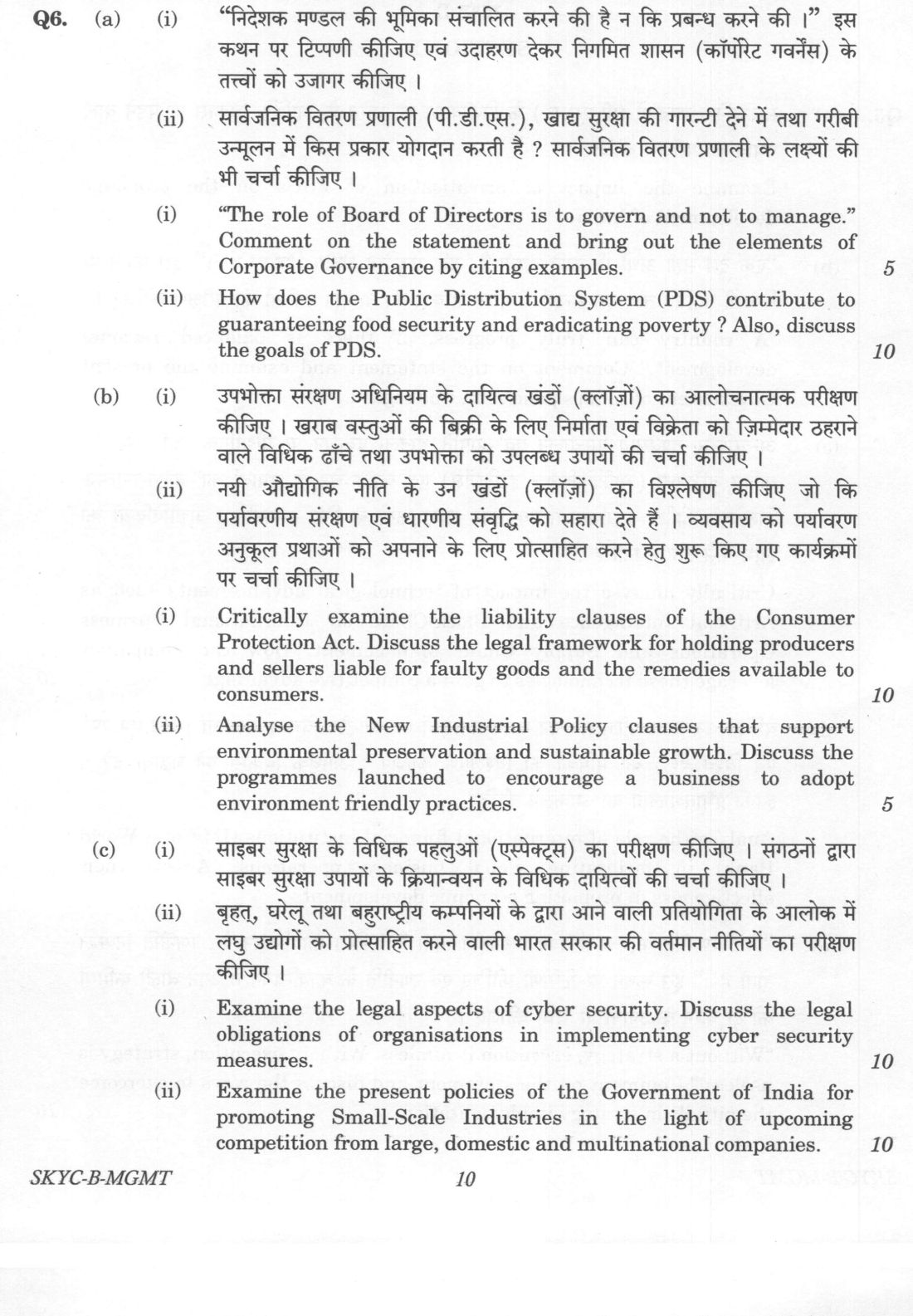
"The role of Board of Directors is to govern and not to manage." Comment on the statement and bring out the elements of Corporate Governance by citing examples. 5 marks
How does the Public Distribution System (PDS) contribute to guaranteeing food security and eradicating poverty ? Also, discuss the goals of PDS. 10 marks
Critically examine the liability clauses of the Consumer Protection Act. Discuss the legal framework for holding producers and sellers liable for faulty goods and the remedies available to consumers. 10 marks
Analyse the New Industrial Policy clauses that support environmental preservation and sustainable growth. Discuss the programmes launched to encourage a business to adopt environment friendly practices. 5 marks
Examine the legal aspects of cyber security. Discuss the legal obligations of organisations in implementing cyber security measures. 10 marks
Examine the present policies of the Government of India for promoting Small-Scale Industries in the light of upcoming competition from large, domestic and multinational companies. 10 marks
हिंदी में प्रश्न पढ़ें
"निदेशक मंडल की भूमिका संचालित करने की है न कि प्रबंध करने की।" इस कथन पर टिप्पणी कीजिए एवं उदाहरण देकर निगमित शासन (कॉर्पोरेट गवर्नेंस) के तत्वों को उजागर कीजिए। 5
सार्वजनिक वितरण प्रणाली (पी.डी.एस.), खाद्य सुरक्षा की गारंटी देने में तथा गरीबी उन्मूलन में किस प्रकार योगदान करती है ? सार्वजनिक वितरण प्रणाली के लक्ष्यों की भी चर्चा कीजिए। 10
उपभोक्ता संरक्षण अधिनियम के दायित्व खंडों (क्लॉजों) का आलोचनात्मक परीक्षण कीजिए। खराब वस्तुओं की बिक्री के लिए निर्माता एवं विक्रेता को जिम्मेदार ठहराने वाले विधिक ढांचे तथा उपभोक्ता को उपलब्ध उपायों की चर्चा कीजिए। 10
नई औद्योगिक नीति के उन खंडों (क्लॉजों) का विश्लेषण कीजिए जो कि पर्यावरणीय संरक्षण एवं धारणीय संवृद्धि को सहारा देते हैं। व्यवसाय को पर्यावरण अनुकूल प्रथाओं को अपनाने के लिए प्रोत्साहित करने हेतु शुरू किए गए कार्यक्रमों पर चर्चा कीजिए। 5
साइबर सुरक्षा के विधिक पहलुओं (एस्पेक्ट्स) का परीक्षण कीजिए। संगठनों द्वारा साइबर सुरक्षा उपायों के क्रियान्वयन के विधिक दायित्वों की चर्चा कीजिए। 10
बृहत्, घरेलू तथा बहुराष्ट्रीय कम्पनियों के द्वारा आने वाली प्रतियोगिता के आलोक में लघु उद्योगों को प्रोत्साहित करने वाली भारत सरकार की वर्तमान नीतियों का परीक्षण कीजिए। 10
Model answer
Written by UPSC Answer Check against this question's marking rubric, to the expected length. UPSC does not publish answers for Mains — this is one way to score well, not an official key.
(a)(i) The statement is broadly correct: the Board governs by setting strategy, monitoring risk, approving compliance and overseeing management, while management executes operations. SEBI LODR and the Kotak Committee reinforce this through independent directors, audit committees and board-CEO separation. Governance elements are transparency, accountability, fairness, responsibility, independence and disclosure. The Tata-Mistry dispute and Infosys board restructuring show how independent oversight, shareholder rights and disclosure discipline correct management overreach. It is not passivity; boards must challenge strategy.
(a)(ii) PDS contributes to food security by converting MSP procurement and buffer stocks into Targeted PDS supplies under NFSA 2013, giving priority households entitlement to subsidised cereals; NFSA covers 67% population, with 5 kg per person per month for priority households and 7 kg for vulnerable groups. This reduces food expenditure, protects the poor from price shocks, and supports farmer incomes, thereby aiding poverty eradication. Its goals are food security, price stabilisation, poverty alleviation and social justice. Yet leakage, exclusion errors and stock wastage weaken outcomes. Aadhaar seeding, e-POS machines and online rationing improve targeting and accountability.
(b)(i) Under CPA 2019, Chapter VI (Sections 82–87) creates product liability. Section 84 makes manufacturers liable for harm from manufacturing, design or warning defects; this is largely strict, though the consumer must prove defect and causation, and statutory defences apply. Section 85 covers service providers, but liability is not pure strict; it turns on defective service and negligence/failure to exercise reasonable care. Section 86 makes sellers liable where they substantially controlled or altered the product, gave an express warranty, knew or ought to have known of the defect, or failed in reasonable care. E-commerce sellers are covered if these conditions apply. Remedies include refund, replacement, compensation and punitive damages, enforced through CCPA and consumer commissions. It is balanced but needs faster e-commerce adjudication.
(b)(ii) The New Industrial Policy 1991 supported environmental preservation and sustainable growth through its environmental clause, which made environmental protection a policy objective, required compliance with pollution laws and environmental clearance, and encouraged clean technology, resource conservation and pollution abatement. Later policy instruments operationalised these clauses through the polluter-pays and precautionary principles. Programmes such as Perform, Achieve and Trade, ZED certification, Ecomark, corporate environmental reporting and Extended Producer Responsibility push firms toward energy efficiency, waste reduction, circular production and environment-friendly business practices.
(c)(i) Cyber security law in India rests on the IT Act 2000 (as amended), SPDI Rules 2011, CERT-In directions and the DPDP Act 2023. Section 43A imposes compensation for failure to protect sensitive personal data; Section 66 penalises computer-related offences; Section 72A penalises unlawful disclosure. Organisations must adopt reasonable security practices, build cyber-resilience frameworks, obtain consent, notify breaches, maintain records, appoint data protection officers where required, and report incidents to CERT-In/NCIIPC within prescribed timelines. The DPDP Act adds data fiduciary duties, breach notification and children’s data safeguards. DPDP unifies data protection.
(c)(ii) To make SSI/MSEs competitive against large domestic and multinational firms, the Government uses PMEGP for micro-enterprises, SFURTI and the Cluster Development Programme for technology, marketing and shared infrastructure, MUDRA for credit, and the Public Procurement Policy 2012 reserving a substantial share of government orders for MSEs. GST compliance, technology gaps and scale diseconomies remain constraints. Hence policy must combine credit, digitalisation, skill upgradation, cluster branding and faster compliance support. MSEs also need quality certification, export readiness and productivity support to move up value chains and survive competition.
Overall, governance, consumer accountability, environmental policy and cyber/data law are interlinked: credible boards reduce risk, sustainable practices lower costs, and SSI competitiveness needs compliance support. India should strengthen enforcement, digital compliance and cluster upskilling.
What "Critically examine" is asking you to do
Test the proposition the question puts to you and return a finding on how far it holds. Examine stems carry a claim, or ask whether something has happened, and expect evidence weighed both ways before the extent is stated — often with remedial measures attached. “Critically” is not a section added at the end: name the yardstick you are judging by — the evidence, the stated objective, a constitutional principle, a rival explanation — and let a verdict close each part of the body. Where the question quotes a claim, that verdict must land on the claim itself, accepted, qualified or rejected, and not on the theme in general.
Structure that answers it
Restate the claim as the question frames it → evidence that supports it → evidence that undercuts it → the conditions under which it holds → verdict on how far it stands
Where marks are lost
Merits in one paragraph, demerits in the next, and a conclusion calling for a balanced and holistic approach. That is a survey with the judgement left out and it holds the answer in the middle band. The opposite error is reading “critically” as permission to attack — and with the odd pairings, critically describe or critically explain, the exposition still carries most of the marks, the judgement being a layer on it rather than a substitute for it.
How this answer will be evaluated
Approach
Framework: null. (a) comment: context > arguments both sides > judgment > close | (b) examine: intro > 3-4 dimensions > example > balanced close | (c) examine: definition/context > points in order > small example > short close Full marks: Precise legal frameworks with specific examples and critical analysis
Key points expected
- Governance vs management distinction
- Corporate Governance elements with examples
- Consumer Protection Act liability clauses
- Legal framework for faulty goods
- Consumer remedies
- Cyber security legal aspects
- Organizational cyber security obligations
Evaluation rubric
Each sub-part is marked on its own, against the marks and word limit printed on the paper.
- (a) Distinguish governance from management and list elements of Corporate Governance with examples.
comment— context → arguments both sides → judgment → close
Must cover
- Define governance vs management distinction
- List 3-4 elements of Corporate Governance
- Cite specific examples for elements
- Provide a clear judgment on the statement
Loses marks
- Defining management without contrasting governance
- Listing elements without examples
- Failing to take a position on the statement
Earns more
- Mention Board of Directors' fiduciary duties
- Reference SEBI or Companies Act 2013
- Distinguish strategic vs operational roles
Extra mark
- Cite a specific corporate governance failure case
- Reference Cadbury Committee report
- (b) Analyze liability clauses of Consumer Protection Act and legal framework for faulty goods.
examine— intro → 3-4 dimensions → example → balanced close
Must cover
- Identify key liability clauses in CPA
- Explain legal framework for producer/seller liability
- List remedies available to consumers
- Provide critical analysis of effectiveness
Loses marks
- Describing CPA without critical examination
- Listing remedies without legal framework
- Ignoring producer vs seller distinction
Earns more
- Mention Consumer Protection Act 2019
- Reference product liability provisions
- Discuss Consumer Disputes Redressal Commission
Extra mark
- Cite a specific consumer protection case law
- Reference recent amendments to CPA
- (c) Examine legal aspects of cyber security and organizational obligations.
examine— definition/context → points in order → small example → short close
Must cover
- Identify legal aspects of cyber security
- List legal obligations of organizations
- Discuss implementation of security measures
- Reference relevant cyber security laws
Loses marks
- General discussion without legal specifics
- Ignoring organizational obligations
- Failing to connect law to implementation
Earns more
- Mention IT Act 2000
- Reference Data Protection regulations
- Discuss cyber security frameworks
Extra mark
- Cite a specific cyber security incident
- Reference CERT-In guidelines
Practice this exact question
Write your answer and it is marked point by point against the model answer above — what you covered, what you missed, what you got wrong.
Evaluate my answer →More from Management 2023 Paper II
- Q3 (a) State the different forms of waste management. 15 marks (b) State the various factors…
- Q4 (a) (i) Define e-Governance. (ii) State the advantages of e-Governance. (iii) State the e…
- Q5 (a) Examine the impact of privatisation of PSUs on the economic development of India. 10…
- Q6 (a) (i) "The role of Board of Directors is to govern and not to manage." Comment on the s…
- Q7 (a) (i) How do companies scan the environment and analyse the same to reset the objective…
- Q8 (a) (i) "Regional Economic Cooperation can play an important role in India's unfavourable…