Paper II — Q8
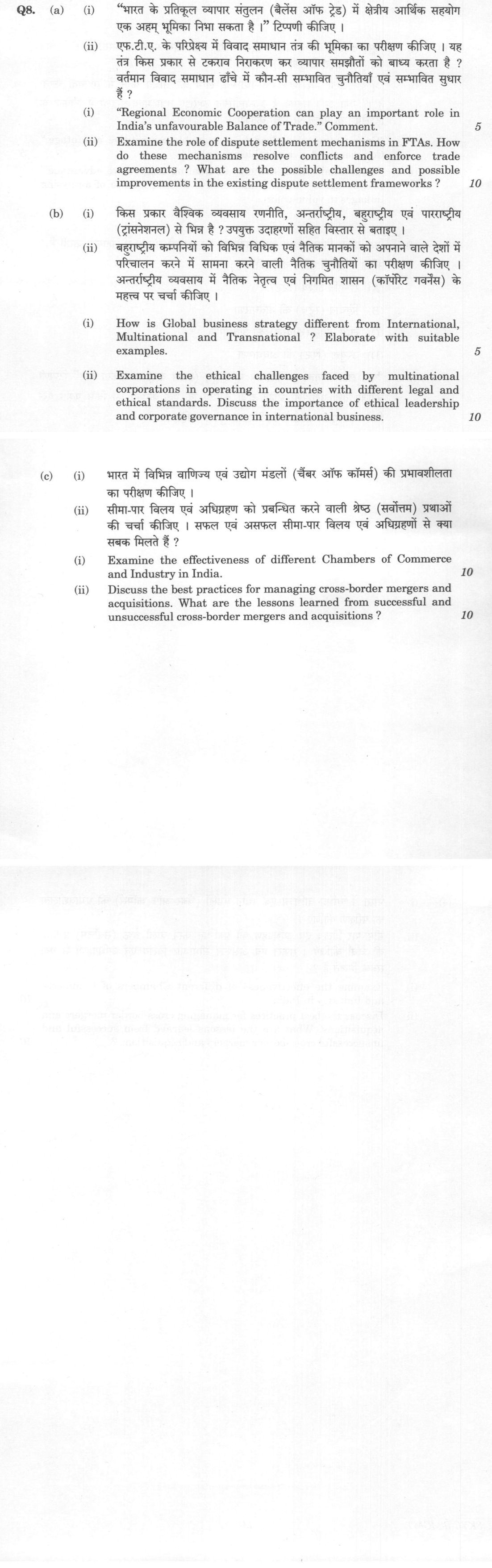
(a) (i) "Regional Economic Cooperation can play an important role in India's unfavourable Balance of Trade." Comment. 5…
"Regional Economic Cooperation can play an important role in India's unfavourable Balance of Trade." Comment. 5 marks
Examine the role of dispute settlement mechanisms in FTAs. How do these mechanisms resolve conflicts and enforce trade agreements ? What are the possible challenges and possible improvements in the existing dispute settlement frameworks ? 10 marks
How is Global business strategy different from International, Multinational and Transnational ? Elaborate with suitable examples. 5 marks
Examine the ethical challenges faced by multinational corporations in operating in countries with different legal and ethical standards. Discuss the importance of ethical leadership and corporate governance in international business. 10 marks
Examine the effectiveness of different Chambers of Commerce and Industry in India. 10 marks
Discuss the best practices for managing cross-border mergers and acquisitions. What are the lessons learned from successful and unsuccessful cross-border mergers and acquisitions ? 10 marks
हिंदी में प्रश्न पढ़ें
"भारत के प्रतिकूल व्यापार संतुलन (बैलेंस ऑफ ट्रेड) में क्षेत्रीय आर्थिक सहयोग एक अहम भूमिका निभा सकता है।" टिप्पणी कीजिए। 5
एफ.टी.ए. के परिप्रेक्ष्य में विवाद समाधान तंत्र की भूमिका का परीक्षण कीजिए। यह तंत्र किस प्रकार से टकराव निराकरण कर व्यापार समझौतों को बाध्य करता है ? वर्तमान विवाद समाधान ढांचे में कौन-सी संभावित चुनौतियाँ एवं संभावित सुधार हैं ? 10 marks
किस प्रकार वैश्विक व्यवसाय रणनीति, अंतर्राष्ट्रीय, बहुराष्ट्रीय एवं पारराष्ट्रीय (ट्रांसनेशनल) से भिन्न है ? उपयुक्त उदाहरणों सहित विस्तार से बताइए। 5
बहुराष्ट्रीय कम्पनियों को विभिन्न विधिक एवं नैतिक मानकों को अपनाने वाले देशों में परिचालन करने में सामना करने वाली नैतिक चुनौतियों का परीक्षण कीजिए। अंतर्राष्ट्रीय व्यवसाय में नैतिक नेतृत्व एवं निगमित शासन (कॉर्पोरेट गवर्नेंस) के महत्व पर चर्चा कीजिए। 10
भारत में विभिन्न वाणिज्य एवं उद्योग मंडलों (चैंबर ऑफ कॉमर्स) की प्रभावशीलता का परीक्षण कीजिए । 10
सीमा-पार विलय एवं अधिग्रहण को प्रबंधित करने वाली श्रेष्ठ (सर्वोत्तम) प्रथाओं की चर्चा कीजिए । सफल एवं असफल सीमा-पार विलय एवं अधिग्रहणों से क्या सबक मिलते हैं ? 10 marks
Model answer
Written by UPSC Answer Check against this question's marking rubric, to the expected length. UPSC does not publish answers for Mains — this is one way to score well, not an official key.
Regional Economic Cooperation and India’s Balance of Trade Regional Economic Cooperation (REC) presents a dual dynamic for India’s persistent merchandise trade deficit. While agreements like SAFTA offer export avenues in textiles and pharmaceuticals, major pacts like the India-ASEAN FTA (AIFTA) and CEPA with Japan and South Korea have historically exacerbated the trade deficit due to asymmetric tariff concessions, inverted duty structures, and non-tariff barriers facing Indian exporters. India’s withdrawal from the RCEP highlighted this dilemma: the fear of import surges from China outstripped potential market access gains. REC can redress India’s balance of trade only if accompanied by domestic manufacturing competitiveness (via PLI schemes), strict Rules of Origin to curb circumvention, and deeper integration into global value chains (GVCs).
Dispute Settlement Mechanisms in FTAs Dispute settlement mechanisms (DSMs) in modern FTAs provide predictability by establishing structured stages: bilateral consultations, WTO-style ad-hoc arbitral panels, and, in advanced pacts, appellate review. Non-compliance leads to authorized remedies, such as the suspension of tariff concessions or financial compensation. However, existing frameworks suffer from significant infirmities: prolonged timelines, exorbitant arbitration costs that disadvantage developing nations, power asymmetries during retaliation, and the absence of permanent appellate bodies—mirroring the crisis at the WTO Appellate Body. Improvements require creating permanent regional rosters of neutral arbitrators, binding mediation windows, fast-tracked procedures for MSMEs, and transparent compliance monitoring mechanisms.
Strategic Typologies: Global, International, Multinational, Transnational Using Bartlett and Ghoshal’s Integration-Responsiveness framework, firms navigate global markets through four distinct strategies:
- Global Strategy: High global integration, low local responsiveness. Products are standardized to leverage economies of scale (e.g., Apple sourcing and selling uniform hardware globally).
- International Strategy: Low integration, low responsiveness. Core competencies developed domestically are transferred abroad with minimal adaptation (e.g., early-stage HUL leveraging parent Unilever’s formulations).
- Multinational (Multi-domestic) Strategy: Low integration, high responsiveness. Operations are decentralized to tailor offerings to local consumer tastes and regulations (e.g., Nestlé modifying Maggi flavors per regional palate).
- Transnational Strategy: High integration, high responsiveness. A complex, interdependent network achieves scale while retaining local flexibility (e.g., Unilever’s current model of global supply hubs coupled with localized marketing).
MNC Ethics, Leadership, and Governance Operating across divergent jurisdictions exposes Multinational Corporations (MNCs) to ethical arbitrage: corporate bribery, sweatshop labor conditions, environmental dumping in weakly regulated pollution havens, and aggressive Base Erosion and Profit Shifting (BEPS). Cross-border compliance is governed by extraterritorial statutes like the US Foreign Corrupt Practices Act (FCPA), UK Bribery Act 2010, and OECD Guidelines for Multinational Enterprises. Navigating these risks necessitates ethical leadership that sets an uncompromising "tone-at-the-top." Institutionalizing robust corporate governance—through independent board oversight, triple-bottom-line reporting, and ESG-aligned global supply chain audits—ensures that competitive pursuit does not compromise human rights or sustainability.
Effectiveness of Indian Chambers of Commerce Apex industry associations in India shape policy and industrial competitiveness with distinct specializations. The Federation of Indian Chambers of Commerce and Industry (FICCI) excels in macroeconomic policy advocacy and trade delegation interface. The Confederation of Indian Industry (CII) drives institutional competitiveness, pioneering sustainability standards and the Naresh Chandra-aligned corporate governance codes. The Associated Chambers of Commerce and Industry (ASSOCHAM) acts as an anchor for MSMEs and grassroots enterprises. Nonetheless, their collective effectiveness is constrained by perceived biases toward large conglomerates, insufficient representation of the informal and digital gig economy, and gaps in handholding smaller firms through cross-border regulatory shifts and digital transitions.
Cross-Border Mergers and Acquisitions: Best Practices and Lessons Cross-border M&A demands disciplined execution across three pillars: comprehensive due diligence (encompassing tax, anti-trust, and cultural compatibility), rigorous Post-Merger Integration (PMI), and transparent stakeholder communication. Lessons from corporate history reveal critical pitfalls:
- Strategic Fit vs. Debt Overhang: Tata Steel’s acquisition of Corus proved vulnerable to global commodity cycles and high leverage, whereas Sun Pharma’s absorption of Ranbaxy succeeded through patient regulatory remediation with the USFDA.
- Partner Alignment and Exit Clarity: The Tata-Docomo dispute underscored the peril of ambiguous exit and valuation clauses in international joint ventures, while the Vodafone-Idea merger demonstrated the hazard of integration delays amidst predatory domestic competition and retrospective regulatory dues.
Conclusion India’s integration into the global economy hinges on a coherent continuum: negotiating balanced FTAs with enforceable dispute safeguards, adopting appropriate corporate structural typologies, maintaining uncompromising governance across borders, leveraging industry chambers for policy agility, and executing disciplined cross-border investments.
What "Examine" is asking you to do
Test the proposition the question puts to you and return a finding on how far it holds. Examine stems carry a claim, or ask whether something has happened, and expect evidence weighed both ways before the extent is stated — often with remedial measures attached.
Structure that answers it
Restate the claim as the question frames it → evidence that supports it → evidence that undercuts it → the conditions under which it holds → verdict on how far it stands
Where marks are lost
Stopping at description. An examination has to reach a finding, and “examine with justification” means the extent must be stated, not implied.
How this answer will be evaluated
Approach
Framework: Bartlett & Ghoshal Strategic Posture Model. (a(i)) comment: context > arguments both sides > judgment > close | (a(ii)) examine: intro > how/why with reasoning > evidence > conclusion | (b(i)) compare: paired headings or table > key differences > significance > conclusion | (b(ii)) examine: intro > how/why with reasoning > evidence > conclusion | (c(i)) examine: intro > how/why with reasoning > evidence > conclusion | (c(ii)) discuss: intro > 3-4 dimensions > example > balanced close Full marks: Precise application of frameworks, specific examples, and clear judgments.
Key points expected
- Context of India's unfavourable BoT
- Arguments supporting the claim
- Arguments against or limitations
- Final judgment on the claim
- Role of dispute settlement in FTAs
- Process of conflict resolution/enforcement
- Challenges in existing frameworks
- Possible improvements
Evaluation rubric
Each sub-part is marked on its own, against the marks and word limit printed on the paper.
- (a(i)) Context of India's trade deficit, arguments for/against regional cooperation, and a final judgment. 5 marks
comment— context → arguments both sides → judgment → close
Must cover
- Context of India's unfavourable BoT
- Arguments supporting the claim
- Arguments against or limitations
- Final judgment on the claim
Loses marks
- One-sided argument without counter-view
- Generic definition of BoT without application
Earns more
- Mention of specific FTAs (e.g., RCEP, SAFTA)
- Reference to trade diversion vs. creation
Extra mark
- Specific trade data for India
- Reference to a specific regional agreement clause
- (a(ii)) Mechanism of FTA dispute resolution, conflict resolution process, challenges, and improvements. 10 marks
examine— intro → how/why with reasoning → evidence → conclusion
Must cover
- Role of dispute settlement in FTAs
- Process of conflict resolution/enforcement
- Challenges in existing frameworks
- Possible improvements
Loses marks
- Confusing FTA mechanisms with WTO
- Listing challenges without proposing improvements
Earns more
- Comparison with WTO DSU
- Mention of arbitration panels
Extra mark
- Specific FTA dispute case study
- Reference to specific treaty articles
- (b(i)) Differentiation of Global, International, Multinational, and Transnational strategies with examples. 5 marks
compare— paired headings or table → key differences → significance → conclusion
Must cover
- Definition of all four strategies
- Key differences between them
- Suitable examples for each
- Significance of the distinction
Loses marks
- Confusing Multinational with Transnational
- Definitions without examples
Earns more
- Use of Bartlett & Ghoshal matrix
- Reference to standardization vs. adaptation
Extra mark
- Specific company examples (e.g., McDonald's, Toyota)
- Reference to specific strategic shifts
- (b(ii)) Ethical challenges of MNCs in diverse legal/ethical environments, and the role of leadership/governance. 10 marks
examine— intro → how/why with reasoning → evidence → conclusion
Must cover
- Ethical challenges in different jurisdictions
- Importance of ethical leadership
- Role of corporate governance
- Linkage to international business success
Loses marks
- Generic ethical principles without context
- Ignoring the 'different standards' aspect
Earns more
- Mention of CSR/ESG frameworks
- Reference to specific ethical dilemmas
Extra mark
- Specific MNC ethical scandal case
- Reference to specific governance codes
- (c(i)) Effectiveness of Indian Chambers of Commerce and Industry in promoting trade and industry. 10 marks
examine— intro → how/why with reasoning → evidence → conclusion
Must cover
- Role of CCI in India
- Effectiveness in trade promotion
- Effectiveness in industry support
- Conclusion on their impact
Loses marks
- Generic description of CCI without 'effectiveness' analysis
- Ignoring the 'different' CCI aspect
Earns more
- Mention of specific CCI functions
- Reference to government-CCI interaction
Extra mark
- Specific CCI initiative or report
- Reference to specific industry sector
- (c(ii)) Best practices for cross-border M&A and lessons from success/failure cases. 10 marks
discuss— intro → 3-4 dimensions → example → balanced close
Must cover
- Best practices for cross-border M&A
- Lessons from successful M&A
- Lessons from unsuccessful M&A
- Balanced conclusion
Loses marks
- Generic M&A advice without 'cross-border' focus
- Listing practices without 'lessons learned'
Earns more
- Mention of due diligence
- Reference to cultural integration
Extra mark
- Specific successful M&A case (e.g., Tata-Steel)
- Specific failed M&A case
Practice this exact question
Write your answer and it is marked point by point against the model answer above — what you covered, what you missed, what you got wrong.
Evaluate my answer →More from Management 2023 Paper II
- Q5 (a) Examine the impact of privatisation of PSUs on the economic development of India. 10…
- Q6 (a) (i) "The role of Board of Directors is to govern and not to manage." Comment on the s…
- Q7 (a) (i) How do companies scan the environment and analyse the same to reset the objective…
- Q8 (a) (i) "Regional Economic Cooperation can play an important role in India's unfavourable…