Paper II — Q5
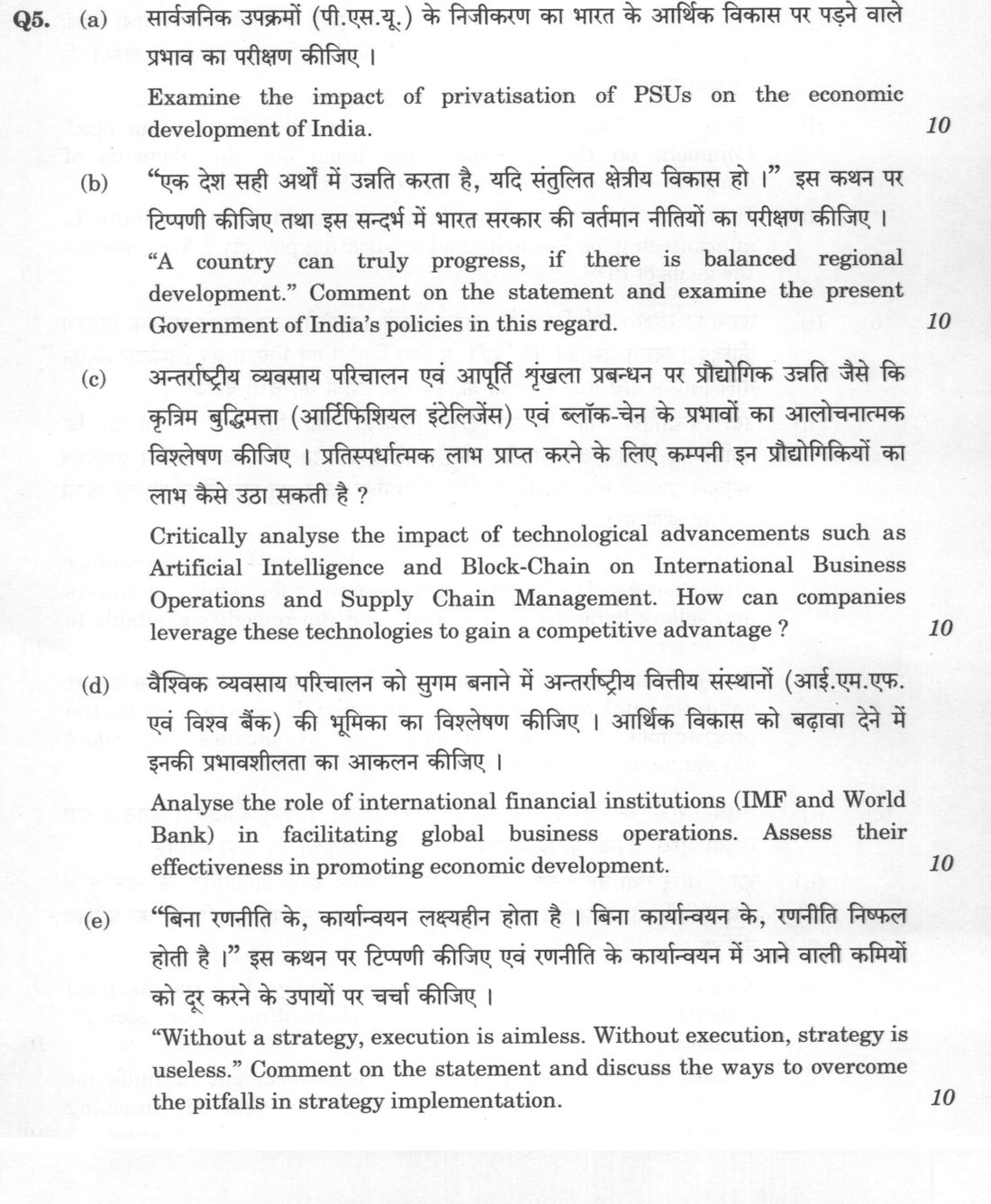
(a) Examine the impact of privatisation of PSUs on the economic development of India. 10 (b) "A country can truly progress, if…
Examine the impact of privatisation of PSUs on the economic development of India. 10 marks
"A country can truly progress, if there is balanced regional development." Comment on the statement and examine the present Government of India's policies in this regard. 10 marks
Critically analyse the impact of technological advancements such as Artificial Intelligence and Block-Chain on International Business Operations and Supply Chain Management. How can companies leverage these technologies to gain a competitive advantage ? 10 marks
Analyse the role of international financial institutions (IMF and World Bank) in facilitating global business operations. Assess their effectiveness in promoting economic development. 10 marks
"Without a strategy, execution is aimless. Without execution, strategy is useless." Comment on the statement and discuss the ways to overcome the pitfalls in strategy implementation. 10 marks
हिंदी में प्रश्न पढ़ें
सार्वजनिक उपक्रमों (पी.एस.यू.) के निजीकरण का भारत के आर्थिक विकास पर पड़ने वाले प्रभाव का परीक्षण कीजिए । 10
"एक देश सही अर्थों में उन्नति करता है, यदि संतुलित क्षेत्रीय विकास हो ।" इस कथन पर टिप्पणी कीजिए तथा इस संदर्भ में भारत सरकार की वर्तमान नीतियों का परीक्षण कीजिए । 10
अंतर्राष्ट्रीय व्यवसाय परिचालन एवं आपूर्ति श्रृंखला प्रबंधन पर प्रौद्योगिक उन्नति जैसे कि कृत्रिम बुद्धिमत्ता (आर्टिफिशियल इंटेलिजेंस) एवं ब्लॉक-चेन के प्रभावों का आलोचनात्मक विश्लेषण कीजिए । प्रतिस्पर्धात्मक लाभ प्राप्त करने के लिए कंपनी इन प्रौद्योगिकियों का लाभ कैसे उठा सकती है ? 10 marks
वैश्विक व्यवसाय परिचालन को सुगम बनाने में अंतर्राष्ट्रीय वित्तीय संस्थानों (आई.एम.एफ. एवं विश्व बैंक) की भूमिका का विश्लेषण कीजिए । आर्थिक विकास को बढ़ावा देने में इनकी प्रभावशीलता का आकलन कीजिए । 10
"बिना रणनीति के, कार्यान्वयन लक्ष्यहीन होता है । बिना कार्यान्वयन के, रणनीति निष्फल होती है ।" इस कथन पर टिप्पणी कीजिए एवं रणनीति के कार्यान्वयन में आने वाली कमियों को दूर करने के उपायों पर चर्चा कीजिए । 10
Model answer
Written by UPSC Answer Check against this question's marking rubric, to the expected length. UPSC does not publish answers for Mains — this is one way to score well, not an official key.
Impact of Privatisation of PSUs on India's Economic Development
Privatisation in India has evolved through three distinct phases: Phase I (1991–2000), characterized by token minority stake sales to bridge fiscal deficits following the recommendations of the G.V. Ramakrishna Disinvestment Commission; Phase II (2001–2004), which witnessed path-breaking strategic sales with management transfer; and Phase III (2014–present), marked by the New Public Sector Enterprise (PSE) Policy (2021) that explicitly demarcates strategic and non-strategic sectors, alongside landmark strategic disinvestments such as Air India and the mega-listing of Life Insurance Corporation of India (LIC).
Sectoral outcomes demonstrate clear efficiency gains alongside welfare trade-offs. In aviation, the transfer of Air India to the Tata Group stemmed massive recurring fiscal drains and revived fleet modernization. In telecommunications, the earlier disinvestment of VSNL catalysed India's IT and BPO revolution by dismantling bandwidth monopolies, whereas the retention of BSNL/MTNL highlighted the fiscal cost of operational delays. In the metals sector, strategic sales such as Hindustan Zinc and BALCO led to multi-fold expansions in production, operational efficiency, and dividend yields for the exchequer.
However, the divergence between minority stake dilution (which often reshuffles state ownership to public institutions like LIC without managerial autonomy) and strategic privatisation is sharp. While strategic disinvestment optimizes capital productivity, curbs administrative interference, and spurs market competition, it also raises concerns regarding employment rationalization, the dilution of statutory affirmative action (reservations), and potential private oligopolies in capital-intensive sectors. Thus, privatization enhances macroeconomic efficiency only when accompanied by robust independent sectoral regulation.
Balanced Regional Development and Policy Interventions
Balanced regional development is an indispensable prerequisite for sustainable economic progress. Gunnar Myrdal’s Theory of Cumulative Causation warns that unregulated market dynamics exacerbate spatial divergence through "backwash effects" (capital and skilled labour flight from lagging peripheries to developed cores) dominating over "spread effects." Similarly, Jeffrey Williamson’s Inverted-U Hypothesis posits that spatial income disparities widen during early development stages unless corrected by deliberate policy interventions. Growth localized only in specific urban corridors constrains aggregate domestic demand, accelerates unmanageable urbanization, and fuels socio-political instability.
The Government of India has transitioned from entitlement-based mechanisms like Special Category Status to targeted, outcome-driven frameworks. Following the 14th and 15th Finance Commissions' higher untied tax devolutions, spatial equity is pursued through targeted schematic interventions:
- Aspirational Districts Programme (ADP): Driven by NITI Aayog, ADP deploys real-time tracking, dynamic ranking, and convergence across 112 backward districts to uplift social and economic infrastructure.
- PM Gati Shakti National Master Plan: Integrates multi-modal infrastructure planning to dismantle logistical isolation in central, eastern, and north-eastern regions.
- Sectoral Connectivity Schemes: Pradhan Mantri Gram Sadak Yojana (PMGSY) ensures rural market linkages; UDAN (Ude Desh ka Aam Naagrik) bridges regional aviation gaps; and PM-SHRI modernizes school education infrastructure in underserved regions.
Despite these measures, regional inequality indices—measured by inter-state disparities in per capita Gross State Domestic Product (GSDP) between the peninsular/western states and the eastern/central belt—continue to persist. Bridging this structural gap requires decentralizing industrial credit, incentivizing private capital flows to lagging states, and strengthening sub-state local governance capacity.
Impact of Technological Advancements on International Business and SCM
Technological disruptions are fundamentally altering international business operations and global supply chain management (SCM) by enhancing visibility, traceability, and speed.
Artificial Intelligence (AI) transforms SCM through predictive analytics, machine-learning-driven dynamic demand forecasting, algorithmic route optimization, and autonomous warehouse operations. AI drastically dampens the "bullwhip effect" across complex multi-tier supply networks, allowing multinational corporations (MNCs) to align production with real-time demand fluctuations. Concurrently, Blockchain technology provides immutable, decentralized ledgers that enable smart contracts, frictionless decentralized trade finance (DeFi), and verifiable end-to-end provenance tracking. This reduces document processing time, mitigates counterparty default risks, and eliminates intermediaries in international customs documentation.
Companies leverage these technologies for competitive advantage by lowering transaction costs and building resilient, fault-tolerant supply chains. Indian enterprises and public institutions provide clear evidence of this shift:
- NITI Aayog’s National Strategy for AI (#AIforAll) has catalysed enterprise AI adoption across logistics, agriculture, and supply chain hubs.
- Indian port logistics and export conglomerates actively integrated with platforms like TradeLens (developed by Maersk and IBM) to automate cargo visibility and paperless customs processing.
- The Reserve Bank of India (RBI) has pioneered blockchain pilots for the Trade Receivables Discounting System (TReDS) and the Central Bank Digital Currency (CBDC/e-Rupee), mitigating credit risk and accelerating cross-border settlement velocity.
Role and Effectiveness of International Financial Institutions (IMF and World Bank)
The International Monetary Fund (IMF) and the World Bank (IBRD and IDA) form the bedrock of post-war global economic architecture, facilitating cross-border commerce and capital flows.
The IMF anchors global trade by maintaining exchange rate stability, conducting surveillance (Article IV consultations), issuing Special Drawing Rights (SDRs) to augment global liquidity, and providing emergency Balance of Payments (BoP) lending. The World Bank facilitates long-term economic development by providing concessional financing for public goods, physical infrastructure, and institutional capacity building, alongside benchmark analytics.
Their developmental effectiveness, however, presents a dual record. During the 1991 Indian Balance of Payments crisis, IMF assistance accompanied by structural conditionality was instrumental in dismantling the license-permit raj, opening trade, and ushering in macroeconomic stabilization.
Conversely, Structural Adjustment Programmes (SAPs) in Africa and Latin America have drawn significant criticism for imposing pro-cyclical austerity, rapid trade liberalization, and social sector spending cuts that often exacerbated domestic poverty and inequality. Furthermore, the World Bank’s discontinued Ease of Doing Business index—tainted by data irregularities in the 2020 report—revealed methodological biases favouring deregulation over broader social resilience. Persistent voting-power asymmetries in both institutions continue to marginalize the Global South, warranting structural governance reforms to preserve their institutional legitimacy.
Strategy-Execution Dialectic and Implementation Frameworks
Strategy and execution exist in dynamic codependence. Strategy establishes competitive positioning, resource boundaries, and organizational direction; execution translates these strategic choices into operational reality. Formulation without execution remains academic wishful thinking, whereas execution devoid of strategic coherence results in wasted organizational energy.
Lawrence Hrebiniak’s implementation framework highlights that executing strategy is inherently more difficult than formulating it, as it involves managing change across complex organizational structures. Similarly, Robert Kaplan and David Norton’s Strategy Execution System (the Balanced Scorecard framework) demonstrates that strategy must be systematically translated into operational terms, aligned across business units, and tied to dynamic feedback loops.
To overcome common execution pitfalls—such as resource allocation gaps, organizational silos, cultural resistance, and misaligned incentives—organizations must adopt structured implementation disciplines:
- Adopting Objectives and Key Results (OKRs): Pioneered by Andy Grove and popularized by John Doerr, the OKR methodology cascades strategic priorities into transparent, measurable, and time-bound quarterly milestones.
- Agile Resource Allocation: Dynamically shifting capital, technology, and talent toward high-priority execution vectors rather than adhering to rigid annual budgetary cycles.
- Cultural Alignment and Incentivization: Aligning executive compensation, Key Performance Indicators (KPIs), and recognition structures directly with execution milestones rather than short-term operational outputs.
- Continuous Feedback Loops: Establishing agile governance reviews to iterate strategy based on operational realities and real-time market data.
Conclusion
India’s trajectory toward becoming a developed economy relies on the synchronized functioning of these dimensions: unlocking corporate productivity via targeted PSU privatisation, ensuring domestic social cohesion through balanced regional development, capturing global value chains through AI and blockchain adoption, navigating multilateral financial architectures prudently, and executing national industrial policies with disciplined managerial frameworks.
What "Examine" is asking you to do
Test the proposition the question puts to you and return a finding on how far it holds. Examine stems carry a claim, or ask whether something has happened, and expect evidence weighed both ways before the extent is stated — often with remedial measures attached.
Structure that answers it
Restate the claim as the question frames it → evidence that supports it → evidence that undercuts it → the conditions under which it holds → verdict on how far it stands
Where marks are lost
Stopping at description. An examination has to reach a finding, and “examine with justification” means the extent must be stated, not implied.
How this answer will be evaluated
Approach
Framework: null. (a) examine: intro > how/why with reasoning > evidence > conclusion | (b) comment: context > arguments both sides > judgment > close | (c) analyse: intro > causes > effects > stakeholders/linkages > way forward | (d) analyse: intro > causes > effects > stakeholders/linkages > way forward | (e) comment: context > arguments both sides > judgment > close Full marks: Comprehensive analysis with specific examples, frameworks, and balanced judgment.
Key points expected
- Define privatisation and disinvestment context
- Analyze impact on efficiency and productivity
- Analyze impact on fiscal deficit and FDI
- Provide a balanced conclusion on development
- Define balanced regional development
- Identify current regional disparities in India
- Examine specific central government policies
- Provide a judgment on policy effectiveness
Evaluation rubric
Each sub-part is marked on its own, against the marks and word limit printed on the paper.
- (a) Assess the impact of PSU privatisation on India's economic development. 10 marks
examine— intro → how/why with reasoning → evidence → conclusion
Must cover
- Define privatisation and disinvestment context
- Analyze impact on efficiency and productivity
- Analyze impact on fiscal deficit and FDI
- Provide a balanced conclusion on development
Loses marks
- General definitions without specific Indian context
- Ignoring the social impact of job losses
Earns more
- Mention specific PSU examples (e.g., BHEL, SAIL)
- Reference specific policy shifts (e.g., 1991 reforms)
- Discuss social cost vs economic gain
Extra mark
- Cite specific data on FDI inflows post-privatisation
- Reference specific government committees (e.g., Narasimham Committee)
- (b) Comment on balanced regional development and examine current policies. 10 marks
comment— context → arguments both sides → judgment → close
Must cover
- Define balanced regional development
- Identify current regional disparities in India
- Examine specific central government policies
- Provide a judgment on policy effectiveness
Loses marks
- Vague generalities about 'development' without regional focus
- Listing policies without analyzing their impact
Earns more
- Mention specific schemes (e.g., Gati Shakti, NEP)
- Reference specific regions (e.g., North East, J&K)
- Discuss infrastructure connectivity role
Extra mark
- Cite specific budget allocations for backward regions
- Reference specific infrastructure projects (e.g., All India Road Network)
- (c) Analyze AI/Blockchain impact on IB and SCM; explain competitive advantage. 10 marks
analyse— intro → causes → effects → stakeholders/linkages → way forward
Must cover
- Analyze AI impact on supply chain operations
- Analyze Blockchain impact on international business
- Explain how these create competitive advantage
- Provide a critical analysis of limitations
Loses marks
- Defining AI/Blockchain without application to business
- Ignoring the 'critical' aspect of the command word
Earns more
- Mention specific applications (e.g., predictive analytics, smart contracts)
- Discuss data security and transparency benefits
- Reference specific industry examples (e.g., logistics, retail)
Extra mark
- Cite specific companies using these technologies (e.g., Walmart, Maersk)
- Reference specific regulatory challenges (e.g., GDPR, data sovereignty)
- (d) Analyze role of IMF/World Bank in global business and economic development. 10 marks
analyse— intro → causes → effects → stakeholders/linkages → way forward
Must cover
- Analyze IMF's role in global business operations
- Analyze World Bank's role in economic development
- Assess effectiveness of these institutions
- Provide a balanced judgment on their impact
Loses marks
- Confusing the roles of IMF and World Bank
- Ignoring the 'effectiveness' assessment part of the question
Earns more
- Mention specific mechanisms (e.g., loans, structural adjustment)
- Discuss their role in stabilizing economies
- Reference specific countries or regions
Extra mark
- Cite specific controversies or criticisms (e.g., austerity measures)
- Reference specific recent initiatives or reforms
- (e) Comment on strategy-execution link; discuss overcoming implementation pitfalls. 10 marks
comment— context → arguments both sides → judgment → close
Must cover
- Comment on the relationship between strategy and execution
- Identify common pitfalls in strategy implementation
- Discuss ways to overcome these pitfalls
- Provide a balanced conclusion
Loses marks
- Defining strategy without discussing execution
- Listing pitfalls without providing solutions
Earns more
- Mention specific frameworks (e.g., Balanced Scorecard, OKRs)
- Discuss the role of leadership and culture
- Reference specific case studies of failure/success
Extra mark
- Cite specific management thinkers (e.g., Michael Porter, Peter Drucker)
- Reference specific tools for monitoring execution (e.g., KPIs, dashboards)
Practice this exact question
Write your answer and it is marked point by point against the model answer above — what you covered, what you missed, what you got wrong.
Evaluate my answer →More from Management 2023 Paper II
- Q2 (a) The following table gives the production in three shifts and the corresponding number…
- Q3 (a) State the different forms of waste management. 15 marks (b) State the various factors…
- Q4 (a) (i) Define e-Governance. (ii) State the advantages of e-Governance. (iii) State the e…
- Q5 (a) Examine the impact of privatisation of PSUs on the economic development of India. 10…
- Q6 (a) (i) "The role of Board of Directors is to govern and not to manage." Comment on the s…
- Q7 (a) (i) How do companies scan the environment and analyse the same to reset the objective…
- Q8 (a) (i) "Regional Economic Cooperation can play an important role in India's unfavourable…