Paper II — Q4
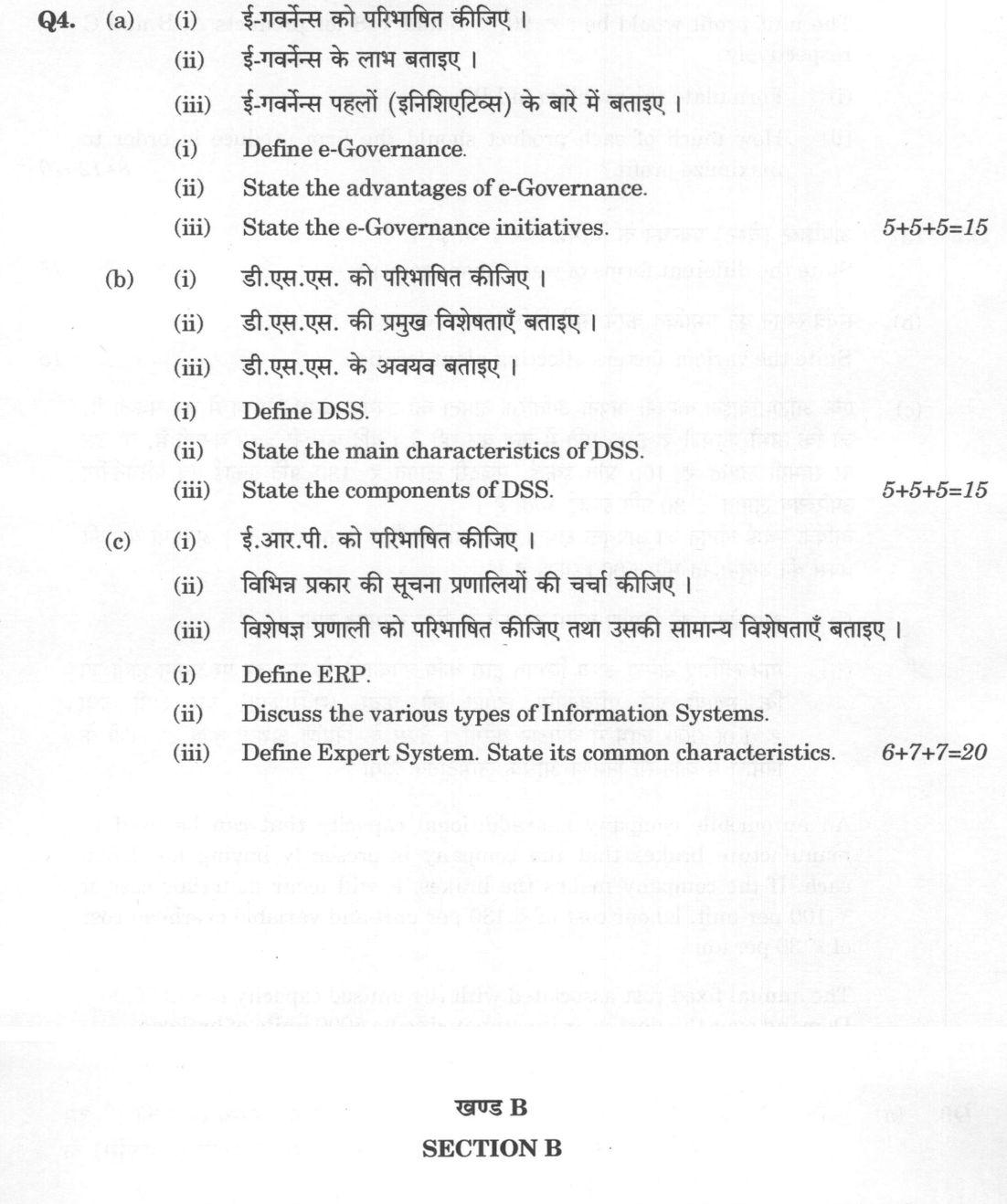
(a) (i) Define e-Governance. (ii) State the advantages of e-Governance. (iii) State the e-Governance initiatives. 5+5+5=15…
Define e-Governance.
State the advantages of e-Governance.
State the e-Governance initiatives. 5+5+5=15 marks
Define DSS.
State the main characteristics of DSS.
State the components of DSS. 5+5+5=15 marks
Define ERP.
Discuss the various types of Information Systems.
Define Expert System. State its common characteristics. 6+7+7=20 marks
हिंदी में प्रश्न पढ़ें
ई-गवर्नेंस को परिभाषित कीजिए ।
ई-गवर्नेंस के लाभ बताइए ।
ई-गवर्नेंस पहलों (इनिशिएटिव्स) के बारे में बताइए । 5+5+5=15
डी.एस.एस. को परिभाषित कीजिए ।
डी.एस.एस. की प्रमुख विशेषताएँ बताइए ।
डी.एस.एस. के अवयव बताइए । 5+5+5=15
ई.आर.पी. को परिभाषित कीजिए ।
विभिन्न प्रकार की सूचना प्रणालियों की चर्चा कीजिए ।
विशेषज्ञ प्रणाली को परिभाषित कीजिए तथा उसकी सामान्य विशेषताएँ बताइए । 6+7+7=20
Model answer
Written by UPSC Answer Check against this question's marking rubric, to the expected length. UPSC does not publish answers for Mains — this is one way to score well, not an official key.
The three parts trace a continuum from digitising public services to supporting managerial and strategic decisions.
a) e-Governance E-Governance is the use of ICT to transform governance: delivering services, enabling citizen participation, improving inter-agency coordination and making administration more transparent, accountable and responsive. It spans G2C, G2B, G2G and G2E interactions, covering service delivery, grievance redressal, policy communication, record-keeping and internal workflow. It also improves G2G coordination through shared platforms, reduces delays, and enables data-driven policy. Its advantages include greater transparency and accountability, citizen empowerment, reduced cost and time, wider reach, better data for policy, reduced corruption, faster grievance redressal, paperless administration and improved service delivery. Major Indian initiatives include Digital India, UMANG as a unified mobile application aggregating central and state services, e-Office, DigiLocker, Aadhaar-enabled services, NIC’s e-Kranti/NeGP 2.0, e-Courts, and state-level e-Seva centres, such as Andhra Pradesh’s e-Seva, and e-Office systems. These move governance from paper-based to digital, though benefits depend on connectivity, data quality, digital literacy and institutional adoption. AI-driven grievance redressal, predictive analytics and citizen dashboards can further strengthen e-Governance.
b) DSS A Decision Support System is a computer-based system that supports managerial decisions, especially semi-structured or unstructured ones, by combining data, models and user interaction. It does not replace judgment but improves it by presenting alternatives, consequences and evidence. Its value lies in structured analysis of complex, data-rich problems. Main characteristics are user-friendliness, model-driven analysis, flexibility, interactivity, support for what-if and sensitivity analysis, handling of semi-structured problems, and use of data, models and knowledge. Its components are data management (databases, data warehouses, external data), model management (optimisation, simulation, forecasting, statistical models), user interface, and a knowledge base for rules, cases or expert knowledge. In India, DSS can support disaster management, crop advisory, urban planning, public-health response and resource allocation, helping officials compare alternatives before acting. It can also support budgeting, logistics, emergency response and performance monitoring.
c) ERP, Information Systems and Expert Systems ERP is an integrated, enterprise-wide information system that automates core business processes—finance, HR, procurement, inventory, production—on a common database, improving coordination, real-time visibility and process efficiency. It standardises workflows, reduces duplication, and provides managers with consolidated reports. It is used in government, banking, manufacturing and services. SAP and Oracle are well-known ERP packages.
Information systems can be viewed by hierarchy and function. At the operational level, TPS handles routine transactions; at the tactical level, MIS converts them into periodic reports and DSS supports semi-structured decisions; at the strategic level, EIS/ESS supports strategic monitoring. OAS automates office tasks such as email, calendars and document flow; KWS supports knowledge workers in creating and sharing knowledge; ES emulates expert reasoning; SCM and CRM manage supply-chain and customer relationships. Together they form a progression from operational processing to strategic intelligence, with functional systems extending support to specific domains. TPS, MIS, DSS and EIS/ESS form a vertical hierarchy; OAS, KWS, ES, SCM and CRM are horizontal functional systems.
An Expert System is an AI-based system that emulates human expertise in a narrow domain. Its common characteristics are heuristic reasoning, symbolic reasoning, ability to handle uncertainty, explanation capability, ability to acquire and update knowledge, domain specificity, transparency of reasoning and interactivity. It can reason from rules or cases and provide traceable explanations, making it useful where expert availability is limited. Classic examples are MYCIN and DENDRAL; Indian applications may include diagnostic support in healthcare, crop-disease diagnosis in agriculture, and AI-driven governance tools.
The way forward is to integrate e-Governance, DSS, ERP and expert systems into a coherent digital architecture: citizen-facing services, data-driven decision support, efficient back-office processes and domain-specific intelligence. This requires secure data sharing, interoperable platforms, digital literacy, institutional capacity and inclusive design, so that technology improves both public service and managerial judgment. It also needs data governance, cybersecurity, and citizen trust.
What "Discuss" is asking you to do
Lay the issue out from more than one side — how it arose, what is claimed for it, what is held against it, and where it now stands. UPSC attaches discuss to broad topics with several live dimensions, so coverage of the dimensions earns more than the strength of your opinion.
Structure that answers it
Set the issue up → the case as it is made → the case against → the dimension both sides leave out → where the balance now lies
Where marks are lost
Listing facts with no thread between them, or arguing one side throughout and calling it a discussion.
How this answer will be evaluated
Approach
(a(i)) define: precise definition > the distinguishing feature > one example | (a(ii)) highlight: name the salient points > one line of substance each > close | (a(iii)) enumerate: list the items in order > one line each > no commentary | (b(i)) define: precise definition > the distinguishing feature > one example | (b(ii)) highlight: name the salient points > one line of substance each > close | (b(iii)) enumerate: list the items in order > one line each > no commentary | (c(i)) define: precise definition > the distinguishing feature > one example | (c(ii)) discuss: intro > 3-4 dimensions > example > balanced close | (c(iii)) define: precise definition > the distinguishing feature > one example Full marks: Precise definitions, clear distinction between concepts, specific examples, and accurate listing of components/characteristics.
Key points expected
- Definition involving IT/ICT usage
- Mention of government-citizen interaction
- Mention of service delivery or transparency
- Mention of transparency/accountability
- Mention of efficiency/cost reduction
- Mention of citizen convenience/access
- Mention of a specific national initiative (e.g., UMANG, DigiLocker)
- Mention of a specific state or local initiative
Evaluation rubric
Each sub-part is marked on its own, against the marks and word limit printed on the paper.
- (a(i)) Precise definition of e-Governance and its distinguishing feature. 5 marks
define— precise definition → the distinguishing feature → one example
Must cover
- Definition involving IT/ICT usage
- Mention of government-citizen interaction
- Mention of service delivery or transparency
Loses marks
- Vague definition without 'government' or 'IT'
- Confusing e-Governance with general e-Commerce
Earns more
- Distinction from e-Administration
- Reference to digital infrastructure
Extra mark
- Citation of a specific national policy definition
- (a(ii)) Salient points of the advantages of e-Governance. 5 marks
highlight— name the salient points → one line of substance each → close
Must cover
- Mention of transparency/accountability
- Mention of efficiency/cost reduction
- Mention of citizen convenience/access
Loses marks
- Listing disadvantages instead of advantages
- Generic IT benefits not specific to governance
Earns more
- Reduction of corruption
- Faster decision making
Extra mark
- Specific example of a service (e.g., passport)
- (a(iii)) List of e-Governance initiatives. 5 marks
enumerate— list the items in order → one line each → no commentary
Must cover
- Mention of a specific national initiative (e.g., UMANG, DigiLocker)
- Mention of a specific state or local initiative
- Mention of a global or international initiative
Loses marks
- Listing generic concepts (e.g., 'online portal')
- No specific named initiatives
Earns more
- Brief description of the initiative's purpose
- Mention of specific technology used (e.g., blockchain)
Extra mark
- Recent regulatory change or launch date
- (b(i)) Precise definition of DSS and its distinguishing feature. 5 marks
define— precise definition → the distinguishing feature → one example
Must cover
- Definition as a computer-based system
- Mention of semi-structured/unstructured problems
- Mention of support for decision-making
Loses marks
- Defining it as a general database
- Confusing DSS with Expert Systems
Earns more
- Distinction from MIS
- Mention of interactive nature
Extra mark
- Reference to a specific DSS model (e.g., Sprague's)
- (b(ii)) Salient points of the main characteristics of DSS. 5 marks
highlight— name the salient points → one line of substance each → close
Must cover
- Mention of interactivity
- Mention of flexibility/adaptability
- Mention of ease of use
Loses marks
- Listing components instead of characteristics
- Generic software characteristics
Earns more
- Support for 'what-if' analysis
- Integration of data and models
Extra mark
- Reference to specific DSS characteristic (e.g., responsiveness)
- (b(iii)) List of the components of DSS. 5 marks
enumerate— list the items in order → one line each → no commentary
Must cover
- Mention of Database Management System (DBMS)
- Mention of Model Base Management System (MBMS)
- Mention of User Interface (UI)
Loses marks
- Listing characteristics instead of components
- Missing the Model Base component
Earns more
- Mention of Knowledge Base (if applicable)
- Mention of DSS Generator
Extra mark
- Labelled diagram of DSS architecture
- (c(i)) Precise definition of ERP and its distinguishing feature. 6 marks
define— precise definition → the distinguishing feature → one example
Must cover
- Definition as an integrated software suite
- Mention of core business processes
- Mention of central database
Loses marks
- Defining it as a general accounting software
- Confusing ERP with CRM
Earns more
- Distinction from standalone applications
- Mention of real-time data processing
Extra mark
- Reference to a specific ERP vendor (e.g., SAP, Oracle)
- (c(ii)) Intro, 3-4 dimensions of Information Systems types, example, balanced close. 7 marks
discuss— intro → 3-4 dimensions → example → balanced close
Must cover
- Mention of Transaction Processing Systems (TPS)
- Mention of Management Information Systems (MIS)
- Mention of Decision Support Systems (DSS)
- Mention of Executive Information Systems (EIS)
Loses marks
- Listing types without discussion
- Confusing DSS with Expert Systems
Earns more
- Brief description of each type's function
- Mention of the hierarchy of information needs
Extra mark
- Comparison table of the types
- Specific example of a system in use
- (c(iii)) Definition of Expert System and its common characteristics. 7 marks
define— precise definition → the distinguishing feature → one example
Must cover
- Definition as a computer program mimicking human expertise
- Mention of Knowledge Base
- Mention of Inference Engine
- Mention of User Interface
Loses marks
- Defining it as a general AI system
- Missing the Inference Engine component
Earns more
- Mention of Explanation Facility
- Mention of Acquisition Facility
Extra mark
- Example of a specific Expert System (e.g., MYCIN)
- Labelled diagram of Expert System architecture
Practice this exact question
Write your answer and it is marked point by point against the model answer above — what you covered, what you missed, what you got wrong.
Evaluate my answer →More from Management 2023 Paper II
- Q1 (a) State the chief characteristics of Index Numbers. (10 marks) (b) What do you mean by…
- Q2 (a) The following table gives the production in three shifts and the corresponding number…
- Q3 (a) State the different forms of waste management. 15 marks (b) State the various factors…
- Q4 (a) (i) Define e-Governance. (ii) State the advantages of e-Governance. (iii) State the e…
- Q5 (a) Examine the impact of privatisation of PSUs on the economic development of India. 10…
- Q6 (a) (i) "The role of Board of Directors is to govern and not to manage." Comment on the s…
- Q7 (a) (i) How do companies scan the environment and analyse the same to reset the objective…