Paper II — Q1
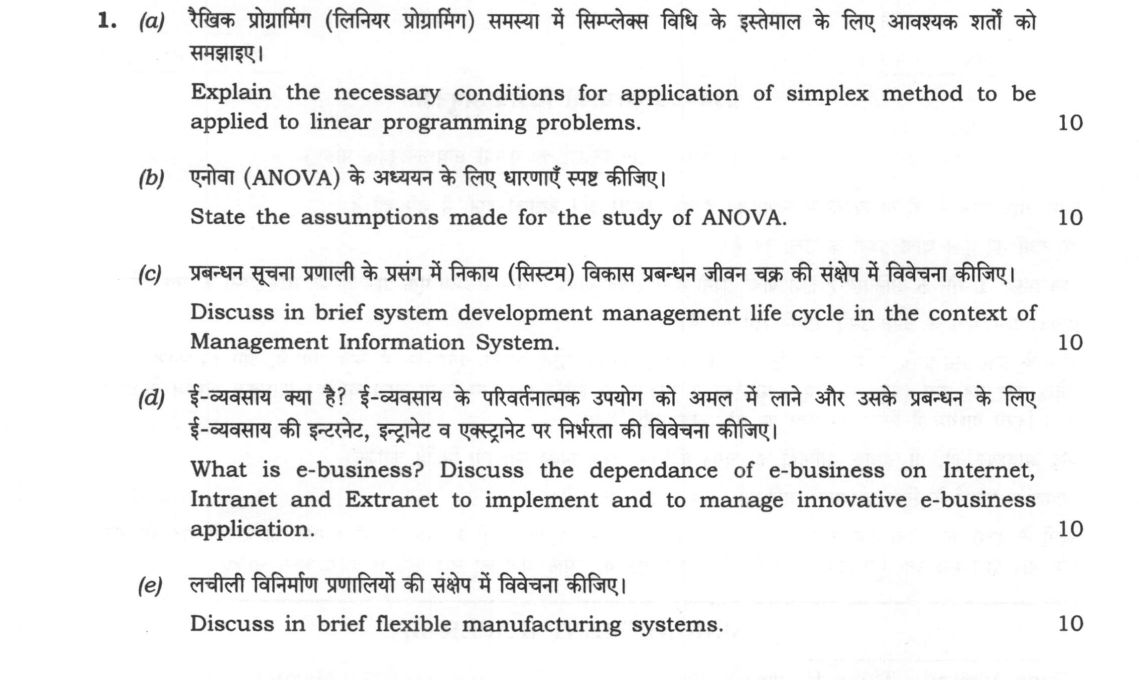
(a) Explain the necessary conditions for application of simplex method to be applied to linear programming problems. 10 marks (b)…
Explain the necessary conditions for application of simplex method to be applied to linear programming problems. 10 marks
State the assumptions made for the study of ANOVA. 10 marks
Discuss in brief system development management life cycle in the context of Management Information System. 10 marks
What is e-business? Discuss the dependance of e-business on Internet, Intranet and Extranet to implement and to manage innovative e-business application. 10 marks
Discuss in brief flexible manufacturing systems. 10 marks
हिंदी में प्रश्न पढ़ें
रैखिक प्रोग्रामिंग (लिनियर प्रोग्रामिंग) समस्या में सिम्प्लेक्स विधि के इस्तेमाल के लिए आवश्यक शर्तों को समझाइए। 10
एनोवा (ANOVA) के अध्ययन के लिए धारणाएं स्पष्ट कीजिए। 10
प्रबंधन सूचना प्रणाली के प्रसंग में निकाय (सिस्टम) विकास प्रबंधन जीवन चक्र की संक्षेप में विवेचना कीजिए। 10
ई-व्यवसाय क्या है? ई-व्यवसाय के परिवर्तनात्मक उपयोग को अमल में लाने और उसके प्रबंधन के लिए ई-व्यवसाय की इंटरनेट, इंट्रानेट व एक्स्ट्रानेट पर निर्भरता की विवेचना कीजिए। 10
लचीली विनिर्माण प्रणालियों की संक्षेप में विवेचना कीजिए। 10
Model answer
Written by UPSC Answer Check against this question's marking rubric, to the expected length. UPSC does not publish answers for Mains — this is one way to score well, not an official key.
Modern managerial decision-making relies on an integrated foundation of quantitative optimization, statistical inference, enterprise information architectures, and advanced manufacturing paradigms to navigate complex competitive environments.
(a) Necessary Conditions for the Application of the Simplex Method
The simplex method is an iterative algebraic algorithm developed by George Dantzig to solve Linear Programming Problems (LPP) by traversing the extreme points of a convex feasible region. For the method to be mathematically valid and operational, the underlying problem must satisfy several foundational conditions:
- Linearity (Proportionality and Additivity): The objective function and all constraints must be strictly linear. Proportionality requires that the contribution of each decision variable to the objective value and resource consumption is directly proportional to its value. Additivity dictates that the total measure of performance and total resource utilization equal the sum of the individual contributions of each variable, ruling out interaction effects.
- Divisibility (Continuity): Decision variables are continuous and non-negative, meaning fractional values are admissible. If variables are strictly integers, standard simplex fails, necessitating branch-and-bound or cutting-plane techniques.
- Certainty (Determinism): All parameters—including objective function coefficients (cⱼ), technological coefficients (aᵢⱼ), and right-hand side resource limits (bᵢ)—must be known with certainty.
- Non-negativity Constraints: All decision variables must be non-negative (xⱼ ≥ 0), restricting the solution space to the first quadrant/orthant.
- Standard Form Conversion: To initiate the simplex algorithm, the LPP must be transformed into standard canonical form where the objective function is optimized (maximization or minimization), all right-hand side constants are non-negative (bᵢ ≥ 0), and all inequality constraints are converted into strict equalities. This conversion introduces slack variables (for ≤ constraints to represent unused capacity), surplus variables (for ≥ constraints to represent excess utilization), and artificial variables (together with Big-M or Two-Phase methods to generate an initial basic feasible solution when no natural identity basis exists).
(b) Assumptions Made for the Study of ANOVA
Analysis of Variance (ANOVA) is a parametric statistical technique used to test the equality of three or more population means by partitioning total variance into explained (between-group) and unexplained (within-group or error) components. The validity of the F-test in ANOVA rests on four critical assumptions:
- Independence of Observations: Sample observations within and across groups must be mutually independent. This requires random sampling and random assignment of treatments to prevent autocorrelation or cluster effects, which severely distort the Type I error rate.
- Normality of Residuals: The random error terms (εᵢⱼ) and, consequently, the response variable within each treatment population must follow a normal distribution, denoted as εᵢⱼ ∼ N(0, σ²). Normality can be assessed via Shapiro-Wilk tests or normal Q-Q plots; mild departures are tolerated in large, balanced designs due to the Central Limit Theorem.
- Homogeneity of Variances (Homoscedasticity): The variances of the error terms across all treatment populations must be equal (σ₁² = σ₂² = … = σₖ² = σ²). This assumption is formally tested using Levene's test or Bartlett's test. If heteroscedasticity occurs, ANOVA yields misleading p-values, requiring variance-stabilizing transformations (such as logarithmic or square-root) or non-parametric alternatives like the Kruskal-Wallis test.
- Additivity of the Linear Model: The underlying data-generating process must follow a linear additive model (e.g., Yᵢⱼ = μ + αᵢ + εᵢⱼ), where treatment effects and environmental factors combine additively rather than multiplicatively without unmodeled interaction artifacts.
(c) System Development Life Cycle (SDLC) in the Context of MIS
The System Development Life Cycle (SDLC) is a structured, phased framework used by organizations to plan, analyze, design, build, and maintain Management Information Systems (MIS) that align information flows with strategic organizational goals.
`` Planning & Feasibility ➔ System Analysis ➔ System Design ➔ Implementation ➔ Maintenance & Review ``
- Planning and Feasibility Study: Identifies organizational problems and strategic opportunities. It entails conducting comprehensive feasibility studies across technical, economic (cost-benefit analysis), and operational dimensions to justify resource commitment.
- System Analysis: Gathers end-user and stakeholder requirements through interviews, questionnaires, and workflow modeling (e.g., Data Flow Diagrams). Active stakeholder engagement is vital at this stage to prevent scope creep and ensure the system addresses real operational needs.
- System Design: Converts functional requirements into technical specifications. Logical design outlines data models, entity relationships, and business logic, while physical design specifies database schemas, network architectures, and user interfaces.
- System Implementation: Encompasses code development, hardware installation, system integration, rigorous testing (unit, integration, user acceptance), and cutover strategies (parallel, direct, phased, or pilot conversion), alongside user training.
- System Maintenance and Review: Involves continuous post-implementation auditing, bug remediation, security patching, and system updates to adapt the MIS to evolving organizational needs.
In modern MIS implementations, organizations employ linear Waterfall models for well-defined, low-risk systems, or iterative Agile and Spiral methodologies when rapid user feedback, dynamic requirements, and proactive risk management are essential.
(d) E-Business and its Dependence on Internet, Intranet, and Extranet
E-business refers to the holistic transformation of core business processes through digital and networked information communication technologies. It encompasses not only commercial transactions (e-commerce) but also internal operations, procurement, customer relationship management, and inter-firm collaboration. The execution of innovative e-business applications relies on three interconnected network tiers:
- Internet: The public, globally accessible network of interconnected computers based on standard TCP/IP protocols. It serves as the primary conduit for customer-facing B2C and public B2B e-business models. It provides the reach required for digital marketing, customer acquisition, and transaction processing. Examples include consumer retail platforms like Flipkart and public utility services like IRCTC, which operate over the public internet to deliver high-volume, real-time customer services.
- Intranet: A private, firewalled network within an organization that uses internet protocols to support secure internal communication, workflow management, and operational collaboration. Intranets host internal Enterprise Resource Planning (ERP), Human Resource Management Systems (HRMS), and knowledge repositories. For instance, TCS utilizes its proprietary TCS BaNCS and internal Ultimatix intranet portals to manage enterprise workflows, project delivery, and internal resource allocation securely across global delivery centers.
- Extranet: A private, controlled extension of an intranet that allows secure, authenticated access to trusted external entities, such as suppliers, logistics partners, distributors, and key business clients. It utilizes virtual private networks (VPNs) and electronic data interchange (EDI) to synchronize supply chains, share demand forecasts, and manage vendor-managed inventory. An example is Maruti Suzuki, which operates dedicated vendor extranets to link Tier-1 suppliers directly into its real-time production scheduling and just-in-time (JIT) material replenishment systems.
(e) Flexible Manufacturing Systems (FMS)
A Flexible Manufacturing System (FMS) is an automated, computer-integrated production system designed to produce a mid-volume, mid-variety mix of parts with the efficiency of mass production and the versatility of a job shop.
- Core Structural Components:
- Workstations: Highly automated Computer Numerical Control (CNC) machine tools, machining centers, and automated inspection stations capable of performing multiple machining operations.
- Automated Material Handling System (AMHS): Mechanisms such as Automated Guided Vehicles (AGVs), conveyors, and Automated Storage and Retrieval Systems (ASRS) that transport raw materials, work-in-progress, and tooling between workstations without manual intervention.
- Central Computer Control System: A centralized supervisory network coordinating machine scheduling, routing decisions, tool management, traffic control of AGVs, and real-time failure recovery.
- Operational Capabilities and Benefits: FMS provides routing flexibility (rerouting parts when a machine breaks down) and machine/mix flexibility (switching between different product designs without costly retooling downtime). This setup reduces work-in-progress inventory, shortens manufacturing lead times, increases capital equipment utilization, and allows rapid adaptation to changing market demand.
- Indian Applications: Leading Indian automotive and engineering enterprises, such as Tata Motors (in its commercial and passenger vehicle plants) and Maruti Suzuki, deploy FMS architectures on their mixed-model assembly and engine machining lines to seamlessly manufacture diverse vehicle variants on a single production line in response to dynamic customer orders.
Together, linear optimization, rigorous statistical design, robust MIS frameworks, ubiquitous network architectures, and flexible manufacturing systems form a cohesive managerial toolkit. The integration of these analytical, digital, and operational methodologies allows Indian enterprises to achieve systemic efficiency, data-driven control, and sustained competitiveness across increasingly volatile domestic and global markets.
What "Explain" is asking you to do
Make the working of something clear — what sets it off, what follows from what, and what it produces. Explain is the Commission's mechanism word: it dominates the technical papers and the “explain why” stems, where the marks sit in the causal chain and not in the label.
Structure that answers it
State what it is → the initiating condition → the chain of cause, step by step → an instance where it plays out → what the chain produces
Where marks are lost
Describing what something looks like instead of why it works that way. Naming the stages without linking them reads as description too.
How this answer will be evaluated
Approach
(a) explain: definition/context > points in order > small example > short close | (b) enumerate: list the items in order > one line each > no commentary | (c) discuss: intro > 3-4 dimensions > example > balanced close | (d) discuss: intro > 3-4 dimensions > example > balanced close | (e) discuss: intro > 3-4 dimensions > example > balanced close Full marks: Precise technical definitions with clear distinction between concepts (e.g., Intranet vs Extranet).
Key points expected
- Linearity of objective function and constraints
- Non-negativity of decision variables
- Feasibility of the solution region
- Boundedness of the solution region
- Normality of the population distribution
- Homogeneity of variances (homoscedasticity)
- Independence of observations
- Interval or ratio scale of measurement
Evaluation rubric
Each sub-part is marked on its own, against the marks and word limit printed on the paper.
- (a) List and explain the specific mathematical and structural prerequisites for applying the Simplex method. 10 marks
explain— definition/context → points in order → small example → short close
Must cover
- Linearity of objective function and constraints
- Non-negativity of decision variables
- Feasibility of the solution region
- Boundedness of the solution region
Loses marks
- Confusing Simplex with graphical method
- Ignoring the non-negativity condition
Earns more
- Mention of standard form conversion
- Requirement of slack/surplus variables
Extra mark
- Example of a non-linear constraint
- Reference to Dantzig's original formulation
- (b) List the statistical assumptions required for the validity of ANOVA results. 10 marks
enumerate— list the items in order → one line each → no commentary
Must cover
- Normality of the population distribution
- Homogeneity of variances (homoscedasticity)
- Independence of observations
- Interval or ratio scale of measurement
Loses marks
- Confusing ANOVA with t-test assumptions
- Vague statements like 'data must be good'
Earns more
- Mention of random sampling
- Additivity of effects
Extra mark
- Reference to Levene's test for variance
- Mention of robustness to normality violations
- (c) Outline the stages of the System Development Life Cycle (SDLC) as applied to MIS. 10 marks
discuss— intro → 3-4 dimensions → example → balanced close
Must cover
- System Planning/Analysis phase
- System Design phase
- Implementation/Development phase
- Maintenance and Evaluation phase
Loses marks
- Generic IT definition without MIS context
- Missing the maintenance phase
Earns more
- Mention of Waterfall vs Agile models
- Context of Management Information Systems
Extra mark
- Reference to specific MIS software (e.g., SAP)
- Diagram of the SDLC loop
- (d) Define e-business and analyze its reliance on Internet, Intranet, and Extranet. 10 marks
discuss— intro → 3-4 dimensions → example → balanced close
Must cover
- Definition of e-business
- Role of Internet (external customers)
- Role of Intranet (internal employees)
- Role of Extranet (partners/suppliers)
Loses marks
- Treating Internet/Intranet/Extranet as identical
- Focusing only on e-commerce (sales)
Earns more
- Distinction between e-commerce and e-business
- Mention of security protocols
Extra mark
- Example of a specific e-business model
- Reference to cloud computing infrastructure
- (e) Explain the concept and key features of Flexible Manufacturing Systems (FMS). 10 marks
discuss— intro → 3-4 dimensions → example → balanced close
Must cover
- Definition of FMS
- Use of CNC machines and robotics
- Ability to handle product variety
- Computerized control and scheduling
Loses marks
- Confusing FMS with general automation
- Ignoring the 'flexibility' aspect
Earns more
- Comparison with rigid mass production
- Mention of Just-In-Time (JIT) integration
Extra mark
- Example of an FMS in automotive industry
- Reference to Industry 4.0
Practice this exact question
Write your answer and it is marked point by point against the model answer above — what you covered, what you missed, what you got wrong.
Evaluate my answer →More from Management 2024 Paper II
- Q1 (a) Explain the necessary conditions for application of simplex method to be applied to l…
- Q2 (a) A company gives on-the-job training to its salesmen, which is followed by a test. The…
- Q3 (a) Discuss briefly capacity planning. Explain various kinds of capacity planning. 15 mar…
- Q4 (a) Discuss in brief the new information technology trends that will change the way of in…