Paper II — Q6
(a) "Removing regional imbalance of industrial development should be top priority of Indian planners." Elaborate this statement…
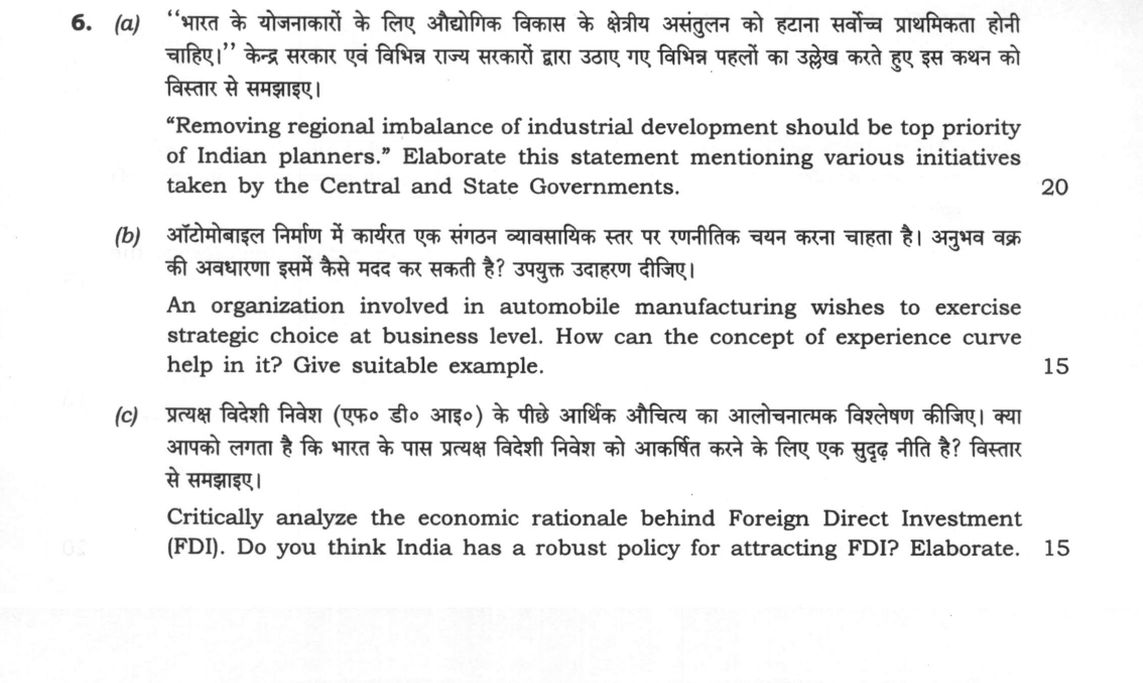
"Removing regional imbalance of industrial development should be top priority of Indian planners." Elaborate this statement mentioning various initiatives taken by the Central and State Governments. 20 marks
An organization involved in automobile manufacturing wishes to exercise strategic choice at business level. How can the concept of experience curve help in it? Give suitable example. 15 marks
Critically analyze the economic rationale behind Foreign Direct Investment (FDI). Do you think India has a robust policy for attracting FDI? Elaborate. 15 marks
हिंदी में प्रश्न पढ़ें
"भारत के योजनाकारों के लिए औद्योगिक विकास के क्षेत्रीय असंतुलन को हटाना सर्वोच्च प्राथमिकता होनी चाहिए।" केन्द्र सरकार एवं विभिन्न राज्य सरकारों द्वारा उठाए गए विभिन्न पहलों का उल्लेख करते हुए इस कथन को विस्तार से समझाइए। 20
ऑटोमोबाइल निर्माण में कार्यरत एक संगठन व्यावसायिक स्तर पर रणनीतिक चयन करना चाहता है। अनुभव वक्र की अवधारणा इसमें कैसे मदद कर सकती है? उपयुक्त उदाहरण दीजिए। 15
प्रत्यक्ष विदेशी निवेश (एफ० डी० आई०) के पीछे आर्थिक औचित्य का आलोचनात्मक विश्लेषण कीजिए। क्या आपको लगता है कि भारत के पास प्रत्यक्ष विदेशी निवेश को आकर्षित करने के लिए एक सुदृढ़ नीति है? विस्तार से समझाइए। 15
Model answer
Written by UPSC Answer Check against this question's marking rubric, to the expected length. UPSC does not publish answers for Mains — this is one way to score well, not an official key.
Regional imbalance in India is not merely a spatial gap but a structural constraint on industrial growth. Activity concentrates in metros and a few states, while many districts remain weak in factory employment, infrastructure, supplier networks and backward linkages. This appears as inter-state disparity (Gujarat, Maharashtra, Tamil Nadu, Karnataka versus Bihar, Jharkhand, Uttar Pradesh), rural-urban imbalance (rural areas lacking agro-processing and light industry), and core-periphery effects (peripheries supplying labour and resources but receiving little value addition). Correcting it is a priority because it promotes equity, creates local demand, reduces distress migration, strengthens national integration, and uses dispersed resources more efficiently. The objective is not to stop growth in advanced regions but to raise the floor in lagging regions.
Part (a) Central initiatives have addressed this through demand-side and supply-side measures. The Aspirational Districts Programme targets 117 districts with improved governance, infrastructure and investment. PM-SVANidhi, though a micro-credit scheme for street vendors rather than a large industrial programme, supports local entrepreneurship and urban demand, which can complement industrial dispersal by creating local markets. PLI schemes are mainly output/sales-linked, not generally location-based; dispersal depends on separate state location incentives, land packages or cluster targets. State governments have used land banks, single-window clearances, power/transport packages and district industrial centres to attract units to non-metro areas. Land banks reduce transaction costs, single-window clearances reduce time, and district industrial centres provide anchor facilities. Yet imbalance persists due to weak backward linkages, infrastructure gaps, and concentration of skilled labour and finance in cores. A balanced strategy therefore requires district-level industrial planning, better connectivity, and public-private partnerships that make backward districts investment-ready.
Part (b) The experience curve, associated with the Boston Consulting Group, holds that unit cost falls by a predictable percentage as cumulative output doubles, because of learning, process improvement, standardisation and scale. It is different from static economies of scale because it is dynamic and cumulative, and can create barriers to entry. In automobile manufacturing, this helps a firm choose business-level strategy: if it can build cumulative volume, it can pursue cost leadership, use lower prices to gain market share, and reinvest savings into R&D or dealer networks. For an automobile manufacturer, the strategic choice is whether to compete on cost, quality or niche segments; the experience curve is strongest where volume can be sustained. Maruti Suzuki illustrates this well. Its long cumulative production of small cars, platform commonality, supplier maturity and high volumes lowered costs, enabling aggressive pricing and high market share. The stable technology and mature supply chain made the experience curve a useful planning tool. A new entrant with low cumulative volume faces higher costs and must either niche-position or build volume quickly.
Part (c) The economic rationale for FDI is that it brings capital augmentation, technology transfer, employment generation, export promotion, balance-of-payments support and competitive discipline. But it must be critically assessed: profits may be repatriated, FDI can crowd out domestic investment, technology transfer may be limited to assembly, and capital flows can be volatile. FDI is not automatically superior to domestic investment; its value depends on spillovers, linkages and policy conditions. India’s policy is broadly robust but uneven. Strengths include expansion of the automatic route, sectoral liberalisation, Make in India, the National Single Window System, PLI schemes, 100% FDI in automobiles, and defence manufacturing liberalisation. Gaps remain: regulatory unpredictability, land acquisition delays, state-level implementation variance, and retrospective-taxation concerns. Compared with Vietnam and China, India offers a large market but must improve ease of doing business, logistics and policy certainty. Policy should therefore focus on implementation certainty, skill development, and linkages with domestic suppliers, so that FDI becomes a source of industrial deepening rather than isolated assembly. A balanced approach—regional dispersal, experience-curve-driven manufacturing, and selective FDI—can strengthen India’s industrial growth.
What "Elaborate" is asking you to do
Give the full detailed account the question has compressed into a line — every dimension of it, with specifics. Elaborate rewards completeness and detail rather than clarification or argument: the examiner is checking whether you can fill out a topic without being told what its parts are.
Structure that answers it
State the proposition → first dimension in detail → second dimension in detail → the part the statement leaves implicit → the consolidated picture
Where marks are lost
Repeating the statement at greater length instead of adding substance. Elaborate also punishes narrowness: omitting a whole dimension costs more here than anywhere else in this family.
How this answer will be evaluated
Approach
Framework: Experience Curve. (a) discuss: intro > 3-4 dimensions > example > balanced close | (b) explain: definition/context > points in order > small example > short close | (c) critique: the claim > its strengths > its weaknesses > your judgment Full marks: Comprehensive, well-structured, with specific examples and critical analysis.
Key points expected
- Define regional industrial imbalance in India
- Cite Central Govt initiatives (e.g., SAG, MIDC, SEZs)
- Cite State Govt initiatives (e.g., Industrial Policy, Incentives)
- Conclude on the effectiveness of these measures
- Define the Experience Curve concept
- Explain the link between cumulative output and cost reduction
- Apply to a specific automobile manufacturing scenario
- Provide a suitable example (e.g., Tata Motors, Maruti Suzuki)
Evaluation rubric
Each sub-part is marked on its own, against the marks and word limit printed on the paper.
- (a) Elaborate the priority of removing regional industrial imbalance with specific government initiatives. 20 marks
discuss— intro → 3-4 dimensions → example → balanced close
Must cover
- Define regional industrial imbalance in India
- Cite Central Govt initiatives (e.g., SAG, MIDC, SEZs)
- Cite State Govt initiatives (e.g., Industrial Policy, Incentives)
- Conclude on the effectiveness of these measures
Loses marks
- Generic discussion without specific scheme names
- Ignoring the role of State Governments
- Failing to link initiatives to the goal of removing imbalance
Earns more
- Mention specific schemes like PM KUSUM or PM-KISAN
- Reference specific state policies (e.g., Gujarat, Maharashtra)
- Discuss the role of Special Economic Zones (SEZs)
- Mention the impact of the Make in India initiative
Extra mark
- Cite specific data on regional industrial growth
- Reference a specific committee report on regional disparity
- (b) Explain how the experience curve concept aids strategic choice in automobile manufacturing. 15 marks
explain— definition/context → points in order → small example → short close
Must cover
- Define the Experience Curve concept
- Explain the link between cumulative output and cost reduction
- Apply to a specific automobile manufacturing scenario
- Provide a suitable example (e.g., Tata Motors, Maruti Suzuki)
Loses marks
- Defining the concept without application
- Failing to provide a suitable example
- Confusing experience curve with learning curve
Earns more
- Discuss the impact on pricing strategy
- Mention the role of learning by doing
- Explain the strategic implications for market entry
- Discuss the limitations of the experience curve
Extra mark
- Cite a specific study on experience curves in the auto industry
- Reference a specific company's cost reduction strategy
- (c) Critically analyze the economic rationale of FDI and evaluate India's policy for attracting it. 15 marks
critique— the claim → its strengths → its weaknesses → your judgment
Must cover
- Analyze the economic rationale behind FDI
- Evaluate India's current FDI policy
- Discuss the strengths of the policy
- Discuss the weaknesses or limitations of the policy
Loses marks
- Failing to critically analyze the rationale
- Providing a one-sided view of India's FDI policy
- Lack of specific examples or data
Earns more
- Mention specific FDI sectors (e.g., IT, Manufacturing)
- Discuss the impact of FDI on employment and technology transfer
- Reference specific policy changes (e.g., 100% FDI in single-brand retail)
- Discuss the role of FDI in India's economic growth
Extra mark
- Cite specific data on FDI inflows to India
- Reference a specific international organization's report on FDI
Practice this exact question
Write your answer and it is marked point by point against the model answer above — what you covered, what you missed, what you got wrong.
Evaluate my answer →More from Management 2024 Paper II
- Q3 (a) Discuss briefly capacity planning. Explain various kinds of capacity planning. 15 mar…
- Q4 (a) Discuss in brief the new information technology trends that will change the way of in…
- Q5 (a) "SMEs are backbone of any country's industrial development." Critically analyze the s…
- Q6 (a) "Removing regional imbalance of industrial development should be top priority of Indi…
- Q7 (a) (i) "Global e-business is being applied by business firms to achieve greater profits.…
- Q8 (a) "Strategic alliance helps in enhancing organizational capabilities." Explain giving e…