Paper II — Q2
(a) A company gives on-the-job training to its salesmen, which is followed by a test. The company is considering whether there is…
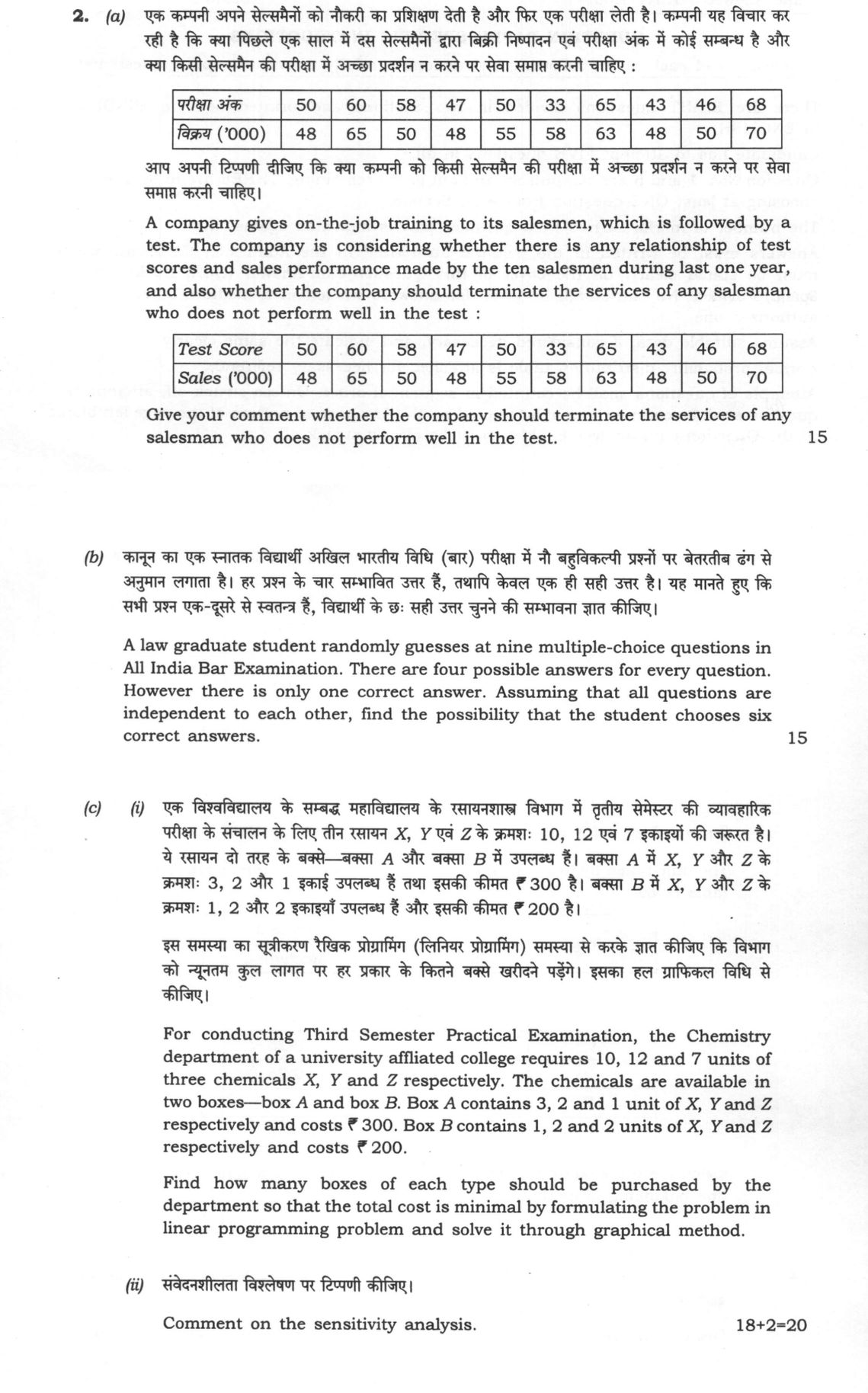
A company gives on-the-job training to its salesmen, which is followed by a test. The company is considering whether there is any relationship of test scores and sales performance made by the ten salesmen during last one year, and also whether the company should terminate the services of any salesman who does not perform well in the test:
| Test Score | 50 | 60 | 58 | 47 | 50 | 33 | 65 | 43 | 46 | 68 |
|---|---|---|---|---|---|---|---|---|---|---|
| Sales ('000) | 48 | 65 | 50 | 48 | 55 | 58 | 63 | 48 | 50 | 70 |
Give your comment whether the company should terminate the services of any salesman who does not perform well in the test. 15 marks
A law graduate student randomly guesses at nine multiple-choice questions in All India Bar Examination. There are four possible answers for every question. However there is only one correct answer. Assuming that all questions are independent to each other, find the possibility that the student chooses six correct answers. 15 marks
For conducting Third Semester Practical Examination, the Chemistry department of a university affiliated college requires 10, 12 and 7 units of three chemicals X, Y and Z respectively. The chemicals are available in two boxes—box A and box B. Box A contains 3, 2 and 1 unit of X, Y and Z respectively and costs ₹ 300. Box B contains 1, 2 and 2 units of X, Y and Z respectively and costs ₹ 200.
Find how many boxes of each type should be purchased by the department so that the total cost is minimal by formulating the problem in linear programming problem and solve it through graphical method. 18 marks
Comment on the sensitivity analysis. 2 marks
हिंदी में प्रश्न पढ़ें
एक कंपनी अपने सेल्समैनों को नौकरी का प्रशिक्षण देती है और फिर एक परीक्षा लेती है। कंपनी यह विचार कर रही है कि क्या पिछले एक साल में दस सेल्समैनों द्वारा बिक्री निष्पादन एवं परीक्षा अंक में कोई सम्बन्ध है और क्या किसी सेल्समैन की परीक्षा में अच्छा प्रदर्शन न करने पर सेवा समाप्त करनी चाहिए:
| परीक्षा अंक | 50 | 60 | 58 | 47 | 50 | 33 | 65 | 43 | 46 | 68 |
|---|---|---|---|---|---|---|---|---|---|---|
| बिक्रय ('000) | 48 | 65 | 50 | 48 | 55 | 58 | 63 | 48 | 50 | 70 |
आप अपनी टिप्पणी दीजिए कि क्या कंपनी को किसी सेल्समैन की परीक्षा में अच्छा प्रदर्शन न करने पर सेवा समाप्त करनी चाहिए। 15
कानून का एक स्नातक विद्यार्थी अखिल भारतीय विधि (बार) परीक्षा में नौ बहुविकल्पी प्रश्नों पर बेतरतीब ढंग से अनुमान लगाता है। हर प्रश्न के चार संभावित उत्तर हैं, तथापि केवल एक ही सही उत्तर है। यह मानते हुए कि सभी प्रश्न एक-दूसरे से स्वतंत्र हैं, विद्यार्थी के छः सही उत्तर चुनने की संभावना ज्ञात कीजिए। 15
एक विश्वविद्यालय के सम्बद्ध महाविद्यालय के रसायनशास्त्र विभाग में तृतीय सेमेस्टर की व्यावहारिक परीक्षा के संचालन के लिए तीन रसायन X, Y एवं Z के क्रमशः 10, 12 एवं 7 इकाइयों की जरूरत है। ये रसायन दो तरह के बक्से—बक्सा A और बक्सा B में उपलब्ध हैं। बक्सा A में X, Y और Z के क्रमशः 3, 2 और 1 इकाई उपलब्ध है तथा इसकी कीमत ₹ 300 है। बक्सा B में X, Y और Z के क्रमशः 1, 2 और 2 इकाइयाँ उपलब्ध हैं और इसकी कीमत ₹ 200 है।
इस समस्या का सूत्रीकरण रैखिक प्रोग्रामिंग (लिनियर प्रोग्रामिंग) समस्या से करके ज्ञात कीजिए कि विभाग को न्यूनतम कुल लागत पर हर प्रकार के कितने बक्से खरीदने पड़ेंगे। इसका हल ग्राफिकल विधि से कीजिए। 18
संवेदनशीलता विश्लेषण पर टिप्पणी कीजिए। 2
Model answer
Written by UPSC Answer Check against this question's marking rubric, to the expected length. UPSC does not publish answers for Mains — this is one way to score well, not an official key.
(a) Using Karl Pearson's product-moment correlation coefficient, let X = test score and Y = sales ('000). For n = 10: ΣX = 520, ΣY = 555, ΣX² = 28076, ΣY² = 31395, ΣXY = 29339. Means: X̄ = 52, Ȳ = 55.5. r = (nΣXY − ΣXΣY) / √[(nΣX² − (ΣX)²)(nΣY² − (ΣY)²)]. nΣXY = 293390, ΣXΣY = 288600, so numerator = 4790. nΣX² − (ΣX)² = 280760 − 270400 = 10360. nΣY² − (ΣY)² = 313950 − 308025 = 5925. Denominator = √(10360 × 5925) = √61,383,000 = 7834.73. r = 4790/7834.73 = 0.6114, i.e. r = 479/√613830 ≈ 0.611. This is a moderate positive relationship. r² = 0.374, so test score explains about 37.4% of variation in sales. For n = 10, the 5% two-tail critical r ≈ 0.632; here r = 0.611, so it is not statistically significant at 5%. Also, a salesman with test score 33 had sales 58, showing poor test performance does not necessarily mean poor sales. Hence the company should not terminate any salesman solely because of poor test performance. The test may be used for training, counselling, probation, and re-testing, along with actual sales records.
(b) This is a binomial distribution problem. Let X = number of correct guesses. Here n = 9, p = 1/4, q = 3/4. P(X = 6) = C(9,6)(1/4)⁶(3/4)³. C(9,6) = C(9,3) = 84. P = 84 × (1/4)⁶ × (3/4)³ = 84 × 27/4⁹ = 2268/262144 = 567/65536 ≈ 0.00865. So the probability is 567/65536 ≈ 0.865%, assuming independent questions and constant p = 1/4.
(c)(i) Let x = number of boxes of type A and y = number of boxes of type B. The LPP is: Minimize C = 300x + 200y subject to 3x + y ≥ 10 (chemical X) 2x + 2y ≥ 12, i.e. x + y ≥ 6 (chemical Y) x + 2y ≥ 7 (chemical Z) x ≥ 0, y ≥ 0; x, y integers.
Graphical method: the boundary lines are: 3x + y = 10: intercepts (10/3, 0), (0, 10) x + y = 6: intercepts (6, 0), (0, 6) x + 2y = 7: intercepts (7, 0), (0, 3.5).
The feasible region lies above all three lines. Key intersections: 3x + y = 10 and x + y = 6 give 2x = 4, so x = 2, y = 4. Check Z: 2 + 2(4) = 10 ≥ 7. Feasible. C = 300(2) + 200(4) = ₹1400. 3x + y = 10 and x + 2y = 7 give x = 13/5, y = 11/5, but x + y = 24/5 = 4.8 < 6, so not feasible. x + y = 6 and x + 2y = 7 give y = 1, x = 5. Feasible. C = 300(5) + 200(1) = ₹1700. Other boundary points: (0,10) gives C = ₹2000; (7,0) gives C = ₹2100.
The minimum occurs at (2, 4). Check: X = 3(2) + 1(4) = 10; Y = 2(2) + 2(4) = 12; Z = 1(2) + 2(4) = 10 ≥ 7. Therefore, the department should buy 2 boxes of A and 4 boxes of B, with minimum cost ₹1400.
(c)(ii) Sensitivity analysis studies how changes in costs or requirements affect the optimum. Here X and Y constraints are binding, while Z has surplus 10 − 7 = 3 units and zero shadow price. From dual/complementary slackness, with Z slack, shadow prices are ₹50 per extra unit of X and ₹75 per extra unit of Y. Thus small increases in X or Y raise minimum cost, but up to 3 extra units of Z cost nothing. If cost coefficients or requirements change beyond allowable ranges, the optimal mix may change.
What "Solve" is asking you to do
Choose the method, then carry it through to a final answer. Identifying what kind of problem this is and why that method applies is the first thing marked; a correct figure arrived at invisibly earns almost nothing.
Structure that answers it
Given data and what is required → method chosen, with the reason it applies → set-up (equation, circuit, free body, trial balance) → working, step by step → answer with units and any condition of validity
Where marks are lost
Doing the middle steps mentally and writing only the result. In mathematics papers, a further loss comes from giving a decimal where the exact value in surds or fractions was wanted, or from skipping the justification a part explicitly asks for.
How this answer will be evaluated
Approach
Framework: null. (a) comment: context > arguments both sides > judgment > close | (b) calculate: given > formula > substitution > result with units > interpretation | (c(i)) calculate: given > formula > substitution > result with units > interpretation | (c(ii)) comment: context > arguments both sides > judgment > close Full marks: Accurate calculations, clear graphical solution, and logical statistical interpretation.
Key points expected
- Calculate correlation coefficient (Pearson's r)
- Test significance of correlation (t-test)
- State conclusion on relationship strength
- Provide verdict on termination policy
- Identify Binomial distribution parameters (n=9, p=0.25)
- Apply binomial probability formula
- Calculate combination term C(9,6)
- Provide final numerical probability
Evaluation rubric
Each sub-part is marked on its own, against the marks and word limit printed on the paper.
- (a) Statistical analysis of relationship between test scores and sales to justify termination policy. 15 marks
comment— context → arguments both sides → judgment → close
Must cover
- Calculate correlation coefficient (Pearson's r)
- Test significance of correlation (t-test)
- State conclusion on relationship strength
- Provide verdict on termination policy
Loses marks
- Verdict without statistical evidence
- Calculation errors in means or deviations
Earns more
- Mention coefficient of determination (r²)
- Discuss limitations of correlation (causation)
Extra mark
- Scatter plot visualization
- (b) Probability of exactly 6 correct answers in 9 independent multiple-choice questions. 15 marks
calculate— given → formula → substitution → result with units → interpretation
Must cover
- Identify Binomial distribution parameters (n=9, p=0.25)
- Apply binomial probability formula
- Calculate combination term C(9,6)
- Provide final numerical probability
Loses marks
- Using wrong probability p (e.g., 0.5)
- Arithmetic errors in factorial calculation
Earns more
- Show step-by-step substitution
- State assumptions of independence
Extra mark
- Comparison with expected value
- (c(i)) Formulate and solve Linear Programming Problem to minimize cost of chemical boxes. 18 marks
calculate— given → formula → substitution → result with units → interpretation
Must cover
- Define decision variables (x, y)
- Formulate objective function (Min Z = 300x + 200y)
- Formulate constraints for X, Y, Z chemicals
- Solve using graphical method (plot lines, find feasible region)
Loses marks
- Incorrect inequality signs in constraints
- Failure to identify optimal corner point
Earns more
- Identify corner points of feasible region
- Evaluate objective function at vertices
Extra mark
- Sensitivity analysis on constraints
- (c(ii)) Brief analysis of sensitivity of the optimal solution to changes in parameters. 2 marks
comment— context → arguments both sides → judgment → close
Must cover
- Mention effect of changing objective coefficients
- Mention effect of changing constraint limits
Loses marks
- Generic statement without linking to LPP
Earns more
- Reference to shadow prices
Extra mark
- Specific numerical range for stability
Practice this exact question
Write your answer and it is marked point by point against the model answer above — what you covered, what you missed, what you got wrong.
Evaluate my answer →More from Management 2024 Paper II
- Q1 (a) Explain the necessary conditions for application of simplex method to be applied to l…
- Q2 (a) A company gives on-the-job training to its salesmen, which is followed by a test. The…
- Q3 (a) Discuss briefly capacity planning. Explain various kinds of capacity planning. 15 mar…
- Q4 (a) Discuss in brief the new information technology trends that will change the way of in…
- Q5 (a) "SMEs are backbone of any country's industrial development." Critically analyze the s…